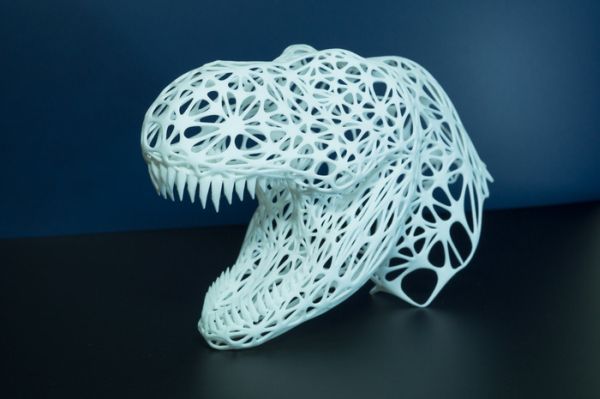
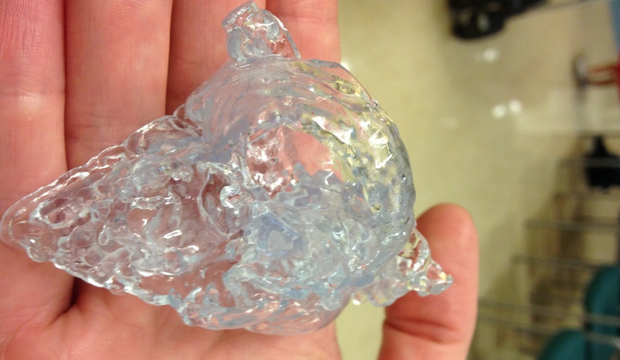
For my project, I have decided to explore the realm of 3-D scanning items and turning that scan into a 3-D printable format. Throughout the upcoming weeks I will be making a platform capable of capturing precise 3-D images of an object with any smartphone, finding the most suitable program to convert these captures into printable .stl format, and testing the practicality of printing replicas by scanning and printing a house key. During the entire process, I will be researching and writing on the impact that making these technologies available to the public could have on society.
My idea first started as a simple way to print out a spare key. During my first attempt to make a key image using 123D Catch, I realized the process would require more tools, the most significant being a stable, adjustable arm to photograph the key from multiple vantage points without moving it. After this realization, I decided to widen the scope of my project and include the development of a platform to scan objects with, using the printer to make many of its components. The idea I came up with was inspired from a photo from a Google search titled “3D scanner platform” but redesigned to work with the gyroscopic sensors used with the 123D Catch Android app. I also discussed my design with Michael, who had previous experience with making a scanner/platform with an XBOX Kinect unit, and he invited me to see that scanner in action. I hope this will shed some light on the next step in the process, which is that of converting the capture into a printable file. Although I haven’t worked with the program yet, I know that 123D Design offers an import/export and brush-up of files captured via phone. Finally, after conquering all of these hurdles, I hope to test the ability of my digitally scanned and converted key file by printing it up and testing it in a lock. But why spend so much time and effort on creating a replica of something that already exists?
I think that the urge to replicate comes from within our own bodies, constructed of DNA endlessly reproducing to scribe our stories within its helical pages. In terms of objects, replicas are seen as synonymous with fakes and forgeries, but can also be used to educate people and create an interactive learning environment when paired with 3-D scans (Roozenburg). Also, there exists a convenience factor of knowing that you have a digital copy of something, whether or not you need to manifest it at any given time. This idea somewhat nullifies the question of what to make in a world so full of stuff, because things could be produced only based on their need, and kept in a digital realm until then. In the case of a key in particular, having a digital copy stored somewhere safe could make you $50-100 richer, and a few hours younger.
After doing some research to see if anybody else had played with this concept, I came across an article in the Telegraph that wrote of two companies – Keys Duplicated and KeyMe – that offer paid services for key duplication. While I find this very similar, I would like to see the services offered to anyone, freely. Aside from that, I saw images and ideas for keys with customizable faces, adding a new element of fun to every lock/unlock session, woo-hoo!
But in the deep, dark corners of searching the internet (actually the front page), I also found atrocities. From bump keys to testing the integrity and safety of the aforementioned KeyMe service, it seemed that the ill intentions were as plentiful as the good. Bump keys, formerly used by professional locksmiths, could be inserted into a lock, whacked a few times, and voila! Problem solved. In the digital realm, these keys can be found and 3-D printed easily, and in the hands of the wrong person they can be devastating (Sparkes). Andy Greenberg decided to test KeyMe’s claim that “only you(key owner)can scan your keys” by attempting to scan his neighbors key, on a keyring, in a 30 second time frame. Surprisingly, he had no problem taking this scanned image and reproducing his neighbor’s key through the KeyMe service(Greenberg). The author and experimenter suggested that people just “keep it (the key) in their pants” because in this day and age, every bit of personal information is at risk.
I hope that over the next six weeks, I can add a new angle to the 3-D scan society by creating a platform that will allow any smart phone user to scan any object of their affection to keep with them forever in the digital realm, or use in a practical situation. In doing this, perhaps another case study can be conducted on what people find necessary to scan into the digital realm.