
This week what I witnessed during observations was, everyone working in Tinkercad on desired projects. On Wednesday we had art lecture and students from our class discussed inequality and student debt. This was a good time for students with similar view points to converse and connect. In Seminar we discussed, things like certain company’s have robots doing work that humans once did. I say that sounds about right technology is rapidly progressing, the constant reproduction and reinvention of already made devices. The perfect example of that I believe is the iPhone. Will we be any better off when we get to the 50th iteration of the iPhone. We also talked about social networking and how people rely less on face to face conversation. I feel we rely so much on technology that the knowledge to take care of ourselves without it is evaporating. With that being said who knows what will happen? The end may be as the beginning, a Big Bang except this one will be into nonexistence.
Page 8 of 17

The following post contains quotes from a research paper written by Salina Christmas a student at University College London in a Core Course in Digital Anthropology. This research paper is about “the implications of rapid prototyping and how ethnography could contribute to an understanding of the challenges ahead”. Our author touches on some core topics discussed in our program and this is one of the few people asking the same types of questions we are.
“There aren’t many anthropological works on rapid prototyping and its 3D printing practitioners. Due to the lack of references, the anthropologist could, primarily, refer to ethnographic works within anthropology that have been carried out on the modes of labour, kinship and sociotechnical systems to inform his research on rapid prototyping.”
This was a valuable piece of advice that will help those interested in further researching 3d printing ethnography’s. Because there is so little written about ‘makers’ and ’3d printing’ or ‘rapid prototyping’ our author suggests that you could look at other aspects surrounding the topic and then relate them to your experiences within the field.
“For three decades, 3D computer aided (CAD) software has enabled industrial designers, architects and imaging engineers to visualise their concepts digitally. The CAD software helps the designer to visualise the artefact he wants to fabricate in image slices. He then exports the design as a stereolitography (STL) file (Onuh and Yusuf, 1999: 308). STL is a markup language used to encode digital 3D models. But the absence of a fast 3D printing mechanism in the past meant that they depended on a handful of “skilled craftsmen” to manually produce the prototypes. This created a bottleneck in the workflow and delayed the product development time. Consequently, designers had less freedom to update the designs, and were discouraged from exploring other solutions before tooling went into production, resulting in parts which at best were seldom optimized, and at worst, did not function properly.”
This quote describes the evolution of the 3d printer and the role it plays in rapid prototyping. Before 3d printers designers were slaves to the few skilled craftsmen that could produce their prototype, slowing down their creative process and often causing the designers to give up on their design because it did not function properly the first time.
“rapid prototyping could affect the classical social structures built around the industrialised work processes as the individual worker begins to assume the roles of creator and producer, worker and capitalist”
What type of affect will rapid prototyping have on the current social structure? The individual can not only be the creator but the producer as well. How is the different from being both a worker and a capitalist?
“Rapid prototyping will challenge a dominant labour system that, since the First Industrial Revolution, has been inflexible. The inevitability of the technology being a ‘desktop operation’ – like computing, musical composition, sewing and inkjet printing – means that the worker who will be “creator and producer” would switch from a machine-based labour to the one focused on tools.
‘… Tool use is authentic and fosters autonomy; one owns and controls one’s own tools and isn’t dependent on or exploited by others. When we use machines, in contrast, we must work at rhythms not of our own making, and we become ensnared in the supralocal relations necessary for their production, distribution, and maintenance. To the extent that we become dependent on machines we do not own, the stage is set for exploitation.’ (Pfaffenberger, 1992: 509).”
This is the foundation for the maker movement. Owning the tools that you use and rely on makes it much harder for someone to exploit you. This shift from machine-based labour to tool based labour is the Maker Revolution.
“The anthropologist also has to look at the modes of knowledge transfer, and how they happen, within rapid prototyping. Rapid prototyping isn’t widely taught at colleges. The principle form for exchanging knowledge for its practitioners is YouTube. Although rapid prototyping is highly technical, the techniques are not acquired via academic journals or educational programmes, but via the informal channel mentioned, and ‘by doing’ at the workplace. To understand why the occupational discourse takes place on YouTube, the anthropologist could consult works on apprenticeship (Brown, 1979; Epstein, 1998).”
As an anthropologist studying 3d printing this quote shows me the value of my work in a field that few have studied by not taking for granted the opportunity to study 3d printing as an ethnographer. Is Youtube just another way of apprenticeship? Now that rapid prototyping is being taught in schools, are we the first to conduct ethnography’s on this topic?
“Crucially, the anthropologist has to determine how disruptive rapid prototyping can be. It has yet to make a big social impact due its inaccessibility. But this warrants the attention of the anthropologist. Any attempts to appropriate the technology for an activity it isn’t designed for, such as art, or food preparation (2), should be monitored closely.”
At the time of this article, 2010, 3d printers were not as accessible as they are now. Now that they have been commercially marketed to the general public we as anthropologists have a responsibility to study and determine the possible negative and positive affects rapid prototyping may have on society.
“The anthropologist needs to appreciate a technology in order to understand it. The processes involved in the interpretative work within ethnography is, like craftsmanship, socially situated (Joyce, 2005). Ethnomethodologically informed ethnography (EM) of knowledge transmission is important in examining the problems relating to technological determinism and design (Crabtree, 2000; Woodhouse & Patton, 2004). For a better appreciation of a technology, the ethnographer should consider ‘studying up’ (Gusterson, 1997).”
What better way to understand a technology as an anthropologist than to participate in that technology. This is exactly what we are currently doing in Making Meaning Matter. We participate in the technology and through this participation we have a better understanding of what it is we are looking at when on the observation side. Can too much participation create biases within your observations?
Here is a download link to the original paper:
christmas_term2_essay_rapid_prototyping-libre
References:
Pfaffenberger, B. 1992. ‘Social Anthropology of Technology’, Annual Review of Anthropology 21: 491-516.
Crabtree, A. 2000. ‘Ethnomethodologically informed ethnography and information system design’, Journal of the American Society for Information Science 51 (7): 666-682.
Gusterson, H. 1997. ‘Studying up: revisited methodology,’ PoLAR: Political and Legal
Anthropology Review 20 (1): 114-119.
Joyce, K. 2005. ‘Appealing images: magnetic resonance imaging and the production of authoritative knowledge’, Social Studies of Science 35 (3): 437-462.
Black and White 120 film hand processed/ self portrait/ movement, motion, and three dimensional explorations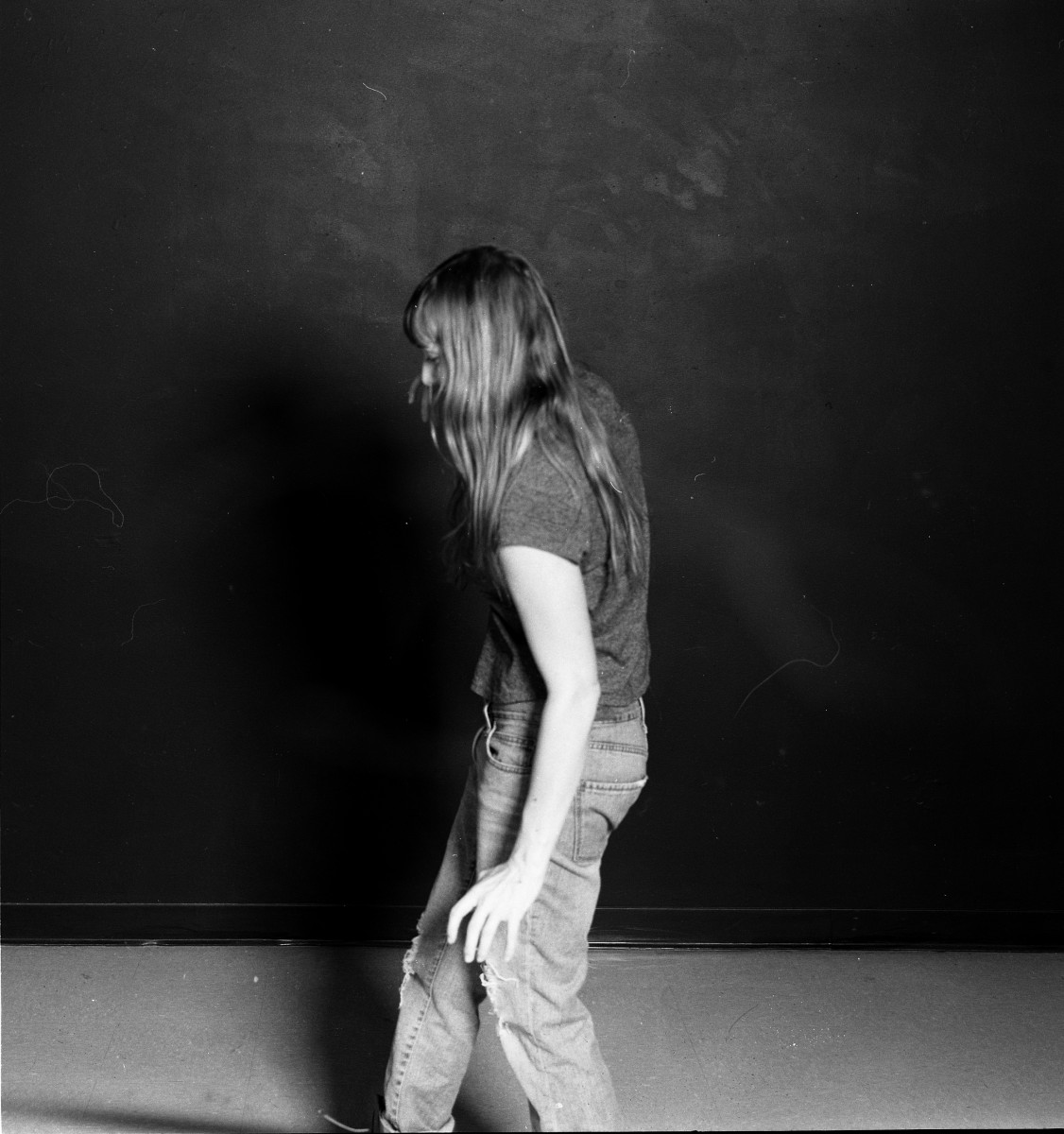

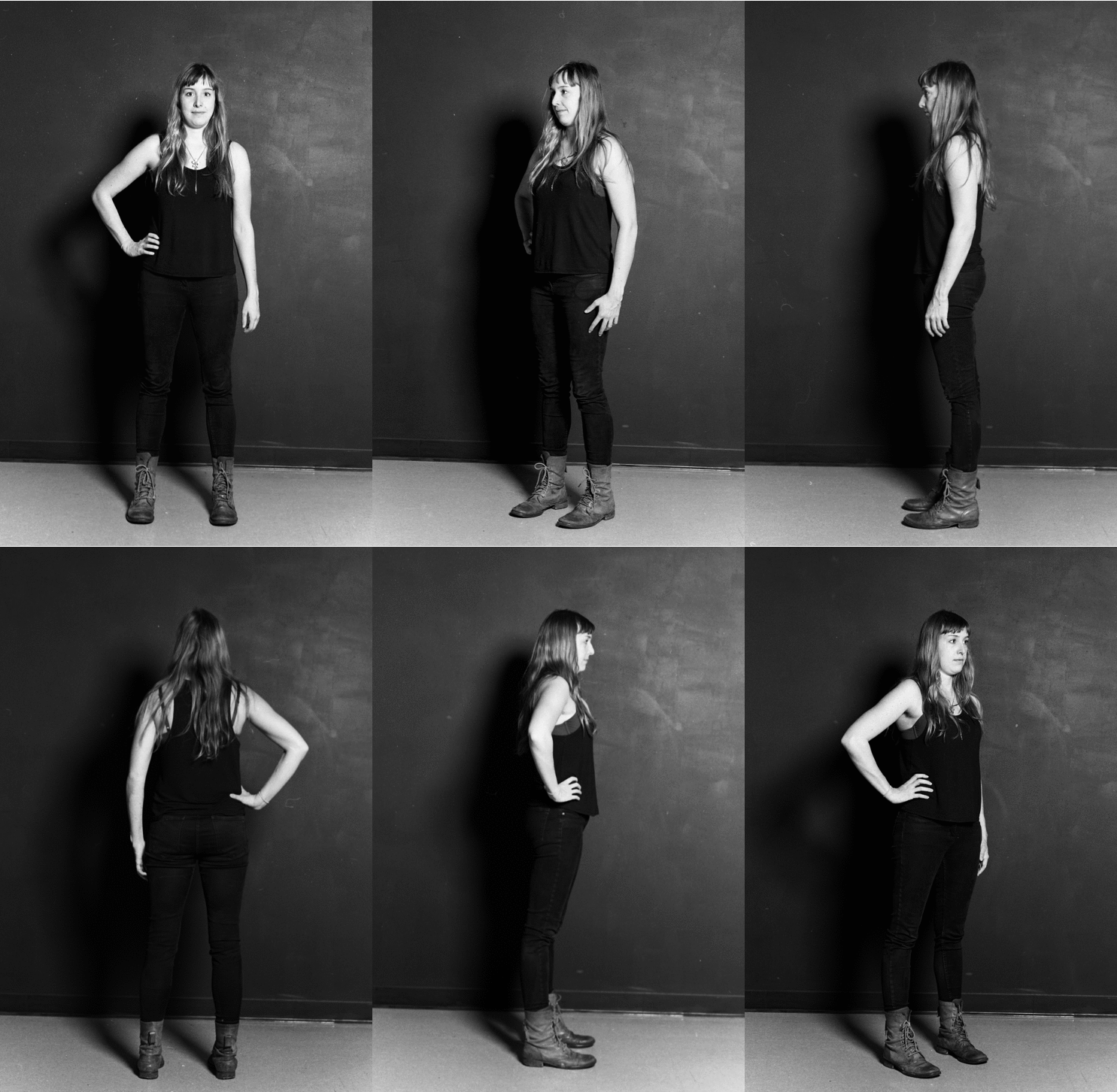
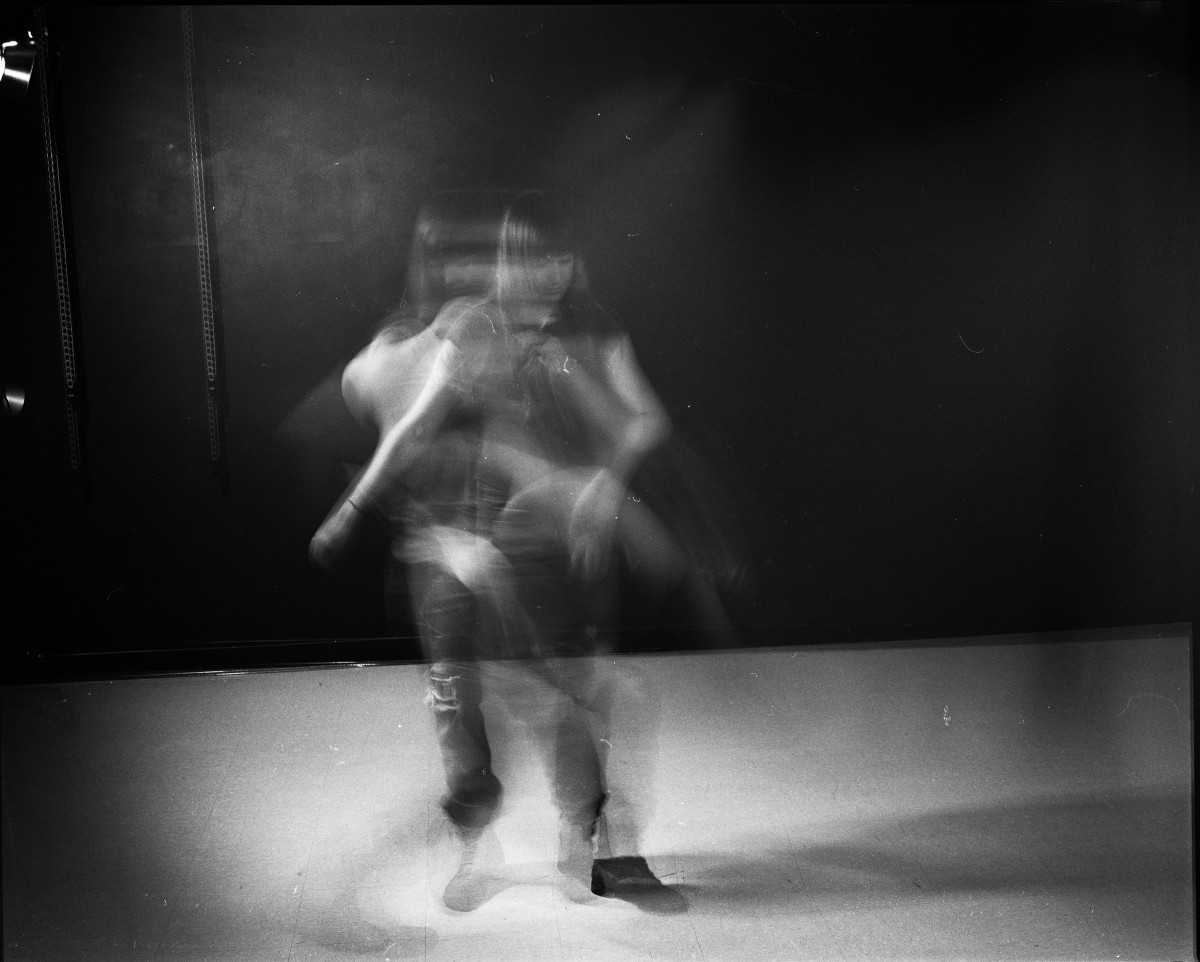

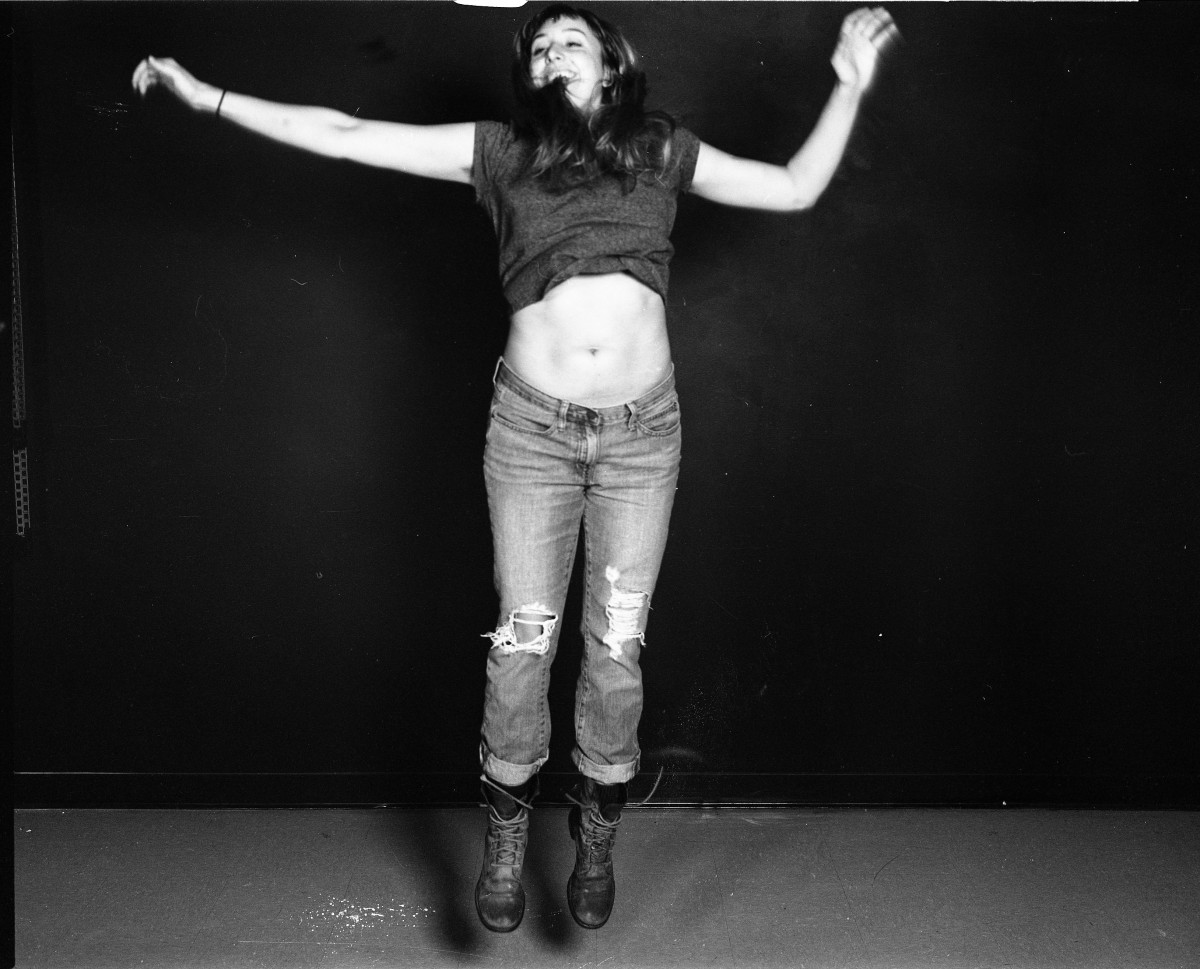

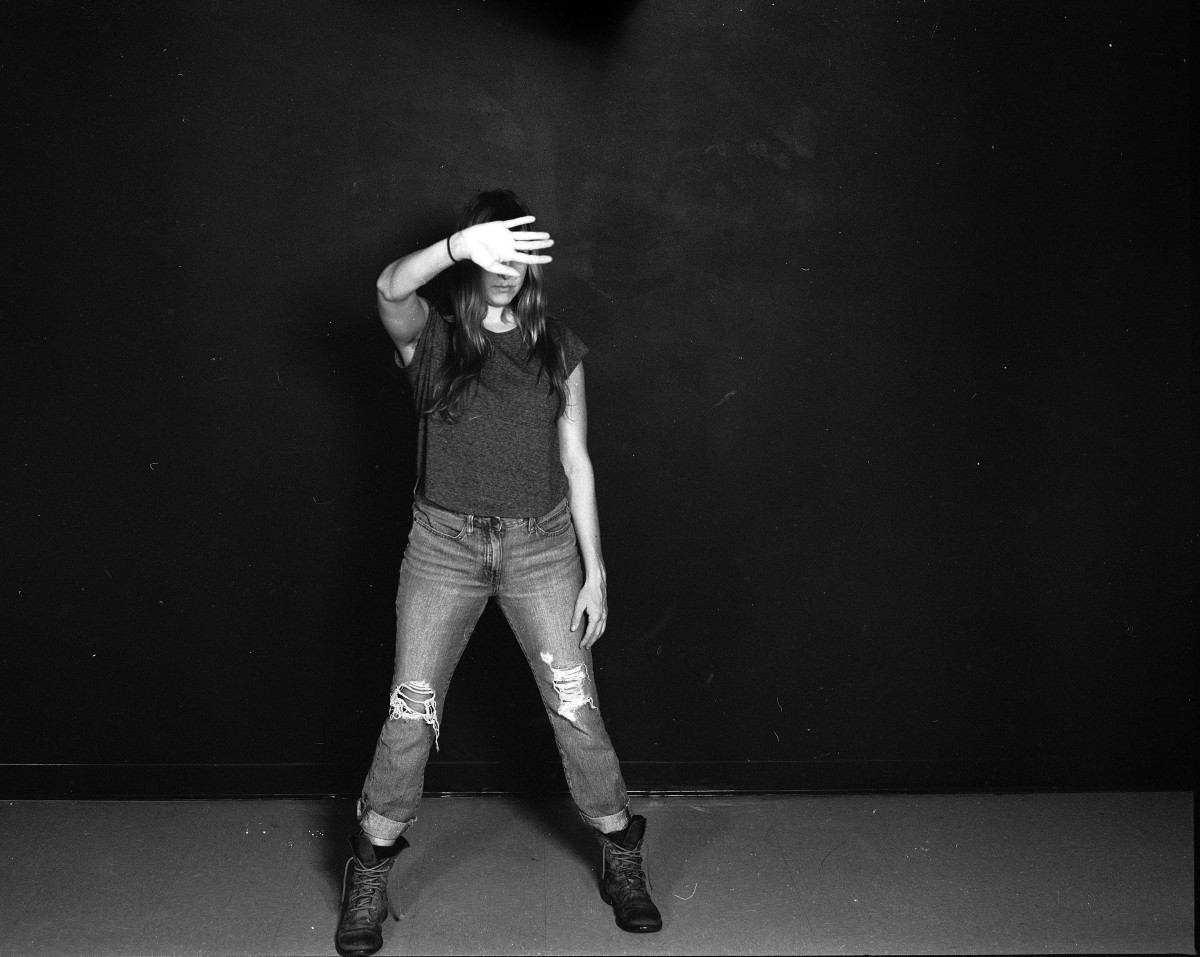
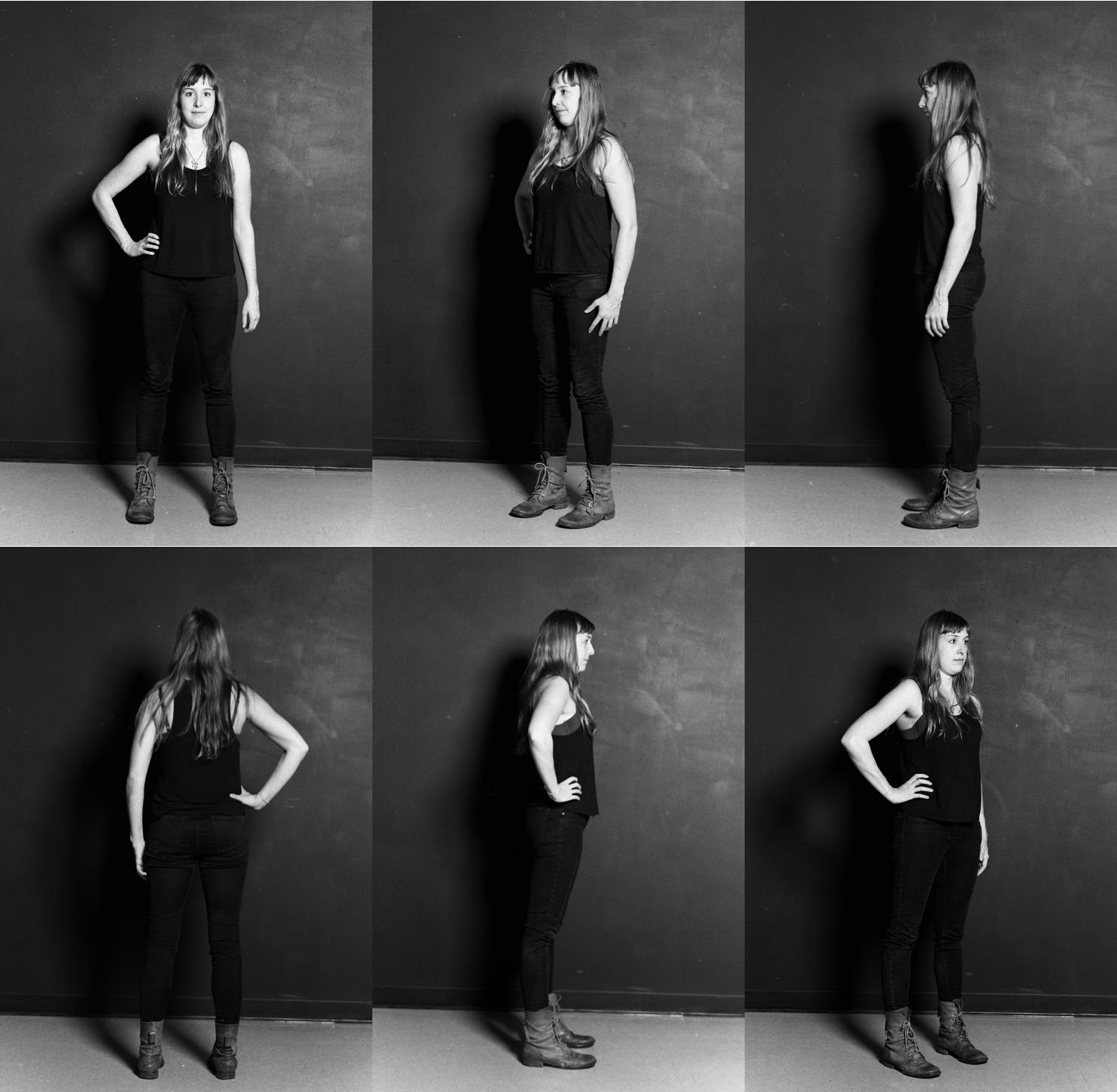
What does it mean? Why does it matter!
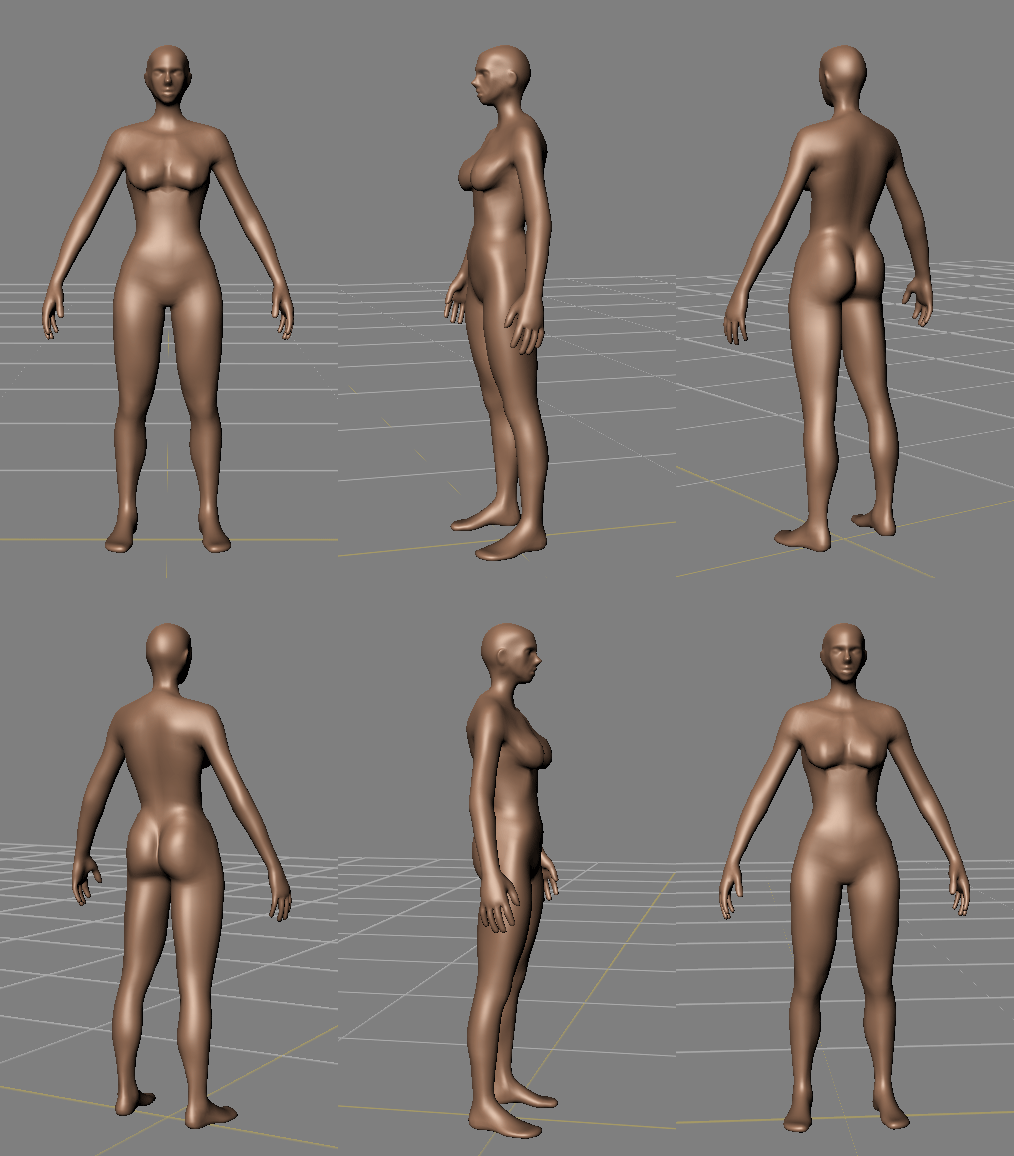
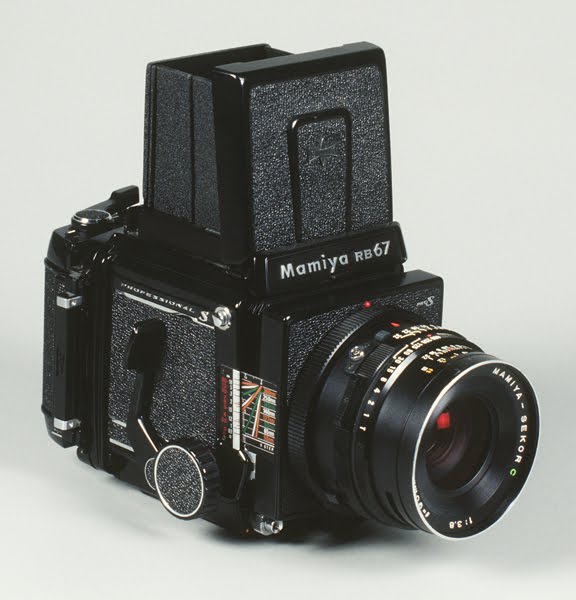
Well, thinking about my three dimensional self in technology, and taking that into my work as a photographer, I made an animated gif of myself using an old mimiya camera (see below) and 120mm film. Our class has been questioning the difference between 3D scan and photography as forms of technology that interfere (good or bad) with identity representation and of course the objectifying gaze.

Controversy is a disagreement which is typically prolonged, public, and heated. Can we ever answer…
November 10th, 2014
“You can use evolutionary algorithms in the sim and come up with really efficient designs, in theory. And computers are cheaper than engineers.” “Is that why you were laid off?” Suzanna said. (Doctorow, 73)
What would be the implications of 3D printing becoming a ‘transparent’ tool or ‘second nature’?; Is the Question I posed to some of my classmates.
I was particularly interested in Sara Redden answer. “Masses of shit. It would become abused. Just as much as it would be used for good, it will be abused.”
I believe that it is very well possible that if the 3D printer becomes a ‘second nature’ tool in the majority of the population, that it will become abused. And I don’t think it is a matter of if but when this happens. Lipson and Kurman state in Frabricated, “In the not-so-distant future, people will 3D print living tissue, nutritionally calibrated food, and ready-made, fully assembled electronic components.” (7)
So as we move in to this transition of change, We need to do so with caution.
How does Suzanne’s work as a journalist compare and contrast to Perry an Lester’s work as inventors and tinkerers?
Suzanne writes stories for the movement Perry and Lester have kept alive since the new work era, and the people she writes about create pieces of mechanical genius and the forum in which these machines are displayed. The big similarity, however, is the fact that these two types of professions are both very creativity-heavy by definition, but the actual work is comprised primarily of anything but. We barely hear about Suzanne struggling with the headline of her work, or losing sleep over whether she portrayed a certain project the right way. Similarly, we don’t hear very often about Lester or Perry needing to put the final touches on the inner workings of their machines. As we get later into the quarter, I am realizing that the blue rabbit project has so deceivingly little to do with the creative process and more to do with a series of research steps processed through a series of programs and iterations.
“I’m going to order some food. What do you feel like?” (Doctorow 199) “Whatever you get, you’ll have to get it from one of the fatkins places. It’s not practical to feed Lester any other way.” (Doctorow 199) This week I was thinking about how I have been feeling about the things I make in Tinkercad. I noticed that I wasn’t feeling as good about making something, I wasn’t getting the good feeling that is described in the Maker Movement Manifesto. I think that this might come from a feeling of assembling in Tinkercad, not actually creating. I feel like I’m just putting pre-made shapes together. None of the other students I talked to shared this feeling. This brings up the question of what does it mean to make something? What is the difference between putting something together on Tinkercad and downloading it from Thingiverse?
“…(T)he primacy of the inherent bodily orientation in the mapping…. (T)he primacy of bodily experience in the structuring of human conceptual processes.” Malafouris p.64
“Every time I get together with a fatkins girl and we’re you know, partying – for both of us it becomes something really intimate. A denial of pain. A fuck-you to the universe that made us so gross and untouchable.” Lester p.207
Pleasure and Collaboration are the seeds of radical disruption.
According to Nunez and Malafouris, the body is integral to how we know things. The example of time is referenced, w/ our tendency to always place time events upon a spatial plane (gone, before, after, not too distant…). If our body provides this “way-of-knowing” then I wonder what affect physical sensation have upon our cognition.
[Could we feel the pleasure of time?]
What about when we use our bodies as sites from which to (re)claim power? (through pleasure?)
WHAT IS SO RADICAL ABOUT FEELING PLEASURE ANYWAY?
Self-Observation (applying the bodily experience of human conceptual processing):
Why did I feel I had to prove “something” in order to utilize the 3D printer, and what does my body have to do with it?
I sit almost entirely still while designing. My embodied relationship to what I “make” is flat and mediated. Is all the knowing in the stroke of my hand, or even more in the fingers?
Instead of viewing the computer as a component, could we recognize it as a collaborator?
“You need something stronger than a bunch of friends who have loose agreements.” (Doctorow 217)
As I was working in the lab last week I had a chance to talk to Katie. We discussed our interest in the education system and how we had taken some classes with the same teacher in the past, but never together. She worries about the education that her child is recieving, she would like to do what is best for them. I began thinking as I was talking to Katie about the importance of the individual, the person behind the test result. Why do people have to be turned against each other? Education shouldn’t be a competetion. Katie and I had such similar interests and I’m excited to begin working with her
“Rides are a lot of fun, Perry. Your ride, it’s amazing. But I don’t want to ride a ride for the rest of my life, and Landon is a ride that doesn’t stop. You can’t get off.” (Doctorow 205)
“’I was playing ball in the house,’ Ada said in the
same small voice. ‘Even though you have told
me not to. And I broke something. I should have
listened to you.’
Eva shook her head. ‘Plays me like a
goddamned cello,’ she said.”

I wonder how programmed we are to “play” individuals we perceive as authority figures. Is it learned in K-12, or is there some evolutionary purpose? Lately, I have been thinking a lot about our species’ shift from hunter-gatherer societies – and if it was, at one point,a genetic advantage to give others the illusion of control. Certainly, once we ceased living in relatively egalitarian communities, some became leaders. But, just as certainly, it was in the interest of a majority of people to not just fall into, but thrive in the role of the subordinate.
But, like so many other things, it comes down to nature versus nurture. A co-explanation to this phenomenon would label it as an acquired skill. So many kids I have known, myself included, have tried everything imaginable to keep compulsory education from feeling like a cheese grader to the back of the head. Many, myself not included, determined that the difference between the-path-of-most-resistance and the-path-of-least-resistance are remarkably similar. And that is potentially a dangerous conclusion to draw.
Is “[t]his creative destruction at its finest”?
(Doctorow 254)
In a small seminar group two weeks ago we briefly talked about whether or not students in this program should be allowed to use designs from Thingiverse and TinkerCAD for our blue rabbit projects. The topic was brought up in conjunction with discussion of heart, and things made by hand. It has become more and more apparent that making things with 3D printers is an entrance to a totally different realm of making. The “rules” and procedures of traditional making do not necessarily apply, and so unique laws, patenting procedures and copy right laws are being worked out and written to suit this medium. It seems to some degree that trust is implied in open source communities, and it is interesting to see what arises when that sense of trust is tested (such as Cory Wilson 3D printing a gun). Trust is something you can’t write laws for. In the handout Zev created, he writes that the final stage of Marx’s five stages of economic development is a stage where “the means of production are in the hands of the workers”. Vinny and I discussed ideas of what would it would be like if everyone had access to 3D printers. Would that mark the beginning of an era of “creative destruction at it’s finest”? Can open source act as an equalizer, or do traditional ideas of economics, and ownership still manage to seep in? I do not think that creativity has anything to do with ownership, but we so often associate and claim it in the realm of individuals. Could technology and art mesh in a way that becomes inextricable?
“[I]t’s so totally suckballs that they’re accusing you of ripping them off – we rip you off all the time.”
(Doctorow 249)

“It was telling the story he know, of growing up with an indefinable need to be different to reject the mainstream and to embrace this subculture and aesthetic” Doctorow 289
“Another of my favorite DARPA projects is the Adaptive Vehicle Make program. This is an experiment in creating a new way to develop vehicle platforms for the military by crowdsourcing the design and then using a distributed manufacturing facility to build them. It actually worked.” Hatch 159
I like to imagine us (us as in Evergreen students, us an in radical reject creative folk, us who grew up with the need to be different to reject mainstream, us who embrace this subculture) as the kind of ‘kids’ who would take Perry and Lesters ride into our own hands to create something. In reality there is us (us the American population, us the American right, us the patriot, us the war monger, us the capitalists) who open source create a “military vehicle” as Hatch puts it, which is a drone. A DRONE. Not (1.) a low humming sound, not (2.) a male bee in a colony of social bees, which does no work but can fertilize a queen, a person who does no useful work and lives off others but (3.) a killing machine. A remote controlled weapon of war used to kill people. That is what we (USA) have so thoughtfully contributed to opensource.
But really:
“That definition fits a $140 million Global Hawk drone, circling over Afghanistan and transmitting video to Air Force intelligence analysts in California. But it also describes the $500 foam plane that my children fly on weekends. Both have sophisticated computer autopilots, high-resolution cameras (we’re partial to GoPros), wireless data connections for video and telemetry, ground stations with heads-up displays and real-time video (my kids were disappointed at a recent tour of the Oshkosh air show to see that today’s military drone pilots have worse ground stations than they do), step-by-step mission scripting, and the capability to play back footage of the mission in full” -Anderson
See more:
How I Accidentally Kickstarted the Domestic Drone Boomhttp://www.wired.com/2012/06/ff_drones/all/
M A K E M A R K S / / C O L L A P S E T H E C O N V E N T I O N
(the body is not passive) (it’s not all in your head)
(there is no ghost in the machine)
What is the status of the body in relation to human cognition?
sta·tus /‘stādəs,ˈstadəs/
noun
1. the relative social, professional, or other standing of someone or something:
“an improvement in the status of women”
“the status of women”
“those who enjoy wealth and status”
“the duchy had been elevated to the status of a principality”
synonyms: standing, rank, ranking, position, social position, level, place, estimation, prestige, kudos, cachet, stature, regard, fame, note, renown, honor, esteem, image, importance, prominence, consequence, distinction, influence, authority, eminence
the official classification given to a person, country, or organization, determining their rights or responsibilities.
WHAT IS THE STATUS OF THE BODY
WHAT IS THE POSITION OF THE BODY
WHAT IS THE ESTIMATION OF THE BODY
WHAT IS THE STATURE OF THE BODY
WHAT IS THE IMAGE OF THE BODY
WHAT IS THE IMPORTANCE OF THE BODY
WHAT IS THE PROMINENCE OF THE BODY
WHAT IS THE CONSEQUENCE OF THE BODY
WHAT IS THE DISTINCTION OF THE BODY
WHAT IS THE INFLUENCE OF THE BODY
WHAT IS THE AUTHORITY OF THE BODY
How do these words take on different meaning w/a relationship to the body? What are our bodies’ (individual + collective) authorities in the CST lab room? In creating? In claiming? What are our physical positions and statures? How does the image of our body (how we are physically seen) and the image we project inwards + outwards (how we affectively feel) relate to the images we are creating next week? etc.
“We are merely dealing with figures of speech—ordinary features of our linguistic ability and of conventional language use. But from the perspective of embodied cognition things appear rather different. […] A metaphor is not simply a figure of speech; it is a cognitive cross-domain mapping.”
(Malafouris 62)
: : : CONCEPTUAL MAPPING : : :
MAPPING OF BODIES AND WORDS ACROSS
GEOGRAPHICAL POINTS OF CONFLICT
BETWEEN SELF AND OBJECT
/////////////////////////////////////////////////////////////////////////////////
Because research procedure cannot “artificially divorce thought from embodied action-taking and […] its surrounding environment”, what intimate linkings between themes of language, ritual and gesture can be made?
When encountering the image-schematic structure (“which compromises recurring patterns in our sensorimotor experiences and perceptual interactions”) we confront center-periphery, balance and equilibrium, the e x p e r i e n c e o f b o u n d e d i n t e r i o r s .
What are these bounded interiors?
In a making space, what are we bound to? (physically, gesturally, a f f e c t i v e l y )
Simultaneously, how do we define the boundary as it defines us?
How can it be expanded to fit us?
How does the boundary uphold us?
MATERIAL METAPHOR VS. LINGUISTIC METAPHOR
“You understand I’m going to write this the way I see it, not the way…
“Those big old companies have two common characteristics: they’ve accumulated more assets than they know what to do with, and they’ve got poisonous, monopolistic cultures that reward executives who break the law to help the company turn a buck. None of that’s changed, and so long as that’s all true, there will be little companies with legit gripes against big companies that can be used as investment vehicles for unlocking all that dead Fortune 100 capital and putting it to work.” (Doctoro, 238,239)
This week we began learning the fundamentals of Adobe Illustrator and translating it into TinkerCAD which really opened up the medium of 3d modeling even more. While most of what was being rendered in Illustrator appeared to be scribbles or really rough renderings of frameworks for blue rabbit projects, the addition of this new software has made materializing our ideas a lot more translatable across multiple mediums. I believe it was Bella who drew an elaborate array of scribbles on the entire workspace she created in Illustrator, moved it to TinkerCAD, and raised the height of this flat object. This object turned into a raised maze like structure that may not be able to serve a functional purpose if materialized with a Makerbot, however demonstrates the limitations and possibilities of working with multiple softwares. I am really curious as to how the ease of bringing rough sketches into TinkerCAD will affect the work we’re doing, perhaps the translatability across mediums will make our work less polished or maybe it will force us to work intricately and deliberately on the spines that shape the bodies of our work. All in all, the introduction of new software seems to excite those working and helps clear a lot of the parameters that TinkerCAD hinders our creativity with.
Chuck Neudorf
The time is approaching where the design aspect of our projects is winding down and the creating part is ramping up. Test prints are being done to insure that components are going to work together. Some of us are going to use our 3D print as a prototype for the final product, and that means we still have another iteration to go, this time in a different media. I am finding that the campus is a better makerspace then I thought. Not only are there a lot of great tools available, but there are also a lot of great people available to help us learn how to use them.
How can we better address the similar problems that we all are all coming across during the our sixth week of class?
I have noticed that there are some issues that all of us are starting to face in the finishing portions of our tinkerCAD work. Things like clips, hinges, and male/female plugs are without a doubt the hardest part about creating with the three-D printer. I am still having troubles with the hinges for my glasses frames, and other students around me seem to be having similar problems to solve. Grant is making maraca shakers and would like to have the bottom clip into the top so he can add beads, but needs it to hold steady when someone is using it. All these little complex problems can become huge problems when three-D printing. Working together in specified groups or more peer-assisted lab work could help keep our projects successful and our troubleshooting to a minimum.
“Transposing the conventional demarcation line of human conceptual architecture outside the brain but still inside the skin, the embodied-mind approach may have resolved the traditional “ghost in the machine” paradox by way of what Anderson (2003) calls the “physical grounding project,” but it also has created a sort of embodied cognitivism in which the material reality remains external and epiphenomenal to the cognitive structure.” Malafouris p. 65
While beginning to bridge the “mind” with the “external” Malafouris still cannot abstain from creating certain demarcations of the self. The holographic nature of the universe ensures that everything is an order of magnitude within another order of magnitude. The macro is mirrored in the micro and vis versa, they cannot be unraveled or untangled. The problem is that humans are too used to inhabiting one’s own body, we must explore other ways of existing to realize that we are viewing the universe through just a tiny porthole. It is interesting to me that we leave our ego behind each night in our dreams and join the ocean of consciousness only to be refunneled upon waking. Does the same essence that left the body come back, or does a different essence enter us every day, functioning under the mode of our particular neural topography?
Chrissy
(a conversation between myself, Zev, and Malafouris during CST lab)
“What are you drawing?”– Zev
“Me? Oh, I don’t know, I’m just sketching what I see.” –Chrissy
“We should be focusing on the interactions among humans and material actors seeking to discern the properties, emergent or otherwise, that are relevant to the working space and the social setting” (Malafouris 79).
“…But how can you sketch this moment when everyone is moving?” — Zev
“As the linear B tablets exemplify, the engagement between cognition and material culture… is not simply a matter of independent mental representation; it is also a matter of meaningful enculturation and enaction– processes that are dependent on and inseparable from their physical realization, bodily or material” (Malafouris 73).
If participation is action, and observation is action, then one of the key circumstances for engaging in participant-observation is movement. Therefore, movement is part of the process of creation.
The CST lab is an ever-changing situation: questions turn into ideas; ideas form statements; statements turn into materials; and materials become extensions of ourselves.
But how can we really document that shift from question to self?
Mindful creation is shaping the world that we live in. It is also bringing everyone together, at once, to make something happen. And that act of making (that movement), is a picture worth sketching.

“The hand is not simply an instrument for manipulating an externally given objective world by carrying out the orders issued to it by the brain; it is instead one of the main perturbatory channels through which the world touches us, and it has a great deal to do with how this world is perceived and classified” (Malafouris 60).

Lester said…’We going to be ready to open soon?’ Perry had fallen into a classic nerd trap of having almost solved a problem and not realizing that the last 3 percent of the solution would take as long as the rest of it put together” (Makers, 201).
Reality stared back at us from the white board as we all quickly realized that time was of the essence. We have four short weeks to perfect and complete our design, run test prints, create images that represent our project, and finally, to bring our idea into reality. Four weeks! Doesn’t seem like such a short period of time until—the ringer—we discovered that we are competing for limited resources; the ability of two 3D printers to print for two committed programs, non-stop for the next four weeks. Nine hours each was our allotment. Time to get to work.
‘Soon, soon.’ Perry said. He stood up and looked around at the shambles. ‘I lie. This crap won’t be ready for hours yet’ (Makers, 201).
“Is he a psycho? What the hell is his beef with me?”
“I think that he thinks that technology hasn’t lived up to its promise and that we should all be demanding better of our tech. So for him, that means anyone who actually likes technology is the enemy, the worst villain, undermining the case for bringing tech up to its true potential.”
The struggle between human and technology was quite apparent during the participant portion of this weeks COM exercises, when the TinkerCAD website was going through updates. I love that we always have a fall-back method to still make sure we learn something useful, be it more programming oriented(OpenSCAD) or visual(Adobe Illustrator). The most important development this week though was by far the formation of smaller groups with similar project scopes. I was also excited to see the Blue’s and Rabbit’s switch up Mondays and Tuesdays, because I was wondering what effect, if any, it would have on us. We are sort of our own experiments in this class which has always intrigued and confused me..
“You mean to say that you’re surprised by building stuff out of unusual materials,” – Cory Doctorow. I’ve noticed an interesting dichotomy amongst the students, which, although it has always been present, it is now making its way into the foreground much more intensely than it did before. It seems as if there is a split … Continue reading
“But it would be very difficult to draw the boundary between the internal and the external parts of the cognitive system involved, even if one were able to locate precisely where these cognitive processes were enacted.” (Malafouris 71)
This quote seemed very fitting to me well for one because our class is working with technologies that have a good way of blending imagination and the material. Using these technologies you can really see that the inner and outer go together perhaps in ways that are just to complex and works at such an implicit level you can’t really put words on it. I feel like history has been like some metamorphosis for our species, thats leading us to a tip of the ice burg like next stage in evolution. So it will be interesting to continue to see how our collective imagination and the material become more and more blurred and fantastic.
“venture capitalism is the major source of funding for commercial lawsuits these days”(Doctorow, 242).
“The body is not as is conventionally held, a passive external container of the human mind; it is an integral component to the way we think”(Malafouris, 60).
Is there a legitimate sense of agency behind the culturally inherent quest for monetary gain? The concept of venture capitalism is very interesting to me because it promotes the almost non-human ability to personally detach and disengage from the transparent interaction between creation and creator. Coming into the “free” market with a solidified understanding that “selling out” and selling out quickly is the achievable working goal can be viewed as a contemporary form of social and market manipulation. Appealing to the mass in disregards to personally creative interests. Is this disconnect from material engagement and purpose entirely detrimental, or can it become useful in other exploitive situations of human interaction? Acquiring a sense of agency over the ability to disconnect from the process of creation when necessary could be useful in viewing one’s output from a different perspective, or could prove to be just as impractical.
“You don’t have to do the suing. That’s the point. You outsource that. You get the money; someone else does the business stuff”(Doctorow, 242).
“Our stories are about the world, so our stories are about people figuring out what’s causing their troubles and changing stuff so that those causes go away.” (Doctorow 176 – 177)
I’ve always known music to be powerful on a personal level, but once I began performing and seeing how my creations affected people listening, music became an entirely new tool. I’m interested in looking at what ways a performance is successful at being an emotionally receivable experience. I ask this question with a bit of a hunch. I’d bet it has a great deal to do with the performer’s mind/spiritual/emotional standings. Ex: Two musicians can play the exact same piece on the piano, the first is accurate, intelligible and you can acknowledge that it is of quality. The second, however, contains all the qualities of the first, but is driven by an emotional force that is moving, powerful and evokes a response. In short, you think the first was good, but the second made you cry. . .
“Kettlewell had done amazing work for him this morning, just out of the goodness of his own heart, and Perry had repaid him by being a stiff-necked dickwad.” (Doctorow, 218)
I feel like people are starting to get more invested into their projects, although I can tell that some are becoming disillusioned with the structure of the class. I’ve heard multiple complaints about how the class has almost stifled students’ creativity. However, this is something I do not agree with; I feel like the ability to choose whatever you want to make and print is incredibly liberating, which is why I chose this quote in particular.
“Do I give up my agency when I give up my physicality to John with a scanner? How do I maintain a sense of self when my tangible body is abstracted?”
-Lauren
“I don’t see it as a woman (or man) when its on the screen. I try to get a good scan, I really don’t see you as that (an object)”
-John

This is an attempt to explain but by no means justify a small aspect of the objectification of women within our society. I think that often the one directly responsible for executing this objectification within the creative world of digital media is often blinded in the moment of creativity. This was my experience while scanning Lauren and then having a conversation with her about it days later. Was my goal as the creator of the scan to show her as an object? No. But now, stepping back, I can see how easily this image of her, although not my intention, could be used to objectify her. I am reminded that we as ‘Makers’ must take a step back from the creative process and take responsibility for the things we make and how they may affect the world.
Is optimism always possible or favorable?
“No fucking way”- Doctorow, Makers, 227
I’m not sure when I stopped being an optimist about everything, but I think this class might change that. Certainly, not much in Makers can be seen as optimistic, but this week, while I was still mad about my inability to link the class to the text, I saw people being more optimistic than me. People were having troubles with their designs and seeing it as learning oppurtunities. People would look at misprints and say “I’ll get it at some point soon.” The class is effectively acting opposite of the text, and it will be interesting to see where it pans out.
“But it would be very difficult to draw the boundary between the internal and the external parts of the cognitive system involved, even if one were able to locate precisely where these cognitive processes were enacted.” (Malafouris 71)
“He patted her arm. ‘”You forgot who you’re talking to. I love fixing stuff. Don’t sweat it.’” (Makers 206)
In Malafouris’ s work, he “undermines” the cognitive processes enacted upon stone tablets that were written sometime in our history, to be able to further understand how the human mind has evolved into more complex interconnected thought processes which is that of our brain. Although this is a hard thing to read by judging the hand movements on a stone tablet, is it not almost like looking through computer code to read how the computer is thinking? Since the creation of computer coding, mankind has worked in a much different way, and I believe that whoever controls the code of the machine can very well control the code of the human, which lives off of, or bases their life off technology, much like Perry and Lester do in “Making.”
Click here to view the embedded video.
When I was shopping on Amazon I came across this new device and after watching this video I didn’t know whether to be excited or disturbed. This device is a channel for consciousness to flow through and even has the mechanical hardware to seemingly make decisions and respond of its own accord to questions. My question was then: is this thing animate or inanimate? It’s seems to be quite animated but isn’t it just a thing? While sitting and meditating next to my printer I thought to myself: this thing is animated by my actions, is it animate? The same thing applied to the Amazon Echo. In a sense it is animated–by my consciousness extending itself into the software and hardware. But does that form of animation have a sense of its own animation? If the biological body is animated out of the mind, who’s to say a mechanical body cannot house conscious?
“But you can’t put everything under one banner—you can’t just declare to these people that their projects are ours—“ (Doctorow 217)
“Without a corporate entity, it’s like trying to herd cats.” (Doctorow 217)
These quotes make me think back to the documentary we watched in class about the industry of 3D printers and the process in which MakerBot essentially sold out and went from open source to closed source, putting the community’s collective work under MakerBot’s name. Is it true that a community of individuals working for a movement is something that can’t be herded? Do people need a leader in order to work towards something? Perry tried so hard to share his idea with everyone and allow them to work off of it without being under Perry’s rule. But when they faced trouble Perry had to take the leadership position in order to efficiently deal. Is there any way around this?
Yarden Solomon
“The task is not to understand how the body contains the mind, but to understand how the body shapes the mind.” (Malafouris, 60)
“Sometimes he grunted or scatted along with his playing but more often he grunted out something that was kind of the opposite of what he was playing, just like sometimes the melody and rhythms he played on the piano were sometimes the opposite of the song he was playing, something that was exactly and perfectly opposite, so you couldn’t hear it without hearing the thing it was opposite of.” (Doctorow, 172-173)
Throughout these weeks, I’ve been noticing a duality in the world. The duality in body and mind, material and conceptual,,light and dark, moon and sun, male and female, positive and negative and so on. It also seems like many of the questions we work with understanding have more then one answer and take many perspectives to grasp. In my mind, I imagine this concept as a shadow. When light is cast on to any material object, in it somewhere contains a shadow. We could apply this concept to everything, and notice that for everything there is an opposite thing,a counteractive, a shadow.