Making Meaning Matter

The Evergreen State College

Category: CST (Page 3 of 8)

Sarah’s week 8 CST post

“Mind to design in minutes”  ?

This is head banner of  tinkercad.com.

I had not noticed this until last week in our all group meeting. I wonder what tinkerCAD means by this, as their statement here takes on meaning for me that I would not have recognized in the same way a few months ago.

“Mind to design”?

Where was the design located before?

What’s after design then?

“In minutes”?

This is now bringing time into the equation.

Equation. For me, this banner does read as mathematical in a way, perhaps because it  brings time into the mix. Which makes me think of equations of the mind.

What do the equations of our mind look like? What is an example?

Are figures of speech equations of the mind? Or more like proofs, or laws? Or are they a meeting point of language, math and reality?

I spoke with one of our classmates about this, he said that math is a kind of figure of speech in itself, as both math and language are attempts at conveying and describing reality.

Malafouris writes about figures of speech involving time and calls the process “cognitive cross-domain mapping” (How Things Shape the Mind 62).  He goes on to write, “[t]hus, this mapping ‘does not belong to the realm of words but to the realm of thought’ ” (Malafouris 62).

This idea of mapping and meeting points, makes me think of thresholds, it also makes me think of the path traced last Monday between Zev and John during the 3D scanning tracing dance.

Was that a kind of visually equation for what was transferred there?

Was it more like a “figure”?


Nice CST Post / Week Seven

“She picked it up and shook it. He heard the works inside rattling and flinched toward it. She jerked it out of reach and threw it, threw it hard at  the wall.” (Doctorow 250)

How does art and media effect the way we react to situations? Makers is packed with plot and plot twists, and the plot moves very fast. This seems to mean that sometimes characters act more abrasively than is natural. There is nothing inherently wrong with this, it is simply a device Doctorow uses. But does this have any correlation to people progressively becoming more melodramatic? We blame soap operas and reality shows — that’s an easy accusation — but what if subtle applications of plot progressions (like the ones Doctorow uses) are just as easily mistaken for a reflection of reality, and just as detrimental to our collective disposition?

CST Field Notes Week 7

November 17th, 2014

“You can use evolutionary algorithms in the sim and come up with really efficient designs, in theory. And computers are cheaper than engineers.” “Is that why you were laid off?” Suzanna said. (Doctorow, 73)

IMG_4368 IMG_4341

Last week as people were printing of there projects, I reflected on Sara Redden statement(“It would become abused. Just as much as it would be used for good, it will be abused.”) to Week 6 question i asked.(What would be the implications of 3D printing becoming a ‘transparent’ tool or ‘second nature’?)

What might the “good” things be that come out of this tool of production? The project i am currently working on is make a replicas of lumbar vertebrae. Another classmate of mine Daniel Loose is making a Bra for Women in transition.

Austin’s Week 7 CST

“Would you like a comment card?” (Doctorow 265)

“No.” (Doctorow 265)

It was interesting to have a different experience in the 3D/CST lab this week.  Experiencing Zev being scanned into a digital form was cool, and some of the discussions that resulted were even cooler.  The hostile tone of the conversation on the politics of scanning a body really shocked me.  I completely did not understand some of the points that were being made and I was very confused.  The two sides of the conversation seemed to be pretty gendered.  I’m curious to explore more how gender is involved in this digital 3D world, as we know it is from the Google searches of “3D man” and “3D woman.”

CST Week 8

People have started to make the jump to fully printing their ideas. I’ve noticed a bit of a lull in motivation regarding our projects lately, although I feel like that can be chalked up to the short week and the break in sight. By now, the novelty of the modeling software we have learned has long since faded, but the vision everyone has of their finished product is still strong in our minds. I’m excited to see how the work in lab time goes this week and during Week 9.

Week 8 CST

The mind croggling Ponzi scheme is the closest thing to a business model we’ve heard yet from the chip-addled techno-hippies of the New Work and its post-boom incarnation.” Makers, 243

“He’s the king of the trolls.” Makers, 244

It’s worth noting that at the end of his nasty article, Freddy leaves the email “honestfred,” so at least on some level he thinks or pretends to think that he’s just being honest. How would it affect us if we added to our CST observations 1 person who conspired against everyone else?

If someone pointed out all the folly of a young college kid like me trying to explore meaning by 3-d printing poetry, maybe a little too idealistic about it, I think it might just make me want to do it better. I don’t know if we need someone who is blatantly mean, because it would kind of hurt my feelings if I got a Freddy-like critique. But I feel like people just kind of accept other peoples’ projects without getting to know the intricacies that well and just say “wow that’s cool.” I’d like to teach other people about my project just so I can learn more about it.

Week #7 – CST

Click here to view the embedded video.

I’ve really enjoyed the role tools have played in this course.  last week, watching Zev get scanned was pretty incredible.  I recall being seven and playing a video game that probably took many months to create, both in drawing and function.  Though now, within minutes, we had an identifiable recreation of Zev on a computer screen.  What does this mean for identity?  We saw last week as well how different google searches for “3D Men” and “3D Women” could be.  I’m reminded of facebook and the dichotomy often seen in peoples photos; that is, ones taken of themselves, or chosen to be profile pictures, often look a great deal different from what photos others tag them in. . .

The attached video shows how sound waves can be manipulated in relation to physical material…  Pretty neat stuff, kind of a silly video though. . .

http://nigelstanford.com/Cymatics/

CST 7

SandhillCrane_MatingDance_6908

Mating Ritual or 3D Scan?

Steph brings up the politics of 3D scanning. Representation and agency of a body that we lose control over once its uploaded to the web, but gain the ability to manipulate and distort the body? Zev is unmoved. He volunteers to be scanned and in what appears to be some sort of mating dance (from an alien perspective) leads to the production of a virtual Zev body, that could be birthed through the womb of 3D printer. Reproduction in its most abiotic form.

Graham CST post week 8

“Webcam sites are a recent invention in a long line of practices in which human animals capture their nonhuman counterparts for the explicit purpose of watching them.” Yes Naturally 165

“I argue that MSA marks and lines externalize nothing but the very process of externalization.  That is, they are enactive projections.” How Things Shape the Mind 193

How are humans projecting “themselves” and how are those experiences mediated? Are we expanding our consciousness to other avatars or merely looking through little glass windows?  We create machines that enable us to view a scene transmitted from thousands of miles away, are we there experiencing it?  If our creations are physical projections, manifested cognition, has our agency been funneled into an entity with self-governance separate from out own?  If a man clones himself do they collectively have the same level of agency or is the progenitor the master?  Chronology is the only difference between them, if the clone went back in time he could be the creator of the original.  Perhaps the relationship should not be hierarchical.  Perhaps as we continue to create machines that outperform our abilities we should view them as “enactive projections.”  However we should be wary of possessive creating.  It is true that without the creator there would be no creations but humans are not the only creators.  Evolutionary progress is inevitable and can occur by an infinite variety of means.  It is conceivable that robots and machines could be born without our interference.  Given the impossible scale of the universe and its timeline, random particulates in space could construct themselves haphazardly, asteroids striking planets, diasporas of elements rippling outward by supernovas.  Perhaps in some place and time in the universe debris from a passing comet collided with lunar satellite, smashing them perfectly to form a robot.  Entropy fluctuates by itself, we are not its only regressor.

CST 7

This week we encountered a new parameter of 3d printing our prospective objects: time constraints. The time constraint of 9 hours of total printing time definitely is not workable for some projects, including mine. Printing one sheet of my fabric takes roughly four hours and produces about 5 square inches of chainmail which is unfortunately not anywhere near the amount that it will take to cover 1/4 of my model’s torso. While this time parameter is frustrating i think it is a healthy reminder that part of design is an art form characterized by constraints and running into constant obstacles that hinder the ability to produce a final product. I am content with the notion that my piece may not be fully formed by the end of week 10, however the potential is there.

steph smith week 8

“We are never alone.”

“Animal behavior, as it occurs without immediate human presence is, as it were, digitally colonized and domesticated, taken up in spheres of human meaning making.” – Yes, Naturally p.166

What is the relationship between Africam, CCTV and the methods of cultural anthropology?

What are we doing/what relationship is made/what structures do we operate within when we watch each other from across the CAL lab?

I think it is possible to watch remotely, even when occupying the same physical space.  I think it is important to objectify our methods of voyuerism, to peer deeply into what draws us (yes, naturally?) into these roles.  I wonder if we could perform within the processes of surveillance.  Could we enact artisitic technological intervention in the everyday?  If well-placed and ubiquituous cameras have altered our physical landscapes, why dow e continue to go about our “business as usual”?  I wonder what the possibilities could be for intentionally haptic interactions with cameras, even with each other.

An exhibit I kept drawing back to when thinking for this post:

Coco Fusco and Guillermo Gomez Pena: The Year of the White Bear and Two Undiscovered Amerindians Visit the West (1992-1994)

fusco1

  tumblr_likx56xmWS1qbw0ioo3_400

as-061_a92-058_020

http://bombmagazine.org/article/1599/


CST Week 7

Chrissy

“Is mark making a necessary condition for symboling?” (Malafouris 180)

“Trust is assumed in the system” (Doctorow 271).


This week in CST/3D lab, our assumed trust in the system became a central theme. Tinkercad was undergoing maintenance once again, so the class took advantage of the time to demonstrate how 3D scanning worked. We discussed the politics of 3D scanning bodies: Can we assume that the “next big thing” is a good thing? There are social repercussions of literally objectifying people through this technology. What actions do we need to take to defend this from spiraling out of control?

One assumption is that scanning data leads to “greater” knowledge of information (i.e. identification). This confronts the issue of accessibility to data and the power that is inherited from it. How will 3D scanning technologies put different bodies at risk and on display?

Like photography, 3D scanning has the potential to change the way that we think about ourselves in the world. But is photography a choice or an assumed power? Do women really have a choice when we live in a world of ubiquitous surveillance/monitoring/scanning?

Surveillance is tied to discrimination. We must proceed this with disbelief in the system, not trust.


Print Time

Chuck Neudorf

There are two issues that need to be considered in regards to getting our projects printed. First, there are a lot of things that need to be printed, and second, not everything is going to print flawlessly on the first try. Only by actually printing an object can it be seen whether or not everything is scaled properly, that the fill is correct, and that the projects are going to behave like we thought they would. On my first attempt, a part was warped and needed adjustments in fill percentage and and to overall thickness.  If there are multiple parts, it can take awhile.

Week Seven Entry

“Perry gave him a mock glare. “You have no right to say anything on this score.” He darted a glance at Suzanne and saw that she was blushing.”

Excerpt From: Doctorow, Cory. “Makers.” iBooks.

The further into Makers we get, the less Suzanne is observing and the more she is being observed.  This is similar to my experience this week when I gave a short demo of 3d scanning.  I really enjoyed hearing all of the different observations from my classmates in Sarah’s seminar group, it really gave me an outside perspective of 3d scanning.  Some thought that it appeared as though Zev and I were participating in some sort of romantic dance, this is something that is hard to see as a participant.  I’m excited to see what will come from the 3d scans and to engage in more conversation about this new handheld technology.


Week Seven CST Observations

public : private

democratic : discrete

“What happens to the things exiting both inside and outside of the binary opposition?”
– Sarah Williams, Monday lecture

(here i interpret binary oppositions as social divisions of human/computer, male/female, work/family, colonizer/colonized, friend/lover, hetero/homo,”unmarked personhood”/racial-, ethnic-, and class-marked identities)

How does a simple “boundary” reverberate to make the world intelligible?

I am thinking about source codes and the various forms of hacking. Hacking which takes place inside of the virtual body and hacking which takes place inside the intimate body. Here, I would define a virtual body as nonsingular and not an entity, but rather, the interaction between human and computer. Similarly, I would not define an intimate body as singular entity in itself, but the mediation between human and the aesthetics of attachment. From Lauren Berlant, I quote, “Contradictory desires mark the intimacy of daily life: people want to be both overwhelmed and omnipotent, caring and aggressive, known and incognito.” (Berlant 5)

In what ways do these new binary oppositions (offered by Berlant:: of overwhelmed/omnipotent, caring/aggressive, known/incognito) serve to uphold the social divisions of our society? On a related note, how do they help to potentially answers questions about what virtual & intimate hackings of the body would look or feel like?

When I think about what it would mean for me to create a source code for my body, the boundaries between virtual and intimate become challenged. I was born with a code already governing my body, but because it was a “fixed” code serving to uphold standards of normativity, it had no real stability amongst myself and the multitude of bodies (imaginary, sexualized, gendered, laboring, and technologically augmented) that I grew into//am becoming. I inhabit a space that is subject to constant fluctuation. I am in body drift. I circulate, fluidly, and transgress. In my liquid drifting state, I am both overwhelmed and omnipotent, caring and aggressive (intermediating w/ myself and my multitude of bodies), and asking to be both known and incognito as I attempt to overcome the predetermined, and hack (or rewrite) my own bodily code.

“Nothing is as imaginary as the material body.” (Kroker 3)

Berlant, Lauren. Intimacy. Chicago: U of Chicago, 2000. Print.

Kroker, Arthur. Body Drift: Butler, Hayles, Haraway. N.p.: U of Minnesota, 2012. Print.

CST Week 7 Thomas Bouwer

What do we do when things change?

“I don’t know, man.” -Doctorow, Makers, 256

Because of Veteran’s day, this past week was a bit different. We found ourselves thrust into a different situation, A situation where we had to fulfill the roles of embedded journalists and 3D designers simultaneously. To some degree, I think that’s what we were supposed to have been doing, but this allowed us to actually “get it”. However, Monday also appeared confusing. It seemed as though we knew what were supposed to be doing, and that we did not, at the same time. The question is: “What do we do when that happens?” The answer appears to have been “Hell if I know, but we’ll likely get something out of it.”

CST Post Week Seven

There was much less time spent in the CST labs this week as compared to in the past, but even with that limitation, I felt that the level of discourse perhaps went beyond anything that had happened in earlier weeks. Because the time was devoted entirely to discussion, the classroom time felt much more valuable, … Continue reading »

~Anthony’s Week 7 CST Post~

“How can competitors become imitators, and how does that relate to the conceptual mind?” (Doctorow 262)

“Markings matter because they constitute putative evidence for the presence, or the origin, of symbolically mediated behavior.” (Malafouris 183)

How can the lines and edges implemented in the engravements of fragments through the finger-work of our ancestors compare to that of the lines and edges that come from our 3D Printers when they are creating an object? This is what comes to my mind when reading our texts since we have been discussing the relations between technology and human cognition. I also wonder in factual support like technological culture, how technology changes people’s “culture” ,(aka: the way we live), and the societal boundaries of what is right and wrong. If technology exceeded to a point beyond our current conception of the future, would it be morally correct to print fetus beads?

CST Week Se

“Marks are important only if they can be shown to be anthropogenic- that is, made by humans. For markings to have value, they must be artificial” (Malafouris, 185).

Why is the cognitive effort of participating in artificial creation inherently valued by humans? Is the interactive mental process of marking or “scribbling” in some ways, more valuable than the visually symbolic (outcome) representation being produced by that same marking or scribbling? I like to think of all the necessary steps that were required for paleolithic cave painting along with any other form of environmental marking so long ago. There was a concentrated effort needed to gather proper materials and conscious organization in order to make the printed exchange of ideas between mind and environment entirely possible. Recognizing this effort is critical when attempting to distinguish particular symbolic value relevant to a carving, marking, or drawing. The paint, along with the hand that is manipulating it, collaborate in transparency with one another, growing into a dynamic comparable to a performance. The performance alone, can often be the harbinger of personal relief and accomplishment. Witnessing the creative actions and research intensive steps being taken by fellow classmates in preparation for our conclusive 3D production, I can see the similarities in exalting efforts. The creative process is blended with social pressures, personal integrity, and internal representation, all for a single object’s manifestation of interest and theory. Can this established effort be compared to the performance transparency of marking or any other form of symbolic interaction?


CST: Week 8 The Power of Tools

Recently I have been able to connect people in the class with material tools.  I connected Cooper with my electric guitar and effects board setup and after showing him all the sounds he could make, he made art that surpassed his own imagination of what his sound could be.   There is a great power behind connecting creators with the tools to create.  I was also able to help and assist V in using a Wacom tablet to trace in his drawings of his spine into Adobe Illustrator.  I believe the purpose of technology is to make life more simple, not more complicated.  Good creators create–great creators create the frameworks, structure, and space for others to create. In “Room Full of Mirrors: A Biography of Jimi Hendrix,” when Jimi was finally able to be connected with his first guitar and subsequent material instruments such as amps and effects it enabled him to create so much more. (Cross)

CST post week 8


“Human animals like watching non human animals.” (Foundation, 165)

“From the first cities onward, urbanization has been accompanied by processes of catching  and containing animals, both physically and metaphorically, within realms dominated by humans.” (Foundation, 166)


How/ why are we  as a race creating boundaries and disconnecting ourselves from each other and the earth?

Throughout the class I have noticed how humans have in time have disconnected themselves from the earth and with others. We keep building walls and segregating ourselves with religion, race, countries, cities, etc. We separate ourselves from plants and animals, and separate ourselves from our food, our water, our clothes, and almost everything we own and use. The thing that it seems we have been connecting to is technology, and integrating technology into our homes, and into our personal lives more and more. In a sense technology has the potential to help bridge this gap and reconnect us with each other and with the earth in a beneficial and positive way. I think for this to happen we need a intentional global conscious change.


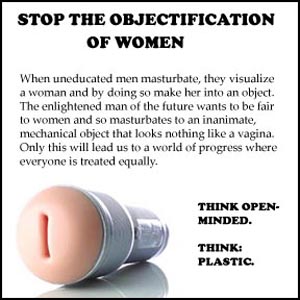
CST Week 7 – “I Object!”

source: http://forums.avoiceformen.com/showthread.php?1814-Epic-feminism-Fail-s

He wanted to tell her that she had never once seen him as a sexual being when he was big and fat, but that he had no trouble seeing her as one now that she was getting old and a little saggy, and so where did she get off criticizing his emotional maturity” (Makers, 251)?

My ears tend to perk up a little when I hear the word “objectification.” As a human being, I’ve been the objector, as well as the objectee. Tensions always seem to rise around this issue, my own included. However, I’ve recently got clear my role in this conceptual human comedic tragedy. People have their perspectives, their passions, their pleasures. And, people get hurt. And most people aren’t willing to be responsible for their role in either circumstance, up to and including the perception that objectification is real, and that it is being done by someone, willingly, to someone else, against their will. The question to ask is, not, what is the role 3D printing plays in supporting/abdicating objectification? But rather, what is my role in allowing an abstract concept to relinquish me of my responsibility toward realizing my own humanity?

Every step he took, he saw that ruin of a face, the compound fracture, the luminous blood around his groin. He made it halfway to the guesthouse before he found himself leaning against a shanty, throwing up. Tears and bile streaming down his face, chest heaving, Lester decided that this wasn’t about fun anymore. Lester came to understand what it meant to be responsible for other people’s lives. When he stood up and wiped his face on the tail of his tight, glittering shirt, he was a different person” (Makers, 274).

Forbes’ week seven reflection

“Most world-dominating plans went sour, while a hefty proportion of modest plans to Make Something Cool actually worked out pretty well, paid the bills, and put food on the table.” (Doctorow 249)

Should we live with intention or just let things happen? How much say do we have in our path? If the ambitious plans to create something significant go “sour”, but tinkering around to just make something cool leads to success and food on the table, how can we trust our intentions will ever be met? According to the above quote, it seems like people have to avoid their goals in order to reach them which doesn’t make sense to me.

CST for week seven

mind-and-body

In the debate between body over mind vs. mind over body my personal belief is their power over one another is equal. Through meditation you can lower your stress levels and increase your health but you can also affect you mind by treating your body better so that you can develop a better outlook and therefore a better mindset. For example in the book 1984 they were able to effect Winston’s mind with his body by re-shaping his personality and creating a new path for his thinking. This is only one example where body over mind is possible.

Eric CST wk7

This week what I witnessed during observations was, everyone working in Tinkercad on desired projects.  On Wednesday we had art lecture and students from our class discussed inequality and student debt. This was a good time for students with similar view points to converse and connect. In Seminar we discussed, things like certain company’s have robots doing work that humans once did.  I say that sounds about right technology is rapidly progressing, the constant reproduction and reinvention of already made devices. The perfect example of that I believe is the iPhone. Will we be any better off  when we get to the 50th iteration of the iPhone. We also talked about social networking and how people rely less on face to face conversation. I feel we rely so much on technology  that the knowledge to take care of ourselves without it is evaporating. With that being said who knows what will happen?  The end may be as the beginning, a Big Bang except this one will be into nonexistence.

Rapid Prototyping and the role of Ethnographers

RP-Process

The following post contains quotes from a research paper written by Salina Christmas a student at University College London in a Core Course in Digital Anthropology.  This research paper is about “the implications of rapid prototyping and how ethnography could contribute to an understanding of the challenges ahead”.  Our author touches on some core topics discussed in our program and this is one of the few people asking the same types of questions we are.


“There aren’t many anthropological works on rapid prototyping and its 3D printing practitioners. Due to the lack of references, the anthropologist could, primarily, refer to ethnographic works within anthropology that have been carried out on the modes of labour, kinship and sociotechnical systems to inform his research on rapid prototyping.”

This was a valuable piece of advice that will help those interested in further researching 3d printing ethnography’s.  Because there is so little written about ‘makers’ and ’3d printing’ or ‘rapid prototyping’ our author suggests that you could look at other aspects surrounding the topic and then relate them to your experiences within the field.


“For three decades, 3D computer aided (CAD) software has enabled industrial designers, architects and imaging engineers to visualise their concepts digitally. The CAD software helps the designer to visualise the artefact he wants to fabricate in image slices. He then exports the design as a stereolitography (STL) file (Onuh and Yusuf, 1999: 308). STL is a markup language used to encode digital 3D models. But the absence of a fast 3D printing mechanism in the past meant that they depended on a handful of “skilled craftsmen” to manually produce the prototypes. This created a bottleneck in the workflow and delayed the product development time. Consequently, designers had less freedom to update the designs, and were discouraged from exploring other solutions before tooling went into production, resulting in parts which at best were seldom optimized, and at worst, did not function properly.”

This quote describes the evolution of the 3d printer and the role it plays in rapid prototyping.  Before 3d printers designers were slaves to the few skilled craftsmen that could produce their prototype, slowing down their creative process and often causing the designers to give up on their design because it did not function properly the first time.


“rapid prototyping could affect the classical social structures built around the industrialised work processes as the individual worker begins to assume the roles of creator and producer, worker and capitalist”

What type of affect will rapid prototyping have on the current social structure?  The individual can not only be the creator but the producer as well.  How is the different from being both a worker and a capitalist?


“Rapid prototyping will challenge a dominant labour system that, since the First Industrial Revolution, has been inflexible. The inevitability of the technology being a ‘desktop operation’ – like computing, musical composition, sewing and inkjet printing – means that the worker who will be “creator and producer” would switch from a machine-based labour to the one focused on tools.

‘… Tool use is authentic and fosters autonomy; one owns and controls one’s own tools and isn’t dependent on or exploited by others. When we use machines, in contrast, we must work at rhythms not of our own making, and we become ensnared in the supralocal relations necessary for their production, distribution, and maintenance. To the extent that we become dependent on machines we do not own, the stage is set for exploitation.’ (Pfaffenberger, 1992: 509).”

This is the foundation for the maker movement.  Owning the tools that you use and rely on makes it much harder for someone to exploit you.  This shift from machine-based labour to tool based labour is the Maker Revolution.


“The anthropologist also has to look at the modes of knowledge transfer, and how they happen, within rapid prototyping. Rapid prototyping isn’t widely taught at colleges. The principle form for exchanging knowledge for its practitioners is YouTube. Although rapid prototyping is highly technical, the techniques are not acquired via academic journals or educational programmes, but via the informal channel mentioned, and ‘by doing’ at the workplace. To understand why the occupational discourse takes place on YouTube, the anthropologist could consult works on apprenticeship (Brown, 1979; Epstein, 1998).”

As an anthropologist studying 3d printing this quote shows me the value of my work in a field that few have studied by not taking for granted the opportunity to study 3d printing as an ethnographer.  Is Youtube just another way of apprenticeship?  Now that rapid prototyping is being taught in schools, are we the first to conduct ethnography’s on this topic?


“Crucially, the anthropologist has to determine how disruptive rapid prototyping can be. It has yet to make a big social impact due its inaccessibility. But this warrants the attention of the anthropologist. Any attempts to appropriate the technology for an activity it isn’t designed for, such as art, or food preparation (2), should be monitored closely.”

At the time of this article, 2010, 3d printers were not as accessible as they are now.  Now that they have been commercially marketed to the general public we as anthropologists have a responsibility to study and determine the possible negative and positive affects rapid prototyping may have on society.


“The anthropologist needs to appreciate a technology in order to understand it. The processes involved in the interpretative work within ethnography is, like craftsmanship, socially situated (Joyce, 2005). Ethnomethodologically informed ethnography (EM) of knowledge transmission is important in examining the problems relating to technological determinism and design (Crabtree, 2000; Woodhouse & Patton, 2004). For a better appreciation of a technology, the ethnographer should consider ‘studying up’ (Gusterson, 1997).”

What better way to understand a technology as an anthropologist than to participate in that technology.  This is exactly what we are currently doing in Making Meaning Matter.  We participate in the technology and through this participation we have a better understanding of what it is we are looking at when on the observation side.  Can too much participation create biases within your observations?


Here is a download link to the original paper:

christmas_term2_essay_rapid_prototyping-libre


References:

Pfaffenberger, B. 1992. ‘Social Anthropology of Technology’, Annual Review of Anthropology 21: 491-516.

Crabtree, A. 2000. ‘Ethnomethodologically informed ethnography and information system design’, Journal of the American Society for Information Science 51 (7): 666-682.

Gusterson, H. 1997. ‘Studying up: revisited methodology,’ PoLAR: Political and Legal

Anthropology Review 20 (1): 114-119.

Joyce, K. 2005. ‘Appealing images: magnetic resonance imaging and the production of authoritative knowledge’, Social Studies of Science 35 (3): 437-462.


CST Field Notes Week 6

November 10th, 2014

“You can use evolutionary algorithms in the sim and come up with really efficient designs, in theory. And computers are cheaper than engineers.” “Is that why you were laid off?” Suzanna said. (Doctorow, 73)

What would be the implications of 3D printing becoming a ‘transparent’ tool or ‘second nature’?; Is the Question I posed to some of my classmates.

I was particularly interested in Sara Redden answer. “Masses of shit. It would become abused. Just as much as it would be used for good, it will be abused.”

I believe that it is very well possible that if the 3D printer becomes a ‘second nature’ tool in the majority of the population, that it will become abused. And I don’t think it is a matter of if but when this happens. Lipson and Kurman state in Frabricated, “In the not-so-distant future, people will 3D print living tissue, nutritionally calibrated food, and ready-made, fully assembled electronic components.” (7)

So as we move in to this transition of change, We need to do so with caution.


Week 7 CST

How does Suzanne’s work as a journalist compare and contrast to Perry an Lester’s work as inventors and tinkerers?

Suzanne writes stories for the movement Perry and Lester have kept alive since the new work era, and the people she writes about create pieces of mechanical genius and the forum in which these machines are displayed. The big similarity, however, is the fact that these two types of professions are both very creativity-heavy by definition, but the actual work is comprised primarily of anything but. We barely hear about Suzanne struggling with the headline of her work, or losing sleep over whether she portrayed a certain project the right way. Similarly, we don’t hear very often about Lester or Perry needing to put the final touches on the inner workings of their machines. As we get later into the quarter, I am realizing that the blue rabbit project has so deceivingly little to do with the creative process and more to do with a series of research steps processed through a series of programs and iterations.

Austin’s Week 6 CST

“I’m going to order some food.  What do you feel like?” (Doctorow 199) “Whatever you get, you’ll have to get it from one of the fatkins places.  It’s not practical to feed Lester any other way.” (Doctorow 199) This week I was thinking about how I have been feeling about the things I make in Tinkercad.  I noticed that I wasn’t feeling as good about making something, I wasn’t getting the good feeling that is described in the Maker Movement Manifesto.  I think that this might come from a feeling of assembling in Tinkercad, not actually creating.  I feel like I’m just putting pre-made shapes together.  None of the other students I talked to shared this feeling.  This brings up the question of what does it mean to make something?  What is the difference between putting something together on Tinkercad and downloading it from Thingiverse?

steph week 7 CST

“…(T)he primacy of the inherent bodily orientation in the mapping…. (T)he primacy of bodily experience in the structuring of human conceptual processes.” Malafouris p.64

“Every time I get together with a fatkins girl and we’re you know, partying – for both of us it becomes something really intimate.  A denial of pain.  A fuck-you to the universe that made us so gross and untouchable.”  Lester p.207

Pleasure and Collaboration are the seeds of radical disruption.

According to Nunez and Malafouris, the body is integral to how we know things.  The example of time is referenced, w/ our tendency to always place time events upon a spatial plane (gone, before, after, not too distant…).  If our body provides this “way-of-knowing” then I wonder what affect physical sensation have upon our cognition.

[Could we feel the pleasure of time?]

What about when we use our bodies as sites from which to (re)claim power? (through pleasure?)

WHAT IS SO RADICAL ABOUT FEELING PLEASURE ANYWAY?

Self-Observation (applying the bodily experience of human conceptual processing):

Why did I feel I had to prove “something” in order to utilize the 3D printer, and what does my body have to do with it?

I sit almost entirely still while designing.  My embodied relationship to what I “make” is flat and mediated.  Is all the knowing in the stroke of my hand, or even more in the fingers?

Instead of viewing the computer as a component, could we recognize it as a collaborator?


CST #6

“You need something stronger than a bunch of friends who have loose agreements.” (Doctorow 217)

As I was working in the lab last week I had a chance to talk to Katie.  We discussed our interest in the education system and how we had taken some classes with the same teacher in the past, but never together.  She worries about the education that her child is recieving, she would like to do what is best for them.  I began thinking as I was talking to Katie about the importance of the individual, the person behind the test result.  Why do people have to be turned against each other?  Education shouldn’t be a competetion.  Katie and I had such similar interests and I’m excited to begin working with her

“Rides are a lot of fun, Perry.  Your ride, it’s amazing.  But I don’t want to ride a ride for the rest of my life, and Landon is a ride that doesn’t stop.  You can’t get off.” (Doctorow 205)

Really Awesome CST Post / Week Six

“’I was playing ball in the house,’ Ada said in the
same small voice. ‘Even though you have told
me not to. And I broke something. I should have
listened to you.’
Eva shook her head. ‘Plays me like a
goddamned cello,’ she said.”

I wonder how programmed we are to “play” individuals we perceive as authority figures. Is it learned in K-12, or is there some evolutionary purpose? Lately, I have been thinking a lot about our species’ shift from hunter-gatherer societies – and if it was, at one point,a genetic advantage to give others the illusion of control. Certainly, once we ceased living in relatively egalitarian communities, some became leaders. But, just as certainly, it was in the interest of a majority of people to not just fall into, but thrive in the role of the subordinate.

But, like so many other things, it comes down to nature versus nurture. A co-explanation to this phenomenon would label it as an acquired skill. So many kids I have known, myself included, have tried everything imaginable to keep compulsory education from feeling like a cheese grader to the back of the head. Many, myself not included, determined that the difference between the-path-of-most-resistance and the-path-of-least-resistance are remarkably similar. And that is potentially a dangerous conclusion to draw.

Sarah’s Week 7 CST post

Is “[t]his creative destruction at its finest”?

(Doctorow 254)

In a small  seminar group two weeks ago we briefly talked about whether or not students in this program should be allowed to use designs from Thingiverse and TinkerCAD for our blue rabbit projects. The topic was brought up in conjunction with discussion of heart, and things made by hand. It has become more and more apparent that making things with 3D printers is an entrance to a totally different realm of making. The “rules” and procedures of traditional making do not necessarily apply, and so unique laws, patenting procedures and copy right laws are being worked out and written to suit this medium. It seems to some degree that trust is implied in open source communities, and it is interesting to see what arises when that sense of trust is tested  (such as Cory Wilson 3D printing a gun). Trust is something you can’t write laws for. In the handout Zev created, he writes that the final stage of Marx’s five stages of economic development is a stage where “the means of production are in the hands of the workers”. Vinny and I discussed ideas of what would it would be like if everyone had access to 3D printers. Would that mark the beginning of an era of “creative destruction at it’s finest”? Can open source  act as an equalizer, or do traditional ideas of economics, and ownership still manage to seep in? I do not think that creativity has anything to do with ownership, but we so often associate and claim it in the realm of individuals. Could technology and art mesh in a way that becomes inextricable?

“[I]t’s so totally suckballs that they’re accusing you of ripping them off – we rip you off all the time.”

(Doctorow 249)


« Older posts Newer posts »