

As discussed on Thursday, you may bring one single personally prepared 3 inch by 5 inch note card with you to Monday’s quiz. You may write on both sides of the card. It’s important that you personally prepare the note card. Please take advantage of preparing the note card as a learning opportunity. You may put anything on your note card that you choose, as long as you have personally prepared it. We do not plan to collect your note card.
Week 1 Problem Set Solutions available
You can find solutions to the week 1 problem sets in math, chemistry, and physics here.
Week 2 Math Reading, Learning Objectives, Reading Response Form
For Week 2 Math:
- Read 2.1, 2.2, 2.3
- Access Reading Response via WileyPLUS (if you don’t have WileyPLUS yet, click here). See Guidelines.
- Learning Objectives
- (continuing objectives) I: Be able to work in and switch between verbal, numerical/tabular, graphical, and algebraic/symbolic representations. II: Connect and apply concepts and methods of calculus to other disciplines, particularly physics and chemistry.
- Define, determine, and interpret the average rate of change of a function over an interval numerically & algebraically (using the difference quotient), and graphically (using the slope of the secant line).
- Use the idea of limits to explain that: the instantaneous rate of change of a function at a point is the limit of the average rate of change of the function over an interval including the point, as the interval approaches zero; and the tangent line to the graph of a function at a point is the limit of the secant line between two points on the graph as the points approach each other.
- Define the derivative at a point as the instantaneous rate of change of a function at that point, and connect that to the slope of the tangent line to the graph of the function. Use the limit definition of the derivative to determine and interpret the derivative numerically & algebraically, and graphically (as the slope of the tangent line).
- Generalize the derivative at a point to the derivative as a function.
- Interpret and apply the derivative graphically, including being able to estimate the graph of the derivative from the graph of the function, determine the equation of the tangent line to a function at a point, and use the sign of the derivative on an interval to determine whether the graph of the function is increasing, decreasing, constant, or changing direction.
- Use the power rule to determine the derivative of power functions.
Week 2 Chemistry Reading, Learning Objectives, Reading Response Form
For Week 2 Chemistry:
- Read Ch. 2 (skim 2.7, 2.10)
- Access Reading Response form here. See Guidelines.
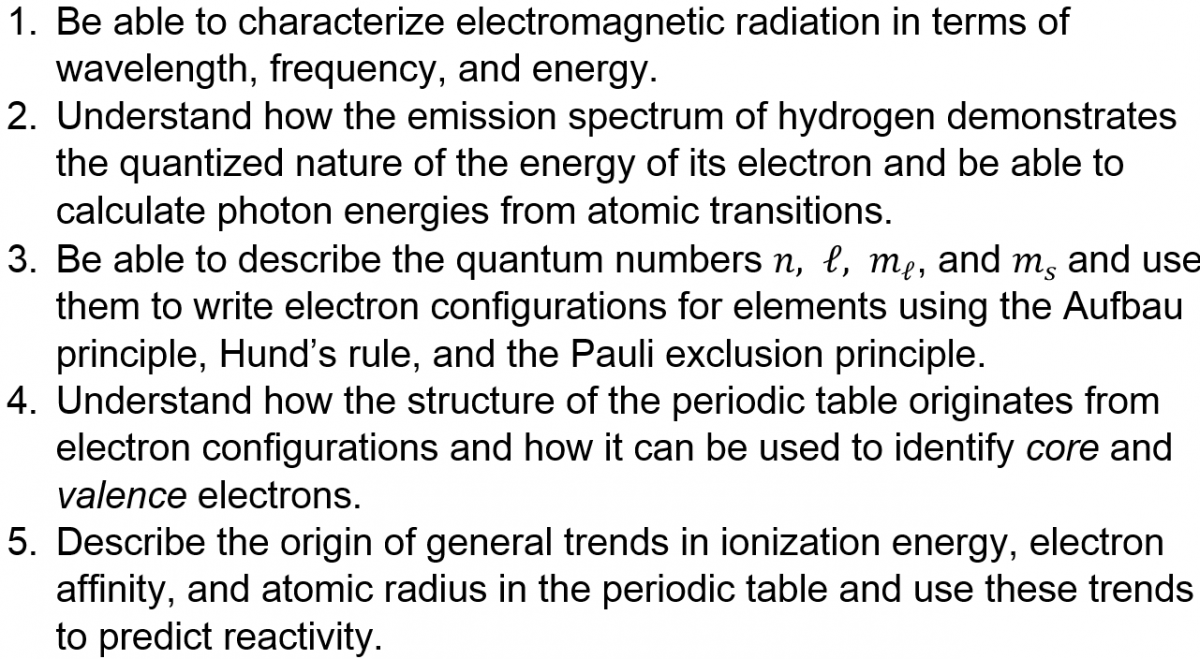
- Learning Objectives
Reading Response Guidelines
- From the Syllabus: “Reading Responses are intended to help you keep up with the reading, orient you to the material for the upcoming week, and to give your instructors feedback on how best to use our class time, based on what you have difficulty with. You are welcome to use your book and other resources to complete the Reading Response, but should take it individually.”
- We’re looking for your thoughtful effort, but this is just the beginning of our week – so what you don’t know after reading the texts is just as important as what you do.
- We encourage you to use the Learning Objectives and the Reading Response prompts to help guide you through the reading assignments.
Tutoring times: Program Tutors and QuaSR
You have access to a number of resources to support your learning in the program. These include program tutors and QuaSR tutors. In addition to tutor support during Workshop and Problem Sessions,
- our program tutors Pat and Pyxie have math, chemistry, and physics tutoring hours on Thursdays from 4 – 6 in Lab 2 3064, dedicated just to students in M&M; this is a great time to meet up with each other and Pat and Pyxie as you work on your math, chemistry, and physics homework problems due Friday and Saturday
- the QuaSR has general tutoring support for math, chemistry, and physics nearly every hour it is open; see the hours here
In addition tutoring support, we highly encourage you to form regular study groups. And of course please feel free to contact the faculty.
Customized problems in MasteringPhysics and WileyPLUS
Some problems in MasteringPhysics and WileyPLUS have randomized variables, which means that the numbers in your version of the problem will be different than your classmates. This gives you the opportunity to work closely with classmates and tutors as you are figuring out how to do the problem but then to check for yourself what you have learned to do by applying your skills and knowledge to a customized version of the problem.
Physics Week 1 Problem Set
Chapter 1
- Workbook: 30, 31, 36
- Conceptual Questions: 3, 4, 5, 6, 7, 8
- Exercises and Problems: 9, 13, 23, 24, 26, 27, 49, 51, 53, 54, 55
- Attempt all problems before Thursday Problem Session.
- Include solutions to all text problems in your Problem Set Notebook; Workbook problems can stay in the Workbook.
- Submit bold underlined problems via MasteringPhysics by 9pm Sat. Oct. 3. Note that MasteringPhysics algorithmically generates a unique set of numbers for each student, so while the broad structure is the same as the problem in the text, some specific details may be different.
- Due to the varying nature of students’ personal computers, I did not assign any problems involving drawing or graphing to be submitted via MasteringPhysics. That does not mean that these questions are not important, so please do complete them in your Problem Set Notebook.
Calculus Week 1 Problem Set
- 1.7: 3, 4, 8, 9, 19, 20, 26, 27, 37, 42
- 1.8: 3, 18, 22, 28, 51, 53, 56, 57, 64, 65
- Attempt all problems before Thursday Problem Session.
- Include solutions to all problems in your Problem Set Notebook.
- Submit bold underlined problems via WileyPLUS by 9pm Fri. Oct. 2. Note that WileyPLUS algorithmically generates a unique set of numbers for each student, so while the broad structure is the same as the problem in the text, some specific details may be different.
- Many of these problems will require you to review the toolkit functions from Sections 1.1-1.6. You may also find a significant amount of algebra in this assignment. Please take advantage of the QuaSR, program tutors, and your study groups.
Week 1 Chemistry Problem Set
This problem set is due to the box outside Riley’s office (Lab II 3271) by 9 am Friday Oct. 2nd.
Ch. R: 21, 22, 28, 33, 36, 39, 48, 49, 53, 67, 69, 78
Ch. 1: 11, 16, 24, 34, 37, 39, 44, 45, 57