
Our class visit this past Wednesday to the Denkmal für die ermordeten Juden Europas (Memorial to the Murdered Jews of Europe) and the Topographie des Terrors (Topography of Terror) presented me with one of most emotionally challenging trips we have gone on during this course. Floating on top of the steady waves of sorrow that always attended me during visits to these kind of places, was a series of complicated dialectics, ones difficult to resolve or even develop at the current moment, save for their brief mention: (the victims/the perpetrators), (reason/unreason), (above ground, light filled/subterranean, dark), (site/non-site), (information aesthetic/aesthetic impenetrability), (text/image), (unfathomability/directness of story and narrative). Unfortunately, I remain, at least at the time of this writing, stuck in the silence that Georges Didi-Huberman so earnestly asks us to break in his excellent Images in Spite of All, a silence that sticks to and is complicated by the 2,711 uneven, rectangular stele that reside above the Information Center of the memorial.
Category: Berlin (Page 3 of 11)
It went from sunny, to drizzling, to pouring pretty suddenly during the opening information and discussion session at the memorial. I haven’t been wearing sunglasses very often since I began wearing normal glasses again, but it was bright enough out when we began, and seemed like it might stay that way, so I cased-up my glasses and put on my sun glasses. Within a few minutes it was dark and we were getting soaked by rain. Thankfully our tour guide was able to secure us a seminar room so he could continue preparing us with information and context for the experience of the memorial’s documentation center. It’s nice to have exits and contingencies.
There’s not really a lot I want to say about the things I saw and read in the center, except that both the particulay intensity and the vastness of atrocity are extremely difficult to hold in your mind, and to hold both at once is just about impossible, and so I think the choice of the curators to focus on the two separately (and the latter only after acquainting you with the former) is the right choice.
With regard to the Topography des Terrors memorial, I was much more intellectually engaged there. There were, of course, many nightmarish images and historical accounts, and it may have been determined in part by the tone and focus of our guide, but I found myself mostly concerned with the logistical question of how the Nazi regime established itself and its various arms of violence. The most interesting aspect of what I read was, I think, the role played by the ‘normal’ criminal and order police in not only the day to day functioning of the regime, but specifically in the production of the technologies and practices of “euthanasia” and extermination. It’s clear that the images of the criminal, the insane, the infirm, and the deviant, are images produced by the most dangerous and odious forms of power. Maybe the functionalists are right that the police (in some generic sense) are essential to social being, but they should nevertheless at no point be trusted.
Current tunes: Pigeon Flying Over Berlin Zoo – Ian Anderson
Current location: Senatsverwaltung für Stadtentwicklung und Umwelt
6.4.16 – City Office of Development
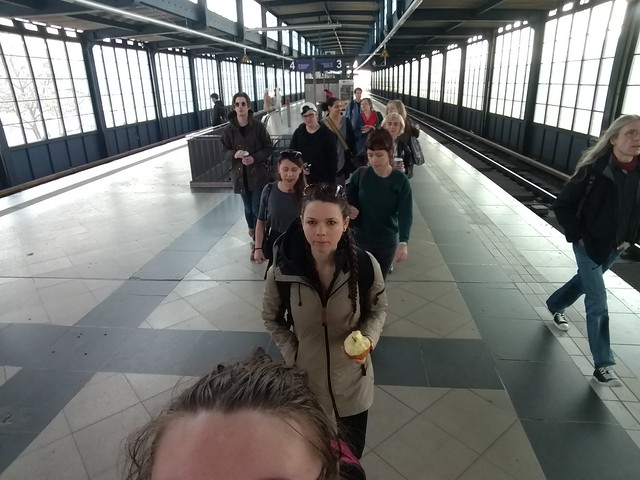
THE morning started out as well as could have been expected, and by that I mean multiple people having trouble with transit. It’s something that is normal when changing places, feeling excited, and when transit just. does. not. work. But for our second outing we all managed to make it.
Upon arrival to Jannowitzbrücke, the station which nearly kills me every time I go there (seriously the way from the U-Bahn to the S-Bahn IS NOT FLUFFY PERSON FRIENDLY); I slugged my way up from the U8 to the S-Bahn tracks above to meet everyone who was there with a… well, not a smile, more of a sweaty grimace. We waited for the Berlin transit system to deliver our other members to us, no more than 15 minutes, before we trekked downstairs and across the river to our destination.
(At this point I would like to make a quick aside that GOING UP ALL THOSE STAIRS ONLY TO GO BACK DOWN, was -eugh.)
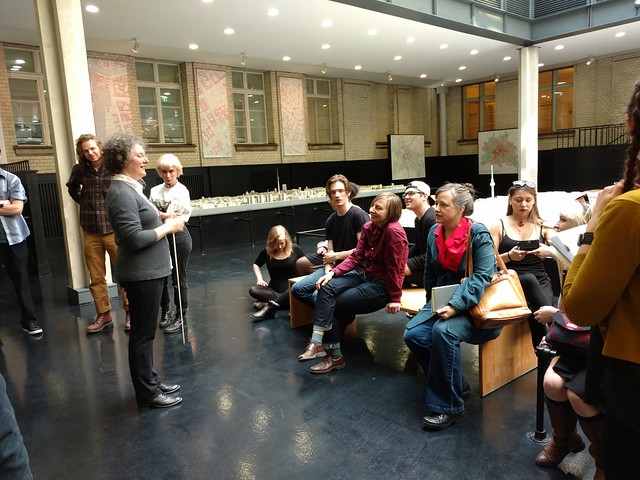
We walked along the Chinese embassy, turned the corner, and came to a door that I would not have looked twice at had I been passing it. This is something that seems to happen a lot in Berlin. Curiosities and wonderful tidbits of information hidden in the most nondescript places. It’s a unintentional treasure hunt every day. But there we were, at the City Office of Development, staring at several huge displays of Berlin, in a room (converted courtyard), probably bigger than one of Evergreen’s normal classrooms.
Our tour guide was a lovely older lady whose name escapes me at the moment, but she was obviously knowledgeable about the Urban Development, Berlin, and was eager to share. We were slowly lead around the room, all of us looking curiously at the models and amazed at the sheer size of them. Our guide talked to us and a discussed things with us for nearly 2 hours, so I can’t even begin to give you anything close to enough information.
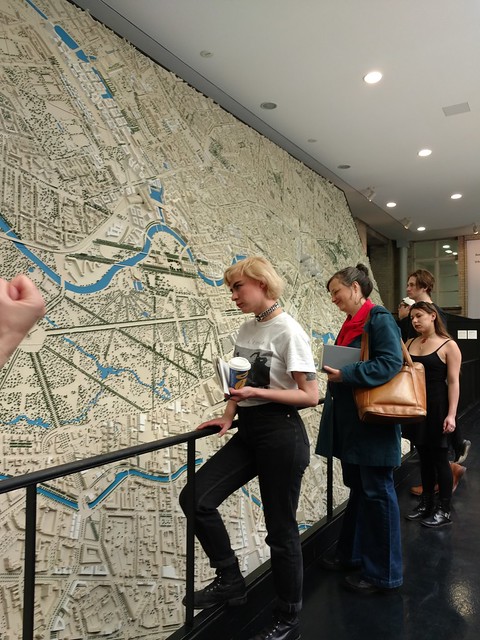
(The above is not the main model, it did take up a whole wall though.)
The blue and brown and green and white of the immense city model that dominated the room would have kept my attention if it were not for the smaller, more colorful (to me at least) model, pushed to the side under a less lit area to the main model’s right. A relic of Soviet ideals, the “Stadtplan” for the GDR’s Berlin, the future that could have been. I don’t know why I liked it so much, it was showing less than half of Berlin, and in that less than half there was more space that I would have thought the GDR wanted. It also had more modern looking buildings in it’s design. I just really liked it for some reason.
Looking at these maps made me realize that Berlin is city I know I can never see all of and that saddens me a bit. But, because of it’s dynamic nature, I’m sure this city will keep me coming back for more.
I do have one important note for you all though:
DO NOT TRUST BERLIN PALM TREES.
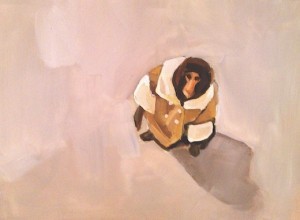
(Image: Ikea Monkey, from Lauren Kaelin‘s Benjameme series)
For this PsychicCity assignment I went to a cafe under the Friedrichstrasse S-Bahnhof, ordered some coffee and warm strudel, and answered the following questions (as offered by Jules).
Q: Honestly, how are you doing?
A: I’m very, seemingly inescapably tired. I’m sure everybody has heard me complain about it at this point–so sorry everyone!–but I really find it strange. No matter how much or how little sleep I get, I still feel exhausted for all but about 3 hours of every day.
Q: Do you hate it here or do you love it?
A: I would say that I like it a lot, but it’s hard to say whether I love it. It’s a sort of peculiar experience to be here for so long without needing to think about or plan for normal life things; and that makes it difficult to compare to other experiences.
Q: Are you homesick?
A: Nope. I really like living in an urban environment, so while I miss some people a lot I really don’t miss being in either Washington or Texas.
Q: Are things getting hard?
A: Some things are… Showering and laundry have become a bit stressful (which is bad because I’m already pretty lazy about those things), so it would be nice to be in a place where I felt like I had an equal claim again. My host parents are totally gracious, it’s just something I can’t help but to feel.
Q: What is your temporal experience? (For example: I don’t operate on dates or days of the week)
A: That still feels pretty normal, except that the weeks are passing very quickly (but that’s not uncommon when I’m at home either).
Q: Are you remembering things? Can you access images and feelings and emotions at any point in this city? Are you unable?
A: I am reading this as asking if I’m able to access memories from earlier in life while on this trip; and I’m not sure if it is more or less than is usual but it is definitely a yes. I am especially reminded of many of my experiences when I first lived in NYC and I didn’t know the city very much so I was frequently just a little bit lost, and a little too nervous to ask for help.
Q: Are your habits changing?
A: Some, but not as many as I expected (or perhaps hoped). I have been eating breakfast more regularly because my blood sugar has been a much more present concern than it normally is. I have also been going to sleep earlier than I do at home (except for one or two nights a week).
Q: What is scaring you?
A: My general fatigue, and my struggle to become conversational (let alone fluent) in German are both worrying me with regard to my graduate school prospects.
Q: How do you handle being alone?
A: It’s honestly more that I need regularly (and sometimes struggle to attain) that it is something for me to cope with.
Q: What could you possibly do in a strange place to truly calm down?
A: I don’t know about Truly… but I typically find somewhere to nap. Sometimes that is at ‘home’ in bed, or sometimes it is on a bench somewhere, or even on the ground in a park if it is sunny and dry.
Q: Is class stressful?
A: Yes, I am struggling to stay on top of everything. This is due in part to the previously mentioned exhaustion/fatigue, and partially to my own normal laziness and poor attention.
Q: What kind of thoughts are you thinking? There’s usually a pattern there.
A: Lately, a lot of pessimistic ones. :/
Q: Do you miss anyone?
A: Yes.
The gleaner woman holds grain in her arms, shes moving me, shes valuing what other don’t stop to see. In mosaics I see divine permission contrived. I see normal things like guns, pain, fairies and ecstasy. Marble stone looking like wood looking like fleshy oysters. I notice Christ last. I am calculating every stained glass window square. There are 11200 stained glass window squares. Quantifying is a way to calm the system. Now things are shaping into photographs taken of the universe, painted-in blues and warm bursts add dimension. I get so calm I almost fall asleep and a moment of divine serenity beckons my finger to my nose. I am here to excavate and contemplate myself outside myself and under the bluer light of god. The man levitating in the middle of this alter doesn’t look like Christ at all. Outside, stone circles on the ground wear light and shadow like unfinished sundials. Now they are wearing my feet and for a moment I turn them into hands and do my part to help quantify the day.
After visiting both the Memorial to the Murdered Jews of Europe and the Topography of Terror in one day, so much was on my mind that I needed a day of recovery to gather myself to properly convey what it was that I had just experienced.
Beginning with the Memorial, I decided to read through the whole chronological timeline first when I arrived. Although it took quite a bit of time, as I read it I increasingly felt that it was more and more important to finish. As I was reading the information, I noticed that a lot of the people around me where looking up at the section written in German. I wondered how they felt about reading this. I saw the word German referring to forces, authorities and soldiers many times and I realized that these were the ancestors of some of the people standing next to me. I can’t begin to know how one should go about dealing with being associated with such monstrosities. I know that these people could not have possibly been part of what happened to the Jews, and I guess what I’m wish I could tell them was that I knew that. History is filled with wrongdoings, that is why it is essential in schools, we must learn from our mistakes. I claim American citizenship, yet I wish that Oppenheimer had never built the atom bomb. I also wish that we would not have invaded Iraq and Vietnam, and, and, and…
As you can see, my thoughts have strayed from the primary reason for the Memorial, but I like to believe that is one of the purposes. Our tour guide Boris mentioned a way that people should feel. Usually I am against enforcing a certain mentality, however, in this case, I feel it is certainly appropriate that at boy the Memorial and the Topography of Terror, people attempt to remain both self conscious as well as open to influence. After reading the Huberman, this is a good time to remind people that sometimes we have to force ourselves to imagine the unimaginable.
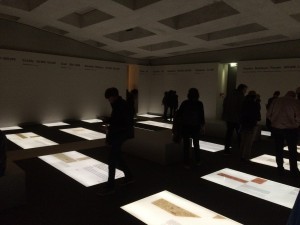
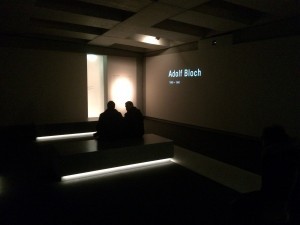
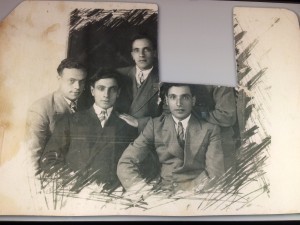
What a long, depressing day of witnessing the products of the reign of National Socialism! Although I had already visited the information center under the Memorial to the Murdered Jews of Europe, this second experience of it was certainly different in the context of my 4-years-older brain. I consider myself pretty well informed as far as WWII and the Holocaust go, but this memorial is very powerful in that it paints a much more personal picture of the atrocities of the Nazis’ “final solution”. Boris, our tour guide, gave a very interesting and informative talk prior to our entrance into the exhibit, in which he described to us the degree of controversy and the many years of planning and re-planning that went into the construction of the monument and the information center below, and tried (only somewhat successfully) to engage us in a discussion of some of the potential meanings of this intentionally ambiguous memorial. We then proceeded into the exhibit itself, which consists of various rooms with various focus. The first room has rectangles of light on the floor with fragments of writings from survivors and witnesses of the different stages of Jewish persecution in Germany during the Nazi era. One of the most striking of these was a poem written by a Hungarian Jew which gives a vivid description seemingly from the perspective of a living person in one of the mass graves, corpses of his neighbors falling onto him. The next room provides short biographies of different Jewish families from various areas of Nazi occupation, describing their lives and their fates. This was a very sobering experience and Boris’s attempts to entice us to discussion after our trip through the various rooms even less successful.
We then proceeded directly to the Topography of Terror which stands on the former site of the SS headquarters and is dedicated to documenting their rise to power and the subsequent horrors committed by them throughout Europe. At this point, though, it seemed as though everyone–including myself–was pretty much Nazi-ed out for the day, and our lack of enthusiasm was almost certainly apparent to our tour guide.
The best thing about this outing, for me, was seeing the lengths to which modern-day Germany has gone to be transparent about their bloody and terrible past. It was also very heartening to note that neither of these two memorial sites charged entrance fees–perhaps in order to avoid profiting from the atrocious deeds of their past.
After some miscommunication that lead our group to two different meeting spots, we finally came together in front of the information center of the outdoor memorial to the Berlin wall. We began by watching two short documentaries about life surrounding the wall, and the different phases of its use and construction. We then proceeded outside and walked through the park/memorial directly across the street. There was a section of the wall standing in its original spot, and we walked though what during the war would have been the space between the two walls separating east from west, where 30 years earlier we would have all been shot, if we had not already fallen prey to land mines or any of the other myriad forms of discouragement to any would-be escapees. It was interesting to learn that in the east the wall was strictly referred to as the “anti-fascist protection rampart” (because they had always been socialists in east Berlin and couldn’t possibly had anything to do with the actions of the nazi fascists). Further interesting bits of information included: the length of wall that stood along the memorial was in fact one of the first sections to be torn down during the people’s revolution that ended the division of Berlin, but had been replaced for the creation of this memorial; the guard tower on display next to the re-created “death zone” had been similarly replaced after having been purchased back from a private collector on E-Bay; and that the church that stands on the sight of the Church of Reconciliation (which was originally between the two walls and was consequently demolished by the DDR) holds in its basement a disarmed American bomb.
Kaiser Wilhelm Gedächtis KIRCHE
* ICH * LASSE * DICH * NICHT * DU * SEGNEST * MICH * DENN *
[I will not let you unless you bless me]
ALTARRAUM/sanctuary
Blue room. Blue around the crown. Just for my crown and eyes to see, not for my feet to see. Smatters of gold and red panes in the blue, reminds me of Egon Schiele.
Here’s what I mean about my foot perspective: the design of the church includes entire walls of stained glass cells, the equivalent of three stories high. The glass starts 12 feet up the walls of the sanctuary. We (MaryJane, me and the other tourists) feel like we are in the ground, we feel like carrots and our root crowns are all that pop out of the soil to feel the blue light of twilight.
MJ and I had a hard time getting to this spot and I am still buzzing, here now where I sit. We sang like a prayer on the train and then more in the hallway (der Flur) as we walked out of the underground.
I hear you call my name, and it feels like home
Someone began playing the organ, in fragment practice phrases and it washed out the carrot-ness of being in the room. Now my most activated sense is letting the sound comb out all my body’s ways of being here.
DRAUßEN im Platz
Outside in the Platz between the sanctuary and the church my head is getting filled back up with the sounds of a shopping center, boiling an egg. My attention is rushing back into the church and flying around the wee fairy carved into the wall.
Monday we went as a group to the Jewish museum. We met in front of the building, whose facade was somewhat misleading as to the actual contents of the museum as it was a very typically German-looking building with no traces of modernity. Upon entering, the reality of its contents were revealed. The entrance to the museum itself–beyond the security check, gift shop, coat room, etc.–took us down a set of stairs into a slanted and skewed floor. Our tour guide asked us to interpret this design choice, a request which few of us were eager to answer. He brought us next to one of the 3 or 4 levels of the museum, in which was held information about Jews in the late 19th to 20th century Germany, and gave us some insight into the influence that Jewish people held in those periods. It was refreshing to hear things about German Jews other than the terrible crimes committed against them during the third reich, which seemed to be the main focus of many other tributes to the history of Jews in Germany. It felt like it took agency on the subject of Judaism away from the Nazis and put it in its rightful place.
I’m somewhat biased against these sorts of tours, and they generally make me somewhat uncomfortable, so I was relieved to be able to explore some of the rest of the exhibits independently. It was very interesting to learn about the centuries-long history of Jews in Germany, and to see relics and accounts from before and after the genocide of the Holocaust. Again, it was great to have the focus put on the Jewish people rather than on their victimization during WWII, which I think usually overshadows the hundreds of years that Jews spent as influential members of German and European society. It framed them as something more than victims of a horrific genocide, without ignoring or brushing aside that terrible fact, but also not focusing on it as the most important part of German-Jewish history.