Of Blood and Beauty

The Evergreen State College

Category: Berlin (Page 4 of 11)

Information Center/Topography of Terror

Going down below the Memorial to the Murdered Jews of Europe to the Information Center was like stepping into the mass graves scattered across these countries. It takes you step by step through the process of how the holocaust came about. It shows you six victims pictures blown up so you can get a sense as to who was targeted.
Information Center/Topography of Terror

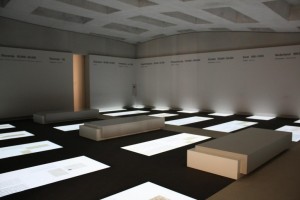
The first of four rooms gives you numbers in estimation of the Jewish people killed in each of the countries occupied. On the floor in patterns that echo the stelae above there are notes from diaries, letters, postcards thrown from mass transport trains where people stood packed sometimes for 30 plus hours. One that caught my eye was the brief letter to her father saying that they were taking them off to die today and how they wish they could live but alas they are to die.
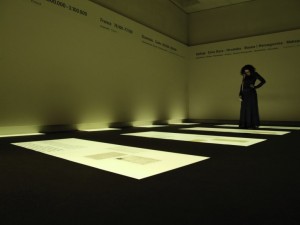
Information Center/Topography of Terror


The second room gives you an image of different families from different regions that were put to death, again on the stelae pattern as above, only now instead of lights on the floor they are pillars that don’t quite reach the ground.
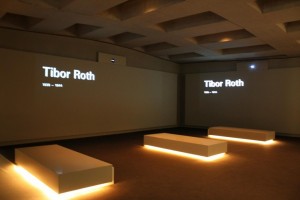
Information Center/Topography of Terror

The third is a room where four projectors are constantly telling the stories of different names of individuals that lost their lives and placing their names on the blank walls. I couldn’t stay in this room for very long as it was maddening to hear the monotony with which the speakers told their stories, like listing off numbers on a document, like a roll call when no one is present.

The last is a room of sites where these massive murders took place. You can listen in on stories and brief histories of a few of these places, and then look at the map and see they are only a drop in the bucket of sites. All the while the same undulation that is seen above on the ground you walk through the stelae on can be seen on the ceiling in these chambers. I got a sense of looking from underwater towards the surface of a wave above only there was no image you could see beyond the wave. The wave barred life entrance.

/

The Topography of Terror was kind of odd to me. I can understand the choice in architecture and grounds layout. They seem to impose a certain terrible foreboding quality. Maybe it is just because of all of the other images I have seen from World War II, but I couldn’t help but feel like this site didn’t get the point it was trying to make across to the audience as well as some others.

I would say the information is all well laid out and organized according to what part of the National Socialist structure they are wanting to emphasize. I feel like I got the sense that there was supposed to be this feeling that since we can see how this was all laid out we can somehow make sure to never make this same mistake again, but by the end of the hanging placards of information I realized that many of the people who were a part of this regime were never punished for their crimes. It makes a good point though in asking how do you punish any one individual for the crimes committed so anonymously or out of fear of death.

At the beginning I assumed that all of what I saw would be the face of evil and by the end what I saw were terrifying acts of murder under the pressure of a force that no individual could possibly hope to stand up to. The survival instinct of most of these individuals heavily outweighed their ability to do otherwise. That being said, there was something lurking beneath the surface that seemed far to close to home with the situations the world is currently tensioned under.
Sammlung Boros Bunker

11.04.2016

A tire that spins against a wall and deteriorates more and more with every sideward glance cast upon it, a tree that circles itself and drags its branches along the ground ad infinitum while its leaves fade to a dusty and dehydrated brown, popcorn that pops into a room filled with ten year-old kernels that will only ever be touched by Tom Hanks and will never fill the millions of empty stomachs in the world. The Sammlung Boros Bunker “plays on the ignorance of the audience” by showing us things we think we know, expecting us to question that knowledge, and then revealing that initial knowledge to be true all along. Each piece is open to any interpretation that the viewer projects onto it by leaving the titles of the works as well as the artists responsible for them in a booklet at the front desk. Without a guide there is no hope of taking away any artistic intention from the pieces, and even less hope of being able to find the exit.

Claustrophobia reaches its ultimate peaks in this bunker, whether it comes from the size of your group that you cannot walk away from, or from the omnipresent bourgeoisie that looks down its ever-lifting nose at your laughable blindness in a room filled entirely with lights. What good is art if we are immediately deemed too stupid and too ignorant to understand it? What sort of knowledge did these collectors possess that we seem to inherently lack in the 21st century? It’s something that only Tom Hanks will ever understand.

Berlin Wall Memorial Documentation Center

20.04.2016

Berlin Wall Memorial Documentation Center

Standing above the “death strip” in between the two sides of what once was the Berlin Wall, looking at the spaces where corpses were uncovered and relocated outside the cemetery walls where the original Church of Reconciliation used to stand, doing my best to take in the fierce amount of pain and suffering involved in the history of this space. The casual and light-hearted manner in which this tour took place was disconcerting–my face flushed with embarrassment as our tour guide cracked jokes about “former Nazis” and the adversity that was endured during the time of the Iron Curtain.

The ability to remove oneself from historical agony and slap a superficial band-aid over the wounds brought about by the latent totalitarianism of this world’s history shocks me, even more so when I find myself dissociating and brushing off the torment that lies before me with thoughts of how hungry or tired I am. This tour was more than a reminder of my placement in the capitalist machine I have come to call home. Even when it feels like we have left the playpen, Big Brother’s gnarled fingers loom in each of our shadows.

Das Jüdisches Museum Berlin

18.04.2016

With nothing but honesty in mind, this was by far the most boring and frustrating tour of the most interesting museum that I have yet to experience in my young adult life. While I completely understand the world’s general distaste for Americans, our tour guide’s lack of interest in the group and our ability to comprehend what was being presented to us was nothing if not disheartening. My ability to retain the information he spewed at us took a heavy hit as he compared us to high school students, and was completely shut down upon being asked if we had ever heard of Walter Benjamin.

I left the majority of the museum unexplored due to my frustrations with our guide, and yet I was still able to walk away with at least a slightly better understanding of the history we have studied throughout the past two quarters in class. I wonder how much more I will be able to absorb and appreciate when I return to this museum during my Wanderzeit, hopefully unaccompanied by one of Berlin’s most disparaging and unfavorable museum docents.

Street Art in Berlin

13.04.2016

Street Art in Berlin

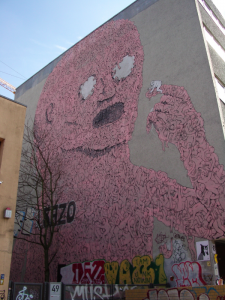
As of yet this was my favorite of the various tours we have taken as a group since arriving in Berlin. Our guide, Evelyn, was an incredibly intuitive wealth of information. Her ability to point out specific tags and posters beyond the stops that were planned by our other guide, Rachel, astonished and inspired me. I could feel the connections she held with each piece she inspected and tackled in the emotion in her voice and the excitement in her face. Her anecdotes about her various experiences with some of the artists whose works we saw opened my eyes to a side of Berlin I had yet to be able to visualize on my own–running from the cops, partying at squats, and assisting different artists with major pieces were just some of the many stories told that day.

The very best part of the tour took place after the group dispersed when I was able to walk around Berlin with Evelyn and Gabby as a group of three. She told us about her experiences as a foreigner (originally from Finland) in Berlin, her encounters with various authority figures in Germany and other European countries, and the dystopia she had found in this strange city we have come to know for the past few weeks. While sitting in a park in front of one of Berlin’s many churches, Evelyn told us she had found it to be an unfortunately true cliché that Berliners seemed to have a gaping hole in their souls. Her uncannily relevant words still echo in my ears, “it’s all a spiral.”

Urban Development – Planning, Models, and Projects

06.04.2016

Admittedly my mind was not with my body in Berlin during this tour because I had just found out the night before that my mother was in the hospital in California, so the majority of my thoughts were on how much it would cost to buy a ticket back to the states in less than 24 hours as opposed to the extensive history of the city of Berlin that was being presented to me. While my brain was tethered to the streets of my hometown, I occasionally let it meander through the miniature streets of the expansive 3D model of Berlin, brushing past the identical artificial trees and windowless buildings that towered above my tiny imaginary self. The differentiation between new and old-standing buildings as white plastic and light brown wood pulled the leash around my heart even closer to Los Angeles, wondering which buildings I could even place as having been built before 2000. My internal comparison of these two metropolises that have incited such different emotions in my being has prompted daily restructures of my understanding of Berlin as a city of “becoming”.

Berlin Wall memorial park

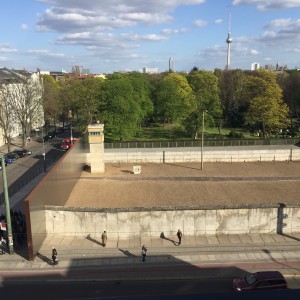
On Wednesday, Rachel (our CIEE tour guide) took us through the Berlin Wall memorial. The section dedicated to the memorial is the patch where the Church of Reconciliation was trapped in the death strip between the walls, and was eventually torn down for better patrolling visibility. The wall exists still in fragments, including a big chunk that has been rebuilt to depict the size and intimidation of the death strip that divided Berlin during the Cold War (see photo below).

We watched two quick videos that were surprisingly capitalist propagandistic. It was disappointing that the museum didn’t present the information more critically. It is clear that that the construction/maintenance/elaboration of the wall was oppressive literally and figuratively, but during this time presently when there is a rising and threatening conservative right-wing extremist movement in the East of Germany it is important to pay attention to both sides of the wall. Most of the viewing happened from a high tower in the West, looking East.

Berlin Wall memorial park

Jüdisches Museum – Berlin

We were given a guided tour of the Jewish Museum in Berlin this last Monday, with a half hour at the end to explore on our own. The main body of the museum is ordered chronologically from the first time Jewish people are known to be living in Western Europe. I tried to start from the beginning of the installations with my half hour, but I didn’t get far at all so I promised myself that I would to talk a little more in.

———

Our tour guide’s (Viktor) lecture was on the years between 1871-1933, beginning with the construction of the New Synagogue in Breslau (now Poland) in 1872. The architecture referenced Christian architecture and was an expression of the Jewish community’s  citizenship in what was the newly founded “unified Germany.” Viktor emphasized that the Jewish Germans had been made to take painfully tiny and patient steps to “earn” their civil rights within the German nation in those years leading up to 1933 and had only a few years of freedom before the rise of fascism and the anti-Semitic agenda.

——————

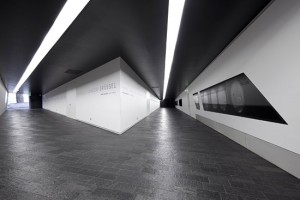
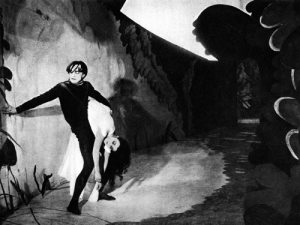
Visitors of the museum take a tunnel from the welcome area into the modern museum, the pathways below are called the “axes” and are an architectural embodiment of three paths of Jewish life in Germany after the third reich: Exile, Continuation, and the Holocaust. These hallways are twisted  in scale and measure. I was immediately reminded of the set design of The Cabinet of Dr. Caligari, a German silent horror film from 1920. Jüdisches Museum – Berlin Jüdisches Museum – Berlin

Psychic City one: Katy Wert’s wandering assignment

Location: Invalidenfriedhof Cemetery – Mitte

I can’t speak to spirits and I don’t care if they can hear me either way. I do, in spite of fact believe in spirits but I think only the worst and most self-centered of ghosts would choose to hang out in cemeteries next to their body. Like an automaton fantasy, why would anyone care to linger next to such a useless thing other than to project and reminisce who they thought they might have been. The spirit and it’s double. Do spirits still try to haunt the mind after the heart stops beating and how long before the fleshiness gets to them? Does the spirit re-propagate itself the like spores from a fern? The word spirit seems to have a sophisticated and unsophisticated way of being used in academia. The most sophisticated way would be to avoid it at all costs and merely draw contour lines around it with other less damp words. The word spirit has become an ear worm, I think it out of an embodied sense and into a thought so loud it plays like a chorus, vibrating out to the edges of all my openings.

Brandenburg tour

So far I have been writing all of the outings in reverse order which is an interesting to trace back how my perspective and expectations of tours have been built up an shifted over just a few weeks. Waiting at the Brandenburg gate for everyone to arrive I really don’t know what I was expecting but I remember appreciating that our two tour guides were not authoritative white guys.

Looking up at the golden women who stiffly chills atop the gate and thinking about her being once a bringer of peace to a rescued symbol of victory was striking. Celebrating liberation and celebrating the exertion of power over others are two different things but one can be very easily twisted into the other.

The memorial to the murdered Jews of Europe: Walking through watching oneself try to have a proper and authentic experience for fear of disrespecting the essence of the memorial. It got colder the deeper I was in. Walking through the narrow gridded walkways reminded me of an abandoned slaughter house I explored when I was younger. It gave me an analogous sensation to these moments back when I was retracing the steps the animals took through the narrow, long corrals of the killing floor. I wonder if it was a purely architectural sensation or because I was given contextual knowledge of why each were made, or perhaps also because I felt it necessary in both cases to feel my way into a speculative narrative based on the event and site of death.

« Older posts Newer posts »