Of Blood and Beauty

The Evergreen State College

Category: Berlin (Page 1 of 11)

Berlin 2016-05-27 14:34:37

Hamburger Bahnhof Museum für Gegenwart
27//5

Spent a day at this former 19th century train station in Mitte, the first terminal style station in Berlin, currently a gallery for modern art and temporary storage for a substantial portion of the art of the Nationalgalerie during its renovation. I meandered through two extraordinary exhibitions, the first, a breadth of Carl Andre’s works, from sculpture, “concrete poetry” and “dada forgeries” to photography and a full catalogue of mail art. The second exhibit, the draw, was the Neue Galerie: The Black Years, Histories of a Collection: 1933–1945, which “features works from the Nationalgalerie which were either created between 1933 and 1945, acquired by the collection during this period, or seized by the National Socialist regime.”

The exhibit includes an incredible diversity of artists, including those who collaborated with the Nazis to implement their visions of the “Aryan ideal” and uphold the mythology of the German bloodline, as well as artists who underwent an “inner migration” and continued to produce art under the auspices of Reich Chamber of Fine Arts merely to maintain their practice, as well as those who worked in exile, in secrecy or in bold defiance of the regime.

The history of each piece is given in detail, including the location of the production of the work, original owners and exhibitions/galleries it may have been shown in or belonged to, to its trace during the Nazi era – whether it was deemed degenerate and shown as a part of a degenerate art exhibition, stashed away, or sold/stolen by Nazi officials – either by official dealers commissioned by the NS to divest confiscated works to fund the Reich or by lone figures such as Goebbels and Goering for personal gain/prestige.

I stood before a painting by Edvard Munch titled “Melancholy” to re-enact the captivated-aura psychogeography assignment, though in reality I basked in suspension before all of the paintings and sculptures, and only made a decision about this work at last. This piece, selected for this exhibit not for it’s relevance to degeneracy, subversion or controversial history, was an example of the categorical inconsistencies within the National Socialist party as to what “degenerate” art appears as. Melancholy is wildly expressionist, with the figure of a woman in a red plume of a dress sitting at a bench, her upper torso doubled forward as her blue hair cascades over her head and into the sea. All figures and landscapes are suggested, the sea, a sea-stack, the horizon, the sun, a cityscape – all sweeping and vivid gestures, without definition at first glance.  The work was painted in 1906/7, prior to any major war. Goebbels, upon seeing the piece, deemed Munch the “Nordic father of Expressionism”, before appropriating the work in 1937 and selling it to a dealer in Oslo. The brushstrokes and errant drips are sweepingly powerful, exact by suggestion; the aura is in the movement of the strokes, the vivaciousness of the color and the forlornness of the figure are in a harmonized tension, a tense harmony. An excess of blue paint is left where free to fall and stain without distraction, but rather to emphasize the movement of the work – it is an untold mark of beauty. In some corners the tweed of the material used for a canvas is left exposed, further emphasizing not heedlessness, but an intensity of focus on aspects disinterested in perfection – indicating that the skill and precision of this work is not the immediate technique or form, but what the work reveals in its expression.

There are many other pieces in this collection with complicated histories and impossible “auras” – from the “Isle of the Dead” by Arnold Boecklin, to famous works by Dix, Kirchner, Picasso, Kollwitz & Klee, to canvases that conceal secrets of a double past and others that make for subversive interpretations.

Definitely worth the visit!

http://www.smb.museum/en/exhibitions/detail/neue-galerie-die-schwarzen-jahre.html

Erwin Hahs – Great Requiem, 1944/1945


SpreePark Geist

I visited Spree Park on a sunny day with friends from home.

We recognized the location from, maybe embarrassingly, a lot of films and that is why I steered us there. We were hoping to get to explore the abandoned rides, but the park was overgrown, often dismantled, and fenced off by a tall fence. Built by the GDR and opened in 1969, it was one of the few entertainment destinations in East Germany.

The Ferris Wheel is the clear eye-catcher, peeking above the trees In view quite a ways west up the Spree river. When we finally entered into the forgotten park, we could see that the wind was moving the wheel squeakily. How satisfyingly eerie. I pushed my phone through the fence to capture a video of the motion. I think I could be YouTube famous if I play my cards right:

My friend Jan told me that the automatic motion of the Ferris Wheel has attracted lots of trespassing riders, who have many times become stuck up high in the air when the wind stopped mid-ride. I can’t stop thinking of trying to anyway.

Kultur- Karnival Comes to Town

Over the weekend of May 13-15, the Karnival Der Kultur took place in the center of Berlin in the Kreuzberg neighborhood. In the days leading up to it, we had received plenty of prior notice about just how big and crazy this can get. The biggest party of the year was not to be taken lightly, if you didn’t want a large crowd, then you were to avoid this at all costs. I didn’t know what to expect when I caught the train to Halleches Tor on the first night. The train was noticeably packed, but nothing unusual for a Friday night. However, once I got off that rain and followed the crowd, things quickly unfolded. Heading up the stairs, I could hear the Karnival before I could see it. The reggae/rap music was echoing throughout the station walls as the crowds quickly became congested. I reached the top of a stairway, and another crowd of people from another direction converged on us. It took a good five minutes just to get out of the station, shoulder to shoulder, inching forward, everyone in town had come out apparently. I didn’t know the half of it.
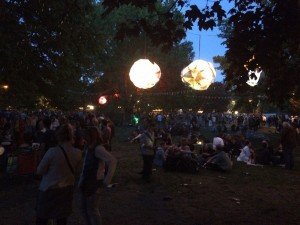
Kultur- Karnival Comes to Town

Once I managed to get out of the station I was able to find wiggle room and was able to walk at a more leisurely pace, every where you went, though, there were people around you. The first thing I saw was a stage with music playing, the bazaar stage it was called, I had read about it earlier and it appeared to be the main stage of the whole thing. But this didn’t mean a whole lot, here were music stages everywhere, each one playing its own genre of music with its own cultural influence. There was a stage with Latino/Hispanic music, there was German music, various nationalities of African music, Jamaican music, Country music, Rock music, Electro, you name it. All of the various cultures of Berlin had come together at this one place, for this one weekend for everyone to experience. It didn’t end with the music, however. Everywhere there were kiosk with foods influenced by different nationalities and cultures, as well as clothing and other homemade antiques such as wood carvings and jewelry. If anyone is familiar with Folklife in Seattle, this was like that, only on crack.
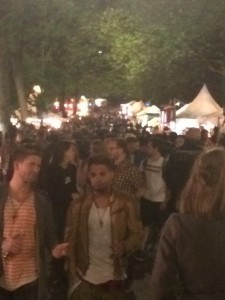
Kultur- Karnival Comes to Town

I cannot imagine how many tens of thousands of people were there. Possibly even hundreds of thousands. Everywhere I went, the Karnival just expanded further and further, once you entered, it just never ended. The crowds of people kept the moving slow, so you had to take shortcuts behind tents if you wanted to get anywhere fast. I wanted to get a pictures for just how big this Karnival was, and I found myself walking for hours just figuring out where the borders were. On a map, it looked so small, but Berlin is a big city, and these were some open streets, and they were all just packed.

I had heard the the Karnival almost did not happen this year, due to the levels of garbage and waste and glass that accumulates. After spending only one night there, this is very obvious to see. There was broken glass everywhere. Trash lined the street curbs, and the garbage cans were overflowing. Is there no way to keep this from happening when bringing large groups of people like this together all the time? One place I went to certainly tried. I went to an Ethiopian food kiosk and ordered a bread rice and sauce dish. I had no idea what it was called, but it looked good, and I wanted to try something new. In the process of purchasing the food, I noticed that I was charged an extra 2 euro. I looked at the change and hesitated to walk away. The man said something to me, yet I couldn’t understand at all. He repeated again, pointing at the food, and again when I looked at it. Then I heard the word teller, plate in German, then I understood. The was a 2 euro deposit for the plate that the food was on, it wasn’t a paper plate, it was ceramic, and we would get the deposit back when we brought the plate back. Good for them. Rather than a wasteful paper plate, they were trying to renew and conserve as much as possible. I had experienced this earlier when I went to the Hertha/Munich game, a 2 euro deposit was required for the plastic mugs for beer. Smart.

One of the more notable experiences of that first night was a large drum circle that had been formed. People were all crowding around this group of people, who were dispersed amongst the crowd, continually playing a fast paced beat that you couldn’t help but shake your body to. It was less of a dance and more of a rhythm. I pushed my way through to get as close to the drummers as possible. There were a couple guys who weren’t playing instruments but were holding up there hands and blowing whistles to direct the drummers. It was interesting to see that such basic and almost primitive sounds, when joined together in harmony like so, could be so pleasant and exciting and draw such a crowd.

That was the first night.

The next day, I played some pickup ball with a group of guys, all of whom were from South America. So I had to trade not understanding any German to not understanding any Spanish. Oh my god it was so much fun, but this is another story for another time. Anyway I hung out with them after we played and it turns out that one of them was in a band that was going to be playing at the bazaar stage at 8pm at the Karnival that night. I would be sure to go to that. I tried to arrive a little early, but everything was so busy that I ended up being a little late, so they were already playing when I got there. The guy I played with, Rodrigo, was actually the lead singer of the band. He, like many of the guys I played with, was Columbian, and he sang in Spanish and addressed the crowd in German. He was an entertainer too, he got everyone to clap there hands and sings lyrics, and even start bending over and getting low to the ground before bringing them back up, impressive. I looked around for some of the other players, but couldn’t find any, with the crowd that bug it was hopeless anyway. Afterwards, when the band had finished and the crowd dispersed momentarily to make way for the next band coming on, I realized that all the guys I knew were literally in the front row the whole time. No wonder I couldn’t find them. The rest of the night was spent similar to the first, mostly just exploring the different kiosks and listening to different music. Two things of note though. Many of the African, I don’t know which nationalities, kiosks served fruit flavored beers. Banana beers and orange and pinapple beers, these were new to me, I never knew they existed. Secondly, there was a large church inside the boundaries of the Karnival. This struck me as odd, I wouldn’t expect a place of worship to be home to such a hectic atmosphere. And it wasn’t. When I went inside, there were seats everywhere, people could go up the stairs and watch from up above, near a giant organ, and everyone listened quietly as soothing, melodic violin and stringed instruments were played. Quite different from just outside the door.
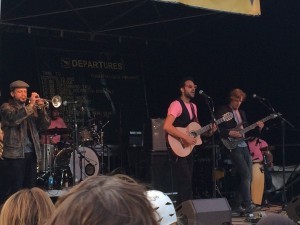
Kultur- Karnival Comes to Town

The third day was the day of the parade. Ross, his mom, Ian and I all went to an FC Union game before hand, again different story, before coming back and catching the parade in full swing. Gneisenaustrasse, which our school had been on, was completely filled. Floats were slowly driving by. We decided to follow the flow of the crowd and tag along behind various floats, each with their different themes. At some point I found a coconut on the ground, one which had served as someone’s beverage. I began kicking it around, back and forth with Ian and Ross, and other people soon joined in. Soon we were darting through crowds kicking this coconut around, getting all kinds of people to join in. That’s what I’m talking about! Football is universal, everyone loves it, it’s a great times, it’s fun, it is part of culture, it is its own culture. Only the police wouldn’t join in. I, foolishly attempted to meg an officer, and he yelled at me and I almost got arrested. No more of that. The coconut didn’t last long, someone eventually smashed it and the fun was over. As the night went on, different stages were still performing music and large groups were huddled around them. I eventually got tired and made my way to my hostel, which I had cleverly booked only a couple blocks away.
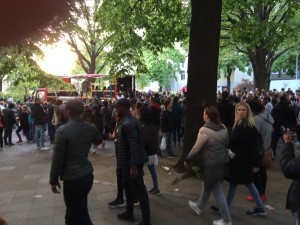
Kultur- Karnival Comes to Town

Rube and Mandy find some culture. And then walk all over it.

Rube and Mandy find some culture.

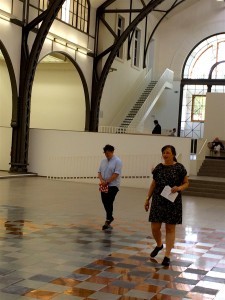
Friday, May 20: Hamburger Bahnhof. Museum für Gegenwart:  Julian Rosefeldt’s Manifesto (13 high production films in one space, all starring Cate Blanchett [still trying to think what that does for/to the project], all presenting manifesto montages, from Marx to the situationists), some key pieces from Warhol (Hammer and Sickle!), Beuys (including the giant tallow sculptures), and an amazing, extensive Carl Andre show (for those of you who spent time with de Duve, an important figure in his writing).  Below, Mandy/Kathleen walks on the art. Nervously, dare I say Rube-ishly, in spite of the wall texts exhortation to “walk naturally.”  With her, faculty member Julia Zay, always ready to walk all over the art:

Rube and Mandy find some culture.

Later that night, Rube, Mandy, and Julia went to see Konono No 1 at the Hebbel am Ufer theater.  Konono No 1 is a Congolese band that works at the juncture of many genres, sometimes known as ‘electro-traditional’.

Saturday: Off the Bauhaus Archiv to witness a workshop for children and adults, walking the length of the Tiergarten, then to the Berlin Ensemble for Nina Hagen’s Brecht concert.

the nature of reality

Current song: The Nature of Reality – Oasis

Current location: Friedrichshain, Berlin

the nature of reality

We need proof of life photos/entries. I feel this adequatly sums up my level of liveliness.

Kultur-Not the Dance Dance Revolution Museum

Kultur-Not the Dance Dance Revolution Museum

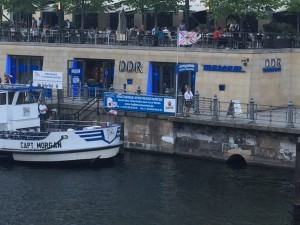
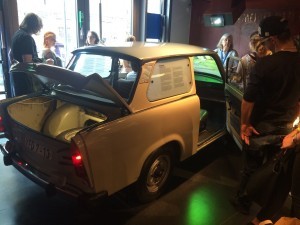
The DDR Museum, to my disappointment, but not to my surprise, did not consist of arcade games and dance moves, but instead focused on the lifestyles and cultures of people living in East Germany after World War 2. I have heard much about the harsh conditions that sparked open riots, which were violently surpressed., but never had I seen so in depth a look at how people lived I this part of the world, completely walled off from everyone else. Everything was detailed here, from the traditional trabak cars, built for two, to the nude beaches which miraculously thrived while under the Soviet supervision. Yes you heard that last part right. Nude beaches were common in East Germany. Which is especially surprising given the Soviet’s strong stance against the influence of radical west cultural ideals. Nude beaches were definitely not considered traditional.

Kultur-Not the Dance Dance Revolution Museum

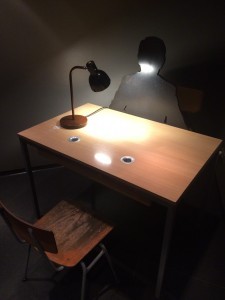
The anti western movement was on full display here in the museum. I fact, come to mention it, so far, while I’ve been in Germany, anything at all having to do with either the wall or East Germany division, has always been spun to have the westerners be portrayed as the good guys or the heroes with the right ideals, while the east, communists, Russians and so on, are depicted as evil. I am aware that building a wall was definitely extreme, but it is incorrect to assume that this whole side of the wall was hidden in a shadow. Here, though, most likely to accommodate the constant influx of American tourists, the west is victorious and claims the right to portray the east as less than ideal. The room with the interrogator was a great example of this. Yes there were prisoners taken, yes they were mistreated, but when is this not the case in any radical social movement? The American Government has claimed responsibility for torturing prisoners at Guantanamo, yet we will probably never hear from their perspectives. This may be an extreme point, but it is one of the best examples that I can really think of.

Kultur-Not the Dance Dance Revolution Museum

Other examples of culture on display were the musical movements, the prevalence of rock and roll surely did its part to disrupt the soviets vice grip on Berlin. While people were taught and raised to do the specific waltz, which was clean and fluid, westerners when wild, let their hair grow out and headbanger their brains out. Maybe that wasn’t this time period quite yet, but you get the point.

Prague Blague

How can one summarize Prague after spending only one weekend there? First of all let me start by saying that I have been missing Prague ever since I left. It has taken me more than a week to fully gather myself, mentally and physically after being barraged by its beauty to finally be able to put the details of mythoughtd into words to attempt to discuss the city that I will never forget.

Prague Blague

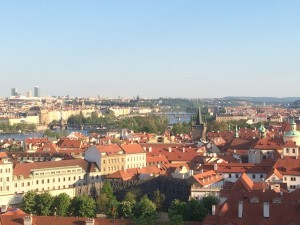
Having to survive in Berlin without knowing very much German is already quite difficult, but to survive in Prague without knowing, literally, any Czech is impossible. And thus I would not say that my time in Prague was spent surviving but rather living. Caution was thrown to the wind as we, as a class collectively, were released from the confines of a classroom and given instead as human sacrifices to the city. During our first night, after we all finished eating, we made our way back through the heart of the city on a busy Saturday night. After seeing the popular destinations in the day, I was not prepared for the lush nightlife that was thriving right when we stepped outside the door. The crowds were thick and the aroma of mischief and scandal gripped me as I struggled to keep up with the the rest of my American brethren. The city was truly alive at night. During the day it hides itself in disguise as a polite and classy city with beautiful red tiled roofs as far as the eye can see. It’s bridges seem to be from antiquity until you see a tram pass over it by the other tourists. At night, though, the lights come out. The churches are on top of their game as people thrive in their presence guided by the streetlights with old hues vibrating from them.

Prague Blague

What sets Prague apart from the rest of the continent? Why would Prague be the place to go over the more familiar destinations of Paris and London? I have never been to either of these, but I will offer my opinion. Prague has managed to maintain its old age charms while still being swept up in the tide of cultural and societal evolution. I won’t deny it, the city smells of American capitalism around every corner, the constant presence of sex shops and naked women on public news fliers attest to this. It would normally be a shame  to see a beautiful old city fall victim to this new era of civilization. However, in his case, Prague seems to own these details and make a so much a part of its culture that you feel as if they belong there and should come as no surprise. I hesitate apply a nick name that I know nothing about seeing as how I have never been there either, but I would venture to claim that Prague is the Vegas of Europe. The cit is much smaller than say Berlin, but still big and populated. Over the lack of overs infancy makes it easier to enjoy all that Prague has to offer, at least along the borders of the beautiful river that flows right through the middle of it.

Prague Blague

On our first day, we spent most of the time touring around the old, famous castle on the nearby hill that overlooks the whole city. There were lots of people, but it was by no means crowded. On that same night, I decided to go for a night run to try and claim a little more familiarity with the the city. I got lost and eventually found myself at this same cattle from earlier, the only thing was there was no one there. I mean no one. Throughout the whole surrounding neighborhood on the hill, there was nary a soul in sight. Only occasionally did I jog passed a small group of people dressed up from the medieval fair earlier in the day, who had no business otherwise to be there. This is an area of beautiful small buildings and tight alleys, cobblestone roads everywhere. I kept on trying to find a restaurant or a cafe that would be open at this hour, but there was nothing. This struck me as special in two ways. First that a whole neighborhood in such a dense city could maintain such an absence of night life. Secondly, that this absence, I believe, was due out of an old respect for the castle, church and other old traditional buildings in that area. It is no secret that Prague has become an increasingly touristy city. The locals know his and, in order to preserve the dignit of these sacred places, want to avoid having people get drunk on its premises and thus risking turning the place into a sty either through garbage or drunkenly damaging the property.

Prague Blague

‘Me’s en abyme: or, Du musst Caligari Werden!

‘Me’s en abyme: or, Du musst Caligari Werden!

I think that if Benjamin had lived much longer he would have made significant revisions to the theories he offers in “The Work of Art in the Age of Mechanical Reproduction.” This is not the place for a general critique, but attempting connect some of the ideas of that essay to my experiences in the Deutsche Kinemathek Museum has, I think, helped me begin to understand why I find this essay so frustrating compared to everything else I’ve read by Benjamin. The problem is that even if you maintain that his description of the authenticity or aura of an art work can or should be read phenomenologically rather than metaphysically (which I do), Benjamin’s analysis still depends on a strong historical concept of authenticity. The most clear and important symptom of this can be found in his distinctions between ritual and politics, and between fetish and value.

I’ve been trying to figure out a way to work through the rest of what I’d like to say about this, and what I think it has to do with the Kinemathek Museum, but it has turned out to require a lot more time and space than I can give it for a blog post. It may become part of my project, as both Benjamin and the concept of ritual are central to that, but we will see. In short, however, there is something really interesting about the way in which the museum begins with the hall of mirrors. This replicates the viewing subject infinitely in a way not unlike (though perhaps obverse to) the universalized perspective of the movie screen. From here I want to argue that Benjamin is wrong about the inherent criticality (or ironic distance) of a film viewer, and bring in some argument from Adorno’s theory of the culture industry to show how through mainstream film we are hypnotized by our own image of our own desires (which have themselves only been produced and magnified previously by this same and adjacent processes).

This might require a little more Freud and Lacan (or Deleuze and Guattari!) than I have time or desire for at the moment, but hopefully this post will at least serve as a reminder to follow through with this later.

Hélène Cixous Conference

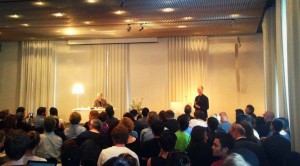
These are a few quotes from hearing Hélène Cixous speak at the conference entitled Untying the Mother Tongue along with a little rant about getting into the conference hall itself.

Hélène Cixous Conference

“German is the language spoken by the hearts mouth.”

“I think she speaks in English because you can speak it anywhere, even in death.”

The eternal return.

Language is myth.

To Montaigne

“I wasn’t simply going there. I was waiting for myself, there.”

“It was a bible, a house of memory…”

“And so I return to death, always suddenly and premature.”

“I discovered my father mummified under sheets of paper… I dared to read him dead.”

“I am an archeologist of traces always impure.”

“The moment the repetition produces. The moment we return we give it power… We
learn what comes back to us.”

“It means The face that comes back to me. No. It means The face that I can bare that I love.”

“I did not lose them. They did not return. They arrived.”

“My mother tongue is religion.”

We stole our way into the conference and talk. They were not allowing more in. As if we were scum coming like rats without the correct and prompt planning capacity they clearly had squired through rigorous patience and practice. As if they could with one glance asses what had brought us to be late and that in that moment met them at the door with disdain. An intuitive move by Kendra allowed entrance to this rebel force, made of angry students, resigned and knowing professors and the like, some Berliners and some not, planning a coop of greater and greater lengths the more we were withheld from entry. We checked our plan at the door and became terrorists of opportunity. Only one counter measure was raised and caused more disturbance than any of us who entered quietly. It was a perfect moment of inappropriate action, an even more inappropriate counter, and the resolution of our arrival.

“I have it and I have only it and it is not mine.”

“Colonial wars were always coupled with internal wars.”

“I was writing without knowing it at thirteen.”

“When I write I don’t decide to use this language or that language because the language I use is writing.”

“When we need it. We the writing we use whatever language comes.”

“One does not calculate… It just comes… The voices come. They orchestrate and they play several instruments.”

“Let’s hold on to the lost.”

“There is a strange benefit in experiencing loss. It is an engagement with our mortality. We need the help of large strange forces and we do this through art.”

The salamander.

“If the translator is an artist then the new work that is born out of the past work can rival with the original. Which you know can happen, but It is impossible, and it can happen.”

“When I talk to you I echo something that has not been adequately received so I know.”

« Older posts