Of Blood and Beauty

The Evergreen State College

Author: Kathleen Eamon (Page 1 of 3)

Mandy makes her way to Dessau on a Bauhaus pilgrimage

Mandy makes her way to Dessau on a Bauhaus pilgrimage

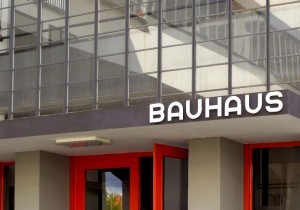
With Julia Zay, Jenny James:  made our way to Dessau by regional train to visit and tour the site of the second (and longest) incarnation of the Bauhaus school.  The school had leave Weimar in 1925, when the Nazis gained local power; it lasted until 1933, when they gained national control.  The style was deemed wesensfremde Architektur, the architectural parallel to entartete Kunst, and the buildings in the Bauhaus style were immediately transformed, modern elements covered over with traditional materials, large windows broken.

We toured the main buildings, original dorm rooms (big, with spare, beautiful Marcel Breuer desks and Marianne Brandt lamps, designs from students incorporated throughout), the auditorium where Schönberg and Bartok played, Oskar Schlemmer put on plays and dances, the houses where Gropius, Magoly-Nage, Klee, and Kandinsky lived.
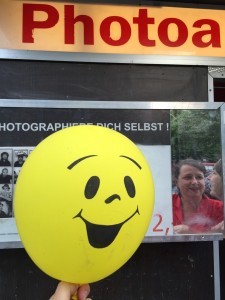
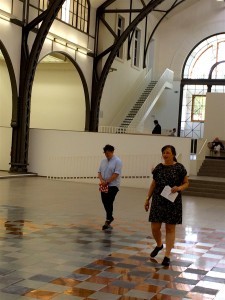
Rube and Mandy find some culture. And then walk all over it.

Rube and Mandy find some culture.

Friday, May 20: Hamburger Bahnhof. Museum für Gegenwart:  Julian Rosefeldt’s Manifesto (13 high production films in one space, all starring Cate Blanchett [still trying to think what that does for/to the project], all presenting manifesto montages, from Marx to the situationists), some key pieces from Warhol (Hammer and Sickle!), Beuys (including the giant tallow sculptures), and an amazing, extensive Carl Andre show (for those of you who spent time with de Duve, an important figure in his writing).  Below, Mandy/Kathleen walks on the art. Nervously, dare I say Rube-ishly, in spite of the wall texts exhortation to “walk naturally.”  With her, faculty member Julia Zay, always ready to walk all over the art:

Rube and Mandy find some culture.

Later that night, Rube, Mandy, and Julia went to see Konono No 1 at the Hebbel am Ufer theater.  Konono No 1 is a Congolese band that works at the juncture of many genres, sometimes known as ‘electro-traditional’.

Saturday: Off the Bauhaus Archiv to witness a workshop for children and adults, walking the length of the Tiergarten, then to the Berlin Ensemble for Nina Hagen’s Brecht concert.

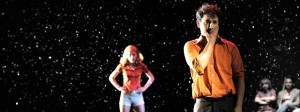
Rube and Mandy take in a show: Maxim Gorki (re- and un-) does Ali: Fear Eats the Soul

Rube and Mandy take in a show: Maxim Gorki (re- and un-) does Ali: Fear Eats the Soul

v.l. Mareike Beykirch (Barbara, Hedwig), Taner Sahintürk (Ali), Sema Poyraz (Paula), TamerArslan (Fuad)

http://www.spiegel.de/kultur/gesellschaft/maxim-gorki-theater-berlin-angst-essen-seele-auf-a-974049.html

Sunday night.  Starring our friend Daniel Kahn, the romantic-tragic Fassbinder film becomes a rom-com-trag-com in the hands of the Maxim Gorki Theater troupe.  Staged and lit like a musical, making good-strange use of the rotating stage, slapstick as social commentary, the glitz and humor worked somehow to amplify Fassbinder’s story of the love between an immigrant from Morocco and a German Putzfrau 20 years his senior, and the remarkable atmosphere of gossip, everyday life, and racism in which it either lives or dies.

a note from Trudi:

Hey guys,
 
I wanted to thank you all for the great weekend we spent together in Prague! I am actually going on a short trip again this weekend (hiking in Brandenburg with some friends), so I have my daughter Lily type and translate this little email for me 🙂
 
I had a really good time with all of you and hope you enjoyed it as well…
 
This weekend is the carnival of cultures and all of you should join the big parade on Sunday. It is really fun!
 
I hope we might have the opportunity to see each other again before you all leave.
 
Best regards,
 Trudi
 
(could you please forward this to the others? That would be great!)

The Work of Art in the Age of the Deutsche Kinemathek, Museum für Film und Fernsehen

“Even the most perfect reproduction of a work of art is lacking in one element: its presence in time and space, its unique existence at the place where it happens to be.”  (220)

“[T]hat which withers in the age of mechanical reproduction is the aura of the work of art.” (221)

“Mankind, which in Homer’s time, was an object of contemplation for the Olympic gods, now is one for itself.  Its self-alienation has reached such a degree that it can experience its own destruction as an aesthetic pleasure of the first order.  This is the situation of politics which Fascism is rendering aesthetic.”  (242)

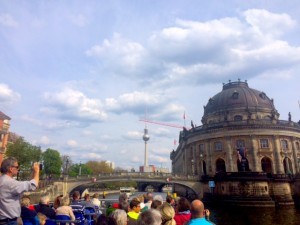
Rube and Mandy take a shiptour on the Reederei Riedel. 64 bridges, 23 kilometers.

Rube and Mandy take a shiptour on the Reederei Riedel. 64 bridges, 23 kilometers.

Rube and Mandy gave up their pretensions to belonging for three gloriously touristic hours atop a big boat in the middle of the Spree, passing through the locks into the Landwehrkanal and other byways, and meeting, it must be said, a very different Berlin.   They followed up the tour by tracking down but not entering a series of galleries designated as Gallery-Weekend hotspots; in what can retrospectively be construed as an act of resistance, they sat down a block away and ate so much Norwegian food that art was out of the question.  At least the restaurant was named for an artist: Munch’s Hus.  (And, in a thematically-relevant twist, it was full of mechanical reproductions of Munch’s works.)

« Older posts