Of Blood and Beauty

The Evergreen State College

Category: PsychoGeography (Page 1 of 2)

All About Allianz Arena

For my second Psychogeography experiment I decided to go on a tour of Allianz Arena, home of FC Bayern Munich! Like many of the places I have been to while on this wanderbondage, this is a place I never thought I would get to go to. This stadium opened up in 2005, which is very new considering the history of stadiums in this country, so it is built using all kinds of state of the art architecture and designing. Before using this stadium, Olympic Stadium was where Bayern played its matches. This is peculiar considering both the rich history behind this club as well as the fact that this field wasn’t designed for football but rather Olympic sporting events, so it still has the track that goes around the field, which both players and fans do not appreciate. One of the most prominent features of this new stadium is that is is capable of lighting up at night, in different colors, depending on who is playing there. If Bayern is playing, the stadium lights up red, if TSV Munich (from the 2nd league) is playing, the stadium turns blue, if the national team is playing there, white, and apparently on St. Patrick’s Day it turns green. My tour guide also informed me that recently, for a match against Italy, the stadium lit up with the colors red, black and gold, to symbolize the national Deutsch colors.
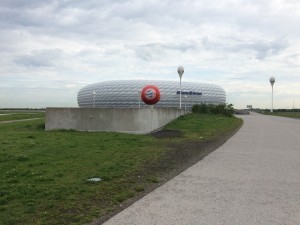
All About Allianz Arena

This stadium can hold 75,000, so by definition, it is the second largest stadium in Germany. Dortmund’s home stadium, Signal Iduna Park, can hold upwards of 80,000. However to counter this, one could argue that it is what happens on the stadium, not around it that matters. And certainly no other teams in this country, in many countries can claim dominance over the domestic leagues like Bayern Munich can. Just recently, they finished wrapping up their 25th Bundesliga title, the next closest would be Dortmund with 5. This level of dominance has grown to aggravate many. FCB had won the last 4 league titles in a row, which has never been done before. True fans of the sport relish the competitive nature of the league and love to see underdogs thrive. Now however, it seems everyone except FCB and Dortmund are underdogs. While many may be disappointed with how the shift of power has been tilted, there is no doubt that the people of this city love seeing their team win over and over again. Because this stadium was built so recently, it allowed a special section to be allowed specifically has a museum dedicated to the history of FCB. How many clubs can claim this?

All About Allianz Arena

FCB was formed in 1900, when a group of 16 men decided to break away from the local gymnastics club, who saw football as a barbaric English game and would not support it in their institution. So, these men formed their own club and it has kept the name ever since. The club was an immediate success, winning all of its first games against opponents by scores of 5 or 6 to zero, I sign of things to come I’d say. In its early years, the club also went through many political ‘advancements’ (for lack of a better word). Problems such as field times and spaces  were hard to come by as the sport in general was only just beginning to gain success. In fact Bavaria as a whole was rather slow to catch on to the football bandwagon as places like Berlin and Dortmund saw prominence in the sport many years earlier. One problem found a solution and FCB partnered up with the local (organization, I forget who, which is disappointing as this is rather important) in 1906 and were able to play at more regular intervals. In order for this to happen though, the club would have to wear red shorts instead of the traditional blue and white. Blue and white are the colors of Bavaria as I have found out after spending a couple days in Munich, so I had wondered why FCB famously wore red all the time, and now I had my answer.

All About Allianz Arena

In the first couple decades of FCB’s existence, much of their success was due to the coaching and organizing of two Jewish men, Richard Dombi and Kurt Landauer. So when the Nazi movement began to gain momentum, and both of these men were forced into exile, the club naturally suffered in its efficiency. All of War War 2 however, naturally took its toll on both FCB and football throughout the country as well. Many players were soldiers and many did not come home. In response to this, after the war, Kurt Landauer returned and helped guide his side once again, but ticket prices were also severely reduced. The equivalent price of a ticket at the time was something like 50 cents. The club wanted to give the people something to cheer for after  the devastation that WW2 had brought. And it worked, attendance slowly increased more and more throughout the years, and the fan base grew so passionate that when FCB made it to their first German Championship, which was played in Nürnburg, thousands of fans rode their bicycles hundreds of kilometers to the game. FCB rewarded this loyalty with free tickets and refreshments at every resting point along the way home, (after they had won of course).

All About Allianz Arena

FCB has always had a reputation for trying to connect with their fans. A shining example of this is the fact that in the stadium, they have their very own beer garden. Beer in Deutschland, and especially in Munich, is a national treasure that they take very seriously. And they always have! Munich was in fact founded by monks, hence the name, who often brewed their own beer. Inside the halls leading to the beer garden, there are several pictures of players, dressed in the traditional Bavarian cloth known as Lederhosen, drinking beers with each other. There was in fact also a team picture, with everyone dressed this way, with beers in hand.

All About Allianz Arena All About Allianz Arena

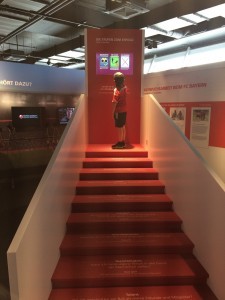
In the late 60’s and 70’s FCB boasted the names of incredible German legends in their lineup. Names like Beckenbauer, Muller and Maier, who all played for the national team as well. The national team of West Germany, that is. With significant contributions from these players, some of the greatest of all time, Germany won the highly public education and exciting World Cup of 1974, defeating a powerhouse Dutch squad captained by Johan Cruyff. The the trophy in Germany, and all the star players coming from Munich, FCB saw a decade long stint of dominance that set the modern trend for their reputation in Deutschland. Many claim that this squad, with these players, was the best they have ever had. Even better than the team who famously won their first treble in 2013. The treble is winning the league title, the domestic cup and the European championship (Champjons League) all in the same year. These incredible names have certainly added to the club, however, make know mistake, every player is remembered. In he stadium, there is a hall of fame with a face and name for every player that has ever played for FCB. If you came through their ranks, you were acknowledged. This type of respect for the players claims its source for the fans, who essentially idolize the players of their team, and consider them part of their Bavarian family.

All About Allianz Arena All About Allianz Arena

FCB also claims one of the most efficient academy systems in the world. I have discussed earlier about the option of young kids, as early as age 7 being picked out for football with the idea that they each have the potential to become the next best players the world. However, what sets FCB apart is their commitment to building these kids up to be good people first and foremost. This is what I respect. They have a three part system of personal, academic and sporting development. Like any school team, they claim that personal and academic come first. This gives off the notion that kids will be successful in life here,  no matter if they play football professionally or not. Of course, what they really want is to keep winning trophies, make money and have the best players, but that doesn’t sell to they out has well. In the end, football in Deutschland starts with the youth. These kids, decades from now, may or may not have played ball, but it will have been so integral in their lives that they will always love it, watch it, play it when they can, and come together with friends and family through it.
All About Allianz Arena


Berlin 2016-05-27 14:34:37

Hamburger Bahnhof Museum für Gegenwart
27//5

Spent a day at this former 19th century train station in Mitte, the first terminal style station in Berlin, currently a gallery for modern art and temporary storage for a substantial portion of the art of the Nationalgalerie during its renovation. I meandered through two extraordinary exhibitions, the first, a breadth of Carl Andre’s works, from sculpture, “concrete poetry” and “dada forgeries” to photography and a full catalogue of mail art. The second exhibit, the draw, was the Neue Galerie: The Black Years, Histories of a Collection: 1933–1945, which “features works from the Nationalgalerie which were either created between 1933 and 1945, acquired by the collection during this period, or seized by the National Socialist regime.”

The exhibit includes an incredible diversity of artists, including those who collaborated with the Nazis to implement their visions of the “Aryan ideal” and uphold the mythology of the German bloodline, as well as artists who underwent an “inner migration” and continued to produce art under the auspices of Reich Chamber of Fine Arts merely to maintain their practice, as well as those who worked in exile, in secrecy or in bold defiance of the regime.

The history of each piece is given in detail, including the location of the production of the work, original owners and exhibitions/galleries it may have been shown in or belonged to, to its trace during the Nazi era – whether it was deemed degenerate and shown as a part of a degenerate art exhibition, stashed away, or sold/stolen by Nazi officials – either by official dealers commissioned by the NS to divest confiscated works to fund the Reich or by lone figures such as Goebbels and Goering for personal gain/prestige.

I stood before a painting by Edvard Munch titled “Melancholy” to re-enact the captivated-aura psychogeography assignment, though in reality I basked in suspension before all of the paintings and sculptures, and only made a decision about this work at last. This piece, selected for this exhibit not for it’s relevance to degeneracy, subversion or controversial history, was an example of the categorical inconsistencies within the National Socialist party as to what “degenerate” art appears as. Melancholy is wildly expressionist, with the figure of a woman in a red plume of a dress sitting at a bench, her upper torso doubled forward as her blue hair cascades over her head and into the sea. All figures and landscapes are suggested, the sea, a sea-stack, the horizon, the sun, a cityscape – all sweeping and vivid gestures, without definition at first glance.  The work was painted in 1906/7, prior to any major war. Goebbels, upon seeing the piece, deemed Munch the “Nordic father of Expressionism”, before appropriating the work in 1937 and selling it to a dealer in Oslo. The brushstrokes and errant drips are sweepingly powerful, exact by suggestion; the aura is in the movement of the strokes, the vivaciousness of the color and the forlornness of the figure are in a harmonized tension, a tense harmony. An excess of blue paint is left where free to fall and stain without distraction, but rather to emphasize the movement of the work – it is an untold mark of beauty. In some corners the tweed of the material used for a canvas is left exposed, further emphasizing not heedlessness, but an intensity of focus on aspects disinterested in perfection – indicating that the skill and precision of this work is not the immediate technique or form, but what the work reveals in its expression.

There are many other pieces in this collection with complicated histories and impossible “auras” – from the “Isle of the Dead” by Arnold Boecklin, to famous works by Dix, Kirchner, Picasso, Kollwitz & Klee, to canvases that conceal secrets of a double past and others that make for subversive interpretations.

Definitely worth the visit!

http://www.smb.museum/en/exhibitions/detail/neue-galerie-die-schwarzen-jahre.html

Erwin Hahs – Great Requiem, 1944/1945


SpreePark Geist

I visited Spree Park on a sunny day with friends from home.

We recognized the location from, maybe embarrassingly, a lot of films and that is why I steered us there. We were hoping to get to explore the abandoned rides, but the park was overgrown, often dismantled, and fenced off by a tall fence. Built by the GDR and opened in 1969, it was one of the few entertainment destinations in East Germany.

The Ferris Wheel is the clear eye-catcher, peeking above the trees In view quite a ways west up the Spree river. When we finally entered into the forgotten park, we could see that the wind was moving the wheel squeakily. How satisfyingly eerie. I pushed my phone through the fence to capture a video of the motion. I think I could be YouTube famous if I play my cards right:

My friend Jan told me that the automatic motion of the Ferris Wheel has attracted lots of trespassing riders, who have many times become stuck up high in the air when the wind stopped mid-ride. I can’t stop thinking of trying to anyway.

Borussia

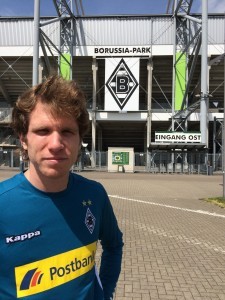
Aside from being quite the artist, Emil was able to shed some light on the history of football in northern Deutschland. Many years ago, at the turn of the previous century, coal had been discovered in this part of the country. When it was, Germany had recruited thousands of workers from Eastern Europe to move their and dig for it. These were people from Polish and Slavic backgrounds, in what was at that time Eastern Prussia. With them they brought their cultures as well as the label of Borussia, which is German for Prussia. At the same time as all of this was happening, football, as a sport had begun to emerge as the popular pastime as we know it today.

As coal miners, these Borussian men were the definition of proletariat or working class. After they finished their hard physical labor, they would play football as a way to unwind. The owners of the mines, the aristocrats, saw them and their football as a low game and would have no part in it, the workers relished this. Eventually clubs were formed in this region, two of which became more prominent than the others, and still exist to this day in the highest class of German football. These clubs were Borussia Dortmund and Borussia Münchengladbach. Although the times have certainly changed over the years, the division between worker and owner is still ever present. Today football has become a billion dollar industry, where the big wigs and the top cats have all the money and control the enterprise. Players are able to be paid large sums of money, only when they are able to bend to the will of these owners and do as they say, no matter their performance on the field.

Emil and I had an interesting discussion after he told me this, and it was primarily surrounding a theory of mine. Coal mining is hard, physical labor, and doing so makes a man much stronger and thus would make him a potentially better footballer. I told him about how, in the first decades of the invention of football, the sport was primarily dominated by strength. Tactics were not so fully developed yet and it was not until the 30’s when the influence of tango in Uruguay made players more skillful with the ball and thus feigns and moves became more prominent. No, before all this, the game was primitive, run faster and be stronger. These coal miners were bred to be good ball players, and it shows now all these years later in how they had managed to become so prominent in the rise of football that, these two clubs specifically, are held in such high prestige to this day.

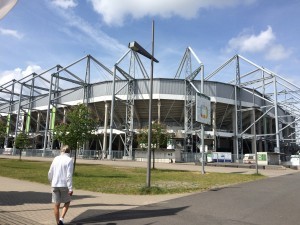
Later Emil brought me to the home stadium of Münchengladbach. They essentially had a whole autobahn exit dedicated to their stadium. Emil said that when there were games, the whole place was packed and that many people would be outside the stadium who couldn’t even get in.

Borussia Borussia

A Night and Day In Oldenburg

[geo_mashup]

Arrival: 16th of May

Let me just start out by saying that the drive here was very safe and we made it in the city of Oldenburg with plenty of light and found a perfectly central little hotel to stay in. The Internet, as per the usual in the hotels I have thus far experienced in Europe, is pretty hit or miss in the room and just fine down in the lobby. My mother is very pleased with all of the accommodations and our stay thus far.

A Night and Day In Oldenburg

OK. That all being said I would like to add that the drive we took yesterday can and will go down as top five most stressful driving trips I have ever been a part of. We have a rental car and drove entirely on the autobahn. That was fine. I made sure we had directions the night before on a map off my phone, my Mom got some good tips about what to look out for on the road, and we got the car insured under my name very easily.

No big deal. The real sticky situations arose around our conversations which I won’t go into now due to the personal nature of the dialogue, but they revolved around family dynamics and that tends to be a heated debate between me and my Mom. We were able to expand on some philosophical points around children, how and what conversations to have with them, what choices couples have to come to terms with as a part of long term committed relationships, and the like. All well and good even though at times it did get tense.

So already I’m chalking this trip up as a great success because this is the sort of thing that as an adult I think is a rarity. To have such complex dialogues around touchy and sometimes taboo subjects and be able to find a way to express oneself clearly and articulate them in such a way as to share ones opinion, but not judge the individual giving it is really tricky to juggle all at once. This is all while driving very diligently on this super highway, on a trip where I’m wanting to get a better understanding of where I come from, in the country where I come from. Now that I take all that into consideration it doesn’t sound all that bad. In fact it sounds pretty great.

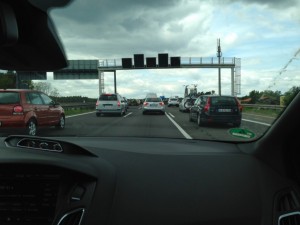
I guess the only real problems yesterday were getting stuck in traffic for about two to three hours and missing a turn and ending up in Hamburg. I mean we were close enough to the North Sea to be able to see the shipyard loading cranes. This was about an hour out of the way we were supposed to go. What was supposed to be a fairly simple four hour drive turned into an almost nine hour drive. The drive ended at Antares Hotel on Staulinie Strasse. Even with all of the stress and anxiety I’m really glad that we took the time to make it out here to a town some of our ancestors were from according to an essay my Great Uncle wrote while researching our ancestry. We got situated in the hotel got Chinese at a local place around the corner, and crashed.

17th of May

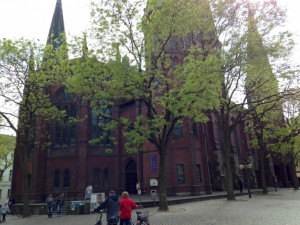
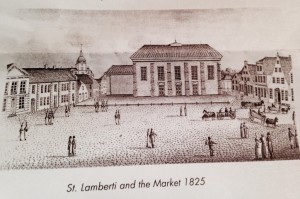
Today we went for a little wander around the downtown footpath streets and found an information center, the shopping centers, the bar streets, and a church that has been redone so many times the town doesn’t even know how it got there to begin with. It’s called the St. Lambertikirche in Oldenburg. And it is a massive piece of architecture to stumble upon while walking down these windy little corridors.

A Night and Day In Oldenburg

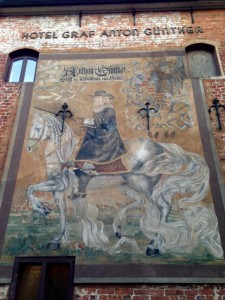
When I stepped into the white space inside this neo-gothic brickwork exterior I kept expecting to see a different aesthetic around the next corner. I was wondering where it was going to start being an old church with all of the elaborate and ornate pieces from saints and bible passages. None of it. The entire interior in painted very simply white with accents of a dull gold and light blue. In the entryway there are the sarcophagi of two of the most prominent noblemen of the town of old; Count Anton Günther (this guy)

A Night and Day In Oldenburg

and the Protestant Prince Bishop of Lübeck Friedrich Augustus, both laid empty.

A Night and Day In Oldenburg

It was the latters successor who rebuilt the interior of the church in the neo-classical style. Instead of the long gothic nave it is now a wel-lit rotunda which is much smaller than the outer dimensions suggest. Even with the seemingly out of place and somewhat tacky floating cross in the center of this space it is still a beautiful little historically misplaced place of worship. It just seems like it’s almost a part of the half brutalist half classical style of the third reich, even though the history clearly states otherwise, but you get an eerie sense that that sense of style was not unwelcome here. I’m just glad to say that my ancestors would have been here when it still looked like this.

A Night and Day In Oldenburg

Prahahaha

Prahahaha

15.05.16

Vítejte v Praha

Time to start working on my project again. Baudelaire and I haven’t spoken in weeks and our reunion is long overdue. The last few times I’ve tried to speak French turned into a Frankenstein-like German-French monster, so the idea of diving headfirst into the murky waters of French poetry is a bit terrifying, but also exhilarating. I expect to be holed up in my apartment for the next three weeks, save for the occasional trip to the grocery store to buy wine and cigarettes. Maybe some food, too.

Prahahaha

Proof of Life Selfie #1

Praha – Ideal of Work Week

I arrived in Praha last night, where I’ll be staying with Kate and Gabby for two days before I move into my own place on Monday.

This is the current line up of work I will accomplish this week, beginning today:

  • Reading & Explosive passages from Ways of Seeing by John Berger – up to page 55, or more if I feel inclined
  • Three Kafka short stories, every day – should be relatively easy since their relatively small
  • One longer Kafka story each week
  • Wander around Prague; including stops to the Communism Museum and churches
  • Character research
  • Selected readings of Susan Sontag’s On Photography

Sites, Sights, und so weiter

The Palace Gardens in Prague are surreal. The city is not quite a bustling urban hub, its age and dependence on tourism are apparent everywhere, but still, stepping into the enclosed area of the gardens with its baroque fountains and hedges and casual peafowl evokes the same sort of timeless, Lewis Carol absurdity that one feels visiting Hampton Court in England. The traditional performance of Moravian music and dance that happened to be underway when we visited added the simultaneous touch of both authenticity and banal production that is coming to characterize historical locales for me. I don’t mean that in a critical or cynical way exactly, I loved the experience, but there’s something necessarily put-on about intentional cultural-historical spaces.

The Kafka museum evoked even more powerfully in me thoughts and feelings about museums (as productions, as spectacle) that I’m still trying to think through. I think the the intentions behind the two museums are pretty different. The Kinemathek Museum is probably more explicitly intending to be spectacular, as this is completely in keeping with its matter. The Kafka museum is, rightly I think, trying to avoid an exclusively informative or idolatrous presentation of an author who probably would have revolted at the very idea of a monument to himself or his work. Regardless, I struggled in both places not to feel like I was at Epcot, Disney World. Maybe Disney World would be a lot cooler if there were more rides based on “The Penal Colony”.

Berlin Wall memorial park

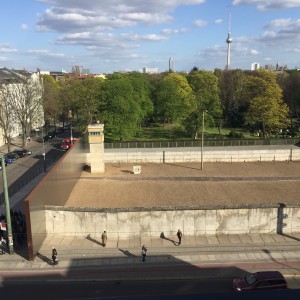
On Wednesday, Rachel (our CIEE tour guide) took us through the Berlin Wall memorial. The section dedicated to the memorial is the patch where the Church of Reconciliation was trapped in the death strip between the walls, and was eventually torn down for better patrolling visibility. The wall exists still in fragments, including a big chunk that has been rebuilt to depict the size and intimidation of the death strip that divided Berlin during the Cold War (see photo below).

We watched two quick videos that were surprisingly capitalist propagandistic. It was disappointing that the museum didn’t present the information more critically. It is clear that that the construction/maintenance/elaboration of the wall was oppressive literally and figuratively, but during this time presently when there is a rising and threatening conservative right-wing extremist movement in the East of Germany it is important to pay attention to both sides of the wall. Most of the viewing happened from a high tower in the West, looking East.

Berlin Wall memorial park

Sammlung Boros, Bunker, Berlin Mitte

The Boros Collection is shown in a bunker built for the Nazi establishment between 1941-1942, it has since been used for food storage (“the banana bunker”), paintball, fetish parties, raves, and then purchased by two art collectors in the early 2000s to use as a gallery.

It is hard to imagine that the Chimera-like building could fade into the background enough for an art installation to succeed. It is not neutral in aesthetic or memory, so many of the installations were altered to respond to the space, some made you forget and some were built with the context in mind.

The floor plan looks like a labyrinth. A labyrinth tries to keep a secret, without wholly containing it.

« Older posts