a poem-like thing I wrote while working on my project recently:
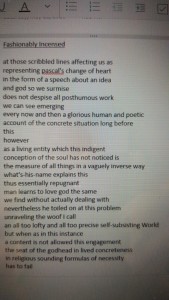

a poem-like thing I wrote while working on my project recently:
I was going to make an update but I can’t find anywhere in Nuremberg to use wifi long enough to upload photos to this frustrating website. So this is a placeholder in the meantime!
(Note: I don’t have a decent word processor on my pc because I typically use Google Docs, so not having wifi makes typing up anything very difficult. Should have planned for this but…)
over-caffeinated with nowhere to go listening to the new death grips album for the first time staring at some baroque cathedral Wanting to Scream:
The Palace Gardens in Prague are surreal. The city is not quite a bustling urban hub, its age and dependence on tourism are apparent everywhere, but still, stepping into the enclosed area of the gardens with its baroque fountains and hedges and casual peafowl evokes the same sort of timeless, Lewis Carol absurdity that one feels visiting Hampton Court in England. The traditional performance of Moravian music and dance that happened to be underway when we visited added the simultaneous touch of both authenticity and banal production that is coming to characterize historical locales for me. I don’t mean that in a critical or cynical way exactly, I loved the experience, but there’s something necessarily put-on about intentional cultural-historical spaces.
The Kafka museum evoked even more powerfully in me thoughts and feelings about museums (as productions, as spectacle) that I’m still trying to think through. I think the the intentions behind the two museums are pretty different. The Kinemathek Museum is probably more explicitly intending to be spectacular, as this is completely in keeping with its matter. The Kafka museum is, rightly I think, trying to avoid an exclusively informative or idolatrous presentation of an author who probably would have revolted at the very idea of a monument to himself or his work. Regardless, I struggled in both places not to feel like I was at Epcot, Disney World. Maybe Disney World would be a lot cooler if there were more rides based on “The Penal Colony”.
I almost boarded a train to the wrong Frankfurt but thankfully did not. The train ride to the right Frankfurt was very pleasant.
Nobody was at my hostel to meet me at the scheduled time so I called them and was told to return in an hour. I returned in one hour and ten minutes and was chided for being “so late.” My room is nice. I had microwave schnitzel and watched a music/variety show from the 70s called Disco.
Frankfurt is very different from Berlin; much more urban and a little intimidating. Doener costs over twice the normal price in Berlin but that is okay because I need to stop eating it anyway. Now I’m watching Bonanza in German and trying to stop feeling stressed.
I think that if Benjamin had lived much longer he would have made significant revisions to the theories he offers in “The Work of Art in the Age of Mechanical Reproduction.” This is not the place for a general critique, but attempting connect some of the ideas of that essay to my experiences in the Deutsche Kinemathek Museum has, I think, helped me begin to understand why I find this essay so frustrating compared to everything else I’ve read by Benjamin. The problem is that even if you maintain that his description of the authenticity or aura of an art work can or should be read phenomenologically rather than metaphysically (which I do), Benjamin’s analysis still depends on a strong historical concept of authenticity. The most clear and important symptom of this can be found in his distinctions between ritual and politics, and between fetish and value.
I’ve been trying to figure out a way to work through the rest of what I’d like to say about this, and what I think it has to do with the Kinemathek Museum, but it has turned out to require a lot more time and space than I can give it for a blog post. It may become part of my project, as both Benjamin and the concept of ritual are central to that, but we will see. In short, however, there is something really interesting about the way in which the museum begins with the hall of mirrors. This replicates the viewing subject infinitely in a way not unlike (though perhaps obverse to) the universalized perspective of the movie screen. From here I want to argue that Benjamin is wrong about the inherent criticality (or ironic distance) of a film viewer, and bring in some argument from Adorno’s theory of the culture industry to show how through mainstream film we are hypnotized by our own image of our own desires (which have themselves only been produced and magnified previously by this same and adjacent processes).
This might require a little more Freud and Lacan (or Deleuze and Guattari!) than I have time or desire for at the moment, but hopefully this post will at least serve as a reminder to follow through with this later.
i accidentally miscalculated dates and one of my hostel reservation in Frankfurt starts a day too late. on the one hand this sucks because i have to pay 10 euro extra for a private room for that night, but on the other hand holy shit am i excited to have space to myself like that for the first time in forever.

Jetzt: billiger und einfacher!
Jetzt: billiger und einfacher!
On April 5th I attended a lecture by the English journalist Paul Mason entitled “After Capitalism?!” The interrobang at the end of this title is either a little bit embarrassing, or devastating, depending on your relationship to anti-/post-capitalist discourse in general, and to the various new liberal third positionisms that seem to be getting a lot of attention over the last couple of years. I’m Highly Ambivalent.
What most non-reactionary accelerationists argue is that the transition between and production of economic forms is not ultimately accomplished by the activities conceived of as political during a given form’s lifetime, but rather by the emergence, out of a given form, of the new material conditions for the succeeding one; and that this process can be actively accelerated. The logic goes: capital was produced by the self-intensification of the economic relations of old-imperial mercantilism, so if we wish to move beyond capitalism we need to figure out which of capital’s characteristic relations are potentially liberatory (especially those that make is so remarkably adaptable to new challenges) versus those that are primarily conservative. If we can get a better image of this then we can locate the places where these things that are contradictory in principle are contradictory in material form, and then we can intensify or accelerate the relevant processes. It is a fundamentally marxist position, but one which (whether explicitly or not) amputates most marxist theory of revolution from Marx’s ontological core of dialectical materialism.
I have no idea if Paul Mason considers himself an accelerationist, or whether he’s ever heard the term, but as far as I can tell he is working from this same basic logic. Where he differs is in his focus not only on the positive capacities of the technologies of capital, but also on roles these play in what he sees as a necessary acceleration in the tendency of the rate of profit to fall. As traditional market growth slows and stagnates the digital economy increasingly colonizes our subjectivity. Desire for both immaterial goods (and really only secondarily the material media of these goods) is a new market front, but one which requires constant reproduction, as the labor input and consumption are increasingly identical. Facebook et al are valuable to a given user because, and only so long as, many others are using it frequently: practically any direct competition begins pushing surplus value production toward zero; so they can only remain profitable as long as a sort of trust exists between the biggest tech and digital monopolies to simultaneously reduce competition and mutually produce in consumers habits and desires that mutually feed their models rather than freeing the consumers or the media up for alternative activities. This seems to mean that any breaks or resistances to this feedback loop could produce an opposite one in which the power of capital is diminished or threatened while more and more people are simultaneously interacting with each other and with technology in new, creative, and potentially liberatory ways.
Like I said, I’m ambivalent. I agree with the economic logic and hope the possibility for lines of flight out of the current internet desire-machine is a real one, but I’m frustrated to hear another person saying this sort of thing without any idea how to really begin producing these resistances or lines of flight. I also share some of the pessimism of one of Mason’s interlocutors, Hans-Jürgen Urban, who fears that the crises of capital that have already been occurring are producing new forms of conservative power (which may look more like pre-capitalist ones and therefore not be threatened by the same things) faster than Mason and other utopianists recognize. There’s really a lot to say about all of it, and I don’t think that either of the two criticisms I mention here are good reasons not to try what Mason (or other accelerationists) is ultimately suggesting, but I find myself with no more clue how to start than I did before hearing him speak and I think that’s a harder problem than he makes it out to be.
© 2026 Of Blood and Beauty
The Evergreen State College
Olympia, Washington