

Author: Zona Enders (Page 2 of 3)
Today in pop-up salon, the topics of Heaven and the Kingdom of Ends came up, especially how these ideas seem to evoke a hellish kind of mechanistic being. I made the comment that I found all categorial ethical discussion to remind me of this. I semi-lightheartedly blamed this on my reading too much Nietzsche.
I just wanted to clarify that what I meant by that was not that any and all ethical consideration was bad merely because, for instance, it is restrictive, as I think a lot of people do interpret from Nietzsche. I don’t think this is the case and I don’t, for whatever it matters, think Nietzsche’s work supports this view on the whole either. It is merely that I don’t know how ethics can be thought categorially without necessarily appealing to the same transcendent values or, more importantly, the same transcendental forms of (e)valuation, that have til now also been the general forms of violence and instrumentalization.
I will have to think about this part but: I have the feeling that conceiving ethics categorially, as opposed to, say, strategically, is a reversal of what is general and what is particular about a given problem, analogous to the way capital’s alleged protection of the freedom of the individual over the whole is actually a demand for the sacrifice of individuals in the name of a non-existent whole.
Since it was another thing I don’t think I communicate well, I want to add that this is closely related to but not exactly the same point as I was trying to make in seminar about the drive to make judgments about something like the decisions made by death camp prisoners. I think that both have to do with what appeals to me about mysticism like Benjamin’s but I obviously have a lot of working through these things to do.
–Benjy and the Jetzt
It went from sunny, to drizzling, to pouring pretty suddenly during the opening information and discussion session at the memorial. I haven’t been wearing sunglasses very often since I began wearing normal glasses again, but it was bright enough out when we began, and seemed like it might stay that way, so I cased-up my glasses and put on my sun glasses. Within a few minutes it was dark and we were getting soaked by rain. Thankfully our tour guide was able to secure us a seminar room so he could continue preparing us with information and context for the experience of the memorial’s documentation center. It’s nice to have exits and contingencies.
There’s not really a lot I want to say about the things I saw and read in the center, except that both the particulay intensity and the vastness of atrocity are extremely difficult to hold in your mind, and to hold both at once is just about impossible, and so I think the choice of the curators to focus on the two separately (and the latter only after acquainting you with the former) is the right choice.
With regard to the Topography des Terrors memorial, I was much more intellectually engaged there. There were, of course, many nightmarish images and historical accounts, and it may have been determined in part by the tone and focus of our guide, but I found myself mostly concerned with the logistical question of how the Nazi regime established itself and its various arms of violence. The most interesting aspect of what I read was, I think, the role played by the ‘normal’ criminal and order police in not only the day to day functioning of the regime, but specifically in the production of the technologies and practices of “euthanasia” and extermination. It’s clear that the images of the criminal, the insane, the infirm, and the deviant, are images produced by the most dangerous and odious forms of power. Maybe the functionalists are right that the police (in some generic sense) are essential to social being, but they should nevertheless at no point be trusted.
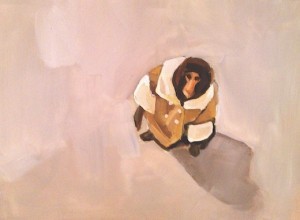
(Image: Ikea Monkey, from Lauren Kaelin‘s Benjameme series)
For this PsychicCity assignment I went to a cafe under the Friedrichstrasse S-Bahnhof, ordered some coffee and warm strudel, and answered the following questions (as offered by Jules).
Q: Honestly, how are you doing?
A: I’m very, seemingly inescapably tired. I’m sure everybody has heard me complain about it at this point–so sorry everyone!–but I really find it strange. No matter how much or how little sleep I get, I still feel exhausted for all but about 3 hours of every day.
Q: Do you hate it here or do you love it?
A: I would say that I like it a lot, but it’s hard to say whether I love it. It’s a sort of peculiar experience to be here for so long without needing to think about or plan for normal life things; and that makes it difficult to compare to other experiences.
Q: Are you homesick?
A: Nope. I really like living in an urban environment, so while I miss some people a lot I really don’t miss being in either Washington or Texas.
Q: Are things getting hard?
A: Some things are… Showering and laundry have become a bit stressful (which is bad because I’m already pretty lazy about those things), so it would be nice to be in a place where I felt like I had an equal claim again. My host parents are totally gracious, it’s just something I can’t help but to feel.
Q: What is your temporal experience? (For example: I don’t operate on dates or days of the week)
A: That still feels pretty normal, except that the weeks are passing very quickly (but that’s not uncommon when I’m at home either).
Q: Are you remembering things? Can you access images and feelings and emotions at any point in this city? Are you unable?
A: I am reading this as asking if I’m able to access memories from earlier in life while on this trip; and I’m not sure if it is more or less than is usual but it is definitely a yes. I am especially reminded of many of my experiences when I first lived in NYC and I didn’t know the city very much so I was frequently just a little bit lost, and a little too nervous to ask for help.
Q: Are your habits changing?
A: Some, but not as many as I expected (or perhaps hoped). I have been eating breakfast more regularly because my blood sugar has been a much more present concern than it normally is. I have also been going to sleep earlier than I do at home (except for one or two nights a week).
Q: What is scaring you?
A: My general fatigue, and my struggle to become conversational (let alone fluent) in German are both worrying me with regard to my graduate school prospects.
Q: How do you handle being alone?
A: It’s honestly more that I need regularly (and sometimes struggle to attain) that it is something for me to cope with.
Q: What could you possibly do in a strange place to truly calm down?
A: I don’t know about Truly… but I typically find somewhere to nap. Sometimes that is at ‘home’ in bed, or sometimes it is on a bench somewhere, or even on the ground in a park if it is sunny and dry.
Q: Is class stressful?
A: Yes, I am struggling to stay on top of everything. This is due in part to the previously mentioned exhaustion/fatigue, and partially to my own normal laziness and poor attention.
Q: What kind of thoughts are you thinking? There’s usually a pattern there.
A: Lately, a lot of pessimistic ones. :/
Q: Do you miss anyone?
A: Yes.

(West Bank, Palestine 2007)
“All rulers are the heirs of those who conquered before them. Hence, empathy with the victory invariably benefits the rulers.” (Benjamin, “Theses on the Philosophy of History” VII)
We visited the Jűdisches Museum on Monday and it’s now Friday morning, so I’m pretty late with this reflective note. This is mostly accounted for by the fact that I’m lazy and forgetful. Part of it, however, is due to the fact that I don’t think I took very much away from the visit. Our tour guide was very knowledgeable, and he was more critical than you typically get from official tour guides. It was interesting to learn about the role of department stores in the history of Jews in Berlin (and vice versa), and I’m glad to have learned who Grete Löbenstein was. With rare exceptions I am really not a fan of guided tours. Especially not in places which already present an extremely produced experience to the visitor. I took too long eating lunch and did not get to see the section on the Jewish faith, and that is my fault. I can’t remember when it happened, but I bought a book by Martin Buber in the museum gift shop and I love it. I should maybe go back when I can wander around at my own pace and visit that section on the Jewish faith.
When I was through, he spoke hesitatingly, then, carried away by the importance of his subject, ever more passionately. “How can you bring yourself to say ‘God’ time after time? How can you expect that your readers will take the word in the sense in which you wish it to be taken? What you mean by the name of God is something above all human grasp and comprehension, but in speaking about it you have lowered it to human conceptualization. What word of human speech is so misused, so defiled, so desecrated as this! All the innocent blood that has been shed for it has robbed it of its radiance. All the injustice that it has been used to cover has effaced its features. When I hear the highest called ‘God.’ it sometimes seems almost blasphemous.”
The Kindly clear eyes flamed. The voice itself flamed. Then we sat silent for a while facing each other. The room lay in the flowing brightness of early morning. It seemed to me as if a power from the light entered into me. What I now answered, I cannot to-day reproduce but only indicate.
“Yes,” I said, “it is the most heavy-laden of all human words. None has become so soiled, so mutilated. Just for this reason I may not abandon it. Generations of men have laid the burden of their anxious lives upon this word and weighed it to the ground; it lies in the dust and bears their whole burden. The races of man with their religious factions have torn the word to pieces; they have killed for it and died for it, and it bears their finger-marks and their blood. Where might I find a word like it to describe the highest!” (Buber, The Eclipse of God 5-6)
Since we are no longer going to Istanbul, I had to rethink my Wanderwochen plans. I’m sad about not getting to see Istanbul or the Balkans but it will be good to spend more time in Germany and get a better idea what it’s like outside of Berlin.
Here’s my tentative plan:

If anybody with Hulu Plus is looking for a good deustchsprachige movie to watch, Der Fangschuss/Coup de grâce is available through the Criterion Collection. It’s something like the French/German New Wave counterpoint to All Quiet on the Western Front, and it features a small supporting roll by an 84 year old Valeska Gert, whom I mentioned in my PsychicCity post. It is partially in French, but mostly German if I remember correctly.
Here is the trailer: