Of Blood and Beauty

The Evergreen State College

Author: Katy (Page 1 of 3)

Moin moin!

Lebensvoll an der Strand der Elbe, Hamburg

Moin moin!

Also found here is der Alte Schwede,

Moin moin!Moin moin!

An erratic granite boulder, migrating to Hamburg 400,000 years ago from Småland, south Sweden. Found in 1999 while dredging the Elbe, it’s been deemed Germany’s oldest immigrant,  achieving official citizenship in 2000.


And after walking the tightrope, that Reeperbahn in St. Pauli, dizzying –  glitz, filth and seduction all at once, to wind up and away through the cobbled streets of St. Pauli was a retreat into yet another underworld, the heartland of the dis/mis/interested and the de/re/generate, a hearty punk mecca.

“At ease, sailor”


Berlin 2016-05-27 14:34:37

Hamburger Bahnhof Museum für Gegenwart
27//5

Spent a day at this former 19th century train station in Mitte, the first terminal style station in Berlin, currently a gallery for modern art and temporary storage for a substantial portion of the art of the Nationalgalerie during its renovation. I meandered through two extraordinary exhibitions, the first, a breadth of Carl Andre’s works, from sculpture, “concrete poetry” and “dada forgeries” to photography and a full catalogue of mail art. The second exhibit, the draw, was the Neue Galerie: The Black Years, Histories of a Collection: 1933–1945, which “features works from the Nationalgalerie which were either created between 1933 and 1945, acquired by the collection during this period, or seized by the National Socialist regime.”

The exhibit includes an incredible diversity of artists, including those who collaborated with the Nazis to implement their visions of the “Aryan ideal” and uphold the mythology of the German bloodline, as well as artists who underwent an “inner migration” and continued to produce art under the auspices of Reich Chamber of Fine Arts merely to maintain their practice, as well as those who worked in exile, in secrecy or in bold defiance of the regime.

The history of each piece is given in detail, including the location of the production of the work, original owners and exhibitions/galleries it may have been shown in or belonged to, to its trace during the Nazi era – whether it was deemed degenerate and shown as a part of a degenerate art exhibition, stashed away, or sold/stolen by Nazi officials – either by official dealers commissioned by the NS to divest confiscated works to fund the Reich or by lone figures such as Goebbels and Goering for personal gain/prestige.

I stood before a painting by Edvard Munch titled “Melancholy” to re-enact the captivated-aura psychogeography assignment, though in reality I basked in suspension before all of the paintings and sculptures, and only made a decision about this work at last. This piece, selected for this exhibit not for it’s relevance to degeneracy, subversion or controversial history, was an example of the categorical inconsistencies within the National Socialist party as to what “degenerate” art appears as. Melancholy is wildly expressionist, with the figure of a woman in a red plume of a dress sitting at a bench, her upper torso doubled forward as her blue hair cascades over her head and into the sea. All figures and landscapes are suggested, the sea, a sea-stack, the horizon, the sun, a cityscape – all sweeping and vivid gestures, without definition at first glance.  The work was painted in 1906/7, prior to any major war. Goebbels, upon seeing the piece, deemed Munch the “Nordic father of Expressionism”, before appropriating the work in 1937 and selling it to a dealer in Oslo. The brushstrokes and errant drips are sweepingly powerful, exact by suggestion; the aura is in the movement of the strokes, the vivaciousness of the color and the forlornness of the figure are in a harmonized tension, a tense harmony. An excess of blue paint is left where free to fall and stain without distraction, but rather to emphasize the movement of the work – it is an untold mark of beauty. In some corners the tweed of the material used for a canvas is left exposed, further emphasizing not heedlessness, but an intensity of focus on aspects disinterested in perfection – indicating that the skill and precision of this work is not the immediate technique or form, but what the work reveals in its expression.

There are many other pieces in this collection with complicated histories and impossible “auras” – from the “Isle of the Dead” by Arnold Boecklin, to famous works by Dix, Kirchner, Picasso, Kollwitz & Klee, to canvases that conceal secrets of a double past and others that make for subversive interpretations.

Definitely worth the visit!

http://www.smb.museum/en/exhibitions/detail/neue-galerie-die-schwarzen-jahre.html

Erwin Hahs – Great Requiem, 1944/1945


KW Institut for Contemporary Art

KW Institut for Contemporary Art
SECRET SURFACE
WHERE MEANING MATERIALIZES
Group exhibition
14.2.
1.5.16

In his terror of chaos, (man) begins by putting up an umbrella between himself and the everlasting chaos. Then he paints the underside of his umbrella like a firmament. Then he parades around, lives, and dies under his umbrella. Bequeathed to his descendants, the umbrella becomes a dome, a vault, and men at last begin to feel that something is wrong.

D.H. Lawrence

Departing from the traditional coordinates of the occidental world-view, the exhibition SECRET SURFACE asks where –  and more importantly, how –  meaning may materialize.

Through our permanent reference to a “beyond” (be it the horizon, the universe, or the ultimate “beyond” death), an opposition is set up in which these depths are regarded as the ordinary’s other, which provide direction to our existence, and which implicitly devalue the surface. People and things are considered superficial if they lack complexity and intensity. SECRET SURFACE turns this logic upside down, and presents contemporary artworks that conceive of the surface as the location of experience itself, both in terms of subjectivity and towards the outer world.

With contributions by niv Acosta, Auto Italia (Kate Cooper, Marianne Forrest, Andrew Kerton, and Jess Wiesner), Trisha Baga, Anna Barham, Eduardo Basualdo, Viktoria Binschtok, Gwenneth Boelens, Beth Collar, Hollis Frampton, Spiros Hadjidjanos, Andy Holden, Alex Israel, Philipp Lachenmann, Mark Leckey, Lawrence Lek, Ying Miao, Philippe Parreno, Elizabeth Price, Naufus Ramírez-Figueroa, Emily Roysdon, Georgia Sagri, Prem Sahib, Nora Schultz, Katharina Sieverding, Reena Spaulings, Patrick Staff and Cara Tolmie, Philipp Timischl, Frances Stark, and Martijn in ‘t Veld.”

Visiting this exhibit on 30//4, the gallerie was standing-room only, with artists and enthusiasts crowding into the halls floor by floor for a look at the strange collection of works of this surface-dominant installation.
There were many interpretations and elaborations upon the theme, but probably the most amusing was Beth Collar’s ISLAND OF THE DEAD: a projection of an out of focus index finger pointing at an equally out of focus asymmetrical dark shadow. The single phrase “all of the dead go there. there. all of the dead go there.”was repeated hundreds of times with the hand gesturing towards the dark area occasionally moving closer to or even through the stain. Eventually the image comes into focus, as a raw outcropped volcanic island, and the audio adjusts accordingly: “look at that rock over there. it’s the island of the dead. look. at that rock over there. the island of the dead” The film went on and on, and regardless of how much definition the image gained, there was little clarity. As the phrase was repeated, meaning dropped from the words altogether. “all” “dead” “go” “there” “island” were just as insubstantial as the projection itself. This installation was on the first floor, where  “the prologue Secret of the Surface introduces the subject matter and demonstrates that surfaces appear seductive because they can never be completely experienced visually”
Overall, an interesting renditions on the theme throughout, from addressing “social norms as a surface from which the individual can gain opportunities for action more through appropriation and varying repetition than attempted dissociation.” to a “media defined/virtual realm of existence with the screen as surface that mediates the relationship between individual and surrounding.”
This show ended on the 30th of April, but the gallery is well worth checking out for other installations.
www.kw-berlin.de

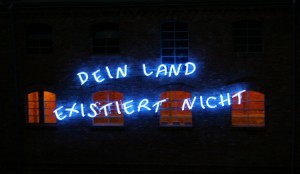
Hélène Cixous // I Say Allemange

Hélène Cixous // I Say Allemange

Untying the Mother Tongue Conference
Berlin Institute for Cultural Inquiry
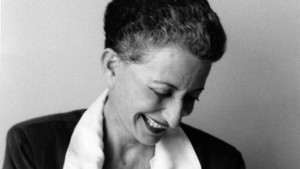
Hélène Cixous

12//5

A beautiful, sonorous reading given by Hélène Cixous woven around her enduring linguistic and literary attachments from a childhood of multilingualism, where the languages spoken by her father, mother and grandmothers (French, German, English) connected her, dreamily, to the distant lands of her ancestors and their domesticated languages, creating, by extension, the personification of language as being an omi or a mama. “I multiply and divide myself in a multiplicity of languages, emotions come through in diverse language.” “Since omi is German, I am only a child of German”


Here are a few further notes from her reading:

“The heimat is never to be confused with nation. The heimat is a mixture of love and attachment, milk and tradition. The heimat is a retreat. And home, the more we return to it, the more we safeguard strength and power. Muttersprach. Language is mother, almost a more real mother than the other.”

“We must resist nationalism, it is a deceitful appropriation.” “The loss of language is the loss of those, and humanity, to connect to. Humanity is gained by learning language.”


Berlin 2016-05-17 06:56:39

Untying the Mother Tongue:
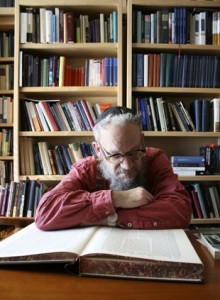
Daniel Boyarin: Philological Investigations

The Concept of Cultural Translation in American Religious Studies

” “Jedenfalls aber ist unsere philologische Heimat die Erde; die Nation kann es nicht mehr sein.” (Our philological home is the earth. It can no longer be the nation.)
Erich Auerbach, Philology and Weltliteratur (1952)

For many years, Daniel Boyarin has been engaged in a project to discover how or why it makes sense to speak of “religion” as existing or not at a given time and place. In this project, Wittgenstein has proven to be an increasingly consequential compagnon de route. Boyarin takes the Philosophical Investigations not so much as a work of academic philosophy but as an attempt to describe how language actually works, how human beings produce meaningful speech and writing. The central question treated in this presentation is adequacy of terms drawn from Euro-American languages to describe the cultures of alter. In order to adumbrate some answers to these questions the thinking of Talal Asad about cultural translation is pitted against that of J. Z. Smith.”

Event Page Upcoming Events

Here are a series of notes taken during a reading given by Daniel Boyarin at the Institute for Cultural Inquiry

on May 11th, 2016. Direct quotes are in quotations, the rest are my interpretations and quick reductions.

(These notes alone are intriguing and leading without my analysis or commentary)


Wittgenstein writes that philosophy must not interfere with actual use of language, but should only describe it.

The meaning of a word is revealed by its use within the language – meaning is not representation, it is use.


Researchers must look for and see the uses of words, understanding two concepts:

  1. Every new use adds nuance
  2. Interpretation of a word is affected by all prior uses known to the speaker and listener.

A word is placed into context only by “half-remembered words and phrases pulled out in seemingly appropriate usages.”

Wittgenstein describes language as a game – and the basic rule for interpretation of a word is “don’t think but look – look and see if there is something common to all.”


For a word to have meaning, it must exist. If a word doesn’t exist in culture, it has no meaning. However, it is not always the case that the concept doesn’t exist and especially so in regard to religion. So what about religion? Religion as a word must exist in language for it to imply meaning independent from day to day practice.


The phenomenon of religion certainly exists in all cultures, but whether a culture has a word for religion reveals the categorization of religion/practice in a culture.


Older cultures may not have recognized the existence of religion.

Wittgenstein states that “to imagine a language means to imagine a form of life.”

Boyarin: “A form of life is close to culture.” To investigate a language means to investigate a culture, what a language lacks by comparison, the culture has not comprised.


Different cultures have different forms of language – which leads to the question of the possibility of translation.


Our modern Western language is inadequate to describe or understand ancient cultures. We must strive to learn their languages.

As Walter Benjamin wrote, we must turn German (or English) into Greek, Hindi, Hebrew, and not vice versa. We should not try to represent their language systematically in our own lexicon – for in this, we are stuck in our own thought and language.


As an anecdote, English merchants refused to trade with Japan in the 19th century, until the Japanese could describe, or give a definition to their religious practice/s. Hence the Shinto religion had no unifying name until it was forced to be defined by the outside.


“Semantics shift with contact with other forms of life.”


Some definitions require great lengths, books, to define, even in semblance. It is hard work to render concepts/words closely into one another.


In one study, the word ‘religio’ was bracketed out of hundreds of different paragraphs describing religious practice, in an attempt to define ‘religio’ by context alone. It was impossible to derive the meaning of the word; this project gave only the sense of the range of uses.


Religion obscures much more than it reveals. Religion is a praxis – there may not be a term for it when it is wholly embedded as a mode of existence – as not categorized, segregated from other practices.

As an example, Boyarin gives an anecdote about Judeans using a festival, Pentecost, to plot a revolution. To the Judeans, this was a normal course of action – plotting a rebellion was no different than any other praxis, as politics and religion were integral to one another.

Those who opposed the actions of the Judeans criticized the use of Pentecost as a cover for subversive scheming. Those who supported their actions praised their craft. To the Judeans it was a matter of course, not a scheme.

————————- – – – – – – – – – –  –  –  –  –  –   –   –   –   –   –    –    –    –    –    –    –   –     –     –     –     –     –     –       –       –       –       –       –


The task of translating culture is not to reduce an unknown to a known.  We must progress beyond the idea that the “history that I want is the history of the present” illuminating our position by events of the past. Other language also functions as a complex language game, and shakes our grip on the notion that our rationale is superior to those of the past. We must study the validity of other language games, and stop assuming that all the past leads into Enlightenment.


The task is to listen to others, to become strangers to ourselves.

The deformation of our language is imperative in order to translate.

Religion can exist without anyone knowing it does.

We must deform/imagine our life without the word religion.

We must find others in the past and adapt our language to meet theirs.


To avoid being alone in the world: allow the other to be herself.

By allowing others to be themselves, we investigate other forms of life and the possibilities therein – we must surround ourselves with possibilities.


By deforming/converting language it changes our life form – there is a possibility of losing original language, and blurring culture, but we must continually become something new — not collapse into a singular language/culture, but to expand and allow for multiplicities of existences.


In avoiding reducing an unknown to a known – how do we know what we see/hear? In the enterprise of seeking, by turning our eyes towards our own practices in the game of knowledge, requires the removal of knowledge and NOT to seek reducing unknown to known, but finding the unknown in our own language and lives.

Kinemathek Berlin

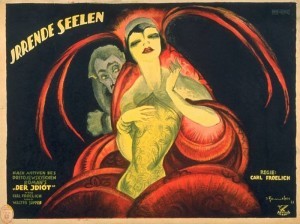
5//5: It was a reeling sojourn through the Kinemathek museum. This collection was a fantastically arranged look into the actual phenomenon of and affects surrounding film, from culture to industry, politics to aesthetics- the curators of this exhibition accounted for many modes, combinations and styles resulting from these contributing factors, from the earliest excitement about the possibility of capturing image and sound, to the harnessing of film as propaganda and the inverse – film as resistance and reframing. The persistence of film as not only entertainment, but as stage for fostering pubic dialogue and reworking the possibilities of story-telling was a theme throughout. Truth was and is always a central concept in film – and the delineation between truth and fantasy is constantly reworked in film, where critical ‘truths’ are often revealed in the most fantastical settings, and the falsehood of ideology ferments in the inflated realism of propaganda. The history of film itself is a front strewn with the wreckage and ruts of so many attempts – successes and failures, the grandiose and the vulgar. What this chronology fails to capture is the other half, the audience, who, meeting the artists  writers, designers, producers and filmmakers half way, bring their own swaying mass of ideas. Here we see the onward transformation of film as it appeals to and marks out the borders of possibility in the imagination, and the battles between fascist regime and artist/creator, but what lacks is the other half – the impression of the consuming audience. The audience is represented, however, portrayed in the films, as their characters. The continual evolution(and also the recurrence) of these characters and settings, occasionally gives insight into what battles are being waged in the streets. But as always, the distinction between what is being waged in the streets, hearts and minds and what is being impressed upon by the films, is always indistinct. The fourth wall is also a stage for filmmakers. Nietzschean Tragedy thrives here – where is the chorus?

The replication of life on film allows for the conceptualization of modern existence, a conjuring of myths which entrench ideas and physically embody the experience – they take an aura of collective erlebnis, reduce it to two dimensional concept, and recast it back to the acting public – (who truly are the original characters – hence the mass appeal and curiosity towards film) – it reveals our lives to us across the spectrum, from individual contrast to casting universal patterns. The gritty modern, day-to-day, experience, living “aura” under the censor of a regime is fastened to film, reduced to a theme with a moral and a story, the confinement (and reverence) of mild day to day life to the reeling frames of a film reduces the complexity of existence and allows for film to be used as the propagation of a strict, controlled mythology, which reinforces the ideaology of a regime. The films whose auras are expansive- critically reflecting life and encouraging the examination and critique of experience/existence-  rather than reductive, as in propagandist film, are those that immediately banned. These expansive, edgy, critical, wild films, are the first to be prohibited and denounced in National Socialist rhetoric. And so, when All Quiet on the Western Front was adapted to film debuted in 1930, the subsequent riots and disruptions by SA and NSDAP officials led to an immediate ban of the film; the story it told did not uphold the Nationalist ideology of German might and victory across Europe, the prevailing political party held final ruling.

“Under National Socialism, light entertainment dominates, movies offer escape from day-to-day reality, especially after 1939.”

These sanctioned films point away from the rigidity of the regime and the actual experience of the proletariat, and towards a stable future just within grasp. The incredible contrast of propaganda films that depict a banal, conclusive, steadfast and conservative lifestyle, to those of brilliant and strange worlds of phantasy, such as The Cabinet of Dr. Caligari, Nosferatu and Metropolis, which point directly at the day to day existence through an abstract mode of phantasy, was fascinating to realize.


Kinemathek Berlin

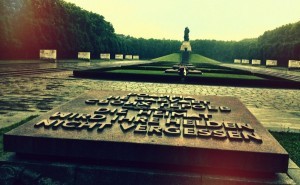
Das Sowjetische Ehrenmal im Treptower Park//Soviet Memorial at Treptower Park

2//4
Das Sowjetische Ehrenmal im Treptower Park//Soviet Memorial at Treptower Park
This burial site and monument was dedicated May 8th, 1949 as burial grounds for 5,000 of the 80,000 fallen Red Army soldiers in the Battle of Berlin.

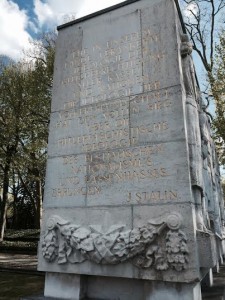
With massive statues and sarcophagi throughout, the central grounds of the memorial recount the story of the Red Army’s betrayal by the National Socialists with the invasion of Russia by German forces on June 22nd, 1941 as operation “Barbarossa” and their subsequent call to arms to defeat Fascist imperialism along the Eastern front. There are 16 limestone sarcophagi lining the both sides of the memorial, depicting, in finest Socialist Realist style, the story of Russian engagement in “The Great War”, from the invasion in 1941 until the “Liberation of Berlin” in 1945. Behind these sarcophagi are theDas Sowjetische Ehrenmal im Treptower Park//Soviet Memorial at Treptower Park graves of the 5,000 Soviet soldiers. The sarcophagi have both Russian and German inscriptions (eight on the right in Russian , eight on the left in German) relaying the timeline of events and rationale of the Soviet engagement in Stalin’s words. This memorial is a counterpart to the Soviet War Memorial in the Tiergarten, and there are commemorative events held here annually on the anniversary.

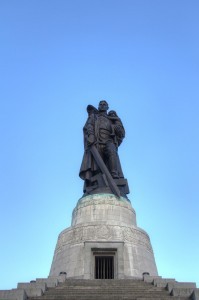
The central figure of the monument is an immense 36 foot tall statue of a Soviet soldier standing atop a shattered Swastika, sword in his right hand anDas Sowjetische Ehrenmal im Treptower Park//Soviet Memorial at Treptower Parkd child cradled in his left arm. The pedestal, atop a large conical hill, serves as a tomb to the fallen Soviet soldiers. The interior of the tomb is a mosaic frieze depicting 16 Soviet figures representing the 16 Soviet republics. At my visit, there were dozens of flowers laid out and a candle burning at the entrance.

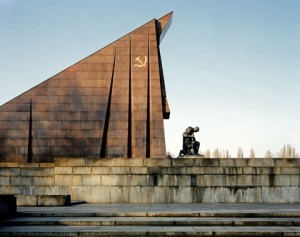
At the opposite end is an grand entryway of red granite, interpreted as lowered Soviet flags.  The main entrance a statue of Mother Russia is weeping, presumably for her son, the soldier standing at the opposite end. The whole memorial is lined with weeping birches and sycamore trees, which cast a deep, sweeping sense of mourning and tranquility, in an otherwise grandiose state-forward Soviet era monument.

Das Sowjetische Ehrenmal im Treptower Park//Soviet Memorial at Treptower Park

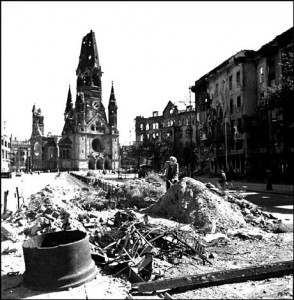
Kaiser-Wilhelm-Gedächtnis-Kirche//Psychic City

Kaiser-Wilhelm-Gedächtnis-Kirche//Psychic City

Just a random mix from my notebook from the visit here. I definitely left feeling dispirited//far from inspired, there was regrettably little to draw from, especially with a constant flux of tourists coming through and taking selfies with the christfigure.
2//5


Pray, what was the last hope you sacrificed to flame?

Here, last hope, survived the flame.

Little more to consume,

little left to praise.
Just holy kitsch and historical clutter,

fragments that connect one era to another.

//////

seven by seven

upright remains

wax gold stone,

glass

wood marble metal

cloth canvas & paper
pure body, no spirit (I have brought my beaming own)

Where is the place that is all spirit and no body?

\\\

blue is the hottest flame &

seven is a holy number–

Still the spirit has flown,

And the wreckage rests at Teufelsberg,

last vestiges,

“We will pray for you”

Psychic City//Soundrings

Psychic City//Soundrings

21//4

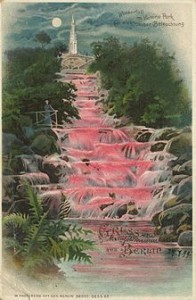
To Viktoriapark, the highest monument, the highest steps –

From the furthest fringes of sound and forward –

(But I wonder, what constitutes the furthest//how can I relegate the cognizance of an order surrounding me to the substrata of these impressions?Right. Best to just stop.)

a distant train, rhythmically clamoring over tracks

traffic in the nearby streets
a faraway 1-2 1-2 ambulance siren

the rush of a waterfall,

china clinks in the cafe

a small bell on a dog’s collar, among the murmur of scattered couples

the wind in the trees (timeless delicacy)
broken violin notes,

ascending, descending, circling steps

dogs barking, birds warbling – calling, responding sparring

fallen petals, dried and grating along the stonework

insect wings

and then blanch – blur toward inward slowly withdrawing –  language fades, inflections, wind, heartbeat – still at the center of a sphere of constant movement, interaction, interrelational, the frantic soundscape, worldwise depth, the whole outside, foreign, unnavigable, dense and multi-dimensional –  I hold my breath, a pure, filthy drag off of that whole outside and reduce myself to a controlled heartbeat, a low echo.

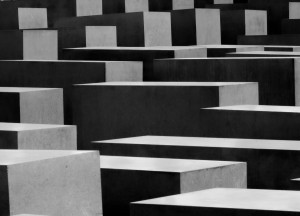
Denkmal für die ermordeten Juden Europas

Denkmal für die ermordeten Juden Europas
//Memorial to the Murdered Jews of Europe

27//4

Quietly situated beneath the slanting gray steles of the memorial, is a small but profoundly dense information center, where not only the chronology of the holocaust, but an array of personal letters, poems, telegrams and diary entries, family histories, and detailed information about the sites of concentration camps that spread throughout the European continent give a compact and complicated account of the Holocaust against Jewish populations.

The entrance to the central rooms is guided by a chronology spanning the rise of the National Socialists in the Reichstag to the arrival of the Allies in 1945.

The chronology is accompanied with photos of street-life as the Nazis ascended to power, and the text is impossible to read without looking into these initially ‘ordinary’ scenes and observing the increasing brutality and decimation as the Holocaust reached ever more brash extremes of violence and horror. The text remains factual, the photos reveal a plight more terrifying than any summary could ever convey.

Yet throughout, there remain flashes of hope, resistance, perseverance – from examples of community organizing, including schools, cultural events and a circulating press in the ghettos enduring the brutal affects of the fascist policy of forced impoverishment, to the uprisings of 1943, and in the more immediate instances of hope, love and resolution that radiate from the poems, letters and scattered lines depicting final moments and departures for the affected.

This is an information center (decidedly not an exhibition or museum, but simply an information center) that is freely open to the public and worthy of close exploration.

Here are a few poems by Miklós Radnóti, whose poem, Postard 4, was on display at the center:

Postcard 2

by Miklós Radnóti
written October 6, 1944 near Crvenka, Serbia
translated by Michael R. Burch

A few miles away they’re incinerating
the haystacks and the houses,
while squatting here on the fringe of this pleasant meadow,
the shell-shocked peasants quietly smoke their pipes.
Now, here, stepping into this still pond, the little shepherd girl
sets the silver water a-ripple
while, leaning over to drink, her flocculent sheep
seem to swim like drifting clouds.

Lines from “I cannot know”

… For we are guilty too, as other peoples are,
knowing full-well when and how and why we’ve sinned so far,
but workers live here too, and poets, without sin
and tiny babies in whom intellect will flourish;
it shines in them and they guard it, hiding in dark cellars
until the finger of peace once again marks our nation,
and with fresh voices they will answer our muffled words.

Cover us with your big wings, vigil-keeping evening cloud.

War Diary

1. Monday Evening

You see, now fear often fingers your heart,
and at times the world seems only distant news;
the old trees guard your childhood for you
as an ever more ancient memory.

Between suspicious mornings and foreboding nights
you have lived half your life among wars,
and now once more, order is glinting toward you
on the raised points of bayonets.

In dreams sometimes the landscape still rises before you,
the home of your poetry, where the scent of freedom
wafts over the meadows, and in the morning when you wake,
you carry the scent with you.

Rarely, when you are working, you half-sit, frightened
at your desk. And it’s as if you were living in soft mud;
your hand, adorned with a pen, moves heavily
and ever more gravely.

The world is turning into another war—a hungry cloud
gobbles the sky’s mild blue, and as it darkens,
your young wife puts her arms around you,
and weeps.

2. Tuesday Evening

Now I sleep peacefully
and slowly go about my work—
gas, airplanes, bombs are poised against me,
I can neither be afraid, nor cry;
so I live hard, like the road builders
among the cold mountains,

who, if their flimsy house
crumbles over them with age,
put up a new one, and meanwhile
sleep deeply on fragrant wood shavings,
and in the morning, splash their faces
in the cold and shining streams.

I live high up, and peer around:
it is getting darker.
As when from a ship’s prow
at the flash of lightning
the watchman cries out, thinking he sees land,
so I believe in the land also—and still I cry out life!
with a whitened voice.

And the sound of my voice brightens
and is carried far away
with a cool star and a cool evening wind.

3. Weary Afternoon

A dying wasp flies in at the window,
my dreaming wife talks in her sleep,
and the hems of the browning clouds
are blown to fringes by a gentle breeze.

What can I talk about? Winter is coming, and war is coming;
soon I will lie broken, seen by no one;
worm-ridden earth will fill my mouth and eyes
and roots will pierce through my body.

Oh, gently rocking afternoon, give me peace—
I will lie down too, and work later.
The light of your sun is already hanging on the hedges,
and yonder the evening comes across the hills.

They have killed a cloud, its blood is falling on the sky;
below, on the stems of the glowing leaves
sit wine-scented yellow berries.

4. Evening Approaches

Across the slick sky the sun is climbing down,
and the evening is coming early along the road.
Its coming is watched in vain by the sharp-eyed moon—
little puffs of mist are gathering.

The hedgerow is wakening, it catches at a weary wanderer;
the evening is spinning among the tree branches
and humming louder and louder, while these lines build up
and lean on one another.

A frightened squirrel springs into my quiet room,
and here a six-footed iambic couplet scampers by.
From the wall to the window, a brown moment—
and it’s gone without a trace.

The fleeting peace disappears with it. Silent
worms crawl over the far fields
and slowly chew to pieces the endless
rows of the reclining dead.

“Miklós Radnóti [1909-1944], a Hungarian Jew and fierce anti-fascist, is perhaps the greatest of the Holocaust poets. He was born in Budapest in 1909. In 1930, at the age of 21, he published his first collection of poems, Pogány köszönto (Pagan Salute). His next book, Újmódi pásztorok éneke (Modern Shepherd’s Song) was confiscated on grounds of “indecency,” earning him a light jail sentence. In 1931 he spent two months in Paris, where he visited the “Exposition coloniale” and began translating African poems and folk tales into Hungarian. In 1934 he obtained his Ph.D. in Hungarian literature. The following year he married Fanni (Fifi) Gyarmati; they settled in Budapest. His book Járkálj csa, halálraítélt! (Walk On, Condemned!) won the prestigious Baumgarten Prize in 1937. Also in 1937 he wrote his Cartes Postales (Postcards from France), which were precurors to his darker images of war, Razglednicas (Picture Postcards). During World War II, Radnóti published translations of Virgil, Rimbaud, Mallarmé, Eluard, Apollinare and Blaise Cendras in Orpheus nyomában. From 1940 on, he was forced to serve on forced labor battalions, at times arming and disarming explosives on the Ukrainian front. In 1944 he was deported to a compulsory labor camp near Bor, Yugoslavia. As the Nazis retreated from the approaching Russian army, the Bor concentration camp was evacuated and its internees were led on a forced march through Yugoslavia and Hungary. During what became his death march, Radnóti recorded poetic images of what he saw and experienced. After writing his fourth and final “Postcard,” Radnóti was badly beaten by a soldier annoyed by his scribblings. Soon thereafter, the weakened poet was shot to death, on November 9, 1944, along with 21 other prisoners who unable to walk. Their mass grave was exhumed after the war and Radnóti’s poems were found on his body by his wife, inscribed in pencil in a small Serbian exercise book. Radnóti’s posthumous collection, Tajtékos ég (Clouded Sky, or Foaming Sky) contains odes to his wife, letters, poetic fragments and his final Postcards.”

And so will I wonder…?

Miklós Radnóti

I lived, but then in living I was feeble in life and
always knew that they would bury me here in the end,
that year piles upon year, clod on clod, stone on stone,
that the body swells and in the cool, maggot-
infested darkness, the naked bone will shiver.
That above, scuttling time is rummaging through my poems
and that I will sink deeper into the ground.
All this I knew. But tell me, the work—did that live on?

« Older posts