B O R O S STREETLEVEL
| & |
COLLECTION R E C L A M A T I O N
________________________________________________________________________
________________________________________________________________________
4//11
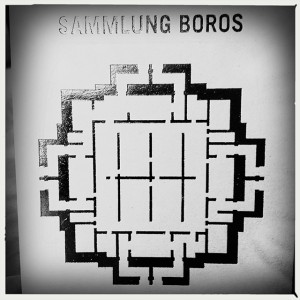
Boros Sammlung Bunker
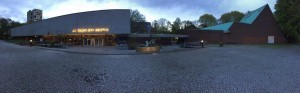
Construction of bunkers in Berlin began as early as 1940, after the advent of allied air raids on Berlin. The construction of the Reichsbahnbunker, (Boros Bunker) began in 1943. The Boros Bunker was designed by Karl Bonatz, in a severely redacted Greek classic style, yet not without ideaological aesthetic detail (the above ground building has false window frames, stylized ledges, ornate symmetry) This building was designed with the expectation that these Bunkers would remain a component of Germania after the final victory of the 1000 Year Reich.
Between 1942-45, 4,000 Germans took refuge here.
From 1945-47, the bunker functioned as a Red Army prison.
From 1947 until the dissolution of the DDR, the bunker functioned as a storage facility for the Soviet party elite. As the walls are 1.8 meters thick, the bunker was ideal for the storage of exotic goods: oranges, bananas, nuts, spices, usw. Castro gifted a shipment of bananas to Soviet party members, which were stored at the Boros bunker; from thereon the bunker was referred to as the “banana bunker”
Which was perhaps more culturally apt after 1990, when from 1991 to ’96 the space was used for a stream of endless techno parties and various other fests of that ilk, until it was shut down and purchased in 2003 for the current exhibition space, taking 5 years of strenuous and cautious renovation.
The exhibit changes every 5 years, rotating through the owners’ (Herr and Frau Boros) collection.
This is not a museum, it is not thematic nor theoretical.
There are no names nor (static) descriptions of the works, just the art.
This museum, complicated by the design of the bunker and the conceptual nature of the collection, necessitates a guide. In order to access the names and (intended) concepts, constructions and collections of the work, one must be verbally and physically ushered through the installations. Many of which are self-apparent, but many more are more effectively illuminated by their his/her/stories and creators.
A few interesting installations:
The Flying Garden – Thomas Saraceno
Dreamers vision of a future city – heightened awareness of interconnectivity and disturbance, all spheres and connections interconnected and inter-effective-affected. “All life connects other life.”
Frequency Curves: “Day Without Yesterday…” – Alicia Kwade
This artist takes interest in Big Bang Theory, and toys with sound produced by light, amplified by speakers, which is not normally audible. This exhibit focused on the limitations of our senses against great universal phenomenon.
Stockholm Trashcans –
A collection of city trash-bins, collected from New York and Sweden, reveal utility, futility, disregard and reverence – through the prism of class divisions – from the state imposing a fine for using trash bins for any other use than garbage (prioritizing property over, perhaps, the comfort of a fire for a homeless camp) to the relative cleanliness of bins found in wealthy districts as compared to the tagged, tattered and “trashed” cans of poorer neighborhoods.
And many many many others.
The collection itself makes demands about class and art, about bourgeois patronage/bourgeois consciousness and the irony of a collection of (sometimes) politically charged conceptual art directly addressing class division, which is withheld from the public except for a fee and requiring a chaperone.
_____________________________________________________________________________
S T R E E T level ART
13//4
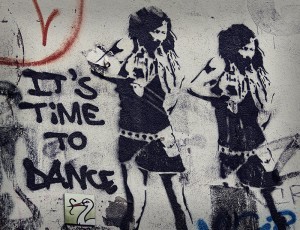
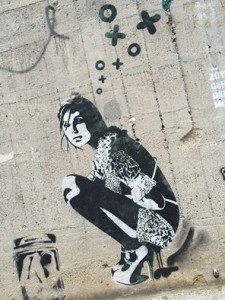
Stencil on the side of the Boros Bunker. Artist: xoooox
In a distinct contrast, here we were guided, unrestrained and free of charge, through the streets of Kreuzberg. A diverse set of artworks are shown, legal and illegal, both skilled and vulgar (left up to interpretation); artists names are given and brief, rumored, histories are told, but these pieces are given no critical explanation.
The difference? “Streets belong to all, street art is a way of reclaiming the streets” and impressing identity/identities upon the face of the city.
From “The Astronaut” a state-commissioned piece by Viktor Ash in 2007 to the pervading “1up” tag lurking on bus-shelters, under eaves, awnings and spanning entire walls, these works cross a wide range of styles, dimensions, purposes and, of course, levels of legality. Tagging comes with the pricetag of 1year in jail, a fine of 2,000 euros, or possible deportation, while stencils, stickers & pasteups are considered a form of littering.
Gentrification has appropriated many of these former-art-dens & havens, converting them into the consumptive highlit world of the culture industry, so, what are the artists to do?
According to our guide, “Many of them have left to buy sustainable farms out of the city, they have started communities of their own, living off of the grid, have created their own galleries or show-spaces.”
They have gone on to a more extreme and, where possible, manageable form of ‘in the world but not of it’. And here, it is not without lament, as in the case of the Blu murals, where two of three were intentionally painted over, that we look on and contemplate these works of art beyond what they offer us immediately – their persistence, and the seeming omniscience attached to the ‘living’ nature of the ever-changing facade of the streets, reveal a street level philosophy of reclaiming these spaces for our (the folks) own ideas and visions and modes of existence – and yet when these ideas and visions and modes are further compromised by an already destructive dominant culture, by encroaching commercial interests, whether by real estate or by attaching a label to or categorizing and instituting this type of interaction, the artists opt to flee or destroy their work, in order to save it from the degradation of exploitation, categorization, and the choke of objectification.