
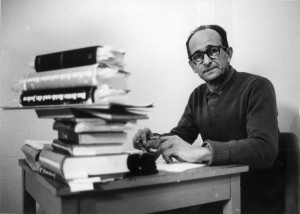
Adolph Eichmann at his desk.
27//4
An evening tour through archives and installations documenting the rise and expansion of the National Socialist regime, at the site of the former Gestapo headquarters. Situated across from the Luftwaffe complex, as directed by Hermann Göring, this district was the throbbing center of administrative power for the Third Reich.
The facts – an onslaught of names and ranks, statistics, strategies, the implicit vie for power, prestige, honor, recognition reduced precisely to the banality described by Hannah Arendt in her book Eichmann in Jerusalem: The Banality of Evil. After a few heavily invested and attentive moments as we were guided through the documentation center, my interest waned to a minimum, I was overcome by an irritation and lack of shock about the inner-workings of fascist machinery. Nothing was, in the abstract, shocking or interesting here, from the dullest bureaucratic moments to the extremes of terror. Probably this reaction was a mode of self-defense agitated by the excess of trivia about the regime, and the inability to make sense of the extremes between the minutiae and horror. And certainly I was fed up after an emotionally exhausting engagement with the stories and experiences of the murdered, those who bore the weight, brutality and expense of this machine. This collection is documentation of fear of the Other manifest in the extreme, and the lifting of the veil here revealed nothing more than the frenzied, albeit well ordered, deluded, yet exact, attempt to realize an Absolute.