
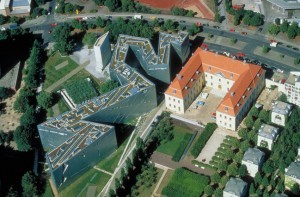
Our visit to the Jewish Museum in Berlin was a but a brief snapshot into the vivacious Weimar period as it pertained to Jewish integration and innovation in 1920s Germany. This segment of Jewish history in Germany is a mere glimmer in a long strand of brilliant cultural contributions and developments, but as this period directly precedes/coincides with the rise of fascism, under the banners of National Socialism, it was in our interest to examine the Jewish experience in the framing of the Republic.
After addressing the central themes of cultural identity, integration, adaptation and contribution, we were directed through the displays of three prominent Jewish figureheads: Georg Wertheim, founder of Wertheim department stores, who represented the sterling example of Jewish mercantilism and retail development in early modern history.
From the regaling tales about the Temple of Retail, we turned to pay respect to the contributions of Magnus Hirschfeld to the roaring 20s. As a great pioneering sexual-rights activist, advocate of women’s rights and founder of both the Institut für Sexualwissenschaft and Scientific Humanitarian Committee, Hirschfeld stripped down taboos and opened up discussion around sexuality and the investigation of sexual behavior as never before.
Here our discussion turned to Margarete Heymann-Löbenstein, whose rejuvenation of aesthetics in pottery ushered in a new vogue in ceramic design and unleashed new stylistic possibility.
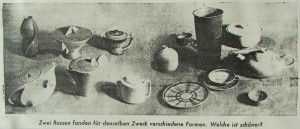
“Nazi propaganda “Der Angriff” newspaper, May 20, 1935. Caption generally translates to “Two races have different forms for the same purpose. Which is more beautiful?””
All three of these figures were revolutionary, as innovators, intellectuals, artists, activists and/or scientists. Jewish citizens of the Weimar period were a mere 1% of the population, yet represented a higher percentage of avant-garde innovation and scientific discovery than the gross population, illuminating their desire for integration and eminence within the broad German culture, which they did with remarkable success.