
26//4
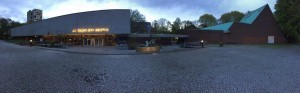
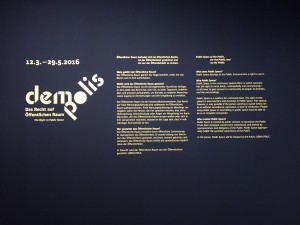
A panel discussion on the subject of the public sphere as a ‘stadtraum’ for an admixture of aesthetic, political (und etwas) expression/creativity/dreaming. This discussion was held at the Akademie fur Kunst, at a satellite exhibition hall in the northern fringe of the Tiergarten. While this conversation was held in German and I couldn’t fully comprehend all of it, the themes of the reclamation of public space and possibility wove a ‘roterfaden’ or red-thread throughout the works and ideas of all of the artists present.
Here’s a few notes from the conversation:
Who does the city belong to?
Originally art in the pubic realm served as ‘denkmaler’ or monuments, yet from the 60’s onward the trend of participation in the decoration of public space has increased rapidly- especially when extended to include or at least consider the role of graffiti art. For architects there is, of course, a technical and artistic side. Designers must ask, “how will we live together?”
Graffiti art, street art, holds a certain geist that animates the urban raum; graffiti is a form of communication. Graffiti artists are ultimately idealists, investing time and money for an art that will likely be destroyed or altered, and yet the streets are writing with endless color and scrawled tags and messages, political, mystical, boastful, territorial, controversial, terrible, etc. There is a freedom and richtigloss to the streets.
Discussion on the function of public sphere led to a discourse on an AUTHENTIC use of space – as envisioned by the Staatsbürger. Unfortunately, when the question of art in public space is put before Berliners, the response is lackluster — the public is not ready for art as central to development, other issues are more pressing, such as housing development. Stadt Mitte/Alexanderplatz/Museum Insel frequently cited as a tourist thoroughfares and little else, wholly privatized, so the question arose, “what is our place, as citizens? what is our architecture? Each project has its own idea about permanence and public interaction.”
“We are all part of this room”
The panel was comprised of six artists/collectors –
Elfi Mikesch – photographer
Jan Edler – architect, designer – mastermind behind the Haus der Zukunft, a forum (under construction) for collaborative discourse on “forward-looking scientific and technical developments of national and international significance”
Florian Matzner -Art historian and curator
Anna Witt – Artist who works found items/garbage
AND!
the most incredible duo of Wermke/Leinkauf, two ingenious and madcap “romantic subverts” of global cityscapes –
creating film and photographs of incredible feats of the imagination and in cunning defiance of the bounds of possibility, both legally and physically. Here’s a quote from a review of their work:
“Over the past years, Matthias Wermke and Mischa Leinkauf have worked together on a romantic, partly subsurface oeuvre that claims, thematises, and celebrates the above-mentioned moment of freedom. Their practice is largely illegal: through temporary actions and interventions they claim our public space, and intently ignore the regulations that apply to our use of it. You could call the duos activities ‘post-graffiti’1, in the sense that it is rooted in, but simultaneously expands on the principles of graffiti by altering its methods and using different media, and thus moves far beyond its dogmas of style-focused formalism. Their actions are subversive antics in the unruly and playful Debordian tradition of the dérive, but here the experiential immediacy and spontaneity of night time drifting is counterbalanced by a conceptual framework of precise planning and execution. A salient aspect in Wermke Leinkauf’s films is the meticulously constructed filmic imagery, which in terms of light, framing, and editing fits in seamlessly with the poetic nature of their artistic project. Most (post)graffiti videos are characterised by nervous hand-held shooting, which translates the intensity of the creative moment into unfettered realism, whereas Wermke Leinkauf take their time to prepare their nightly actions and depict them as still as possible.
Perhaps the most discerning aspect of Wermke Leinkauf’s recent videos, including Zwischenzeit, is the idea of temporality: not only is ‘time’ a defining component of both video and performance as a medium, the artists’ actions can exist only in the shadows of Berlin’s daily reality, sometime between the last subway train late at night, and the rattling daybreaker in the morning. Symbolically charging their loci with poetic-activist energy, these performances forever live on at the scene where they have taken place (in the case of Zwischenzeit: the Berliner U-Bahn network, its tunnels and stations, at night), creating new mythologies for these impersonal but uncannily evocative urban areas. Zwischenzeit is about the time it takes to travel from one subway station to the next. Time that normally passes very fast when riding a subway train, is now slowed down to unveil what is never seen or experienced: the stuff that is in between, the rubble, the imperceptible nothingness. A subway station is what could be defined as a ‘non-space’, but it’s the tunnels that are the real non-space: undiscovered, never truly entered. This is a poetic kind of urban archaeology. A form of play with an emphatic hands-on, do-it-yourself lineage, firmly resisting the rapidly digitizing contemporary play-space, and emphasizing the acute necessity of physically lived experience.”
http://www.wermke-leinkauf.com/en/texts/karstens
Here’s a short introductory clip to some of their feats: https://www.youtube.com/watch?v=nqBvRrAadpo
Overall, well selected panel and a relevant, thoughtful discussion – definitely hope to catch more events at the Akademie in the weeks to come.