Of Blood and Beauty

The Evergreen State College

Author: KDay (Page 1 of 5)

Last Stop- Dresden

After leaving Nürnburg, my next, and last stop before returning to Berlin, was Dresden. This phrase may be over used, but it applies so perfectly here that I must insert it: I saved the best for last. Dresden was gorgeous! The entire city, of course only from what I saw, was so photogenic. I wish I could stay here longer, but I guess leaving now will make me thirst for more in the future. Like pretty much every German city, there is a new town and an old town. The old town is where the big beautiful buildings are that people visit throughout the day. But I stayed in Newtown, and what a good stay it was. Dresden has one of the best young scenes that I have come across. Every night, the entire Newtown is filled with people, most of whom are roughly my age, walking through the streets, sitting and talking and having a great time. Dresden, more than anywhere else I have been, reminds me of Olympia, in a good way of course. There are so many small unique restaurants and stores, as well as murals and street art, that I found myself stopping in my tracts over and over again just so I could appreciate what I had seen. Just north of this area is a large grass park too that, thankfully when I went, was a great hangout spot for tons of people into the night.

I only spent two nights here, like in Núrnburg, but one of the days, me and two other hostelers  took the city by storm and tried to see as much of it as we could in one day. We walked far and covered most of the ground we set out to accomplish. By the end of it a huge rainstorm came blowing through and forced us to retreat onto a tram and head back to the hostel. By the way, Dresden has tons of trams. No u-bahns to my knowledge, but my goodness their tram game is strong.

It is hard to leave this place, especially since the sun is shining so brightly and it is a glorious day. But I must return to Berlin. Tomorrow we present our projects that we have been working on throughout our stay, and so I will get to see my classmates again after almost three weeks of being on my own. So long Dresden, you were wonderful. And thus my wanderbondage has come to an end. Now it’s time for business. Last Stop- Dresden Last Stop- Dresden Last Stop- Dresden Last Stop- Dresden Last Stop- Dresden Last Stop- Dresden Last Stop- Dresden Last Stop- Dresden Last Stop- Dresden Last Stop- Dresden Last Stop- Dresden

Nürnburg

I spent two nights in Nürnburg at a hostel quite close to the HBF. This theme seems to be recurring. I seem to want to not have to travel very far to get to my hostel after arriving in the city. However things turn out from here on, I know that this hostel was a great choice. First, the people I met there were very fun and unique to other places I have been. Again, though, the hostel game is heavily dominated by traveling Americans. Every once in a while though, you meet someone from somewhere you wouldn’t expect. For instance I met Ricardo, from Brazil. It didn’t take long after meeting him before I realized most of our conversations were going to be football oriented. We had many a long chat on this topic; he suggested to me a couple games from past years that would be worth rewatching, and I told him my perspective on the Champions League final, which had just been played.

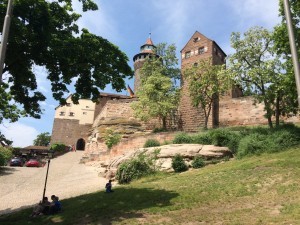
Aside from the people, the city itself was gorgeous, especially when you knew where to look. Nürnburg is more developed and touristy than I was lead to believe. The cit is in fact huge, and all the traditional areas are drenched in modern stores. It is hard to find anywhere that really remains untouched by this. For the most part I spent my time in the middle of the city, inside the old town. This area is surrounded by an amazing wall that, I’m assuming, used to be the border of the city. Inside this area area the main tourist hotspots. Since I wasn’t going to be there long, I decided to hit these. There are a couple large prominent churches inside this area, as well as a river, Pegnitz I believe, and some beautiful bridges. The crown jewel of the city though is the castle in the back of the walled area that overlooks the whole city. From the ramparts here, one gets a free view of the entire south side of Nürnberg, this was probably the main highlight.

Althoug my time was short there, it was very good and informative and I now can say I know a little bit more about Nürnberg. Nürnburg Nürnburg Nürnburg Nürnburg Nürnburg Nürnburg

Leaving Munich

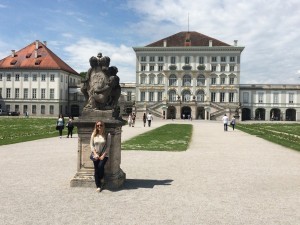
My time in München has come to an end, unfortunately. I spent four great nights in the beer capital of the world, three of which were at the home of Natalya through Airbnb. This Russian girl from Ukraine, who has been living in Germany for 14 years struggled with her English, so we each to advantage of the opportunity to learn from one another. I can confidently say my German has at least become better during my time in Munich, more so than some other places anyway. Together we attended a party in the same apartment building she lived in, we went to Nymphenberg Palace, ate amazing traditional Bacarian food and went to a her favorite beer garden, these amongst other things. If anyone comes through Munich, I highly, highly recommend Nymphenberg Palace; however, if you can, attempt it on a beautiful, sunny day. I know that’s out of your control for the most part, but it is worth it if you guess right.

Now I begin my trek back to Berlin. First I will spend two nights here in Nürnburg. I’m not sure what all I will do here yet, but I’m sure I can figure something out. Next comes Dresden, but I’ll get to that later.

Leaving Munich Leaving Munich Leaving Munich Leaving Munich Leaving Munich Leaving Munich Leaving Munich Leaving Munich Leaving Munich

All About Allianz Arena

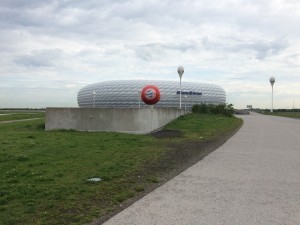
For my second Psychogeography experiment I decided to go on a tour of Allianz Arena, home of FC Bayern Munich! Like many of the places I have been to while on this wanderbondage, this is a place I never thought I would get to go to. This stadium opened up in 2005, which is very new considering the history of stadiums in this country, so it is built using all kinds of state of the art architecture and designing. Before using this stadium, Olympic Stadium was where Bayern played its matches. This is peculiar considering both the rich history behind this club as well as the fact that this field wasn’t designed for football but rather Olympic sporting events, so it still has the track that goes around the field, which both players and fans do not appreciate. One of the most prominent features of this new stadium is that is is capable of lighting up at night, in different colors, depending on who is playing there. If Bayern is playing, the stadium lights up red, if TSV Munich (from the 2nd league) is playing, the stadium turns blue, if the national team is playing there, white, and apparently on St. Patrick’s Day it turns green. My tour guide also informed me that recently, for a match against Italy, the stadium lit up with the colors red, black and gold, to symbolize the national Deutsch colors.

All About Allianz Arena

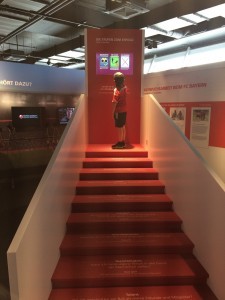
This stadium can hold 75,000, so by definition, it is the second largest stadium in Germany. Dortmund’s home stadium, Signal Iduna Park, can hold upwards of 80,000. However to counter this, one could argue that it is what happens on the stadium, not around it that matters. And certainly no other teams in this country, in many countries can claim dominance over the domestic leagues like Bayern Munich can. Just recently, they finished wrapping up their 25th Bundesliga title, the next closest would be Dortmund with 5. This level of dominance has grown to aggravate many. FCB had won the last 4 league titles in a row, which has never been done before. True fans of the sport relish the competitive nature of the league and love to see underdogs thrive. Now however, it seems everyone except FCB and Dortmund are underdogs. While many may be disappointed with how the shift of power has been tilted, there is no doubt that the people of this city love seeing their team win over and over again. Because this stadium was built so recently, it allowed a special section to be allowed specifically has a museum dedicated to the history of FCB. How many clubs can claim this?

All About Allianz Arena

FCB was formed in 1900, when a group of 16 men decided to break away from the local gymnastics club, who saw football as a barbaric English game and would not support it in their institution. So, these men formed their own club and it has kept the name ever since. The club was an immediate success, winning all of its first games against opponents by scores of 5 or 6 to zero, I sign of things to come I’d say. In its early years, the club also went through many political ‘advancements’ (for lack of a better word). Problems such as field times and spaces  were hard to come by as the sport in general was only just beginning to gain success. In fact Bavaria as a whole was rather slow to catch on to the football bandwagon as places like Berlin and Dortmund saw prominence in the sport many years earlier. One problem found a solution and FCB partnered up with the local (organization, I forget who, which is disappointing as this is rather important) in 1906 and were able to play at more regular intervals. In order for this to happen though, the club would have to wear red shorts instead of the traditional blue and white. Blue and white are the colors of Bavaria as I have found out after spending a couple days in Munich, so I had wondered why FCB famously wore red all the time, and now I had my answer.

All About Allianz Arena

In the first couple decades of FCB’s existence, much of their success was due to the coaching and organizing of two Jewish men, Richard Dombi and Kurt Landauer. So when the Nazi movement began to gain momentum, and both of these men were forced into exile, the club naturally suffered in its efficiency. All of War War 2 however, naturally took its toll on both FCB and football throughout the country as well. Many players were soldiers and many did not come home. In response to this, after the war, Kurt Landauer returned and helped guide his side once again, but ticket prices were also severely reduced. The equivalent price of a ticket at the time was something like 50 cents. The club wanted to give the people something to cheer for after  the devastation that WW2 had brought. And it worked, attendance slowly increased more and more throughout the years, and the fan base grew so passionate that when FCB made it to their first German Championship, which was played in Nürnburg, thousands of fans rode their bicycles hundreds of kilometers to the game. FCB rewarded this loyalty with free tickets and refreshments at every resting point along the way home, (after they had won of course).

All About Allianz Arena

FCB has always had a reputation for trying to connect with their fans. A shining example of this is the fact that in the stadium, they have their very own beer garden. Beer in Deutschland, and especially in Munich, is a national treasure that they take very seriously. And they always have! Munich was in fact founded by monks, hence the name, who often brewed their own beer. Inside the halls leading to the beer garden, there are several pictures of players, dressed in the traditional Bavarian cloth known as Lederhosen, drinking beers with each other. There was in fact also a team picture, with everyone dressed this way, with beers in hand.

All About Allianz Arena All About Allianz Arena

In the late 60’s and 70’s FCB boasted the names of incredible German legends in their lineup. Names like Beckenbauer, Muller and Maier, who all played for the national team as well. The national team of West Germany, that is. With significant contributions from these players, some of the greatest of all time, Germany won the highly public education and exciting World Cup of 1974, defeating a powerhouse Dutch squad captained by Johan Cruyff. The the trophy in Germany, and all the star players coming from Munich, FCB saw a decade long stint of dominance that set the modern trend for their reputation in Deutschland. Many claim that this squad, with these players, was the best they have ever had. Even better than the team who famously won their first treble in 2013. The treble is winning the league title, the domestic cup and the European championship (Champjons League) all in the same year. These incredible names have certainly added to the club, however, make know mistake, every player is remembered. In he stadium, there is a hall of fame with a face and name for every player that has ever played for FCB. If you came through their ranks, you were acknowledged. This type of respect for the players claims its source for the fans, who essentially idolize the players of their team, and consider them part of their Bavarian family.

All About Allianz Arena All About Allianz Arena

FCB also claims one of the most efficient academy systems in the world. I have discussed earlier about the option of young kids, as early as age 7 being picked out for football with the idea that they each have the potential to become the next best players the world. However, what sets FCB apart is their commitment to building these kids up to be good people first and foremost. This is what I respect. They have a three part system of personal, academic and sporting development. Like any school team, they claim that personal and academic come first. This gives off the notion that kids will be successful in life here,  no matter if they play football professionally or not. Of course, what they really want is to keep winning trophies, make money and have the best players, but that doesn’t sell to they out has well. In the end, football in Deutschland starts with the youth. These kids, decades from now, may or may not have played ball, but it will have been so integral in their lives that they will always love it, watch it, play it when they can, and come together with friends and family through it.

All About Allianz Arena


Change of Plans

My original plan was to stay in Nürnburg after Kaiserslautern, but the two family friends that my Mother knew, were both busy and somewhat unavailable. So I decided to skip Nurnburg and save it for June, post class, and instead head to the Capitol of Bavaria, Munich. I arrived a couple days ago, spent a night in a hostel and now found an Airbnb to stay in for another couple days before making my way back to Berlin.

Here I will need to figure out my second PsychoGeography, because I originally intended to do it in Nürnburg.

Like Kings in Kaiserslautern

After my brief stint in the Düsseldorf area, my next stop was Kaiserslautern where I would meet up with our old friend David Hollifield. On my way there I managed to catch a train along the Rhine River. Along it there were many precariously placed yet beautiful called on the tops of hillsides above the river. These were similar to the ones seen from the trai we caught to Prague, however, there were much more here. After I got off in Bungen and caught a transfer train, the surrounding area quickly turned to a rural landscape. For miles and miles, or rather kilometers and kilometers, there was very little other than trees and fields. There were large forests here as well, not just the small patches in between fields. After all, this was the northern tip of what could still be considers the Black Forest, of which we have all heard so much about.

Like Kings in Kaiserslautern

After seeing beautiful fields and trees, the landscape quickly and suddenly changed to buildings and concrete. Before I knew it I had suddenly entered into the city of Kaiserslautern, population 100k. This small town was quite isolated from the rest of Germany, I have spoken with multiple people since. Most Americans have never heard of it. Many Germans had not heard of it either, but no one had ever been there. And here I was.

Like Kings in Kaiserslautern

David and his wife, Mary Kay picked me up from the train station, we hugged it out and we were on our way. David lived actually a 20 minutes drive outside the city. During the drive he told me the this area was dominated by one of the largest US military bases in Europe. This made sense given David’s military history. He and his wife had been here a few years earlier, and they loved it so they decided to move here. Their place outside the city was only temporary. In only a week they would be moving into their new house in the city, which they were excited for, given the horrible traffic the area they were in was known for.

Like Kings in Kaiserslautern

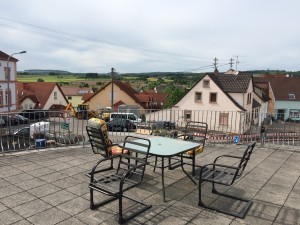
When we arrived, I was delighted by just how far into the country we were. This was definitely rural Germany. There may have been small 1000 person villages every once in awhile, but there were fields everywhere. Their temp. place and an awesome patio/deck which had an amazing view of the nearby landscape. It was still flat here, but there were more hills than Hamburg and Berlin, that’s for sure. I claimed the sofa as my sleeping spot for the night and enjoyed the next couple days catching up with David and exploring this hidden gem of Germany.

Like Kings in Kaiserslautern

Borussia

Aside from being quite the artist, Emil was able to shed some light on the history of football in northern Deutschland. Many years ago, at the turn of the previous century, coal had been discovered in this part of the country. When it was, Germany had recruited thousands of workers from Eastern Europe to move their and dig for it. These were people from Polish and Slavic backgrounds, in what was at that time Eastern Prussia. With them they brought their cultures as well as the label of Borussia, which is German for Prussia. At the same time as all of this was happening, football, as a sport had begun to emerge as the popular pastime as we know it today.

As coal miners, these Borussian men were the definition of proletariat or working class. After they finished their hard physical labor, they would play football as a way to unwind. The owners of the mines, the aristocrats, saw them and their football as a low game and would have no part in it, the workers relished this. Eventually clubs were formed in this region, two of which became more prominent than the others, and still exist to this day in the highest class of German football. These clubs were Borussia Dortmund and Borussia Münchengladbach. Although the times have certainly changed over the years, the division between worker and owner is still ever present. Today football has become a billion dollar industry, where the big wigs and the top cats have all the money and control the enterprise. Players are able to be paid large sums of money, only when they are able to bend to the will of these owners and do as they say, no matter their performance on the field.

Emil and I had an interesting discussion after he told me this, and it was primarily surrounding a theory of mine. Coal mining is hard, physical labor, and doing so makes a man much stronger and thus would make him a potentially better footballer. I told him about how, in the first decades of the invention of football, the sport was primarily dominated by strength. Tactics were not so fully developed yet and it was not until the 30’s when the influence of tango in Uruguay made players more skillful with the ball and thus feigns and moves became more prominent. No, before all this, the game was primitive, run faster and be stronger. These coal miners were bred to be good ball players, and it shows now all these years later in how they had managed to become so prominent in the rise of football that, these two clubs specifically, are held in such high prestige to this day.

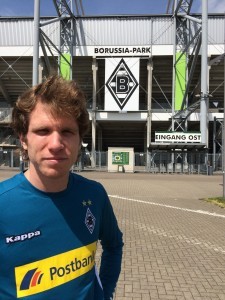
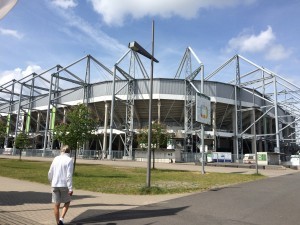
Later Emil brought me to the home stadium of Münchengladbach. They essentially had a whole autobahn exit dedicated to their stadium. Emil said that when there were games, the whole place was packed and that many people would be outside the stadium who couldn’t even get in.

Borussia Borussia

DFB Pokal

While in Viersen, I was able to watch the DFB Pokal final. This is essentially the German championship when it comes to football, the only higher award is winning the league. The two teams playing against each other were Bayern Munich and Borussia Dortmund. These two teams had spent the entire season in first and second place respectively. Dortmund had in fact had the best season they have ever had, and it still wasnt enough to take first place. This game, though, was highly anticipated. The captain for Dortmund, Mats Hummels, who I think is the best defender in the world, was playing his last game for this club, and would be playing for Bayern Munich next season.

I went to the main square in a bigger town next to Viersen, called Münchengladbach. Here there were many bars and restaurants, all packed together, all showing the big game. For the first half, I was out in the crowded seating area outside without a vey good view. But for the second half I moved inside one of the bars, and found a small room at the back that had many open places. I found the seat with the best view and ordered some food to complete the second half.

DFB Pokal

The game was amazing, there was no clear favorite, both teams had had their chances and opportunities, as well as their swings of momentum. Unfortunately in the 60th minute roughly, Hummels had to get subbed out with a hamstring injury. So now Dortmund had a new player, who wasn’t their captain, on the field. This was, though, a sign of things to come. Dortmund had picked up some new talent who would be joining in the offseason, and would also be parting ways with another one or two players.

In the end the game went into overtime, tied at zero, and then to penalty kicks. No matter how hard they had tried neither team was able to put one in the back of the net. So it came down to pk’s and Bayern won, damn I was rooting for Dortmund, and the German football season had come to an end.

Kultur- Emil’s Work

Before I came to Düsseldorf I knew that Emil Schult was an artists. He had created two pieces of work that he had given to my parents. So I had seen some of his work and I was aware of what he could do. However, after spending a couple days with him, I found that I had really known nothing about him before hand. It all started with his studio.

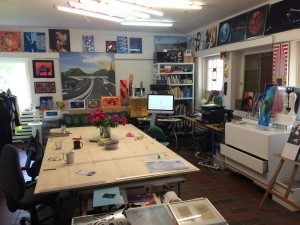
One day Emil decided to bring me to his studio, which was a small apartment a short walk from his house.  This was where he did all of his work. I tagged along, expecting to see some stuff similar to the ones he had given my parents. When I got there, though, as soon as he opened the door and I walked in, my mind was blown. The place was filled with all of the large works, from pictures to sculptures as well. Along with all of his tools and tables. This was a place where he had spent countless hours, I could instantly tell. What surprised me the most was just how many works there were all around in the studio. There were two main rooms, where most of the equipment was, then a kitchen, then a whole downstairs for storage and a bathroom.
Kultur- Emil’s Work

I call his works ‘pictures’ because I don’t know what else to call them. They are the types of work where you look at them and you have no idea how they were made. I still to this day am not entirely sure of the whole process, but I think I at least have a better idea. The works, for the most part, consist of layers of different papers, each cut out to a specific, very fine shape, via scalpel, then they are each individually painted a specific color, before finally being attached to each other some how, mostly by glue. When you see the works he has created, you cannot believe that they were all done by hand. There is so much detail in every work that it is easy to assume that the whole things was done by a computer, at least that is how I felt at first. He does use a computer, more for the design and drafting of the images, to get all of the dimensions correct, before getting to the hard, or maybe he might say fun, work done by hand.

When we arrived there, he had a specific job that he had to do. He had just finished creating cover for a record label, Rebirth they were called, and he needed to sign the pic and package it up and mail it. He had doe this process thousands of times so he really didn’t need my help, so I was surprised when he asked for it and jumped at the offer. These valuable works, which are finalized by being cover in a layer/frame of glass, need to be covered in his hard yet soft cardboard like material. He cut out the pieces to frame them, just right, on every side, before taping them all together. I actually cut my finger on a small piece of the stuff he cut out. He said be careful, because although it felt soft on the outside, underneath was a layer of multiple to help make it durable, and he ripped open the small piece to show me.

Before and after I helped him, I had been browsing all of the works hanging up on the walls. They were each so unique and different from the last. They all had this distinct touch of modernism in their display, from the fine details that made their reflections seem futuristic. The subjects ranged from animals to abstract space designs. I asked him which was his favorite and he said to go look in the kitchen. I did so and above the sink was a small picture of a dog. The dog? I asked, no turn around, he said, I did so, and then I saw it for the first time, I don’t know how I could have missed it. There were two shelves, as long as the room itself, Completely filled with packed up works. You see, he said, I have created so many that it is hard to choose. However, he said, that one I am quite proud of. He pointed out one of the more prominent works that was on display on a stand I the middle of the room, so it made it seem like he had not just finished making it. It was an intriguing and yet bizarre image of a hand, colored unusually, and in its palm was a small computer chip. In the chip was were all these small, tiny details began to emerge the longer and closer I looked at it.

The next day, Emil brought me to the city of Düsseldorf, and we went to a music school called Robert Schumanns, I think it was called. Having not been told what exactly we were doing there, I was expecting to see a musical performance. In the building we were in there was a stage with a lot of people going in and out, there were signs everywhere that reaveled that there was going to be a show there later on that night. However, we wouldn’t be seeing that, instead we went through a door at the back of a room with 15 other people, all but one of whom were roughly 50+ year old women. We we to down some stairs and through another door. In this room Emil had everyone sit in some chairs in front of another small door. There were four large works of his hanging up in this room. It was here that Emil started talking to everyone, in German of course, I still had no idea what was going on. From what little I could discern, he was discussing the Earth and specifically places in the Middle East, one of his pictures was of the large tower in Dubai. After a short talk, everyone put in these funny shoe cover and we walked through the small door. When we got in we found ourselves in a dark, dimly lit room, with small cushions in the middle  for everyone to sit on. Once everyone was seated, Emil, holding a remote in his hand, turned on one of the lights which illuminated the wall behind him, revealing a large immensely colorful wheel of sorts. Emil began to speak to the people again, and this is when I realized that this was all a presentation of his. Again, he spoke in German, so it was hard to pick up on the full dialogue, but I did hear large numbers recited over and over again, as well as an interesting comparison between ich bin and je suis, which both mean the same thing. Emil showed the back side of the room, changing the lights to his will with the remote, which had a golden wall which unfolded revealing a neon cross, the Jesus kind. I gathered that all of the gold walls were in fact painted with real gold, but were also mixed with another sub stance to prevent staining. The ceiling had an interesting space/astronomy design that was only visible when properly illuminated. At one point, Emil stopped talking and began to play some music. Everyone was quiet while it played. It was an interesting tune, it sounded very futuristic, consisting of a calm constant sound that occasionally would change to a high pitch. For some reason, accompanied by the space ceiling, this made me think of aliens.

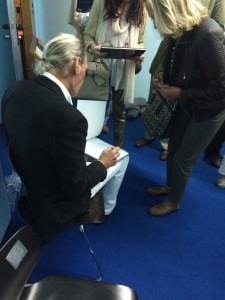
When the music ended, everyone started to leave this magical room. Outside I the small room with chairs and the big pictures I sat next to Emil as he began distributing small books that everyone was buying from him. Each person paid ten euros and he would sit there and sign the book. Everyone, all of them bought a copy. After all was said and done and me and Emil were walking back to the car, he finally revealed to me what I had seen. This room, in which he presented, was called the Crypt, and he had been presenting this room a couple times a week to different groups of people each time, who had come from all over to see it, for over 15 years. It was one of the most visited exhibits in the area. The main concept, he said was the discussion of people and life on earth all being as one on this planet in the eyes of God. This was interesting for me to hear, because Emil, to my knowledge was not a religious man, yet he spoke so clearly and truthfully on this matter that I wasn’t sure any more. I brought up how I had just heard at the Untying the Mother Tongue conference that for many cultures the concept of religion did not exist, and this was simply their way of life.
Kultur- Emil’s Work

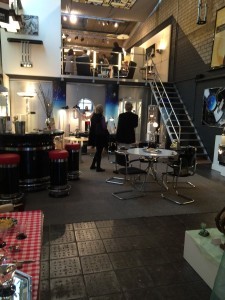
At our next stop, we went to another exhibit, this time of an interior decorator. In this building there were tons of works of art, including many of Emils, but there were also many other things, everything you could think of when it comes to interior decoration. There were tabled and cabinets, as well as many old, from the 50’s or so influenced pieces. We stayed here for a while, I was mostly within a couple steps of the snack bar at all times, before heading off to our last stop. One more art gallery. Here, in the heart of downtown Düsseldorf, there were no works by Emil, but rather all of them were by one artist. This place was called he serateh gallery, if I recall correctly. We were only he a short while, Emil wanted to go in and say hello to a couple people. Afterwards we left and walked around the corner and met his family sitting with another family at a Thai restaurant. The father in this other family was named Rolf, he was Emil’s oldest friend, and together they had formed the musical group Kraftwerk many years ago.
Kultur- Emil’s Work


Doin it up in Düsseldorf

After spending a couple nights in Hamburg, my next destination was a six and a half hour bus ride away in Düsseldorf. A long time family friend, Emil Schult, lived there. I had not seen him in more than ten years, but my family had still maintained contact with him, and thus a connection was possible while in Germany. He had actually spent a year living in the US when he was my age, he lived with my dad and his family, so in a small way our roles were switched.
The first night was a bit of a disaster. My bus was already arriving a bit late into the night, so I felt bad for having Emil pick me up. But to make matters worse, I got off my bus one stop too soon. The town of Duisburg sounded very similar over the intercom to Düsseldorf. I was standing outside the Hauptbahnhof talking with Emil, trying to figure out where he was, when I suddenly looked at a carving on the ground that said Duisburg and my heart sank. I looked at a map and sure enough I was in the next town over, another 30 minute drive away. 30 minutes later, Emil, bless his heart, and his daughter Lianna picked me up. But to top things off for how bad things were, that morning I had awoken with a sore throat and a bit of a headache, which had only become worse during the long, uncomfortable bus ride. Jump ahead, this illness lasted my whole stay in Düsseldorf area, very disappointing. I say Düsseldorf area, because as it turns out, Emil actually lives in Viersen, a small town 30 minutes west of Düsseldorf, quite close to the border of Holland. Before you ask, no I did not go to Holland, but I might in June.

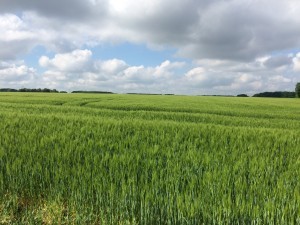
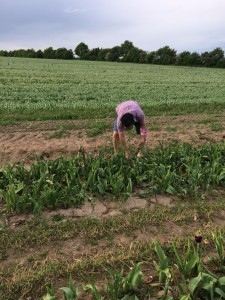
Viersen was much more of a rural/country area than I was anticipating. The twenty mile distance outside the densely populated Rhineland area was enough to turn the landscape from buildings to farm fields separated by the occasional small cluster of trees. The first thing I did with Emil the next morning was go on a walk through a field near his house to truly get a grasp of the scenery. With the land being so flat, it was easy to see for miles. The church towers stood out on the horizon and he said that for hundreds of years those chuches were what people around here had used as guides for transportation since they were so prominent.

Doin it up in Düsseldorf

« Older posts