Of Blood and Beauty

The Evergreen State College

Author: Krawdaddy (Page 1 of 2)

SpreePark Geist

I visited Spree Park on a sunny day with friends from home.

We recognized the location from, maybe embarrassingly, a lot of films and that is why I steered us there. We were hoping to get to explore the abandoned rides, but the park was overgrown, often dismantled, and fenced off by a tall fence. Built by the GDR and opened in 1969, it was one of the few entertainment destinations in East Germany.

The Ferris Wheel is the clear eye-catcher, peeking above the trees In view quite a ways west up the Spree river. When we finally entered into the forgotten park, we could see that the wind was moving the wheel squeakily. How satisfyingly eerie. I pushed my phone through the fence to capture a video of the motion. I think I could be YouTube famous if I play my cards right:

My friend Jan told me that the automatic motion of the Ferris Wheel has attracted lots of trespassing riders, who have many times become stuck up high in the air when the wind stopped mid-ride. I can’t stop thinking of trying to anyway.
PSYCHICCity GEDäCHTIS

Kaiser Wilhelm Gedächtis KIRCHE 

* ICH * LASSE * DICH * NICHT * DU * SEGNEST * MICH * DENN *

[I will not let you unless you bless me]

ALTARRAUM/sanctuary

Blue room. Blue around the crown. Just for my crown and eyes to see, not for my feet to see. Smatters of gold and red panes in the blue, reminds me of Egon Schiele.

Here’s what I mean about my foot perspective: the design of the church includes entire walls of stained glass cells, the equivalent of three stories high. The glass starts 12 feet up the walls of the sanctuary. We (MaryJane, me and the other tourists) feel like we are in the ground, we feel like carrots and our root crowns are all that pop out of the soil to feel the blue light of twilight.

MJ and I had a hard time getting to this spot and I am still buzzing, here now where I sit. We sang like a prayer on the train and then more in the hallway (der Flur) as we walked out of the underground.

I hear you call my name, and it feels like home

Someone began playing the organ, in fragment practice phrases and it washed out the carrot-ness of being in the room. Now my most activated sense is letting the sound comb out all my body’s ways of being here.

DRAUßEN im Platz

Outside in the Platz between the sanctuary and the church my head is getting filled back up with the sounds of a shopping center, boiling an egg. My attention is rushing back into the church and flying around the wee fairy carved into the wall.

Our first tour, as I recall it….

The first tour we did as a class in Berlin started at the Brandenburg Tor, on Monday the 4th of April. It has now been 3 weeks and I’m still letting information from that tour buzz around my mind like a swarm of fireflies.

Halfway through the tour we visited the Memorial for the Murdered Jews of Europe, which fills a city block in Mitte. We passed through the memorial on our own and met at the other side to talk to confer on the walk. Our guide made it clear that the architecture is not meant to symbolize anything. It consists of 2711 stelae that are ordered at a uniform distance from each other in rows, but their height and the slope of the ground is erratic and confusing. Disorientation in the confines of supposed order. The number 2711 is random and meaningless, the stelae are not meant to be symbolic, nor the material, the location, the texture. When we reconvened on the other side Gabriel mentioned that it reminded them of an archeological dig, the memorial is what remains after an excavation of the wreckage.

This week we will return to that site including  the information center below, which promises us a lot more words on the matter.

Berlin Wall memorial park

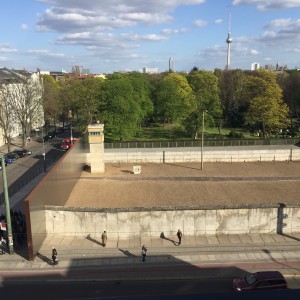
On Wednesday, Rachel (our CIEE tour guide) took us through the Berlin Wall memorial. The section dedicated to the memorial is the patch where the Church of Reconciliation was trapped in the death strip between the walls, and was eventually torn down for better patrolling visibility. The wall exists still in fragments, including a big chunk that has been rebuilt to depict the size and intimidation of the death strip that divided Berlin during the Cold War (see photo below).

We watched two quick videos that were surprisingly capitalist propagandistic. It was disappointing that the museum didn’t present the information more critically. It is clear that that the construction/maintenance/elaboration of the wall was oppressive literally and figuratively, but during this time presently when there is a rising and threatening conservative right-wing extremist movement in the East of Germany it is important to pay attention to both sides of the wall. Most of the viewing happened from a high tower in the West, looking East.

Berlin Wall memorial park

Jüdisches Museum – Berlin

We were given a guided tour of the Jewish Museum in Berlin this last Monday, with a half hour at the end to explore on our own. The main body of the museum is ordered chronologically from the first time Jewish people are known to be living in Western Europe. I tried to start from the beginning of the installations with my half hour, but I didn’t get far at all so I promised myself that I would to talk a little more in.

———

Our tour guide’s (Viktor) lecture was on the years between 1871-1933, beginning with the construction of the New Synagogue in Breslau (now Poland) in 1872. The architecture referenced Christian architecture and was an expression of the Jewish community’s  citizenship in what was the newly founded “unified Germany.” Viktor emphasized that the Jewish Germans had been made to take painfully tiny and patient steps to “earn” their civil rights within the German nation in those years leading up to 1933 and had only a few years of freedom before the rise of fascism and the anti-Semitic agenda.

——————

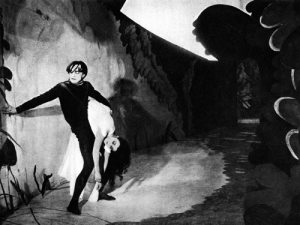
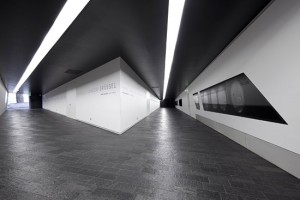
Visitors of the museum take a tunnel from the welcome area into the modern museum, the pathways below are called the “axes” and are an architectural embodiment of three paths of Jewish life in Germany after the third reich: Exile, Continuation, and the Holocaust. These hallways are twisted  in scale and measure. I was immediately reminded of the set design of The Cabinet of Dr. Caligari, a German silent horror film from 1920. Jüdisches Museum – Berlin Jüdisches Museum – Berlin

“Schnauze mit Herz”

Week 3 Psychic City in the Wedding Neighborhood

I spent the late morning into early afternoon in Wedding, known as the “Schnauze mit Herz” of the city according to wiki. It is a working class neighborhood in the Northwest of Berlin. I meant to visit Volkspark Rehberge, a huge people’s park with apparently a lot to explore, but because it was raining and maybe because the Saturday bustle was attractive to me I walked around the main streets for the duration of my time.

Coming home I stopped at a bar in Steglitz and wrote out what I had to say about the visit. Here are two extracted prose bits from the scribbles:

Rule #1: every third word

Wedding city’s a a a was end first from assigned flag to wars

other the the Herz a an poor of I go people’s try the or discover mean boar

it rainy and want on so toward and lined of the were Zehlendorf

shops main just interspersed space were because Saturday

seem felt home not was who wallet Euro hip a and I it park.


Rule #2: 2nd // 3rd // 2nd // 3rd….words

neighborhood a satellite village

a later was end the gasp the the flag

to ego the nations city the Herz not but affordable

poor of city to to park try the enclosure at what mean boar

but grey and I want on feet I the and lined arteries neighborhood structures

more flats on main just few home the busy it Saturday seem it a Euro

hip with cheap warm never it park

Sammlung Boros, Bunker, Berlin Mitte

The Boros Collection is shown in a bunker built for the Nazi establishment between 1941-1942, it has since been used for food storage (“the banana bunker”), paintball, fetish parties, raves, and then purchased by two art collectors in the early 2000s to use as a gallery.

It is hard to imagine that the Chimera-like building could fade into the background enough for an art installation to succeed. It is not neutral in aesthetic or memory, so many of the installations were altered to respond to the space, some made you forget and some were built with the context in mind.

The floor plan looks like a labyrinth. A labyrinth tries to keep a secret, without wholly containing it.

ALARMS AND INCURSIONS

Psychic City Scores

by Kendra Freas and Maryjane Dunphe

ALARM EVENT 1: DIVINATION EXERCISE

Set an alarm for 2:15 P.M. on Wednesday, April 13th, 2016, if possible label the alarm: Divination. At this moment find North, no technological assistance.

ALARM EVENT 2: TOES

Set an alarm for 5:35 P.M. on Saturday, April 23rd, 2016, if possible label the alarm: Toes.
At this moment put all of your attention into your toes for 10 seconds.
Do not talk about it.

ALARM EVENT 3: COMMUNICATE

Set an alarm for 2:45 P.M. on Thursday, May 3rd, 2016, if possible label the alarm: Communicate. At this moment, if you are speaking, stop. If you are not speaking, start.
If you are alone, say: “OK.”

ALARM EVENT 4: WINDOWS

Set an alarm for 3:45 P.M. on Saturday, May 7th, 2016, if possible label the alarm: Windows. At this moment, close your eyes for 20 seconds while recalling your surroundings to the best of your ability.

ALARM EVENT 5: FRIDAY CHOREOGRAPHY
Set an alarm for 11:05 A.M. Friday, May 20th, 2016, If possible label the alarm: Choreography.
At this moment, enact any of the five gestures.
1 Run you hand through your hair
2 Lift your left leg and extend, stretching your foot
3 Roll up your sleeves if they are not already rolled, if they are then un-roll.
4 Inhale a lot of air audibly, exhale
5 Lose your footing

Between Ear & Mouth

image
Sprache und Wissen symposium
Haus der Kulturen der Welt
Between Ear & Mouth
Berlin 2016

Terézia Mora, a fiction writer and translator, moderated an hour’s conversation with Lilian Astrid Geese and Günther Orth, both interpreters, on the craft of Simultaneous Interpretation. I found this symposium while quickly scanning through the offerings of Sprache und Wissen, and I had smushed the concept of interpretation into my understanding of translation and therefore was surprised by the track of the talk.

There were two interpreters in a booth above me, activating exactly what the talk was about by interpreting the German into English. English speakers like me wore headphones that received the English at a very slight delay to the German, laughing/responding seconds behind the direct listeners. Clearly, the talk was highlighting the job and it seemed, or maybe I was projecting, that the interpreters would stumble when they were translating concepts that discussed THEM doing their job. That task would be mind bending, finding yourself the subject of your interpretation has to be a brain twister.

Orth described the process as the act interpreting the concepts from the speech into images that form a whole from the original language, a conceptual image, and interpreting that back into language. Spoken word–>concept image–>spoken word. Spoken language is semi-automatic and the interpreter can rely on that mode, with no time to process or pick apart the concepts while benefitting from the entire sensuous experience of the conversation in real time, atmosphere and tension.

image
Top left is the interpreters booth. With a clear view of speakers, screens and some audience for interpretation of the entire atmosphere.

Musical Views

Tempelhof Airfield of Vision: a game of Musical Views
Site: Flughafen Tempelhoff
Supplies: water & maybe some food for a shared snack

Groups of 4+ or the whole class if we can swing it

Meet in an open area of the park. Spend a few minutes orienting ourselves and each other to our surroundings by pointing out the directions, familiar landmarks, neighborhoods, the directions of our host families, the sun, the moon even, anything.

We will mark enough positions on the ground for everyone present. Four positions will turn toward each quarterly direction (north, east, south, west) and away from the group, the other positions will have variations of our class community involved in the field of vision.

Each of us takes a short turn trying out each perspective trying to pay attention to the shifts in thinking, mood, senses, judgments, needs, comfort, confusion, interest, anything again. I’ll keep time. The exercises ends after sitting with your original viewpoint for the second time.

image

« Older posts