Making Meaning Matter

The Evergreen State College

Page 15 of 17

CST Field notes

October 5th, 2014

“That brings us back to the question of your relationship with Kodacell. They want to do what, exactly,  with you?” “Well, we’ve been playing with some mass production techniques, the three-D printer and so on. When Kettlebelly called me, he said that he wanted to see about using the scanner and so on to make a lot of these things, at a low price point.” (34 Doctorow)

Reading this section of the book discussing the mass production capabilities of the 3-D printer made me think about other things currently being printed with these machines. I was reminded of a TedTalk video that I saw about three-D printers being used in the medical field to print living human organs. The consequences of this technique for medical applications,  both good and bad, were of particular interest to me. Could this the be the cure to heart disease? To lung cancer? To cancer in general? If this is the case,  what would be the repercussions? I began to wonder if our bodies were easy to replace and repair, if we might began to treat them as disposable. Like the old iPod in the book, scuffed..and meant to be replaced in a year.

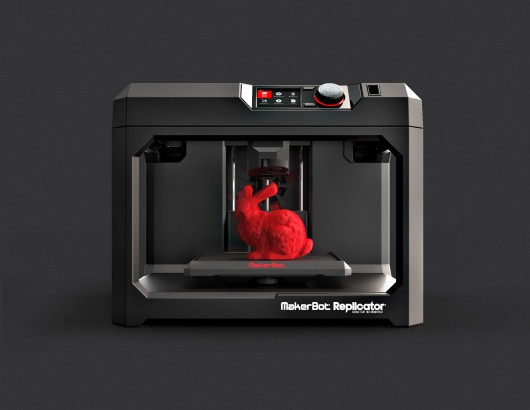
3d printed organipod

First reflection

Tinkercad shapes the style that we use for our designs, as it creates an object with a rough feel and touch when the final design is printed. The lines show where the printer extruded its filament, giving it an appearance kind of like a sketch that hasn’t been finished. Instead of trying to turn the resolution of the printer up to make the object smoother, is there a way that we can incorporate the visible, foundational lines into an aesthetic choice for the objects design? What objects would lend themselves well to spindly strands of filament and rough edges?

Journal #1

“So I’m building a tape-loading seashell toaster robot out of discarded absolute technology because the world is full of capacious, capable, disposable junk, and it cries out to be used again. It is a potlatch.” – Makers


During my examination into the learning process of 3D Printing, I examined how the students were representing themselves through their token’s design that they were going to print. It struck me how many people were not expressing themselves individually through religious symbols, or symbols that represent their viewpoints. I saw one student represent their sexuality through their token. I believe that this was very brave, because not only were they letting people judge them freely, but they were also standing up for what they believed in. I believe most people are afraid to show their views on subjects as such. – 100 words

CST Week 1 – Mirror Image

“Suddenly all the certainties she rested on — her 401(k), her house, her ability to navigate the professional world in a competent manner — seemed to be built on shifting sands” (Makers, 37).

What the hell am I doing here. I don’t belong here. Not the Radiohead song, but I might as well put these thoughts to music. I walk around trying to look as if I know what I’m doing, or at least trying to observe. It seems absurd, but it’s the only thing I know to do. And yet, it is so damn awkward. I know I am not the only one thinking this right now, but it doesn’t matter; I’m all alone in this room, and everyone’s eyes are on me.

Money Garage

10/5/14

“Every industry that required a factory yesterday only needs a garage today” (Doctorow, 45).

Constructing a corporation scale business through connection and partnership of grass-roots innovators and problem solvers. When considering the exponential growth and development of computer technology in the early 1990′s it is easy for me to justify a future free market manipulation of a more modern comparable event relating to technological progression.The corporation of “Kodacell” described in the novel “Makers” basically renders profit through the sales of progressive technological ideas. The concept of linking and integrating groups of determined, below the radar innovators beneath the guide lines of assigned business management would be comparable to giving Steve Jobs and the early co-designers of Apple Computers (working out of a garage) an entry into the free market before the product itself was even completed. At what pace would computer technology be developing today and could it be safe, or helpful?


Week One

“It’s pretty perverse when you think about it: using modern technology to build replicas of obsolete technology rescued from the dump, when these replicas are bound to end up back here at the dump!” (Doctorow. Pg. 34)


Being in the “blue” group, we interacted with the computers and printers first. For me, the feeling in the CAL was partially grounded while partially overwhelming, the mix of fluid language and computer coldness. I was totally in awe of the simplicity of the software and interface used to create the printable objects. I questioned the need for creating and making like this, involving so many facets and gadgets to make a coin. I watched the printer for a while to get a grasp on just exactly what was happening between the two walls of the lab. The machine made an error and I was introduced to the misprint box. This undoubtedly changed the course of my relationship with these machines, to see what happens when they don’t know what’s happening. Calculated chaos?


“This kind of design, we could never mass-produce it”. (Doctorow. Pg. 34)

Week #1 – CST

10/3/14

“WE ARE MAKING THINGS THAT NO ONE WANTS TO BUY” (Makers 15)

My initial feelings on 3D printing were ‘so what?’  Why does this matter?  It was an uninformed stance that didn’t yet know how poignant the technology could be.  Watching how easily my classmates navigate Tinkercad goes to show how well thought out this whole new realm of innovation really is.  It’s empowering.  Its going to allow us to manufacture exactly what we want, nothing more.  It’s simple in this sense, I’d even throw in the word ‘eloquent.’  I like imagining what the world would look like if 3D printers were as common as personal computers, printing only what was necessary. . .

CST Week 1

September 29, 2014

“She settled in for another day of watching the guys work, asking the occasional question. The column she’d ended up filing had been a kind of wait-and-see piece, describing the cool culture these two had going between them, and asking if it could survive scaling up to mass production. Now she experimented with their works-in-progress, sculptures and machines that almost worked, or didn’t work at all, but that showed the scope of their creativity” (Doctrow 39).

“What you people are making has an edge because it’s you making it, very bespoke and distinctive. I think it will take some time for the world to emerge an effective competitor to these goods, provided that you can build an initial marketplace mass-interest in them…. The system makes it hard to sell anything above the marginal cost of goods, unless you have a really innovative idea, which can’t stay innovative for long, so you need continuous invention and reinvention, too (Doctrow 43).


Without any previous experience in the realm of 3D printing, I watched curiously as my peers tinkered with shapes on their screens. My first impression of Tinkercad was that it looked like a simple program for putting together building blocks. On the screen was a three-dimensional graphic plane where shapes were manipulated, transformed, and rotated on all corners. Students began with a flat, orange cylinder and added (or subtracted) shapes to create dimension. They were making coins. The shapes were grouped together and sent to print: they would become the tokens that signified the start of a new skill.

notes

Zev’s Really Fly CST Post / One (And Revision)

“We’re going to create a new class of artisans…” (45) says Tjan in Makers. And indeed, the book is about frontiers in many forms. This is represented by a literal move away from Silicone valley, and the ebbs of the dot-com-boom, by our Carraway-esque heroine, Suzanne Church. “Suzanne had heard a lot of people talk about giving up on the Valley since she’d moved here.” (58). She discovers, like the reader and like the tech industry, that the future is elsewhere. In her case, elsewhere is the seemingly egalitarian workshop of Perry and Lester in a charmingly decaying Miami suburb: “The great cities of commerce like New York and San Francisco seemed too real for her, while the suburbs of Florida were a kind of endless summer camp, a dreamtime where anything was possible.” (71). This perhaps begs the question: are frontiers harder to establish in metropolises with endless competing startups, thirty dollar hamburgers, and two thousand dollar single-bedroom apartments?

A revision:

“The great cities of commerce like New York and San Francisco seemed too real for her, while the suburbs of Florida were a kind of endless summer camp, a dreamtime where anything was possible.” (71). This perhaps begs the question: are frontiers harder to establish in metropolises with endless competing startups, thirty dollar hamburgers, and two thousand dollar single-bedroom apartments?

First steps in 3D printing

What fun it is to get started in the 3D printing lab. I’ve done some 3D printing before so this week was mostly a review of Tinkercad for me. Some of the design programs I’ve used are more numerical, which fits my personal style better, but Tinkercad is tops when it comes to naming your drawings.

It looked to me like everyone enjoyed their first attempts at 3D printing. I saw several very interesting coin designs. A few of the designs might lose some detail in the final print, but it’s hard to tell until you have your little treasure in your hand.


Cultural Studies of Technology

10/4/14

CST

Devin Bender


“You’ve got no business feeling poorly, young lady”, she said to herself. You are as well set up as you could have dreamed, and you are right in the thick of the weirdest and best time the world has yet seen”. pg. 17


You might wonder why I chose this quote or how it is relative to my observations from the field work done in the lab earlier this week, but I feel it was an excellent quote to share due to as I was chatting with fellow students and watching them gain new information and begin the printing process I couldn’t help but feel a sense of optimism for mine and future generations, for with good fresh new ideas and mindful use of technology to enrich and preserve wilderness the youth have a chance to be pioneers of a marvelous future on the globe. I mean you do have to admit if you step back and look we are very much so in the midst of a crucial dramatic interesting and mysterious age where yes there is plenty of evils and too much egoism but on the other hand there is also massive amounts of novel information towards existence and the cosmos from a plethora of genres from the sciences to art all while technology and change are accelerating at faster and faster rates pushing us to stages of more and more connectivity.

Week One Reflection

Why do people want to learn 3D printing and how does “knowing 3D printing” compare to “knowing how to be a software engineer a few years ago”?

Taking this question literally, as I tend to do, I think knowing 3D printing—in the sense of designing something on a program and using a 3D printer to bring it to physical being—isn’t much different than knowing regular 2D printing a couple decades ago. I might also compare it to digital photography. I feel that the skill is in understanding how to use the program or to even build the printer and not how to plug a file into a machine.

CST Post #1 -Shaye Riano 10/6/2014

“Kettlewell thought that there were a thousand, ten thousand people as creative as these two out there, waiting to be discovered. Could it be true?- Suzanne

“Why not? Were just here because someone dropped the barrier to entry, made it possible for a couple of tinkerers to get a lot of materials and to assemble them without knowing a whole lot about advanced materials science, wasn’t it like this when the internet was starting out?” -Perry

Doctorow, Cory. Makers. New York: Tor, 2009. 39. Print.

During our first computer lab session the class focused on learning to use tinkercad. The teacher is showing techniques of how to manipulate and use tinkercad online to make 3D computer images for the 3D printers. Students follow along as Arlen demonstrates on his screen on the overhead. Tinkercad is a really awesome online program, there is no software to download, any “tinkerer” can go online and make an account from anywhere with an internet connection. With youre free account you can save and revisit your projects. The first project is basically just to learn by testing and playing with the interface and tools, trying to make a coin or token to 3D print. -Shaye Riano

Week 1

I noticed a number of things as I observed the Blues this Monday. Many of them worked differently. Some of them were intently watching what Arlen was saying, and doing simply what he showed them to do when he told them to. However, many of the students simply worked as he talked, and played around in Tinkercad, trying to get a feel for how it operated. I was unsure of how it would affect me, but it surprisingly made me believe that Tinkercad was more complex than it actually was. I look forward to observing other such things in the future.

CST post TOKEN

What I observed; The software website we worked on was tinkercad.com.  In Tinkercad we designed a coin and sent it to a 3-D printer.  A few coins had a ruff run but overall it was okay. As a class we were broke up into groups and one group designed the coin and one group observed and then we switched. While observing I asked a few students what they had trouble with and some said adjusting the  size of the object they were working on. Other than that it seemed like a pretty good experience tinkering and learning.

Off and Running:

 It was a very exciting first week. This Sunday I’m off to pick up the school van and gather the food supplies for a retreat to Cornet  Bay tomorrow. Gathering food for 45 people is very much comparable to gathering food for a small tribe.

This week I started my first  shifts at the Computer Applications Lab and have already begun to answer students questions about everything that surrounds our 3D Printers from print bed area to physical limitations of our models.

Below are  creations of my own, one a design I have successfully printed of a trefoil knot the other a brief animation of a water simulation with rigid body physics applied to the fractured object.


TrefoilWeek1Designs


Click here to view the embedded video.

Broadening Mind, Broadening Material.

‘”OK, that’s really cool, but I have to ask the boring question, Perry. Why? Why build a toast robot?”‘… “What I’ve got here are my own constraints. I’m challenging myself, using found objects and making stuff that throws all this computational capacity at, you know, these trivial  problems, like car-driving Elmo clusters and seashell toaster-robots. We have so much capacity that the trivia expands to fill.”‘

Observing what the makers of class were inventing on tinkercad was a bit like stepping into someone’s mind. Never before have I experienced a way to express  a 3D construction so literally as tinkercad allows. The fact that I could imagine  an object, and within minutes have the object represented in front of me with  exact precision blew my mind, and I could sense an excitement and playfulness  around the room. I saw people creating coins that somehow reflected  themselves, like using favorite symbols or numbers, but a question that surfaced  in discussion with the makers of the class and in Makers, is that question why  we create. Why do we put our minds, or ourselfves  into material objects. One  answer that we arrived through discussion, is humans innately want to improve themselves and the world around them by challenging themselves and exploring where the limitations of
the mind and the material may be.


75-100 words

MMM

what is important about that special moment, that precipice-moment before something comes into materiality?
using the internet to “know” something, recreating that something on the computer, and then bringing it into the physical world via 3d printing… (recursion, artifice, interpretation)

NO TCHOTCHKES SIGN
value, power, access, resources
can anything we make ever truly be meaningless?
even if it seems superfluous, isn’t there MEANING to a superfluous gesture enacted by the masses?
(how many people does it take to make an executive decision?)

FIELD NOTES + AFFECT

listening back through my audio recordings, i am struck by the low buzz that permeates the background.  those indiscernible voices and clicks and rustlings form a sum greater than its parts…. what is it?

observations of the first day

Having just transferred from another class I was not present for the first day of class. I have obtained a copy of someone’s notes for the first day but they are pretty loose since it was a hands on activity. I will be sure to try to find out more during the retreat.

CST 1ST IMPRESSIONS

On Monday and Tuesday, the two groups split up while one observed the other getting their bearings of the Tinkercad site and graphing in three dimensional planes. The assignment for the imaging group was to develop a 35mm diameter 5mm tall coin. I was surprised to see that when given this prompt, students would regularly place numerical signs on their coins, implying the assignment of value to an object they created. Within the parameters of Tinkercad, the students could pile multiple pre-created shapes onto their coins. I was surprised that almost all the coins I saw were one sided, and that students were only operating on the x and y axises when they could have raised the object off of the x and y plane and build from both sides.

Token #1

“The ghost-mall was just one of many along Taft Street, ranging in size from little corner plazas to gigantic palaces with broken-in atria and cracked parking lots. A lot of the malls in California had crashed, but they’d been turned into flea-markets or day-cares, or, if they’d been abandoned, they hadn’t been abandoned like this, left to go to ruin. This reminded her of Detroit before she’d left, whole swaths of the inner city emptied of people, neighborhoods condemned and bulldozed and, in a couple of weird cases, actually farmed by enterprising city-dwellers who planted crops, kept livestock, and rode their mini tractors beneath the beam of the defunct white-elephant monorail.”

Growing up down the street from the local mall provided various insights throughout time. It provided some of the first employment, date sites, and hangout spots for so many. Today the few megalithic malls that exist are in such a state of disrepair one would struggle to see the same institution thriving just a few decades ago. Stories are popping up all over the world of the old corpses of shopping have been refurbished into galleries, libraries, churches, and natural habitats. Most though have just lowered the standard of quality for the wares sold, becoming dirtier and more tailored to serving the impoverished.

Detroit today has both sides of the coin present, as the auto industry becomes less of a figure in the public community we see the bane and boon of the death of an industry. The unemployment and the impoverishment are unavoidable in situations where companies collapse, this paired with the rise in crime that also appears to be entangled would make Detroit highly undesirable. The other hand presents falling cost of land at an extremely rapid rate along with the ability to obtain recycled materials makes the option much more plausible. In makers we hear about ,”a couple of weird cases, actually farmed by enterprising city-dwellers who planted crops, kept livestock, and rode their mini tractors beneath the beam of the defunct white-elephant monorail.” (Makers)

The future holds such bounty and destruction. Even know when our economic positions nationally and abroad suffer it is easier for some to acquire wealth now more than ever. Urban farming and maker spaces are just some of the examples of how creative current people are reshaping the way our cities and lives work. It is important to take away from the fact the trash to some is treasure to others. Our role in the coming decades will not be to produce by rather to repurpose and retool existing technologies without the guidance of corporate rules but rather one of autonomy and peer revision.

In “Makers,” Doctorow describes a team working near such an abandonment in Florida, using the resources of what has become the ever present junk pile compiling about our streets of consumerism. Landfills becoming goldmines is no novel concept but to begin to think of them collectively as a ‘Lego Box’ with the ability to reconfigure our very notion of what is ‘raw material’ gives way to more than ever before. Technologies bringing about golden ages has happened throughout history and now again our vey fabric of society and objective reality has been cast on to the stage once again. The ability to create has brought about the very anthropocentric society we live in today, now in order to progress to something better we must change our scope.

We must build scaleable ideas that can be quickly and successfully implemented on what has become the scaffolding left behind from the 1900′s. Our landscape here in America, with its bisecting roadways, cookie-cutter suburban sprawl, all attached with parking lagoons could become something vastly different rapidly if the correct ideas were socially created. No one idea will ever be able to encompass all local areas fully but rather emergent technologies combined with an overarching mindset and teams of driven individuals local economies could become global competitors and specialized patricians for any industry imaginable. 


Excerpt From: Doctorow, Cory. “Makers.” iBooks. https://itunes.apple.com/WebObjects/MZStore.woa/wa/viewBook?id=53FBC78B36F00BF389830E420322DA54


Bibliography:

Doctorow, Cory. Makers. New York: Tor, 2009. 33-34. Print.


« Older posts Newer posts »