Of Blood and Beauty

The Evergreen State College

Page 7 of 27

Kafka Museum

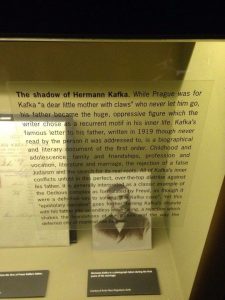
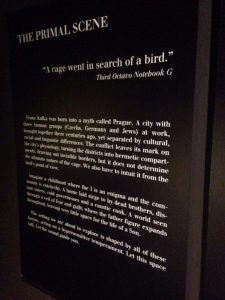
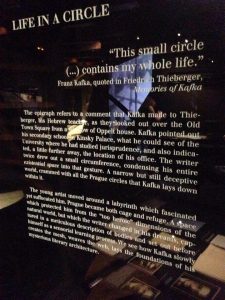
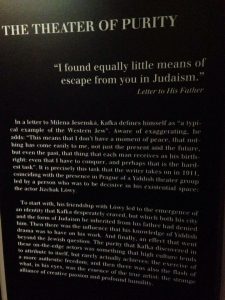
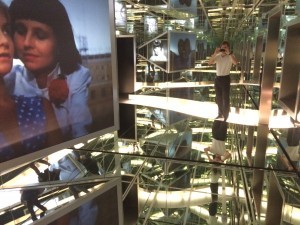
This museum was as perfectly disturbing as the stories we’ve read by Kafka. It was so well done that from the first moment of climbing the stairs it was overwhelming and I was given a sense of vertigo. All black walls line a black staircase with an image of a wavering cityscape behind a red filter shown on the wall at the top. As I walked up I was enveloped in a red glowing cloud of image and an increasingly greater, single toned soundscape that felt as though it was coming off this red glow. I felt as though I was walking into a pool of stagnant air that reeked of the mind of someone entirely estranged from reality and yet in some backwards perverse way it was a reality just like any other. It was both particularly unusual and somehow familiar simultaneously. The whole experience from here on was slightly nauseating locked in a sort of vertigo I couldn’t shake.

Kafka Museum

Kafka Museum

Kafka Museum

Kafka Museum

Jewish District in Praha

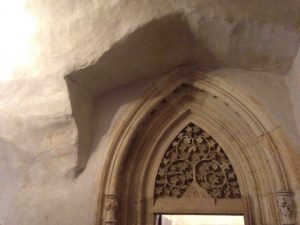
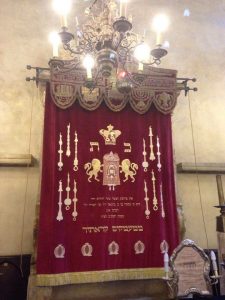
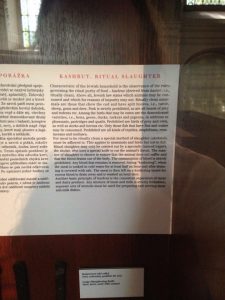
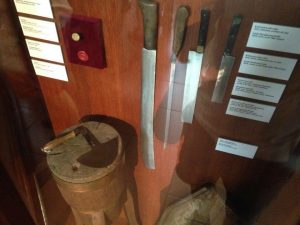
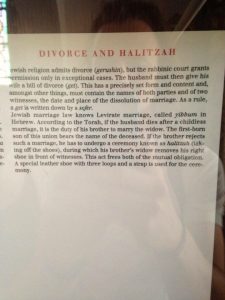
Even though every step of the way was done in such a hurry this was one of my favorite outings from our visit to the Czech Republic. We got a chance to step into many small temples of Jewish faith that had extensive historical significance in this part of Prague. The “Old New Synagogue,”

Jewish District in Praha

Jewish District in Praha

Jewish District in Praha

a synagogue no longer in use except as a museum,

Jewish District in Praha

Jewish District in Praha

Jewish District in Praha

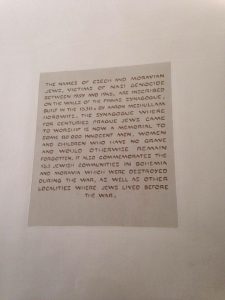
a synagogue being used as a list of names from those who perished in the holocaust from the Czech Republic,

Jewish District in Praha

Jewish District in Praha

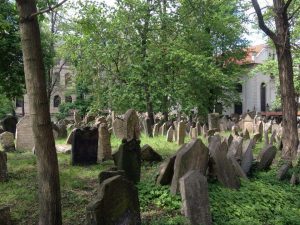
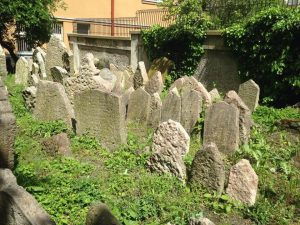
and the graveyard filled with innumerable Jews from Prague.

Jewish District in Praha

Jewish District in Praha

It amazing to visit these places in one district in a small old town of a particularly condensed city. Lucky to have gotten this tour.

The Work of Art in the Age of the Deutsche Kinemathek, Museum für Film und Fernsehen

“Even the most perfect reproduction of a work of art is lacking in one element: its presence in time and space, its unique existence at the place where it happens to be.”  (220)

“[T]hat which withers in the age of mechanical reproduction is the aura of the work of art.” (221)

“Mankind, which in Homer’s time, was an object of contemplation for the Olympic gods, now is one for itself.  Its self-alienation has reached such a degree that it can experience its own destruction as an aesthetic pleasure of the first order.  This is the situation of politics which Fascism is rendering aesthetic.”  (242)

And so it starts…

I’m in a new city with a small group of peers and we go on tours together and it slightly tears at me.

The tear: tourist vs. visitor

I dislike the thought of being a tourist. But I am one, of course. I’m here and I’m surrounded by my brilliant classmates and having people show me around and teach me. I enjoy that. But the thought of being a stereotypical tourist (fanny-packed, passive, wide-eyed, sheep-like) makes me uncomfortable. Why? There’s a certain irrational shame in being an obvious unknowing stranger I guess. I prefer to see myself as the anonymous and shadowy visitor, completely unremarkable, taking everything in silently. Maybe it’s just a jaded city girl thing, though.

Our first group outing brought us from the Brandenberg Tor through the Memorial to the Murdered Jews of Europe, the Finance building with it’s spooky Nazi doorknobs and cheery Eastern bloc mural, ending at the site of Hitler’s bunker, where he and his wife killed themselves for their honeymoon.

I ended up going on that exact same route maybe a week later, with three other people.

Now it’s time to go alone, I think. Be the invisible visitor.

What stuck to me immediately was the beauty of The Memorial to the Murdered Jews of Europe. The levels of planes, perfect lines, grays, light glints, all in perfect harmony…

I will return for it, and fill giant pages with it, so that I won’t forget.

What I’m Gonna Do

I’m staying here in Berlin. Something won’t let me leave. I found a room in an apartment only meters East of where the most dangerous part of the Wall used to be. Its all park now, completely absent except for some plaques here and there. A Leviathan erased by its keeper; I may not ever have known.
Some of the Wall still exists, as we know, and is feed for tourists and history lovers (and our group). Curated, museum-like visual aids accompany the space–a small offering to visitors of this palpable memory. I know this is here.
Together, the small presence and massive absence of an important part of Berlin can make the air electric; tense, like the revulsion between the same sides of each magnet. Something is somewhere, and I need to find it.
This vague something is what I will now unwrap for you.
There is a space winding all throughout my head that is completely absent. Memories my own mind hid from me; forgetting as a means of protection, with a few solid pieces as proof to myself that what happened in my life did, indeed, happen.
When latent BPD II reared its ugly head this past fall, I found myself stuck in a torrent of memories. They would strike me down and flee from me in large groups, everyday, and I wanted so badly to keep them somehow, but I was unable to. But being here, in a place in a very complicated relationship with memory, makes me able to, for the first time in my adult life. Already I’ve been gathering the pieces that fly by, scrawling them down in an old notebook. I’d like to turn them into short, more polished pieces, and somehow map them out. Like the U-bahn map, which is linear but curving and moving in every direction constantly. The subway is an important symbol in my life, and it belongs in my project.
Active Memory: finding a museum in each part of Berlin, taking the train there, and spending time in them. Objects hold memories just as much as repeated, familiar actions. Even if you haven’t seen them. I will gently knock on everything I can to see what crawls out and helps me remember.
Daily train-riding and wandering in and out of different stops–I can’t count on the internet to tell me what Berlin is. I have to go there and make it up for myself, search for nothing and everything, drifting through the space in between.
Weekly posts will be made with each piece of writing, as well as drawings of maps of those memories. Psychic maps.

Active Present: To offset the outcome of existing constantly in the past, I will create handmade postcards with found objects–as many as possible–addressed, but not sent, to capture a sliver of the present, destined to become part of the past as well…

Reading list edit shortly

Kinemathek Museum

Kinemathek Museum

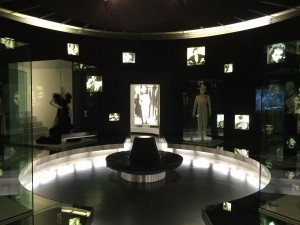
Benjamin says, “that which withers in the age of mechanical reproduction is the aura of the work of art.” Keeping this in mind while visiting a museum on the history of German film is truly inspiring. No art for in history has so mercilessly rendered all other art forms so obsolete as film has. A film is in itself already a mechanical production, and thus mechanical reproduction is nothing special. Where as for thousands of years, what man has done by hand is now possible almost entirely though technology. 3D printers for sculpture, computers for architecture, and graphic design for painting. Of course there are the differences that cannot be replicated through technology, such as the brush strokes and the cracks in the concrete. These are the small minor details, that when accumulated together makes art human. In terms of photography, and later film, though, all production is created through a lens, what is produced is merely manipulated rather than created. The stage of theater has long been a home to artistic expression, and now, through close ups and filters, we have stories revealed to us one frame at a time, all rehearse and perfected and captured and copied exactly forever. There may be, in terms of aura, advancements that have been made as technology has advanced. For instance the introduction of sound has lead the text dialogue to become completely unnecessary. And the ability to allow color to be visible when filming has changed how we see the world through the screen. These two examples, although aged,  both have their own situational qualities to them. I use the recent film The Artist as a great example. In this day and age of computer images, it still takes a special talent, a flair for brining the old school back, that which was once revolutionary to be brought to light all over again. The film the Artist is in black and white and with no sound, a true homage to the birth of film if there ever was one. Instead of letting what was dead stay there, it has been cleverly reborn again to serve as a reminder of just how far we have come.

Sound and color are probably the two most obvious forms of aura for a film that can come to mind. Just as the dust on a record produces the crackling sound that adds an aging effect that we all cannot help but love, so too has the clear and succinct sharpness of film come from a place of similar origin. Old film reels often have scratch marks that, for a brief second are visible before they disappear. Older film can often be full of these marks and thus a whole reel can consist of brief stutters and halts that add an authenticity of sorts that one would not find in movies today. When you think of clear images, you would usually want to avoid these minor imperfections, but when you see them for what they are, you gain an appreciation for their existence as you think that never would you see this happen nowadays.

Kinemathek Museum

Psychic City- Sit Spot 1

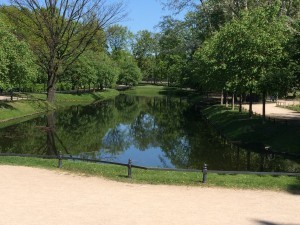
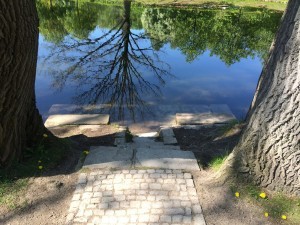
The Venus Pool, or the Venusbassin in German, is one of the lovelier places that I have been to in Berlin, in fact the Tiergarten as a whole was wonderful from what little of it I saw. Because the Tiergarten used to be the Kings royal hunting grounds, I could easily see this place at one time hundreds of years ago being a secluded place of luxury where royalty would lounge in escape from all the affairs of their modern world. Hidden amongst the trees, the pool somehow still maintains a little bit of its seclusion factor, even after the massive renovations put into it to make it a public park.
Psychic City- Sit Spot 1

The warm sunlight on this wonderful day makes everything feel so alive, from the grass and the leaves, even to the benches and the dirt. Because it is so nice out, I am not going to be able to find a place around this pool to sit by myself completely alone. There was another girl who appeared to be doing the same project I was, for she had found a nice spot along the pool to sit and meditate in the sun. I wanted to join her, but she looked comfortable so I decided to leave her in peace.

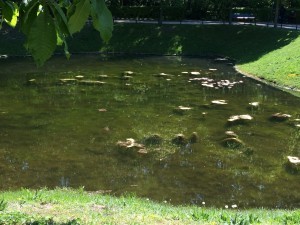
A lush green envelopes the pool, bushes and trees probably used to cover this whole area around the pool, now there are pathways entertaining from one monument to the next. Not 100 feet away is a statue of a woman riding a horse. I couldn’t decipher the name of this work, but I believe it had something to do with Amazon and horses. The horse was in fact facing the pool, should it have suddenly sprung to life, it surely would have journey moped in the pool as the nearest source for water for a refreshing bath. Horses were surely never let into this Royal pool though, and thus the horse would have met its demise through doing so. Should a horse do the same today, it would meet its demise in another way. The water in the pool looks not like something one would swim in, but rather like a science experiment. Surely with all the algae and bacteria present, one sip could be enough to cause a stomach ache like no other.
Psychic City- Sit Spot 1

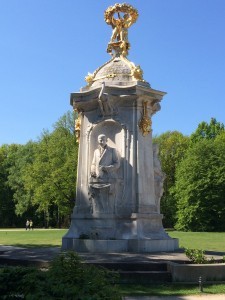
When I first researched this specific spot in the Tiergarter through google maps, it was labeled as Goldfish teich, Goldfish pond. From the side I arrived at first, the sun was at my back and the glare kept most of what was beneath the surface invisible. So from there I felt disappointed with the lack of fish, I even got up right next to the water in order for a better look, but I had no luck. So instead I wrapped around the pool taking in all the small details surrounding it. Nearby there was a woman who was spending her holiday working in the small garden nearby, good for her. On a map, this is labeled the Steppengarten. Farther down, at one end of thepool, seemingly the head of its shape, is a large concrete monument with gold on top. In this statue are carved the figures of Beethoven, Mozart and Haydn, and thus this serves as a decimal, or memorial to them. Apparently the original sculpture was badly damaged during World War 2, and finished remodeling in 2007, so it, as well as many post unification constructions, is rather new.
Psychic City- Sit Spot 1

Moving passed the sculpture, the sun was now above and in fronted me, and from here, the view of the water revealed what I had originally been searching for. Fish, hundreds of them. They appeared to be feeding on the moss the was growing in the surface of the water, for some reason this made me hungry and consider eating my sandwich, but I saved it for later. There really were many fish, they would flee when I got close to the water, so I had to keep my distance. However there was one good sized fish, by this I mean maybe the size of my hand, that looked different from the rest. if had a cool striped pattern and seems to be completely still. I, being a fool, got a little too close, when suddenly it slowly started to sink for a second or two before, fast a lightning zipped into the mossy bed at the bottom of the pool. I wonder how many were down there that’s couldn’t see? Probably a whole army, nay a whole civilization, waiting for evolution to give them an upper hand over humanity. Jokes on them, we’ll have gills soon.
Psychic City- Sit Spot 1


Paul Mason: or, Do Accelerationists Dream of Paper Tigers?

On April 5th I attended a lecture by the English journalist Paul Mason entitled “After Capitalism?!” The interrobang at the end of this title is either a little bit embarrassing, or devastating, depending on your relationship to anti-/post-capitalist discourse in general, and to the various new liberal third positionisms that seem to be getting a lot of attention over the last couple of years. I’m Highly Ambivalent.

What most non-reactionary accelerationists argue is that the transition between and production of economic forms is not ultimately accomplished by the activities conceived of as political during a given form’s lifetime, but rather by the emergence, out of a given form, of the new material conditions for the succeeding one; and that this process can be actively accelerated. The logic goes: capital was produced by the self-intensification of the economic relations of old-imperial mercantilism, so if we wish to move beyond capitalism  we need to figure out which of capital’s characteristic relations are potentially liberatory (especially those that make is so remarkably adaptable to new challenges) versus those that are primarily conservative. If we can get a better image of this then we can locate the places where these things that are contradictory in principle are contradictory in material form, and then we can intensify or accelerate the relevant processes. It is a fundamentally marxist position, but one which (whether explicitly or not) amputates most marxist theory of revolution from Marx’s ontological core of dialectical materialism.

I have no idea if Paul Mason considers himself an accelerationist, or whether he’s ever heard the term, but as far as I can tell he is working from this same basic logic. Where he differs is in his focus not only on the positive capacities of the technologies of capital, but also on roles these play in what he sees as a necessary acceleration in the tendency of the rate of profit to fall. As traditional market growth slows and stagnates the digital economy increasingly colonizes our subjectivity. Desire for both immaterial goods (and really only secondarily the material media of these goods) is a new market front, but one which requires constant reproduction, as the labor input and consumption are increasingly identical. Facebook et al are valuable to a given user because, and only so long as, many others are using it frequently: practically any direct competition begins pushing surplus value production toward zero; so they can only remain profitable as long as a sort of trust exists between the biggest tech and digital monopolies to simultaneously reduce competition and mutually produce in consumers habits and desires that mutually feed their models rather than freeing the consumers or the media up for alternative activities. This seems to mean that any breaks or resistances to this feedback loop could produce an opposite one in which the power of capital is diminished or threatened while more and more people are simultaneously interacting with each other and with technology in new, creative, and potentially liberatory ways.

Like I said, I’m ambivalent. I agree with the economic logic and hope the possibility for lines of flight out of the current internet desire-machine is a real one, but I’m frustrated to hear another person saying this sort of thing without any idea how to really begin producing these resistances or lines of flight. I also share some of the pessimism of one of Mason’s interlocutors, Hans-Jürgen Urban, who fears that the crises of capital that have already been occurring are producing new forms of conservative power (which may look more like pre-capitalist ones and therefore not be threatened by the same things) faster than Mason and other utopianists recognize. There’s really a lot to say about all of it, and I don’t think that either of the two criticisms I mention here are good reasons not to try what Mason (or other accelerationists) is ultimately suggesting, but I find myself with no more clue how to start than I did before hearing him speak and I think that’s a harder problem than he makes it out to be.


PsychicCity wk6: Ross’ Tiergarten Sit Spot

I sat on a log in Tiergarten
only a stump of what it originally was
cut off at the trunk by who knows who
who knows when
and in what order the fallen or the cut I will never be able to say for certain.

This log, presumably some sort of maple based on the markings of the bark and the overwhelming amount of maples in the vicinity of said log, sat by a small and stagnant stream that slowly courses its way through the entirety of the park. The stream is filled with garbage, some sort of unidentified mucus or scum, many small fish and the consequent waterfowl I assume are mallards and a bufflehead couple of some kind. In an island maybe six meters across there was a red squirrel with tufted ears that played with its reflection on the trunk of a leaning cottonwood just above the surface of the water. There is a fox den about twenty meters north of this upturned rootball that the local rabbits come dangerously close to as displayed in their crepuscular grazing. There was a small mouse that came scuttling out for a brief errand from almost beneath the decaying monument. Although I was not able to catch a look of the beaver that chewed the alder opposite me on the island I was able to see in this sit that it had indeed returned to finish the job and had cut clean through the wood. Even so it was unsuccessful due to the clinging branches of the shrubbery below that would not release the fallen timber low enough for the beaver to harvest the fresh cambium lawyer from the twigs.

The log let me sit there without question to observe the many neighbors it had come to witness throughout its time spent on the edge of the water. Based on the decay of the bark, the state of the wood, the lack of soil in the upturned root system, the hole left by the upturning of the roots, how much detritus was slowly filling this hole, and the consecutive years of nettles and wall lettuce growing out of the log itself I would say that it had been lying this way for over ten years.

A bench sits nearby where I have seen multiple couples sitting nestled into one another. How many kissing couples has this log been backdrop for? How many strange men or women have used the privacy and security of the sunken pit and the low pruned yew to urinate or sleep or what have you?

It feels the cold and wet spring with little shelter. It sees the sun in summer through sparse dappled light shown through the mostly maple canopy. The few roots still planted deeply in the soil are dead but still feel the cool water below the water table. It is slowly sinking into the ground as leaf litter, garbage, feces, and decaying plant matter growing out from under it slowly pile up around it to form a thin layer to provide nutrients for the next years vegetation.

It is taking slow, deep breaths into the ground as the wood it once pulled up from the soil touched by its roots comes back into contact with the layers of earth it rests on. The earths way of tilling the soil. This is the natural cycle that keeps the microorganism that remain safe in the darkness can continue to work even as biomass is pulled upward and folded back again. One can only begin to touch on the stories this simple log has been a part of in this saved little corner of the city.

« Older posts Newer posts »