Page 6 of 27
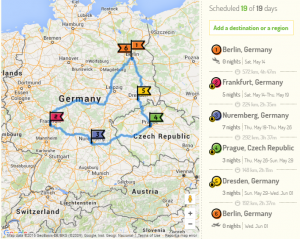
I almost boarded a train to the wrong Frankfurt but thankfully did not. The train ride to the right Frankfurt was very pleasant.
Nobody was at my hostel to meet me at the scheduled time so I called them and was told to return in an hour. I returned in one hour and ten minutes and was chided for being “so late.” My room is nice. I had microwave schnitzel and watched a music/variety show from the 70s called Disco.
Frankfurt is very different from Berlin; much more urban and a little intimidating. Doener costs over twice the normal price in Berlin but that is okay because I need to stop eating it anyway. Now I’m watching Bonanza in German and trying to stop feeling stressed.

I think that if Benjamin had lived much longer he would have made significant revisions to the theories he offers in “The Work of Art in the Age of Mechanical Reproduction.” This is not the place for a general critique, but attempting connect some of the ideas of that essay to my experiences in the Deutsche Kinemathek Museum has, I think, helped me begin to understand why I find this essay so frustrating compared to everything else I’ve read by Benjamin. The problem is that even if you maintain that his description of the authenticity or aura of an art work can or should be read phenomenologically rather than metaphysically (which I do), Benjamin’s analysis still depends on a strong historical concept of authenticity. The most clear and important symptom of this can be found in his distinctions between ritual and politics, and between fetish and value.
I’ve been trying to figure out a way to work through the rest of what I’d like to say about this, and what I think it has to do with the Kinemathek Museum, but it has turned out to require a lot more time and space than I can give it for a blog post. It may become part of my project, as both Benjamin and the concept of ritual are central to that, but we will see. In short, however, there is something really interesting about the way in which the museum begins with the hall of mirrors. This replicates the viewing subject infinitely in a way not unlike (though perhaps obverse to) the universalized perspective of the movie screen. From here I want to argue that Benjamin is wrong about the inherent criticality (or ironic distance) of a film viewer, and bring in some argument from Adorno’s theory of the culture industry to show how through mainstream film we are hypnotized by our own image of our own desires (which have themselves only been produced and magnified previously by this same and adjacent processes).
This might require a little more Freud and Lacan (or Deleuze and Guattari!) than I have time or desire for at the moment, but hopefully this post will at least serve as a reminder to follow through with this later.
i accidentally miscalculated dates and one of my hostel reservation in Frankfurt starts a day too late. on the one hand this sucks because i have to pay 10 euro extra for a private room for that night, but on the other hand holy shit am i excited to have space to myself like that for the first time in forever.

Jetzt: billiger und einfacher!

Jetzt: billiger und einfacher!
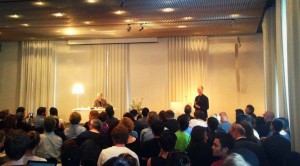
These are a few quotes from hearing Hélène Cixous speak at the conference entitled Untying the Mother Tongue along with a little rant about getting into the conference hall itself.
“German is the language spoken by the hearts mouth.”
“I think she speaks in English because you can speak it anywhere, even in death.”
The eternal return.
Language is myth.
To Montaigne
“I wasn’t simply going there. I was waiting for myself, there.”
“It was a bible, a house of memory…”
“And so I return to death, always suddenly and premature.”
“I discovered my father mummified under sheets of paper… I dared to read him dead.”
“I am an archeologist of traces always impure.”
“The moment the repetition produces. The moment we return we give it power… We
learn what comes back to us.”
“It means The face that comes back to me. No. It means The face that I can bare that I love.”
“I did not lose them. They did not return. They arrived.”
“My mother tongue is religion.”
We stole our way into the conference and talk. They were not allowing more in. As if we were scum coming like rats without the correct and prompt planning capacity they clearly had squired through rigorous patience and practice. As if they could with one glance asses what had brought us to be late and that in that moment met them at the door with disdain. An intuitive move by Kendra allowed entrance to this rebel force, made of angry students, resigned and knowing professors and the like, some Berliners and some not, planning a coop of greater and greater lengths the more we were withheld from entry. We checked our plan at the door and became terrorists of opportunity. Only one counter measure was raised and caused more disturbance than any of us who entered quietly. It was a perfect moment of inappropriate action, an even more inappropriate counter, and the resolution of our arrival.
“I have it and I have only it and it is not mine.”
“Colonial wars were always coupled with internal wars.”
“I was writing without knowing it at thirteen.”
“When I write I don’t decide to use this language or that language because the language I use is writing.”
“When we need it. We the writing we use whatever language comes.”
“One does not calculate… It just comes… The voices come. They orchestrate and they play several instruments.”
“Let’s hold on to the lost.”
“There is a strange benefit in experiencing loss. It is an engagement with our mortality. We need the help of large strange forces and we do this through art.”
The salamander.
“If the translator is an artist then the new work that is born out of the past work can rival with the original. Which you know can happen, but It is impossible, and it can happen.”
“When I talk to you I echo something that has not been adequately received so I know.”
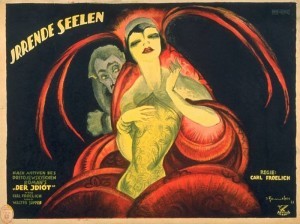
5//5: It was a reeling sojourn through the Kinemathek museum. This collection was a fantastically arranged look into the actual phenomenon of and affects surrounding film, from culture to industry, politics to aesthetics- the curators of this exhibition accounted for many modes, combinations and styles resulting from these contributing factors, from the earliest excitement about the possibility of capturing image and sound, to the harnessing of film as propaganda and the inverse – film as resistance and reframing. The persistence of film as not only entertainment, but as stage for fostering pubic dialogue and reworking the possibilities of story-telling was a theme throughout. Truth was and is always a central concept in film – and the delineation between truth and fantasy is constantly reworked in film, where critical ‘truths’ are often revealed in the most fantastical settings, and the falsehood of ideology ferments in the inflated realism of propaganda. The history of film itself is a front strewn with the wreckage and ruts of so many attempts – successes and failures, the grandiose and the vulgar. What this chronology fails to capture is the other half, the audience, who, meeting the artists writers, designers, producers and filmmakers half way, bring their own swaying mass of ideas. Here we see the onward transformation of film as it appeals to and marks out the borders of possibility in the imagination, and the battles between fascist regime and artist/creator, but what lacks is the other half – the impression of the consuming audience. The audience is represented, however, portrayed in the films, as their characters. The continual evolution(and also the recurrence) of these characters and settings, occasionally gives insight into what battles are being waged in the streets. But as always, the distinction between what is being waged in the streets, hearts and minds and what is being impressed upon by the films, is always indistinct. The fourth wall is also a stage for filmmakers. Nietzschean Tragedy thrives here – where is the chorus?
The replication of life on film allows for the conceptualization of modern existence, a conjuring of myths which entrench ideas and physically embody the experience – they take an aura of collective erlebnis, reduce it to two dimensional concept, and recast it back to the acting public – (who truly are the original characters – hence the mass appeal and curiosity towards film) – it reveals our lives to us across the spectrum, from individual contrast to casting universal patterns. The gritty modern, day-to-day, experience, living “aura” under the censor of a regime is fastened to film, reduced to a theme with a moral and a story, the confinement (and reverence) of mild day to day life to the reeling frames of a film reduces the complexity of existence and allows for film to be used as the propagation of a strict, controlled mythology, which reinforces the ideaology of a regime. The films whose auras are expansive- critically reflecting life and encouraging the examination and critique of experience/existence- rather than reductive, as in propagandist film, are those that immediately banned. These expansive, edgy, critical, wild films, are the first to be prohibited and denounced in National Socialist rhetoric. And so, when All Quiet on the Western Front was adapted to film debuted in 1930, the subsequent riots and disruptions by SA and NSDAP officials led to an immediate ban of the film; the story it told did not uphold the Nationalist ideology of German might and victory across Europe, the prevailing political party held final ruling.
“Under National Socialism, light entertainment dominates, movies offer escape from day-to-day reality, especially after 1939.”
These sanctioned films point away from the rigidity of the regime and the actual experience of the proletariat, and towards a stable future just within grasp. The incredible contrast of propaganda films that depict a banal, conclusive, steadfast and conservative lifestyle, to those of brilliant and strange worlds of phantasy, such as The Cabinet of Dr. Caligari, Nosferatu and Metropolis, which point directly at the day to day existence through an abstract mode of phantasy, was fascinating to realize.

Met the real Avant Bard. Riding the edge between corn-ball and complicating political and sociological nuanced songs. Explaining things after singing seemingly didactic, transparent lyrics never felt like too much information because there was actually a lot going on. The talk after divulged into the mechanical and digital complications that occur when trying to re/produce a piece of music. Small record label owners are more collectors are more collectors and curators than people running businesses, it is difficult to say they are even capitalists as it is such a rare thing in that world to accumulate any sort of profit.