Of Blood and Beauty

The Evergreen State College

Page 11 of 27

PSYCHICCity GEDäCHTIS

Kaiser Wilhelm Gedächtis KIRCHE 

* ICH * LASSE * DICH * NICHT * DU * SEGNEST * MICH * DENN *

[I will not let you unless you bless me]

ALTARRAUM/sanctuary

Blue room. Blue around the crown. Just for my crown and eyes to see, not for my feet to see. Smatters of gold and red panes in the blue, reminds me of Egon Schiele.

Here’s what I mean about my foot perspective: the design of the church includes entire walls of stained glass cells, the equivalent of three stories high. The glass starts 12 feet up the walls of the sanctuary. We (MaryJane, me and the other tourists) feel like we are in the ground, we feel like carrots and our root crowns are all that pop out of the soil to feel the blue light of twilight.

MJ and I had a hard time getting to this spot and I am still buzzing, here now where I sit. We sang like a prayer on the train and then more in the hallway (der Flur) as we walked out of the underground.

I hear you call my name, and it feels like home

Someone began playing the organ, in fragment practice phrases and it washed out the carrot-ness of being in the room. Now my most activated sense is letting the sound comb out all my body’s ways of being here.

DRAUßEN im Platz

Outside in the Platz between the sanctuary and the church my head is getting filled back up with the sounds of a shopping center, boiling an egg. My attention is rushing back into the church and flying around the wee fairy carved into the wall.

Jüdisches Museum Berlin

Monday we went as a group to the Jewish museum. We met in front of the building, whose facade was somewhat misleading as to the actual contents of the museum as it was a very typically German-looking building with no traces of modernity. Upon entering, the reality of its contents were revealed. The entrance to the museum itself–beyond the security check, gift shop, coat room, etc.–took us down a set of stairs into a slanted and skewed floor. Our tour guide asked us to interpret this design choice, a request which few of us were eager to answer. He brought us next to one of the 3 or 4 levels of the museum, in which was held information about Jews in the late 19th to 20th century Germany, and gave us some insight into the influence that Jewish people held in those periods. It was refreshing to hear things about German Jews other than the terrible crimes committed against them during the third reich, which seemed to be the main focus of many other tributes to the history of Jews in Germany. It felt like it took agency on the subject of Judaism away from the Nazis and put it in its rightful place.
I’m somewhat biased against these sorts of tours, and they generally make me somewhat uncomfortable, so I was relieved to be able to explore some of the rest of the exhibits independently. It was very interesting to learn about the centuries-long history of Jews in Germany, and to see relics and accounts from before and after the genocide of the Holocaust. Again, it was great to have the focus put on the Jewish people rather than on their victimization during WWII, which I think usually overshadows the hundreds of years that Jews spent as influential members of German and European society. It framed them as something more than victims of a horrific genocide, without ignoring or brushing aside that terrible fact, but also not focusing on it as the most important part of German-Jewish history.

Memorial to the Murdered Jews of Europe + Topography of Terror

27.04.16

This was our second time walking through the Memorial to the Murdered Jews of Europe, though it was our first time going into the information center underneath the field of stones. During our first visit here the sun was out and the rest of Berlin seemed to follow suite–there were children playing hide-and-go-seek in between the pillars, groups of teens pick-nicking and drinking on the outskirts of the memorial, and sunbathers lying on top of the tomb-shaped monuments basking in deliciously rare vitamin D. Yesterday’s visit was quite different; storm clouds mirrored the mood of the group as rain attacked our notebooks and washed away our smiles. Upon first entering the information center beneath this semblance of a graveyard I was delighted to be sheltered from the less than desirable weather above, though this happiness was quick to depart and superficial at best.

Difficult, distressing, uncomfortable, painful, disheartening, raw, tormenting, harrowing, troublesome, grueling; none of these words seem to do justice to the effect created by this memorial. The vanity of language gets in the way of the actual experience, and frustrates me now more than ever. How can I even begin to try to express this shit when furiously flipping through the pages of my thesaurus results in paper cuts on my fingers before it could ever lead me to a word that actually says something? I can feel Didi-Huberman’s disappointment growing as I type out the words: I cannot begin to explain because I cannot begin to imagine.

I do not mean that I should not try to imagine, and I do not mean to take away from the validity of this memorial or the experience(s) created by it. What I do mean is that I am a firm believer of the idea that one can never fully know what one has not experienced. I can do my best to take in as much information as my own brain is capable of about the Holocaust, but I will never be able to find the “right” words to describe it, because I have led too privileged of a life to do so and/or to do so well.

PsychicCity wk5: Jules:Fragen und Antworten

Honestly, how are you doing?
I am not doing all that great currently. I’m sick. finally when I feel like I’m getting a grasp of how to stop isolating myself I am put in necessary isolation without the cognitive function to get much done other than what is necessary for my body. I’m constantly worn out by the demands I put on myself and because I put so many of them there I end up feeling overwhelmed, a sign of poor planning in my mind that only compounds the issue, and I get very little done and the cycle continues from there.

I just feel like I need time and space that there is never time and space for. Like I have this endless pit of despair that I shouldn’t have but don’t know how to get out of and no one can hear me from inside it as if it is swallowing all sound or possible connecting language and all I end up seeing are the faces of angry strangers thrusting their own insecure daggers down into this whole saying grab on let me help you out.

Yeah. It feels like nothing really helps. As if everything just makes it feel worse. As if there’s nothing I can do to stop the momentum of this quicksand I’m sinking into. It just escalates and I feel less the further in I go. And that’s the thing is the feeling is what can get me out. If only I could feel something. If only I could express something I could make it out because feeling makes the quicksand into a beach looking out at the ocean endless and constant but somehow still significant in each iteration even though it’s just the same shit over and over again. But I can’t get to the expression. It’s like it’s not only something swallowing me up but smothering me from above as well. I’m lost in the absence.

Do you hate it here or love it?
I don’t hat or love it. I am just here and currently the situation feels pretty bad to me. I can’t seem to crawl out of the whole I’ve dug for myself. Objectively the town is great. So many places to explore, so much beauty and information free to all and plenty of encouragement to get out and really be in it. Besides showing up to class as much as possible I find myself rarely saying yes to those things because I limit myself using the excuse that I have “too much to do.” I feel like such a downer most of the time.

Are you homesick?
I think I am. I have found myself wishing this was all over or wondering why I am here when I could just as easily be doing all of these readings, studying German, making notes, and the like in Olympia where I am closer to the community I’ve been a part of for the last seven years. Is that homesickness?

Are things getting hard?
Things are getting progressively more overwhelming. It’s getting harder to find the motivation, energy, and general willpower to get started on most things, even the ones I love to do like bike and immerse in nature. I find myself slipping deeper into a self I do not respect, feel consistently disempowered by, and find in most cases repulsive to be around. I find myself justifying this by saying that it is just the me that is learning to feel comfortable with uncomfortable situations, but at what point can that self no longer find balance within the darkness? Academia and the city life seem to suit me very little. I find myself being very bad at too many things. Even at the things I know I love. Closing off and shutting down.

What is your temporal experience at this point? (For example: I don’t operate on dates or days of the week)
My temporal experience has seemed to shift and fluctuate wildly during this entire trip. Where at first my sleep schedule and eating habits were very regular they are now either way too much of or way too little of both and all other combinations. My study schedule can’t seem to find a regular pattern either.

Are you remembering things? Can you access images and feelings and emotions at any point in this city?
I haven’t been feeling the lightness and alertness I feel I am used to with Spring. I am so grateful we came in the spring because imagining myself here in the winter seems oppressively difficult emotionally. I can’t seem to access many feelings except for feeling down about myself or slightly annoyed at others.

Are you unable to?
Yup

Are your habits changing?
Yes. Like I said earlier things feel like they are in constant flux and the patterns I am used to having when I am at home like regular meal times and time spent outside and physical activity have all but gone away.

What is scaring you?
How isolated I feel. How overwhelmed I’m getting. How down on myself. How hard it has become to do even the things I love. How hard it has been to just appreciate my privilege of being here and doing this. How hard it has become to appreciate much of anything.

How do you handle being alone?
Outside I have plenty of things to do. I haven’t been going recently though. Inside I isolate myself, and turn off my brain with Stephen Colbert or John Oliver.

What could you possibly do in a strange place to truly calm down? (For Example: when things get bad, I go into antique shops to assuage my anxiety)
Find the nearest park. Sit under a tree.

Is class stressful?
Sometimes. I just get into my head about certain things and then I can’t seem to get back out until I realize I haven’t been following the thread and then try to jump back in. Often times this doesn’t work though. I think for the most part class feels like decompressing, but thinking about it is often times a stressful activity.

What kind of thoughts are you thinking? There’s usually a pattern there.
I’ve been thinking a lot about how behind I am and how I wont be able to catch up. A lot about the my lack of self worth.

Do you miss anyone (it’s ok to not)?
I do. I miss my friends and community back in carnation and I miss my partner Ellie.

Information Center/Topography of Terror

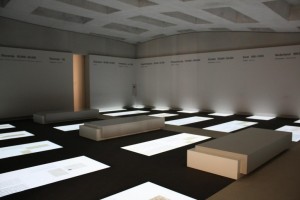
Going down below the Memorial to the Murdered Jews of Europe to the Information Center was like stepping into the mass graves scattered across these countries. It takes you step by step through the process of how the holocaust came about. It shows you six victims pictures blown up so you can get a sense as to who was targeted.

Information Center/Topography of Terror

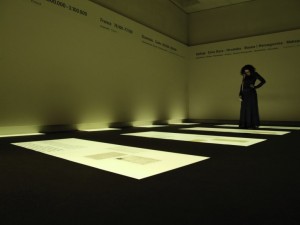
The first of four rooms gives you numbers in estimation of the Jewish people killed in each of the countries occupied. On the floor in patterns that echo the stelae above there are notes from diaries, letters, postcards thrown from mass transport trains where people stood packed sometimes for 30 plus hours. One that caught my eye was the brief letter to her father saying that they were taking them off to die today and how they wish they could live but alas they are to die.

Information Center/Topography of Terror


The second room gives you an image of different families from different regions that were put to death, again on the stelae pattern as above, only now instead of lights on the floor they are pillars that don’t quite reach the ground.

Information Center/Topography of Terror

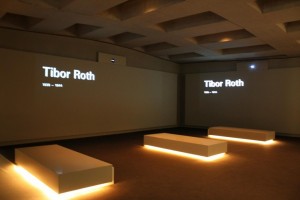
The third is a room where four projectors are constantly telling the stories of different names of individuals that lost their lives and placing their names on the blank walls. I couldn’t stay in this room for very long as it was maddening to hear the monotony with which the speakers told their stories, like listing off numbers on a document, like a roll call when no one is present.

The last is a room of sites where these massive murders took place. You can listen in on stories and brief histories of a few of these places, and then look at the map and see they are only a drop in the bucket of sites. All the while the same undulation that is seen above on the ground you walk through the stelae on can be seen on the ceiling in these chambers. I got a sense of looking from underwater towards the surface of a wave above only there was no image you could see beyond the wave. The wave barred life entrance.

/

The Topography of Terror was kind of odd to me. I can understand the choice in architecture and grounds layout. They seem to impose a certain terrible foreboding quality. Maybe it is just because of all of the other images I have seen from World War II, but I couldn’t help but feel like this site didn’t get the point it was trying to make across to the audience as well as some others.

I would say the information is all well laid out and organized according to what part of the National Socialist structure they are wanting to emphasize. I feel like I got the sense that there was supposed to be this feeling that since we can see how this was all laid out we can somehow make sure to never make this same mistake again, but by the end of the hanging placards of information I realized that many of the people who were a part of this regime were never punished for their crimes. It makes a good point though in asking how do you punish any one individual for the crimes committed so anonymously or out of fear of death.

At the beginning I assumed that all of what I saw would be the face of evil and by the end what I saw were terrifying acts of murder under the pressure of a force that no individual could possibly hope to stand up to. The survival instinct of most of these individuals heavily outweighed their ability to do otherwise. That being said, there was something lurking beneath the surface that seemed far to close to home with the situations the world is currently tensioned under.

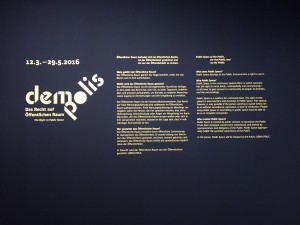
DEMO:POLIS – Art in Public Space or Publicness as Art?

DEMO:POLIS – Art in Public Space or Publicness as Art?DEMO:POLIS – Art in Public Space or Publicness as Art?

26//4

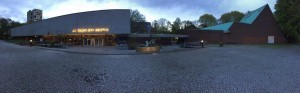
A panel discussion on the subject of the public sphere as a ‘stadtraum’ for an admixture of aesthetic, political (und etwas) expression/creativity/dreaming. This discussion was held at the Akademie fur Kunst, at a satellite exhibition hall in the northern fringe of the Tiergarten. While this conversation was held in German and I couldn’t fully comprehend all of it, the themes of the reclamation of public space and possibility wove a ‘roterfaden’ or red-thread throughout the works and ideas of all of the artists present.

Here’s a few notes from the conversation:

Who does the city belong to?

Originally art in the pubic realm served as ‘denkmaler’ or monuments, yet from the 60’s onward the trend of participation in the decoration of public space has increased rapidly- especially when extended to include or at least consider the role of graffiti art. For architects there is, of course, a technical and artistic side. Designers must ask, “how will we live together?”

Graffiti art, street art, holds a certain geist that animates the urban raum; graffiti is a form of communication. Graffiti artists are ultimately idealists, investing time and money for an art that will likely be destroyed or altered, and yet the streets are writing with endless color and scrawled tags and messages, political, mystical, boastful, territorial, controversial, terrible, etc. There is a freedom and richtigloss to the streets.

Discussion on the function of public sphere led to a discourse on an AUTHENTIC use of space – as envisioned by the Staatsbürger. Unfortunately, when the question of art in public space is put before Berliners, the response is lackluster — the public is not ready for art as central to development, other issues are more pressing, such as housing development. Stadt Mitte/Alexanderplatz/Museum Insel frequently cited as a tourist thoroughfares and little else, wholly privatized, so the question arose, “what is our place, as citizens? what is our architecture? Each project has its own idea about permanence and public interaction.”

“We are all part of this room”

The panel was comprised of six artists/collectors –

Elfi Mikesch – photographer
Jan Edler – architect, designer – mastermind behind the Haus der Zukunft, a forum (under construction) for collaborative discourse on “forward-looking scientific and technical developments of national and international significance”

Florian Matzner -Art historian and curator

Anna Witt – Artist who works found items/garbage

AND!

the most incredible duo of Wermke/Leinkauf, two ingenious and madcap “romantic subverts” of global cityscapes –

creating film and photographs of incredible feats of the imagination and in cunning defiance of the bounds of possibility, both legally and physically. Here’s a quote from a review of their work:

“Over the past years, Matthias Wermke and Mischa Leinkauf have worked together on a romantic, partly subsurface oeuvre that claims, thematises, and celebrates the above-mentioned moment of freedom. Their practice is largely illegal: through temporary actions and interventions they claim our public space, and intently ignore the regulations that apply to our use of it. You could call the duos activities ‘post-graffiti’1, in the sense that it is rooted in, but simultaneously expands on the principles of graffiti by altering its methods and using different media, and thus moves far beyond its dogmas of style-focused formalism. Their actions are subversive antics in the unruly and playful Debordian tradition of the dérive, but here the experiential immediacy and spontaneity of night time drifting is counterbalanced by a conceptual framework of precise planning and execution. A salient aspect in Wermke Leinkauf’s films is the meticulously constructed filmic imagery, which in terms of light, framing, and editing fits in seamlessly with the poetic nature of their artistic project. Most (post)graffiti videos are characterised by nervous hand-held shooting, which translates the intensity of the creative moment into unfettered realism, whereas Wermke Leinkauf take their time to prepare their nightly actions and depict them as still as possible.

Perhaps the most discerning aspect of Wermke Leinkauf’s recent videos, including Zwischenzeit, is the idea of temporality: not only is ‘time’ a defining component of both video and performance as a medium, the artists’ actions can exist only in the shadows of Berlin’s daily reality, sometime between the last subway train late at night, and the rattling daybreaker in the morning. Symbolically charging their loci with poetic-activist energy, these performances forever live on at the scene where they have taken place (in the case of Zwischenzeit: the Berliner U-Bahn network, its tunnels and stations, at night), creating new mythologies for these impersonal but uncannily evocative urban areas. Zwischenzeit is about the time it takes to travel from one subway station to the next. Time that normally passes very fast when riding a subway train, is now slowed down to unveil what is never seen or experienced: the stuff that is in between, the rubble, the imperceptible nothingness. A subway station is what could be defined as a ‘non-space’, but it’s the tunnels that are the real non-space: undiscovered, never truly entered. This is a poetic kind of urban archaeology. A form of play with an emphatic hands-on, do-it-yourself lineage, firmly resisting the rapidly digitizing contemporary play-space, and emphasizing the acute necessity of physically lived experience.”

http://www.wermke-leinkauf.com/en/texts/karstens

Here’s a short introductory clip to some of their feats: https://www.youtube.com/watch?v=nqBvRrAadpo

Overall, well selected panel and a relevant, thoughtful discussion – definitely hope to catch more events at the Akademie in the weeks to come.

Degenerate Art

14.04.2016

Das Museum Berggruen

Degenerate Art

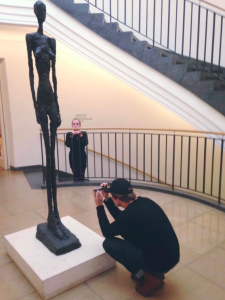
Grande Femme Debout II (Alberto Giacometti, 1959-60)

Degenerate Art

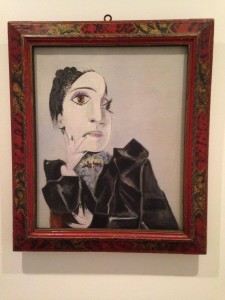
Dora Maar with Green Fingernails (Picasso, 1936)

PSYCHICCITY

Sammlung Boros Bunker

11.04.2016

A tire that spins against a wall and deteriorates more and more with every sideward glance cast upon it, a tree that circles itself and drags its branches along the ground ad infinitum while its leaves fade to a dusty and dehydrated brown, popcorn that pops into a room filled with ten year-old kernels that will only ever be touched by Tom Hanks and will never fill the millions of empty stomachs in the world. The Sammlung Boros Bunker “plays on the ignorance of the audience” by showing us things we think we know, expecting us to question that knowledge, and then revealing that initial knowledge to be true all along. Each piece is open to any interpretation that the viewer projects onto it by leaving the titles of the works as well as the artists responsible for them in a booklet at the front desk. Without a guide there is no hope of taking away any artistic intention from the pieces, and even less hope of being able to find the exit.

Claustrophobia reaches its ultimate peaks in this bunker, whether it comes from the size of your group that you cannot walk away from, or from the omnipresent bourgeoisie that looks down its ever-lifting nose at your laughable blindness in a room filled entirely with lights. What good is art if we are immediately deemed too stupid and too ignorant to understand it? What sort of knowledge did these collectors possess that we seem to inherently lack in the 21st century? It’s something that only Tom Hanks will ever understand.

« Older posts Newer posts »