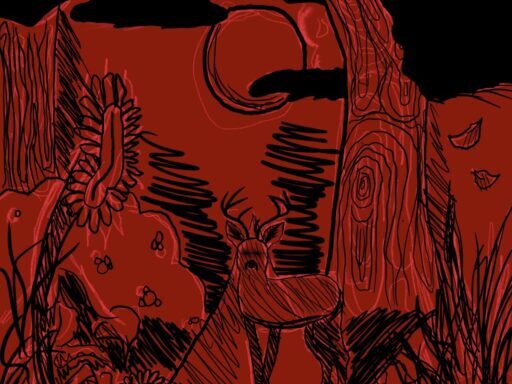
With great exploration comes great cost. The outer wilds of the Evergreen forests and Evergreen fog prove to be a breeding ground of mystery and wonder as we see the taming of previously wild and aggressive animals, plant life that takes a life of its own, and the growing sentience of what was once thought to be outside of the human psyche.
Perhaps the most curious of these all, however, is the increasing number of missing students who venture into these fogs and forests, go missing for days, sometimes weeks, then return from these areas as if nothing happened. These students… they’re different, however. One student by the name of Allison documents that an individual they were treating from the fog could not recognize a pudding cup, let alone what to do with it upon receiving it. The concern was less that the individual didn’t know what pudding was, rather that the individual appeared to have no clue what eating was, or how to do it. The brain fog that comes from overexposure to the fogs is not unusual, but it is unprecedented to take away the memory of performing a basic task necessary for survival. Allison posited this concern at the latest student-wide next steps meeting, and many others immediately jumped on the case of researching this strange phenomenon. Below are their accounts:
May 17th, 4:25 pm
Patient (M) was just recovered from the fog about two hours ago. When asked if they recall anything, M remarks the period of time as nothing but an empty, red void. M can recall basic eating functions, sleep, movement, and motor skills, yet has lost the ability to drink fluids. M recognizes water and other liquids, but does not recognize the action and skills needed to drink and put liquids in their system. Transportation to Olympia is urgent to hopefully set up an IV until the skill returns.
May 16th, 12:20 am
Patient (L) ventured back into the forests. Passerbys could hear it mumbling something about “the eye” and “the sky is looking”. All basic functions are fine, though L has picked up an affinity for licking objects that should not be tasted.
May 19th, 1:25 am
Patient (E) stumbled out of the forests with a haggard appearance and wide, beady eyes. When flashlights were shined onto them, E reacted simply by standing still and looking directly at the person holding the light, akin to a deer in the headlights. When taken into the med bay for patching up and questioning, all E would repeat is “They’re in there. They’re watching. They’re looking for something.” E has attempted many times to return to the forests, but just before entering will pause, as though they have a moment of clarity, before backing away. All other basic functions remain unchanged and working. Patient is on standby as we observe their mental state more.
May 25th, 7:00 am
The most recent rescue crew recovered someone from the fog, referred to as K. K observes the world with a wide-eyed wonder, as if it is their first time experiencing it. While all motor and survival skills are present, K asks many questions about the food and water they are given, asking what it is, where it comes from, how it’s made, if it’s edible. Most interesting and concerning of these questions comes from times where K believes to be alone, where they are heard asking themselves “What should K be doing?” Students have yet to ask K what this means. Partially out of respect from a traumatic event, but mostly out of fear of a reaction.
May 31st, 6:15 pm
Another person came out of the fog today. They were found as the fog receded, around D building. The person in question (referred to as D) did not recognize anybody, or their location. They asked questions like “What is this place? I’m not from here, can I stay with you? How do things work around here?”. Seemingly innocuous questions, yet strange given that D was living on Evergreen campus prior to the catastrophe. D seems to have no memory of where they live, or any concept of what a house is. D has no understanding of the concept of living somewhere, and when asked to stay in the med bay does not understand why or for what purpose.
~ End of accounts~
Curiously, all of these patients retain their sense of self-identity. Knowledge and memories about themselves, their interests, their hobbies, their families all remained intact and untouched. It seems that only base-level automatic skills were simply left behind, like it’s the patient’s first time being a human. More documentation to come.