Of Blood and Beauty

The Evergreen State College

Page 9 of 27

Boros Bunker and Street Art

The Boros Bunker has a lot of interesting history and shows the extent of human creativity and also the progression of Berlin. Once a Bunker, a storage center, and a rave area, it is now a museum of art open by appointment.
The art pieces in here were very modern and interesting. Pictures were not allowed inside, but among the exhibits was a tree hung upside down and constantly being dragged in a circular motion on the ground, a popcorn machine that popped popcorn when you entered the room, and a pipe that extended through at least two walls. The art was modern and creative, very interesting to see.

The street art tour was very interesting as well. Getting to pay attention to a different type of art that was out in the open and seeing What Berlin people think through what they make was very eye opening as well.

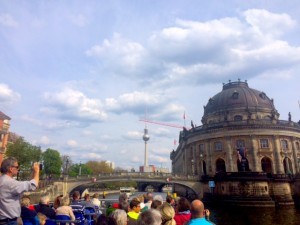
Rube and Mandy take a shiptour on the Reederei Riedel. 64 bridges, 23 kilometers.

Rube and Mandy take a shiptour on the Reederei Riedel. 64 bridges, 23 kilometers.

Rube and Mandy gave up their pretensions to belonging for three gloriously touristic hours atop a big boat in the middle of the Spree, passing through the locks into the Landwehrkanal and other byways, and meeting, it must be said, a very different Berlin.   They followed up the tour by tracking down but not entering a series of galleries designated as Gallery-Weekend hotspots; in what can retrospectively be construed as an act of resistance, they sat down a block away and ate so much Norwegian food that art was out of the question.  At least the restaurant was named for an artist: Munch’s Hus.  (And, in a thematically-relevant twist, it was full of mechanical reproductions of Munch’s works.)

Gallery Weekend 1

Philosophy is a bit hard. To me, studying it can be compared to the experience of holding too many marbles in your hands. Some of them slip out, and as you’re reaching down to scoop them back up, another few fall, and so on and so forth. Which is not a static quality–it’s a matter of honing fine motor skills.
There is something to be said about that, though. In the spaces where the “-ists” and “-isms” should go are spaces that I bridge with other things–more personal ideas, I guess. Whatever that means. But. This weekend is Berlin’s Gallery Weekend. I’ve already spent one day meandering, and will continue to do so today. But I’ve been thinking about the experience of the gallery.
One walks in and finds a dense informative blurb about the artist and their work, serving as a guide of sorts. These blurbs are so dense because they are packed with dense terminology. I have mixed feelings about them. I don’t like being told what to see from the very beginning in heavy academic language, yet I also feel I need to be. More marbles are added to my pockets, and I don’t usually want that. I have plenty already.

All of this is difficult for me to articulate.

This isn’t a new idea, but contemporary art is borne of the countless “-isms” floating around in our atmosphere, a child of philosophy. One could argue that all art is the fruit of that wordy womb.
But galleries. Galleries are a site of intellectual activity, oftentimes, simultaneously self-conscious and ignorant of this fact. Self-conscious insofor as it employs these dense ideas; unconscious because it is also the mere act of experiencing artwork. And of course, museums are like this–however, they are built for the masses and depend on tourists and visitors. The gallery is exclusive, painstaking, and nit-picky. The gallery is not built for a group of bumbling tourists, but for the intellects to gather with wine and one another to exchange their philosophical marbles. I’m not sure if this is a criticism, an us/them situation, because I also partake in the activity (albeit without the plastic cup wine) for the joy of discussing art as it is, in the moment, with a pal. It’s good brain exercise. I get to play with my favorite marbles and listen to the others jangle in the background and on the floor.

I guess my issue is the delineation between the exclusive, intellectual, boujie qualities of the gallery, and the understanding and non-judgmental museum. The former (aggressively?) insists upon its hand-picked artists and their philosophical abstractions and expressions, the latter merely offers a name and date. A clash of direction, of space. And of course, time. It’s funny, the museum makes me want to stay and think hard, and the gallery makes me want to scan and leave. Why is that? All of these ideas will be kept in mind when I go today to more.

I’d love your feedback, and maybe help with molding these ideas a bit more! Bitte Gallery Weekend 1

To be continued, with pictures….

Memorial to the Murdered Jews of Europe and Topography of Terror

This was a difficult day to write about.

I don’t know how to enter into any information or accounting of it.  Our guide was a man named Boris. He was very kind and seemed to try to do his best not to ask down to us as most tour guides do. It felt it a little odd to me that we would begin by looking at some laminated pictures in a folder in the stones above the exhibition but then the rain came and we all bustled inside. Continuing the introductory seminar it was really interesting to find out all of the different potential models made and Richard Serra’s initial involvement with the design of the site. The thing that struck me the most and stayed in my mind as we continued the day at the Topography of Terror was what Boris said at the beginning about it being an inauthentic site for a memorial. It seems that to make a site in remembrance to a very many 6 million people who were disappeared from all over Europe that to choose a single ‘authentic’ site would take away from an atrocity that whenever representing it on this scale can only be sited in the people and their absence.  That said it was very affective. The entire I walked through the rooms and observed and read, I didn’t want to make eye contact with anyone I knew. I don’t know if this is right but I didn’t want to have a collective-connected experience while in there beyond the acknowledgement that there were many other people around. The room of dimension was the most affective space that I walked through. To read the accounts and see the handwriting of families saying their last words and having to look down in order to do this, into the only light made available in the room which were these illuminated boxes covered in text, totally magnified the feeling of looking into some deeper dimensional intimacies. In the midst of feeling a breadth of hard things, we walked back outside and onward toward the Topography of Terror museum. Kevin and I put our hands on each other’s backs for a second during the walk and both agreed that it feels rather necessary to have a human to human check-in in those kinds of moments.The tour guide at Topography was vastly different than Boris’  guide style and demeanor. We were all accidentally late due to a blameless scheduling error and that seemed to started everyone off on a rather stiff foot. I don’t know why exactly and it seems a bit controversial to say but I rather liked him. His quick and somewhat up-tight demeanor paired with his over-sized looking hiking boots and salmon pink scarf was kind of funny to me. Anyway he framed our viewing of the museum with a straight ruler and held everyone on the tour including himself responsible in the proper assessing of old and making of new histories in a truly passive and aggressive way. I had a moment of anger at my public school education while walking through and reading. I could not believe, I felt so ignorant having it take my whole life thus far until getting to the Topography of Terror museum to find out how little the Nazi’s were punished after the war. This information I soaked in and my anger stunted much of my critical faculties that the moment.  Our time was so short there. In the last moments I walked into a room which had the propaganda films of the Nuremberg Rally and watched one minute of it before it was time to leave, not really processing what I had just glimpsed at.

Psychic City//Soundrings

Psychic City//Soundrings

21//4

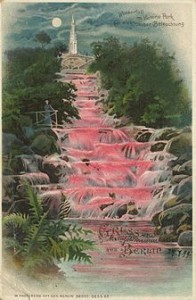
To Viktoriapark, the highest monument, the highest steps –

From the furthest fringes of sound and forward –

(But I wonder, what constitutes the furthest//how can I relegate the cognizance of an order surrounding me to the substrata of these impressions?Right. Best to just stop.)

a distant train, rhythmically clamoring over tracks

traffic in the nearby streets
a faraway 1-2 1-2 ambulance siren

the rush of a waterfall,

china clinks in the cafe

a small bell on a dog’s collar, among the murmur of scattered couples

the wind in the trees (timeless delicacy)
broken violin notes,

ascending, descending, circling steps

dogs barking, birds warbling – calling, responding sparring

fallen petals, dried and grating along the stonework

insect wings

and then blanch – blur toward inward slowly withdrawing –  language fades, inflections, wind, heartbeat – still at the center of a sphere of constant movement, interaction, interrelational, the frantic soundscape, worldwise depth, the whole outside, foreign, unnavigable, dense and multi-dimensional –  I hold my breath, a pure, filthy drag off of that whole outside and reduce myself to a controlled heartbeat, a low echo.

Denkmal für die ermordeten Juden Europas

Denkmal für die ermordeten Juden Europas
//Memorial to the Murdered Jews of Europe

27//4

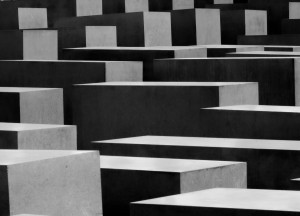
Quietly situated beneath the slanting gray steles of the memorial, is a small but profoundly dense information center, where not only the chronology of the holocaust, but an array of personal letters, poems, telegrams and diary entries, family histories, and detailed information about the sites of concentration camps that spread throughout the European continent give a compact and complicated account of the Holocaust against Jewish populations.

The entrance to the central rooms is guided by a chronology spanning the rise of the National Socialists in the Reichstag to the arrival of the Allies in 1945.

The chronology is accompanied with photos of street-life as the Nazis ascended to power, and the text is impossible to read without looking into these initially ‘ordinary’ scenes and observing the increasing brutality and decimation as the Holocaust reached ever more brash extremes of violence and horror. The text remains factual, the photos reveal a plight more terrifying than any summary could ever convey.

Yet throughout, there remain flashes of hope, resistance, perseverance – from examples of community organizing, including schools, cultural events and a circulating press in the ghettos enduring the brutal affects of the fascist policy of forced impoverishment, to the uprisings of 1943, and in the more immediate instances of hope, love and resolution that radiate from the poems, letters and scattered lines depicting final moments and departures for the affected.

This is an information center (decidedly not an exhibition or museum, but simply an information center) that is freely open to the public and worthy of close exploration.

Here are a few poems by Miklós Radnóti, whose poem, Postard 4, was on display at the center:

Postcard 2

by Miklós Radnóti
written October 6, 1944 near Crvenka, Serbia
translated by Michael R. Burch

A few miles away they’re incinerating
the haystacks and the houses,
while squatting here on the fringe of this pleasant meadow,
the shell-shocked peasants quietly smoke their pipes.
Now, here, stepping into this still pond, the little shepherd girl
sets the silver water a-ripple
while, leaning over to drink, her flocculent sheep
seem to swim like drifting clouds.

Lines from “I cannot know”

… For we are guilty too, as other peoples are,
knowing full-well when and how and why we’ve sinned so far,
but workers live here too, and poets, without sin
and tiny babies in whom intellect will flourish;
it shines in them and they guard it, hiding in dark cellars
until the finger of peace once again marks our nation,
and with fresh voices they will answer our muffled words.

Cover us with your big wings, vigil-keeping evening cloud.

War Diary

1. Monday Evening

You see, now fear often fingers your heart,
and at times the world seems only distant news;
the old trees guard your childhood for you
as an ever more ancient memory.

Between suspicious mornings and foreboding nights
you have lived half your life among wars,
and now once more, order is glinting toward you
on the raised points of bayonets.

In dreams sometimes the landscape still rises before you,
the home of your poetry, where the scent of freedom
wafts over the meadows, and in the morning when you wake,
you carry the scent with you.

Rarely, when you are working, you half-sit, frightened
at your desk. And it’s as if you were living in soft mud;
your hand, adorned with a pen, moves heavily
and ever more gravely.

The world is turning into another war—a hungry cloud
gobbles the sky’s mild blue, and as it darkens,
your young wife puts her arms around you,
and weeps.

2. Tuesday Evening

Now I sleep peacefully
and slowly go about my work—
gas, airplanes, bombs are poised against me,
I can neither be afraid, nor cry;
so I live hard, like the road builders
among the cold mountains,

who, if their flimsy house
crumbles over them with age,
put up a new one, and meanwhile
sleep deeply on fragrant wood shavings,
and in the morning, splash their faces
in the cold and shining streams.

I live high up, and peer around:
it is getting darker.
As when from a ship’s prow
at the flash of lightning
the watchman cries out, thinking he sees land,
so I believe in the land also—and still I cry out life!
with a whitened voice.

And the sound of my voice brightens
and is carried far away
with a cool star and a cool evening wind.

3. Weary Afternoon

A dying wasp flies in at the window,
my dreaming wife talks in her sleep,
and the hems of the browning clouds
are blown to fringes by a gentle breeze.

What can I talk about? Winter is coming, and war is coming;
soon I will lie broken, seen by no one;
worm-ridden earth will fill my mouth and eyes
and roots will pierce through my body.

Oh, gently rocking afternoon, give me peace—
I will lie down too, and work later.
The light of your sun is already hanging on the hedges,
and yonder the evening comes across the hills.

They have killed a cloud, its blood is falling on the sky;
below, on the stems of the glowing leaves
sit wine-scented yellow berries.

4. Evening Approaches

Across the slick sky the sun is climbing down,
and the evening is coming early along the road.
Its coming is watched in vain by the sharp-eyed moon—
little puffs of mist are gathering.

The hedgerow is wakening, it catches at a weary wanderer;
the evening is spinning among the tree branches
and humming louder and louder, while these lines build up
and lean on one another.

A frightened squirrel springs into my quiet room,
and here a six-footed iambic couplet scampers by.
From the wall to the window, a brown moment—
and it’s gone without a trace.

The fleeting peace disappears with it. Silent
worms crawl over the far fields
and slowly chew to pieces the endless
rows of the reclining dead.

“Miklós Radnóti [1909-1944], a Hungarian Jew and fierce anti-fascist, is perhaps the greatest of the Holocaust poets. He was born in Budapest in 1909. In 1930, at the age of 21, he published his first collection of poems, Pogány köszönto (Pagan Salute). His next book, Újmódi pásztorok éneke (Modern Shepherd’s Song) was confiscated on grounds of “indecency,” earning him a light jail sentence. In 1931 he spent two months in Paris, where he visited the “Exposition coloniale” and began translating African poems and folk tales into Hungarian. In 1934 he obtained his Ph.D. in Hungarian literature. The following year he married Fanni (Fifi) Gyarmati; they settled in Budapest. His book Járkálj csa, halálraítélt! (Walk On, Condemned!) won the prestigious Baumgarten Prize in 1937. Also in 1937 he wrote his Cartes Postales (Postcards from France), which were precurors to his darker images of war, Razglednicas (Picture Postcards). During World War II, Radnóti published translations of Virgil, Rimbaud, Mallarmé, Eluard, Apollinare and Blaise Cendras in Orpheus nyomában. From 1940 on, he was forced to serve on forced labor battalions, at times arming and disarming explosives on the Ukrainian front. In 1944 he was deported to a compulsory labor camp near Bor, Yugoslavia. As the Nazis retreated from the approaching Russian army, the Bor concentration camp was evacuated and its internees were led on a forced march through Yugoslavia and Hungary. During what became his death march, Radnóti recorded poetic images of what he saw and experienced. After writing his fourth and final “Postcard,” Radnóti was badly beaten by a soldier annoyed by his scribblings. Soon thereafter, the weakened poet was shot to death, on November 9, 1944, along with 21 other prisoners who unable to walk. Their mass grave was exhumed after the war and Radnóti’s poems were found on his body by his wife, inscribed in pencil in a small Serbian exercise book. Radnóti’s posthumous collection, Tajtékos ég (Clouded Sky, or Foaming Sky) contains odes to his wife, letters, poetic fragments and his final Postcards.”

And so will I wonder…?

Miklós Radnóti

I lived, but then in living I was feeble in life and
always knew that they would bury me here in the end,
that year piles upon year, clod on clod, stone on stone,
that the body swells and in the cool, maggot-
infested darkness, the naked bone will shiver.
That above, scuttling time is rummaging through my poems
and that I will sink deeper into the ground.
All this I knew. But tell me, the work—did that live on?

Der Topographie des Terrors

Der Topographie des Terrors

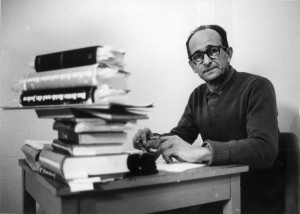
Adolph Eichmann at his desk.


27//4

An evening tour through archives and installations documenting the rise and expansion of the National Socialist regime, at the site of the former Gestapo headquarters. Situated across from the Luftwaffe complex, as directed by Hermann Göring, this district was the throbbing center of administrative power for the Third Reich.

The facts – an onslaught of names and ranks, statistics, strategies, the implicit vie for power, prestige, honor, recognition reduced precisely to the banality described by Hannah Arendt in her book Eichmann in Jerusalem: The Banality of Evil. After a few heavily invested and attentive moments as we were guided through the documentation center, my interest waned to a minimum, I was overcome by an irritation and lack of shock about the inner-workings of fascist machinery. Nothing was, in the abstract, shocking or interesting here, from the dullest bureaucratic moments to the extremes of terror. Probably this reaction was a mode of self-defense agitated by the excess of trivia about the regime, and the inability to make sense of the extremes between the minutiae and horror. And certainly I was fed up after an emotionally exhausting engagement with the stories and experiences of the murdered, those who bore the weight, brutality and expense of this machine. This collection is documentation of fear of the Other manifest in the extreme, and the lifting of the veil here revealed nothing more than the frenzied, albeit well ordered, deluded, yet exact, attempt to realize an Absolute.


Denkmal für die ermordeten Juden Europas (Memorial to the Murdered Jews of Europe) and the Topographie des Terrors (Topography of Terror)

Our class visit this past Wednesday to the Denkmal für die ermordeten Juden Europas (Memorial to the Murdered Jews of Europe) and the Topographie des Terrors (Topography of Terror) presented me with one of most emotionally challenging trips we have gone on during this course. Floating on top of the steady waves of sorrow that always attended me during visits to these kind of places, was a series of complicated dialectics, ones difficult to resolve or even develop at the current moment, save for their brief mention: (the victims/the perpetrators), (reason/unreason), (above ground, light filled/subterranean, dark), (site/non-site), (information aesthetic/aesthetic impenetrability), (text/image), (unfathomability/directness of story and narrative). Unfortunately, I remain, at least at the time of this writing, stuck in the silence that Georges Didi-Huberman so earnestly asks us to break in his excellent Images in Spite of All, a silence that sticks to and is complicated by the 2,711 uneven, rectangular stele that reside above the Information Center of the memorial.

Denkmal für die ermordeten Juden Europas (Memorial to the Murdered Jews of Europe) and the Topographie des Terrors (Topography of Terror)

Our class visit this past Wednesday to the Denkmal für die ermordeten Juden Europas (Memorial to the Murdered Jews of Europe) and the Topographie des Terrors (Topography of Terror) presented me with one of most emotionally challenging trips we have gone on during this course. Floating on top of the steady waves of sorrow that always attended me during visits to these kind of places, was a series of complicated dialectics, ones difficult to resolve or even develop at the current moment, save for their brief mention: (the victims/the perpetrators), (reason/unreason), (above ground, light filled/subterranean, dark), (site/non-site), (information aesthetic/aesthetic impenetrability), (text/image), (unfathomability/directness of story and narrative). Unfortunately, I remain, at least at the time of this writing, stuck in the silence that Georges Didi-Huberman so earnestly asks us to break in his excellent Images in Spite of All, a silence that sticks to and is complicated by the 2,711 uneven, rectangular stele that reside above the Information Center of the memorial.

Psychic City: Listening to Berlin

Location: Humboldthain Park, sitting on a bench next to a friend sitting on the bench.

We walked and sat down together. Looking in front of us we could take in a particularly nice clearing. On either side the paved path connected to darker parts of bush and strategically laid behind us was a partially overgrown storage shed or restroom for the park. The street as we knew from the walk in, wasn’t too far off from us or the clearing.

He set a timer for 15 minutes and we closed our eyes and started hearing around. First was farthest away as possible, I didn’t know how exactly to gauge distance and the farther I tried to hear the more I got this sensation in my head and sinuses that kind of buzzed and made me feel a bit high so I reached for longer than what I should have just to sustain the feeling. I noticed that is was easiest to not attach a source to the sounds, if I tried to hear them all simultaneously. My friend sitting beside me said that he imagined himself into a white room in order to abstract the sounds from any sort of source but then he failed to keep his eyes closed because the white room full of noise began to lull him to sleep. We didn’t describe the textures or colors but more so the way they were organized to us and the different ways we ‘failed’. When doing any project that involves sustaining sound as perceived noise, there’s always a promise of failure. We agreed that the birds were the most difficult not to distract from others sounds as well as trying not to hear it as a ‘bird sound’. After reflecting we noticed that because we had sat still in the same place long enough the squirrels had come out and were just acting like little nut-balls not so far away form where we sat. We watched them until they ran up too far in the trees and walked out of the park.

« Older posts Newer posts »