Of Blood and Beauty

The Evergreen State College

Category: Berlin (Page 7 of 11)

“Schnauze mit Herz”

Week 3 Psychic City in the Wedding Neighborhood

I spent the late morning into early afternoon in Wedding, known as the “Schnauze mit Herz” of the city according to wiki. It is a working class neighborhood in the Northwest of Berlin. I meant to visit Volkspark Rehberge, a huge people’s park with apparently a lot to explore, but because it was raining and maybe because the Saturday bustle was attractive to me I walked around the main streets for the duration of my time.

Coming home I stopped at a bar in Steglitz and wrote out what I had to say about the visit. Here are two extracted prose bits from the scribbles:

Rule #1: every third word

Wedding city’s a a a was end first from assigned flag to wars

other the the Herz a an poor of I go people’s try the or discover mean boar

it rainy and want on so toward and lined of the were Zehlendorf

shops main just interspersed space were because Saturday

seem felt home not was who wallet Euro hip a and I it park.


Rule #2: 2nd // 3rd // 2nd // 3rd….words

neighborhood a satellite village

a later was end the gasp the the flag

to ego the nations city the Herz not but affordable

poor of city to to park try the enclosure at what mean boar

but grey and I want on feet I the and lined arteries neighborhood structures

more flats on main just few home the busy it Saturday seem it a Euro

hip with cheap warm never it park
Psychic City – Legible Erlebnis

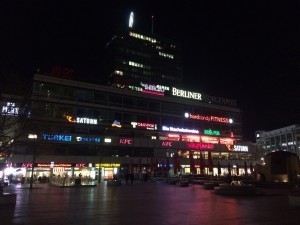
I caught the u-Bahn to the zoologischer garten thinking I would like to go to the zoo at some point, but I knew it was closed this late. I was expecting it to be a little bit more difficult to find the zoo when I got off the train, but I walked up the steps out of the station and boom, the zoo was right in front of me. Looking around I took stock of the scenery. This area was some of the most urban/ industrial I have scene, matching that if Alexanderplatz. This isn’t a place to find traditional architecture and cafes (unless it’s McDonald’s) but rather stores, lots and lots of stores. One building had too many stores to count, so I snapped a pic; got the Mercedes logo in the background too. Oh, there was also a theater nearby, the zoo palast, which was actually the first movie theater I have scene, and not like a stage theater. I’m thinking of seeing the Jungle Book sometime soon, so maybe I’ll go here. I checked the tickets 18.50, that’s pretty pricey. They seem to offer a couple extra things in addition to the ticket for that price though, probable a drink and a snack.

Psychic City – Legible Erlebnis

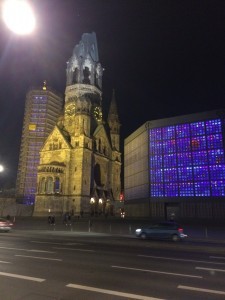
I wanted some coffee, but I knew I was going to have to settle. As in Dunkin Donuts settle. I like my coffee sweet, they make donuts, they can do sweet coffee, this is my logic. As I pull the door open and walk in, some kids behind me approach, and stupid, STUPID me decides to be all nice and shit and holds the door open for them. They are immediately followed by four more of their group, all going to dd’s, all ordering whole boxes of donuts. It took quite a while before I finally got my beverage. Once I did so I did more exploring. I saw that there is a huge train station there, right next to where the u Bahn gets off. There was also a big church in the middle of all the big hotel buildings which seemed so out of place, yet so perfect. Snapped a pic. There was a cool building next to it too with a bunch of lights, which actually turned out to be stained glass windows. From afar I thought it was a mosque, but at the entrance it was simply another church. Standing outside the doors I could hear someone hammering away at the organ in there. Didn’t sound very pleasant. Moving on.

Psychic City – Legible Erlebnis

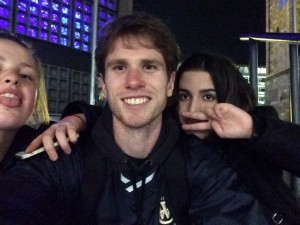
I walked a little way, looked down at my phone to see what the streets were called. This ones called Kurferstend——“Excuse me, parlez vous francais?” I look up, two girls are standing there looking at me. “Uhhh….. Quick remember something, what we’re all those years of French in high school good for?” More stuttering by me, they start listing off different languages; Japanese, Spanish. English? I say. Ahhh English. They spoke pretty much fluently. Paris, like the city and sounds different, and Ronja, with a j as in job sound, were two students from Copenhagen out wandering about. They had been here for a week for their class, this was their last night in Berlin. Eventually, we sat on the steps, me drinking my coffee, which was terrible by the way, them their monster energy drink. We chatted about random stuff, until I found out Paris had been in Brussels a mere block away from the attack when it happened. She said when the bomb went off in the morning, she thought her mother had fallen over. When she went down to the street, everyone was crying. She admitted that when she gets nervous she starts laughing. So she was laughing while everyone was crying. She had been at that terminal the day before.

Psychic City – Legible Erlebnis

PsychicCity Results

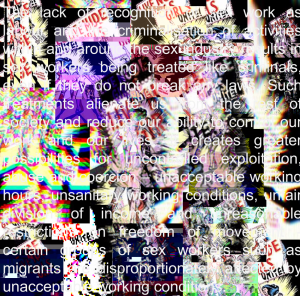
I chose to try Gabrielle’s and Kate’s Degenerate Art experiment. For this I visited the Berlinische Galerie in Kreuzberg, where they are currently exhibiting Berliner art from 1890 to 1980. For my translation I chose to work with Jeanne Mammen’s Valeska Gert (undated, before 1929), which was not featured in the Degenerate Art Exhibition, nor do I believe were any works by Mammen, but the style and the subject (the eponymous and legendary Valeska Gert, whom you should look up if you don’t know her) struck me as utterly unacceptable under the Nazi ideology. The painting can be found here (it’s the big one in the background, click on it to see the whole thing).

Below is my visual translation of the painting, entitled:

Time and a Half on Labor Day

PsychicCity Results

(text is from the Sex Workers in Europe Manifesto found here)

Street art in Kreuzberg

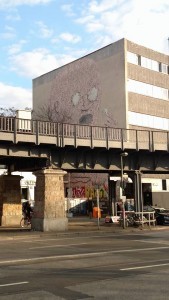
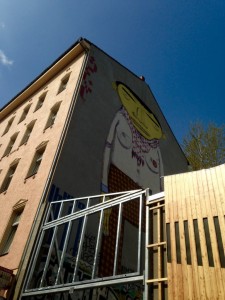
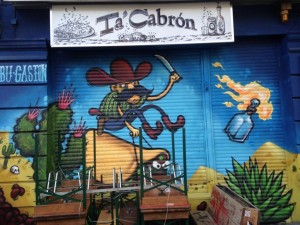
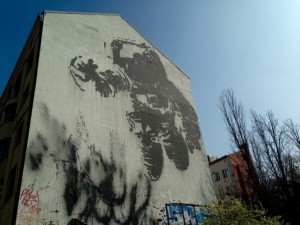
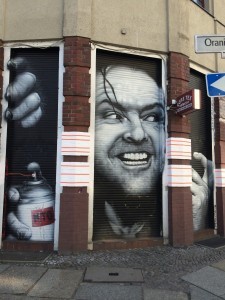
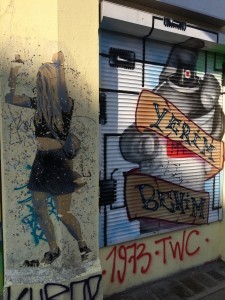
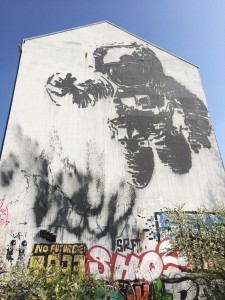
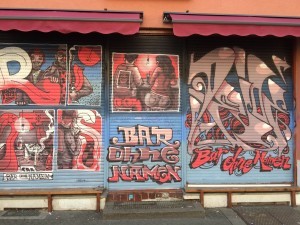
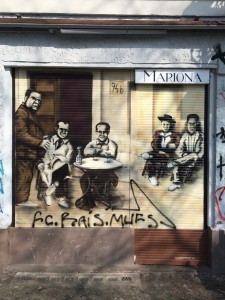
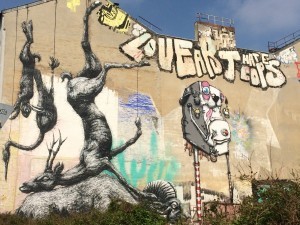
Yesterday we went on a little tour around Kreuzberg, visiting some of the larger street art pieces in the district with a heavily tattooed and pierced local street-artist/freak show performer/burlesque dancer. Many of the pieces that we saw I had already witnessed on my previous explorations of Kreuzberg, but it was interesting to hear what our guide had to say about the pieces and the general street art culture in Berlin. I felt a little conflicted about being on a tour of this thing that is supposed to be counter culture, though; it felt like we were actively participating in the absorption of that subversive art form into the “culture industry”. But it was a beautiful day, and our guide was great, so I’ll keep my complaints to a minimum. Needless to say, I’m glad it wasn’t one of those tours where they hand out supplies for creating your own street art at the end.

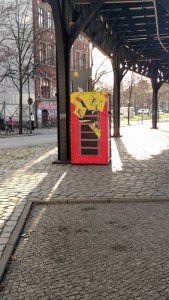
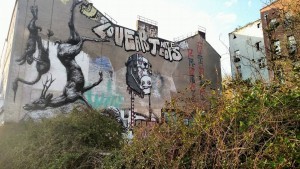
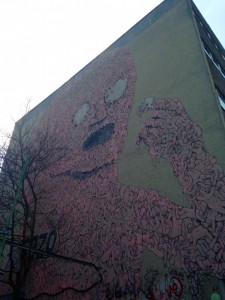
(Pictures not from this particular trip, but all are of pieces that we visited/passed on Wednesday)Street art in Kreuzberg Street art in Kreuzberg Street art in Kreuzberg

The Playground Theory

After doing some research it is clear that a child’s youth is often oriented, (sometimes without a choice), towards a professional football career. For instance, many fathers in Deutschland are ex-players themselves. With the experience they have on the matter, they may believe they are capable of turning their child into the next Messi or Ronaldo. Hence they turn themselves into a coach for the child and force rigorous routines on them at a young age. Now I’m not sure how early into a child’s life this can be, but I do know that there are elite schools for athletic youths. At said schools they are separated from their families and are raised with their fellow classmates, who are also football players. This life isnt very different from what we know as boarding schools. School and football are essentially what a child’s life consists of. His can happen as early as 12 years old, however, I’m almost positive it can happen earlier than that as well. At around fifth grade, many kids are out through various tests to deem whether they are worthy or not of acceptance into these schools. Now I don’t know about you, but this seems far too early. These are prepubescent years, and these schools are gambling on the fact that they can get lucky and a child grow into a perfect football playing machine. During these years a lot is going through a child’s mind, and it may so happen that they find that either football isn’t for them or maybe a child who wasn’t accepted grows up with an unique chance passion to succeed. However I feel about it ethically, it cannot be argued that this is an effective method at creating a nation that is a world powerhouse at football.

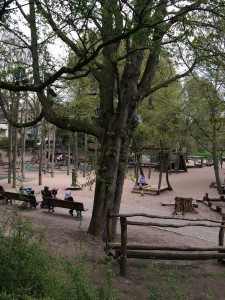
There is something that I wonder about, though, and that is what goes on in the earlier years, before a child is even 10. This range of what we know as elementary school, is undoubtedly a breeding ground, or rather a sorting ground for choosing the most active kids at a young age and putting them into a football oriented world. One thing I have noticed is that there are playgrounds EVERYWHERE. And not just any old playground, heaping, Goliath, mammoth playgrounds. Tell me you wouldn’t want to run around every day as a kid if you lived near a playground that looked like this:

The Playground Theory

This brings a whole new meaning to the word ‘jungle-gym’.

And thus you have kids who perform better than others by the time they would be entering into high school. And are given endorsements and contracts and are basically set for life before they play their first professional game. I don’t know how I feel about this.

Street Art Walk

We went directly through the epicenter of the district fondly known by its area code 36 also known as Kreuzberg. To see some of the well known street art of this city we hopped down Oranienstrasse and Skalitzer Strasse all the way to the Oberbaumstrasse bridge. Along the way we got a chance to discuss the difference between tags of various mediums, commissioned works, and the way gentrification and a constantly shifting subculture of artists are changing and obfuscating the scene today. Here is a passage from Benjamin’s A Berlin Chronicle to help guide you along some of these images of the work we saw.

“Language shows clearly that memory is not an instrument for exploring the past but its theater. It is the medium of past experience, as the ground is the menu=I’m in which dead cities lie interred. He who seeks to approach his own Burris past must conduct himself like a man digging. This confers the tome and bearing of genuine reminiscences. He must not be afraid to return again and again to the same matter; to scatter it as one scatters earth, to turn it over as one turns over soil. For the matter its self is only a deposit, a stratum, which yields only to the most meticulous examination what constitutes the real treasure hidden within the earth: the images, severed from all earlier associations, that stand – like precious fragments or torsos in a collector’s gallery – in the prosaic rooms of our later understanding.” Pp 25-26

Street Art Walk Street Art Walk Street Art Walk Street Art Walk

Kunstbunker

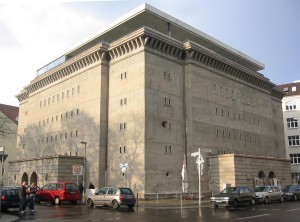
This Monday we met up outside of the imposing Boros Bunker, a private art collection housed in an air-raid bunker from WWII, owned by the Boros family who now occupy a penthouse they had built on the roof of the building. As we were congregating outside of the large, windowless, grey steel doors a buzzer sounded–to my surprise–and we were allowed entry to this fortress of the aesthetic. We were greeted in the lobby by a man whose name escapes me now, who introduced us to the history and the layout of the bunker, and who would guide us through the exhibitions. Once we had all stashed our belongings in a back room, he lead us into the first room where we were confronted with a pair of large conglomerations of rubber cords anchored to different points in the walls/floor/ceiling and then intricately woven together into nebulas of depth which were very difficult for the eye to fully comprehend in their repeating and overlapping layers. The larger of the two also held plastic bubbles within it, and the cords between the walls and both pieces were arranged in such a way that one had to duck under them to move about the room and inspect them from different angles. These would be some of my favorite works throughout the whole of the tour, which was filled with extremely varied styles, mediums, and concepts. Our guide did a wonderful job of leading us through the exhibitions and of providing information about the artists, their works, and the bunker itself, which had quite an intriguing history as a bunker (obviously), but then also a concert/party venue, a paintball arena, and many other things I’m sure. The walls appeared to have been left pretty much bare and in the condition in which their new owners had found them, which I found to be quite the addition to the general ambience of the place. There were other great pieces that reacted to their viewers upon entering their little alcoves, such as a tire against a wall that was designed so that it would start spinning when a person came in to look at it–destroying itself and the wall that it was placed against little by little as long as it was being viewed. There were too many great pieces contained in this bunker for us to see them all, let alone for me to write about (600 altogether, including the members of the Boros collection that weren’t currently on display), and the hour and a half that we spent inside seemed to me to fly by. I think it’s also interesting to note that the Boros family supports artists–some of whom they have been following for years–by funding/purchasing their works

I think that this has been my favorite of our group outings thus far, and I only wish that I could have spent  more time there and seen the rest of the works that were on display (130-some, if I’m not mistaken) because they were nothing if not impressive.

Kunstbunker

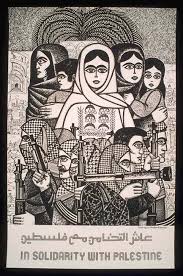
Past Disquiet – Narratives and Ghosts from the International Art Exhibition for Palestine, 1978

Past Disquiet – Narratives and Ghosts from the International Art Exhibition for Palestine, 1978

Haus der Kulturen der Welt

11//4/2016

What began as a traveling “seed exhibition of artists in solidarity with Palestine” – expanded into a worldwide collection and investigation of resistance art movements.  This exhibit documents that expanse, from Palestine to Chile, Italy to Japan.  The curators, having found a catalogue for the exhibition in a library in Beirut, were astonished by the “scale and scope” of the collection, and its absence from any known historical accounts. What they discovered, as they researched the contributors to this collection, from thirty countries, was a worldwide arts movement centered around solidarity and charged by revolutionary politics.

“Past Disquiet is an exhibition of stories collected throughout years of research. Even though the past we uncover is recent, and a number of protagonists are still alive, for the most part they narrate an undocumented chapter in the history of contemporary art: its role in political change and a time when artists brought art to the heart of social life.

The keyword at the heart of ‘Past Disquiet’ (and of the worldwide movement of the 1960s and 1970s) is solidarity.”

Just a few of the many interesting arts collectives/brigades from/in solidarity with Palestine from various countries that stood out:

Palestine Liberation Organization

Plastic Arts Section//Department of Arts and National Culture, Palestine – “mandated to commission, fund and promote the production of posters, art, film, theatre, dance, music and publications; to preserve folklore and cultural traditions, and galvanize support for the Palestinian struggle internationally, in the world of art and culture.”

Arcicoda: Italian art collective

muralismo in Chile: Brigadas Ramona Parra, 1968: “each brigade constituted of 15-20 students and workers, who executed mural paintings during the night or at dawn, born from an urgency to galvanize popular support around social justice and human rights by members of the Communist Party when the media was almost entirely controlled by right-wing political groups. After the coup d’etat, the military erased thousands of images of struggle and hope.” Many Chileans were exiled, and went on to form other arts collectives and muralist brigades in other countries across Europe.

Japan Afro-Asian Latin American Artists Association (JAALA)

International Brigades of Anti-Fascist Painters

Salon de la Juene Peinture

+ + + many others

Also, this exhibit is free on Mondays!

Here’s a link to a great article about the collection:

http://www.museumsportal-berlin.de/en/exhibitions/zeit-unruhe-ueber-internationale-kunstausstellung-palaestina-1978/

Touring the Street Art

Today we toured the streets of Kreuzberg under the guidance of Evelyn, a local enthusiast of street art. She knew all the best places and works for viewing and ended up giving us what felt like an art walk, in quite a literal way. I felt it was a privelage to be guided through such an interesting neighborhood with a new perspective. Here are some of my favorite’s, though certainly not all.

Touring the Street Art Touring the Street Art Touring the Street Art Touring the Street Art Touring the Street Art Touring the Street Art

(Un)successful Kulturbingo

Jules and I spent our Monday meandering through Kreuzberg, looking for our chosen Kulturbingo location: Galerie Open. We passed a lot of Halal and falafel places on our way, as well as the ubiquitous signs for Berliner-Kindl beer, and generally took it pretty slow as we were walking towards our destination. The feeling of the neighborhood changed drastically as we started to move into the more residential areas further from the U-Bahn, but the architecture and the layout of the buildings remained about the same. It began to get much quieter, less crowded, the buildings and doorways less covered in quickly-scrawled tags and peeling stickers, and the shops fewer and farther between. It still felt very lively but in a more subdued, domestic manner. As we followed the blue line on my phone leading us to our destination we took the time to grab a beer from a corner store and eventually came within site of the small park and pond that were shown in front of the gallery on the map, which was ringed on all sides by a road and shops, laid out in a manner similar to a cul-de-sac, with the park in the center, lowered beneath the level of the street surrounding. As google told us that we had arrived at our destination, though, Galerie Open was nowhere to be seen, and in its place stood a fancy boutique clothing store. Jules was less quick to give up than I, and decided to ask the people in the shop where we might be able to find this mystery gallery, and we were disappointed to find that it was now “Galerie Closed”. Nonetheless, it was a lovely day spent wandering through an area we had yet to experience, and we ended our adventure with a couple of consolation drinks at an interesting bar nearby.

« Older posts Newer posts »