Of Blood and Beauty

The Evergreen State College

Page 4 of 27

Prague day 1-2-3

Prague Day 1

Reading Kafka to each other on the train. We arrive and are sprinted across the city to the royal gardens with its peacocks and faux cave wine cellars. We looked out across the city peering down the hills that communists used to ski over and over like Sisyphean athletes because they weren’t allowed to leave.

Prague Day 2

Our synagogue marathon day was disrupted by a marathon. We went through old cemeteries and crowded the tight walkways that snaked around, annoying people with strollers and dogs. There were hands on headstones and possible mis-hearings that aristocrats were to dirty to enter or touch . Disposable yamakas were handed out at the synagogues to help male tourists feel closer to god. Then a Kafka fun house and with a Kafka translator who spoke about the tediousness of language and collaboration. The day finished with one of the best meals of my life and a bird named Gustav.

Prague Day 3

We ate in the breakfast dungeon and set off to Radio Free Europe. A reporter with the last name Serafim spoke about jazz, liberty, and the western world; relations with the east mediated through Hendrix, Pink Floyd and Miles Davis. I kept asking myself what was being obfuscated on the tour. The reporter wanted a certain kind of question to be asked but I couldn’t tell what. I tried to prompt a conversation about the multiplicity of ways to define freedom and the limits of western bourgeois freedom becoming a universal standard, especially when it is hard to find even at its origin. Of course this was at the last minute and we were shooed back through security before any conversational momentum could build.


Denkmal für die im Nationalsozialismus verfolgten Homosexuellen

Yesterday, I paid a visit to the Denkmal für die im Nationalsozialismus verfolgten Homosexuellen (Memorial to Homosexuals Persecuted Under Nazism) which which sits across the street from the Denkmal für die ermordeten Juden Europas. Both have some privacy from the other, produced by a stand of scrubby trees. The memorial is a singular stele of similar proportion to the stones across the way, but is of much larger size and canted more dramatically than those that make up the vast array of rectangular stele in the adjacent site. (The designers are different, however.) While the stele for the Denkmal für die ermordeten Juden Europas look as if they have been excavated archaeologically, dug and uncovered from the earth, this memorial appears as if it has fallen out of the sky, appearing suddenly, without warning. Apparently absent of any signage or documentation, there is an almost happenstance quality to this mausoleum like object: if one wasn’t looking for it, it would be surprising to come across. (Later, upon looking at the memorial’s wikipedia page, there is a low, ground level sign, but, I did not see this during my visit.)

Standing about 3.5 meters tall and 2 meters wide, the concrete block could be described as a peep show viewed through a windowed trapezoidal cut formed into one face the block, a cut who’s shape is reminiscent of neo-brutalism. Upon looking in, a viewer is confronted with a short black & white video loop of two young men, looking in their early 20’s, standing in a park and sharing a moment of intimacy: a kiss, a caress and a whisper. After the whisper, the whispered-to offers a facial expression of joy and mystery; a sly, knowing, excited smile passes over his face. Edited to present itself as seamless, the video loop was shot at the exact cite of viewing. The trees that one sees in the video are the same ones sit behind the block, putting the video it what seems like a contemporary space. Yet, due to the black & white capture, the 1.375:1 “Academy Format” aspect ratio (one that was the standard format in the 1930s), the seeming timelessness of both the haircuts and dress of the two young men; the work speaks to the presence of lost possibility, of robbed chances, of experiences never had. In further, because the law prohibiting homosexual acts by men, §175, was only truly enforceable by members of the public informing on their fellow citizens, a visitor is placed in the position of have to make the choice to allow these two people to be undisturbed as they share their private moment, engaging in what was then an activity punishable by imprisonment.

Mittwoch Fotogallerie im Praha

Today I went to visit the Museum on Communism –

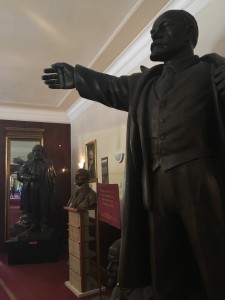
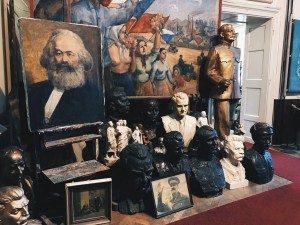
If you return to Prague over the next week and a half, or sometime later in your life, then I would recommend visiting the museum. It’s located on the first floor (think US. 2nd) of a highly trafficked strip mall area; additionally there’s a McDonalds directly 5M away to your right upon exit. The museum itself is gently tucked away into the corner of the building, but don’t let the size fool you–they still found it possible to squeeze in 12 foot tall statues of both Marx and Lenin; along with a theirs busts scattered about the floor.

The content of the museum was fascinating. The walk throughout the space began with an introduction to Czechoslovakia of the early 1920s and the economic and political hardships that were experienced; economically, the shaking of industry that was experienced after the New York Stock Collapse and politically, the rise of fascism and communism. Specifically among the former, the rise of admiration towards the Nazi party among Germans who lived within borders of Czechoslovakia had risen as unemployment and access to basic necessities became more difficult; among the latter, the crisis presented advantageous position for the communist party within the Czech government. From here, the museum winds the viewer through communist political philosophy, propaganda, state violence and citizen uprising.

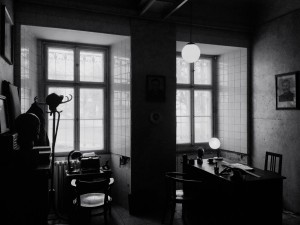
Below are a few photos I snagged while wandering through (the museum attendant kept giving me funny looks for photographing the informational boards, so I hadn’t taken much down to elucidate more on above. Highly recommend viewing this museum yourself, however.)

Mittwoch Fotogallerie im Praha

Mittwoch Fotogallerie im Praha

Mittwoch Fotogallerie im Praha

Other than this, I haven’t explored much – I did wander through a few blocks of the city before stopping at a cafe to keep working on Kafka and story drafts.

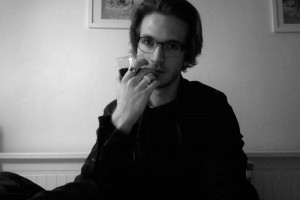
OH, here’s a proof of life:

Mittwoch Fotogallerie im Praha

A Night and Day In Oldenburg

[geo_mashup]

Arrival: 16th of May

Let me just start out by saying that the drive here was very safe and we made it in the city of Oldenburg with plenty of light and found a perfectly central little hotel to stay in. The Internet, as per the usual in the hotels I have thus far experienced in Europe, is pretty hit or miss in the room and just fine down in the lobby. My mother is very pleased with all of the accommodations and our stay thus far.

A Night and Day In Oldenburg

OK. That all being said I would like to add that the drive we took yesterday can and will go down as top five most stressful driving trips I have ever been a part of. We have a rental car and drove entirely on the autobahn. That was fine. I made sure we had directions the night before on a map off my phone, my Mom got some good tips about what to look out for on the road, and we got the car insured under my name very easily.

No big deal. The real sticky situations arose around our conversations which I won’t go into now due to the personal nature of the dialogue, but they revolved around family dynamics and that tends to be a heated debate between me and my Mom. We were able to expand on some philosophical points around children, how and what conversations to have with them, what choices couples have to come to terms with as a part of long term committed relationships, and the like. All well and good even though at times it did get tense.

So already I’m chalking this trip up as a great success because this is the sort of thing that as an adult I think is a rarity. To have such complex dialogues around touchy and sometimes taboo subjects and be able to find a way to express oneself clearly and articulate them in such a way as to share ones opinion, but not judge the individual giving it is really tricky to juggle all at once. This is all while driving very diligently on this super highway, on a trip where I’m wanting to get a better understanding of where I come from, in the country where I come from. Now that I take all that into consideration it doesn’t sound all that bad. In fact it sounds pretty great.

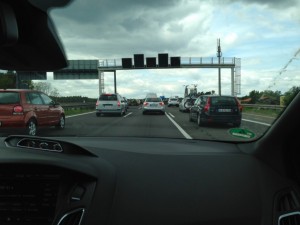
I guess the only real problems yesterday were getting stuck in traffic for about two to three hours and missing a turn and ending up in Hamburg. I mean we were close enough to the North Sea to be able to see the shipyard loading cranes. This was about an hour out of the way we were supposed to go. What was supposed to be a fairly simple four hour drive turned into an almost nine hour drive. The drive ended at Antares Hotel on Staulinie Strasse. Even with all of the stress and anxiety I’m really glad that we took the time to make it out here to a town some of our ancestors were from according to an essay my Great Uncle wrote while researching our ancestry. We got situated in the hotel got Chinese at a local place around the corner, and crashed.

17th of May

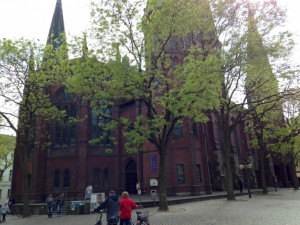
Today we went for a little wander around the downtown footpath streets and found an information center, the shopping centers, the bar streets, and a church that has been redone so many times the town doesn’t even know how it got there to begin with. It’s called the St. Lambertikirche in Oldenburg. And it is a massive piece of architecture to stumble upon while walking down these windy little corridors.

A Night and Day In Oldenburg

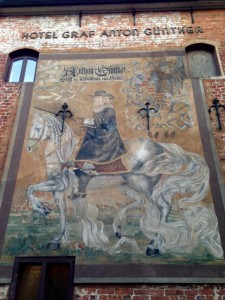
When I stepped into the white space inside this neo-gothic brickwork exterior I kept expecting to see a different aesthetic around the next corner. I was wondering where it was going to start being an old church with all of the elaborate and ornate pieces from saints and bible passages. None of it. The entire interior in painted very simply white with accents of a dull gold and light blue. In the entryway there are the sarcophagi of two of the most prominent noblemen of the town of old; Count Anton Günther (this guy)

A Night and Day In Oldenburg

and the Protestant Prince Bishop of Lübeck Friedrich Augustus, both laid empty.

A Night and Day In Oldenburg

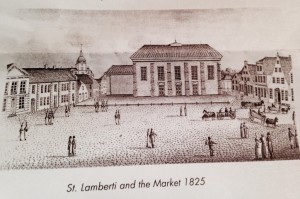
It was the latters successor who rebuilt the interior of the church in the neo-classical style. Instead of the long gothic nave it is now a wel-lit rotunda which is much smaller than the outer dimensions suggest. Even with the seemingly out of place and somewhat tacky floating cross in the center of this space it is still a beautiful little historically misplaced place of worship. It just seems like it’s almost a part of the half brutalist half classical style of the third reich, even though the history clearly states otherwise, but you get an eerie sense that that sense of style was not unwelcome here. I’m just glad to say that my ancestors would have been here when it still looked like this.

A Night and Day In Oldenburg

‘I Say Allemange’ Hélène Cixous

Untying the Mother Tongue Conference //12//5// Berlin Institute for Cultural Inquiry

Hélène Cixous

Notes taken as follows

Perpetual returning of tongues/Mother tongues are a kind of mood/’The delight of painlessly foreigning oneself’/Soul searching states/angst-with willow wisps-prehistoric cities/Dream-Traum-Trauma/Using the word yesterday even when it has been months since the moment was recorded/Spirituality crisis—she can touch it/Fluidly/She can speak of her own experiences while somehow also talking about so many critical ideas and open it up to allow another’s experience and emotion to enter in the moment/’When I go down into languages I am touched/By contact/By rhythm’/I need to derive pleasure from using language/The more we return the more the Subject gains Strength and Power/Inhabiting/ This is a memoir/’These places are so saturated in Phantasms that they are impossible to see/Here everything is lost so let us hold onto the lost.’


the nature of reality

Current song: The Nature of Reality – Oasis

Current location: Friedrichshain, Berlin

the nature of reality

We need proof of life photos/entries. I feel this adequatly sums up my level of liveliness.

KW Institut for Contemporary Art

KW Institut for Contemporary Art
SECRET SURFACE
WHERE MEANING MATERIALIZES
Group exhibition
14.2.
1.5.16

In his terror of chaos, (man) begins by putting up an umbrella between himself and the everlasting chaos. Then he paints the underside of his umbrella like a firmament. Then he parades around, lives, and dies under his umbrella. Bequeathed to his descendants, the umbrella becomes a dome, a vault, and men at last begin to feel that something is wrong.

D.H. Lawrence

Departing from the traditional coordinates of the occidental world-view, the exhibition SECRET SURFACE asks where –  and more importantly, how –  meaning may materialize.

Through our permanent reference to a “beyond” (be it the horizon, the universe, or the ultimate “beyond” death), an opposition is set up in which these depths are regarded as the ordinary’s other, which provide direction to our existence, and which implicitly devalue the surface. People and things are considered superficial if they lack complexity and intensity. SECRET SURFACE turns this logic upside down, and presents contemporary artworks that conceive of the surface as the location of experience itself, both in terms of subjectivity and towards the outer world.

With contributions by niv Acosta, Auto Italia (Kate Cooper, Marianne Forrest, Andrew Kerton, and Jess Wiesner), Trisha Baga, Anna Barham, Eduardo Basualdo, Viktoria Binschtok, Gwenneth Boelens, Beth Collar, Hollis Frampton, Spiros Hadjidjanos, Andy Holden, Alex Israel, Philipp Lachenmann, Mark Leckey, Lawrence Lek, Ying Miao, Philippe Parreno, Elizabeth Price, Naufus Ramírez-Figueroa, Emily Roysdon, Georgia Sagri, Prem Sahib, Nora Schultz, Katharina Sieverding, Reena Spaulings, Patrick Staff and Cara Tolmie, Philipp Timischl, Frances Stark, and Martijn in ‘t Veld.”

Visiting this exhibit on 30//4, the gallerie was standing-room only, with artists and enthusiasts crowding into the halls floor by floor for a look at the strange collection of works of this surface-dominant installation.
There were many interpretations and elaborations upon the theme, but probably the most amusing was Beth Collar’s ISLAND OF THE DEAD: a projection of an out of focus index finger pointing at an equally out of focus asymmetrical dark shadow. The single phrase “all of the dead go there. there. all of the dead go there.”was repeated hundreds of times with the hand gesturing towards the dark area occasionally moving closer to or even through the stain. Eventually the image comes into focus, as a raw outcropped volcanic island, and the audio adjusts accordingly: “look at that rock over there. it’s the island of the dead. look. at that rock over there. the island of the dead” The film went on and on, and regardless of how much definition the image gained, there was little clarity. As the phrase was repeated, meaning dropped from the words altogether. “all” “dead” “go” “there” “island” were just as insubstantial as the projection itself. This installation was on the first floor, where  “the prologue Secret of the Surface introduces the subject matter and demonstrates that surfaces appear seductive because they can never be completely experienced visually”
Overall, an interesting renditions on the theme throughout, from addressing “social norms as a surface from which the individual can gain opportunities for action more through appropriation and varying repetition than attempted dissociation.” to a “media defined/virtual realm of existence with the screen as surface that mediates the relationship between individual and surrounding.”
This show ended on the 30th of April, but the gallery is well worth checking out for other installations.
www.kw-berlin.de

Hélène Cixous // I Say Allemange

Hélène Cixous // I Say Allemange

Untying the Mother Tongue Conference
Berlin Institute for Cultural Inquiry
Hélène Cixous

12//5

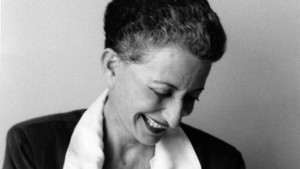
A beautiful, sonorous reading given by Hélène Cixous woven around her enduring linguistic and literary attachments from a childhood of multilingualism, where the languages spoken by her father, mother and grandmothers (French, German, English) connected her, dreamily, to the distant lands of her ancestors and their domesticated languages, creating, by extension, the personification of language as being an omi or a mama. “I multiply and divide myself in a multiplicity of languages, emotions come through in diverse language.” “Since omi is German, I am only a child of German”


Here are a few further notes from her reading:

“The heimat is never to be confused with nation. The heimat is a mixture of love and attachment, milk and tradition. The heimat is a retreat. And home, the more we return to it, the more we safeguard strength and power. Muttersprach. Language is mother, almost a more real mother than the other.”

“We must resist nationalism, it is a deceitful appropriation.” “The loss of language is the loss of those, and humanity, to connect to. Humanity is gained by learning language.”


Berlin 2016-05-17 06:56:39

Untying the Mother Tongue:
Daniel Boyarin: Philological Investigations

The Concept of Cultural Translation in American Religious Studies

” “Jedenfalls aber ist unsere philologische Heimat die Erde; die Nation kann es nicht mehr sein.” (Our philological home is the earth. It can no longer be the nation.)
Erich Auerbach, Philology and Weltliteratur (1952)

For many years, Daniel Boyarin has been engaged in a project to discover how or why it makes sense to speak of “religion” as existing or not at a given time and place. In this project, Wittgenstein has proven to be an increasingly consequential compagnon de route. Boyarin takes the Philosophical Investigations not so much as a work of academic philosophy but as an attempt to describe how language actually works, how human beings produce meaningful speech and writing. The central question treated in this presentation is adequacy of terms drawn from Euro-American languages to describe the cultures of alter. In order to adumbrate some answers to these questions the thinking of Talal Asad about cultural translation is pitted against that of J. Z. Smith.”

Event Page Upcoming Events

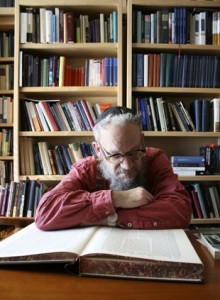
Here are a series of notes taken during a reading given by Daniel Boyarin at the Institute for Cultural Inquiry

on May 11th, 2016. Direct quotes are in quotations, the rest are my interpretations and quick reductions.

(These notes alone are intriguing and leading without my analysis or commentary)


Wittgenstein writes that philosophy must not interfere with actual use of language, but should only describe it.

The meaning of a word is revealed by its use within the language – meaning is not representation, it is use.


Researchers must look for and see the uses of words, understanding two concepts:

  1. Every new use adds nuance
  2. Interpretation of a word is affected by all prior uses known to the speaker and listener.

A word is placed into context only by “half-remembered words and phrases pulled out in seemingly appropriate usages.”

Wittgenstein describes language as a game – and the basic rule for interpretation of a word is “don’t think but look – look and see if there is something common to all.”


For a word to have meaning, it must exist. If a word doesn’t exist in culture, it has no meaning. However, it is not always the case that the concept doesn’t exist and especially so in regard to religion. So what about religion? Religion as a word must exist in language for it to imply meaning independent from day to day practice.


The phenomenon of religion certainly exists in all cultures, but whether a culture has a word for religion reveals the categorization of religion/practice in a culture.


Older cultures may not have recognized the existence of religion.

Wittgenstein states that “to imagine a language means to imagine a form of life.”

Boyarin: “A form of life is close to culture.” To investigate a language means to investigate a culture, what a language lacks by comparison, the culture has not comprised.


Different cultures have different forms of language – which leads to the question of the possibility of translation.


Our modern Western language is inadequate to describe or understand ancient cultures. We must strive to learn their languages.

As Walter Benjamin wrote, we must turn German (or English) into Greek, Hindi, Hebrew, and not vice versa. We should not try to represent their language systematically in our own lexicon – for in this, we are stuck in our own thought and language.


As an anecdote, English merchants refused to trade with Japan in the 19th century, until the Japanese could describe, or give a definition to their religious practice/s. Hence the Shinto religion had no unifying name until it was forced to be defined by the outside.


“Semantics shift with contact with other forms of life.”


Some definitions require great lengths, books, to define, even in semblance. It is hard work to render concepts/words closely into one another.


In one study, the word ‘religio’ was bracketed out of hundreds of different paragraphs describing religious practice, in an attempt to define ‘religio’ by context alone. It was impossible to derive the meaning of the word; this project gave only the sense of the range of uses.


Religion obscures much more than it reveals. Religion is a praxis – there may not be a term for it when it is wholly embedded as a mode of existence – as not categorized, segregated from other practices.

As an example, Boyarin gives an anecdote about Judeans using a festival, Pentecost, to plot a revolution. To the Judeans, this was a normal course of action – plotting a rebellion was no different than any other praxis, as politics and religion were integral to one another.

Those who opposed the actions of the Judeans criticized the use of Pentecost as a cover for subversive scheming. Those who supported their actions praised their craft. To the Judeans it was a matter of course, not a scheme.

————————- – – – – – – – – – –  –  –  –  –  –   –   –   –   –   –    –    –    –    –    –    –   –     –     –     –     –     –     –       –       –       –       –       –


The task of translating culture is not to reduce an unknown to a known.  We must progress beyond the idea that the “history that I want is the history of the present” illuminating our position by events of the past. Other language also functions as a complex language game, and shakes our grip on the notion that our rationale is superior to those of the past. We must study the validity of other language games, and stop assuming that all the past leads into Enlightenment.


The task is to listen to others, to become strangers to ourselves.

The deformation of our language is imperative in order to translate.

Religion can exist without anyone knowing it does.

We must deform/imagine our life without the word religion.

We must find others in the past and adapt our language to meet theirs.


To avoid being alone in the world: allow the other to be herself.

By allowing others to be themselves, we investigate other forms of life and the possibilities therein – we must surround ourselves with possibilities.


By deforming/converting language it changes our life form – there is a possibility of losing original language, and blurring culture, but we must continually become something new — not collapse into a singular language/culture, but to expand and allow for multiplicities of existences.


In avoiding reducing an unknown to a known – how do we know what we see/hear? In the enterprise of seeking, by turning our eyes towards our own practices in the game of knowledge, requires the removal of knowledge and NOT to seek reducing unknown to known, but finding the unknown in our own language and lives.

« Older posts Newer posts »