

The following handouts were given out and discussed during the all-program check-in Week 9 Monday November 27. If you missed class that day, you will be able to pick them up in Tuesday’s Physics Lab. If you missed picking up paper copies or have lost any, they are linked below for your convenience:
Author Archives: Krishna Chowdary
Winter Class Meeting Schedule
Math Quiz #7 Revision and Reflection
- Blank copy of Math Quiz #7
- Math Quiz #7 Revisions & Reflection are due 1pm Mon. Dec. 4
- See this post for detailed guidelines for Revisions and Reflections
Math Problem Set #7 Solutions
- Math Problem Set #7 Solutions
- Compare these solutions to what is in your Math PSN.
- Make notes, corrections, or complete problems using a different color ink directly in your PSN.
- This (along with looking over lecture notes) will serve as excellent preparation for the Math Quiz.
Math Problem Set #8
Complete All Problems in your Math Problem Set Notebook. Bold underline problems also due via WebAssign by 6pm on Fri. Dec. 1.
- 5.3: 3, 7, 14, 28, 31, 37, 43, 47, 49, 53, 60, 64, 74
- 5.4: 3, 6, 8, 9, 12, 14, 17, 19, 20, 21, 25
- Note: Math Problem Set Notebook spot checks will occur week 10 Tue. Dec. 5 in class during the Math Exam – please bring it with you to class on that day. Notebooks will be evaluated on: organization & clarity; attempts at completion; evidence that provided solutions were used to correct/complete your solutions. Notebooks will be checked for entries since the first check in week 5, so use a post-it note (or equivalent) to mark your PSN to that point.
Fall week 8 and 9 Assignments reminders
Some reminders/announcements about assignments:
- As of this post, a number of students hadn’t begun Math Problem Set #7, which is due Fri. Nov. 24 by 6pm via WebAssign.
- There are Reading Responses in Math due Sun. Nov. 26 by 6pm via WebAssign and Physics due Sun. Nov. 26 by 8pm via MasteringPhysics.
- Quiz Revisions are due as normal.
- Physics Week 8 HW: CH 10 is due Mon. Nov. 27 by 6pm via MasteringPhysics as normally scheduled.
- Here is a post about Mandatory Lab Clean-up.
- Here is a separate detailed post about Week 9 Chemistry assignments.
- Our last seminar of the quarter is Thu. Nov. 30 from 9 – 11am. Here are the Week 9 Seminar Readings and Writing Prompts.
- Math Problem Set #8 will be due Fri. Dec. 1 by 6pm via WebAssign.
- The Physics Week 9 HW will be due Sat. Dec. 2 by 6pm via MasteringPhysics: note the non-standard due date, which is to accommodate exams in Week 10.
Fall quarter Mandatory Lab Clean-up
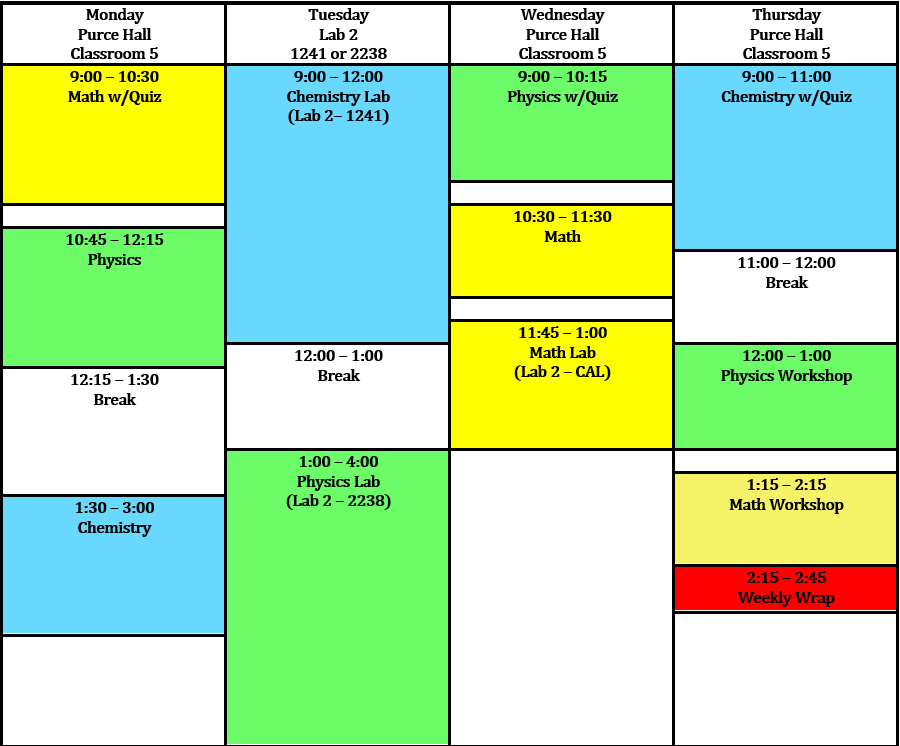
Each student is required to participate in mandatory lab clean-up at the end of each quarter. The session is scheduled in week 9 Tuesday November 28 from 4:30 – 5:00 in either Lab 2 1241 or Lab 2 2238. If you miss this session, you will need to schedule a separate clean-up task with an SIT before you can have an evaluation conference. Make-up clean-ups are on your own time and generally more onerous. You can’t sign up for a conference until this obligation is met.
Week 9 Reading
- Chemistry: no new reading
- Math: Stewart 5.3 – 5.4
- Math Reading Responses due via WebAssign 6pm Sun. Nov. 26
- Physics: Wolfson 11.1 – 11.3; 11.4 – 11.5
- Physics Reading Response due via MasteringPhysics 8pm Sun. Nov. 26
- Seminar Reading for Thu. Nov. 30
Week 9 Seminar Readings and Writing Prompts
Our final seminar of fall quarter will be from 9 – 11am on Thursday November 30. Schedule changes due to this are noted in your Replacement Reading Schedule.
The readings for the seminar (from the peer-reviewed scientific literature) focus on overt and subtle issues of bias related to gender and race in STEM environments:
- Quality of Evidence Revealing Subtle Gender Biases. Link to online version where Supporting Information (SI) can be accessed.
- Double Jeopardy in Astronomy and Planetary Science. Skim article, but pay particular attention to Table 3, Table 6, Section 2.5, and Section 4.4.
We will hand out paper copies of these articles in class Monday so that you can mark those with your annotations and questions, and have them available during Seminar (without people using electronic devices during the discussion).
Pre-Seminar Writing Assignment. Beyond reading the Quality of Evidence paper and skimming the Double Jeopardy paper, we would like for you to respond in writing to the following prompts.
- Please type up your responses and bring them with you, along with the articles, to Seminar.
- Your typed responses will serve as your Seminar Entrance Ticket.
- Faculty will collect these at the end of Seminar and check for evidence of attempting to complete.
The readings for the last seminar of the quarter may be some students’ first introduction to looking at a scientific paper. We do not expect students to be able to read a peer-reviewed article in its entirety and completely understand it after one (or even five) readings. Even experienced scientists skim papers for necessary information and, for the most part, this is what we are asking you to do.
The articles in question we have given you were both published in highly regarded journals. The Proceedings of the National Academies of Science (PNAS) is a journal that publishes high-quality research across many areas of science, while the Journal of Geophysical Research (JGR) is one of the most highly respected journals in the geosciences.
Before you read for content, first scan the heading titles of the subsections of the two papers to get an overview of what goes where. The order of the sections in the JGR paper (Double Jeopardy) should look familiar to those taking chemistry. The PNAS paper (Quality of Evidence) has a slightly different order and the introductory section does not have a heading title.
The PNAS (Quality of Evidence) is shorter. (Many papers published in broad-interest journals such as PNAS, Science, and Nature move a lot of the nitty-gritty details to “Supplemental Information”/SI sections that you can access online; link above.) The questions in the writing assignment below refer to the PNAS paper unless otherwise noted.
- The first part of the PNAS article is an abstract (summary) printed in bold face. Following this is an unlabeled introduction section that discusses the importance of the topic and summarizes the scientific literature on which the current research was built. Figure out how many papers (or other references) are cited in this section and record this number. Then go to the end of the paper, locate the citations for these references, and, based on the names of the journals, make a list of the fields of study being drawn together in this section.
- Based on the “Current Research” and “Materials and Methods” sections of the PNAS paper, write a one- or two-sentence summary of your understanding of each of the three experiments reported in this paper.
- The “Results” section of the PNAS paper is chock full of statistics! If you don’t have a background in statistics, use the guideline that anything with a P-value less than 0.05 represents a significant statistical correlation. Right now the results section is a hard-to understand jumble of numbers. Take your best shot at creating a table that summarizes the results of the three experiments. If you’re not sure how to do this, examine the JGR paper, particularly Table 3 and/or Table 6.
- Skim the “Limitations and Future Directions” section for limitations of the PNAS study and compare to section 2.5 of the JGR paper. What sorts of limitations seem to be inherent in this sort of study? What limitations might be avoided with better experimental design?
- Compare the “Discussion” section of the PNAS paper with section 4.4 of the JGR paper. Both sections discuss actions that might be taken to counter bias in STEM fields. Pick one action from either paper that you think might be effective, and one action that you think might be hard to implement.
Thankstutoring
Some info about program tutoring and QuaSR time around Thanksgiving break week:
- Fri. Nov. 17: regular tutoring and QuaSR hours
- Sat. Nov. 18: regular tutoring
- Sun. Nov. 19 – Sat. Nov. 25: no tutoring, QuaSR closed
- Sun. Nov. 16: regular tutoring and QuaSR hours
- Program Tutoring details here