Category Archives: Events

History of U.S. Cuba Relations and the Possibility of Full-Scale War

by Peter Bohmer, May 7, 2026

At Economics for Everyone Forum, “Stop U.S. Aggression on Iran and Cuba, Olympia, WA

History of U.S.-Cuba Turmoil and Possibility of a Full-Scale War!

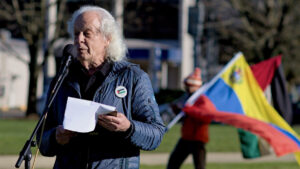
Photo at  Forum, May 7th, Economics for Everyone

By Peter Bohmer, May 7, 2026

Personal note: I have studied the Cuban revolution and taught about and been in solidarity with Cuba since the late 1960’s. I have visited five times including living there with my family for four months and teaching Cuban faculty at the University of Havana in 2001. I took a class from The Evergreen State College to Cuba for eight weeks in 2004, traveling through the entire island, and vising more recently. I keep in touch with a few friends there. Peter

The Trump administration is serious about overthrowing the Cuban government and its political economic structure. What can be done to stop it?

On Mayday, 2026, Trump signed an executive order authorizing additional sanctions on financial institutions and other corporations from around the world trading or investing in Cuba. Trump said, “We will be taking it (Cuba) over almost immediately.” In response, the Cuba President said, “No aggressor, no matter how powerful will find surrender in Cuba.”  If Trump were to attack the country, Miguel Diaz-Canel said, “he will find a people determined to defend sovereignty and independence in every inch of our country”.

This follows the Trump administration’s April 14th directive to the Pentagon to “ramp up preparations for possible military action against Cuba.” Trump told reporters the day before that “we may stop by Cuba after we’ve finished with this” (this referring to war against Iran). This followed a January 29th Executive Order calling Cuba “an unusual and extraordinary threat” to US national security”.  As part of this, Trump announced a blockade of oil to Cuba and stiff tariffs for any country delivering oil to Cuba with US warships around it. The two main suppliers had been Mexico and Venezuela. They and other nations have stopped shipping oil to Cuba except one big shipment by Russia in late March of this year.

The U.S., while threatening an invasion and assassination of its leaders and/or bombing of Cuba is already conducting an act of war by this blockade. This is both a continuation of the 66-year-old U.S embargo of Cuba and a further tightening and escalation. There is an increased U.S. military presence in the Caribbean, and the U.S. continues to have a naval base at Guantanamo on Cuban soil.

The lack of Cuban access to oil is causing increased blackouts and shortages of food and serious declines in the health care system. The Cuba health care system until recently provided universal and quality health care to the entire population. The objective of the Trump administration is to cause so much hardship and suffering of the Cuban people that they revolt against their government and cause its collapse. This is Trumpism’s preferred strategy. It is inhumane, illegal and immoral. It probably won’t succeed as the Cuban state retains legitimacy especially against the U.S. and there is limited opposition within the Cuban military and the Communist Party against the leadership. Still, an actual military attack by the U.S.  is a possibly. Let us not let it happen!

The Cuban Revolution led by Fidel Castro overthrew the dictatorship of Fulgencio Batista on January 1, 1959. President Eisenhower in spring, 1960 signed an order calling for the overthrow of the Cuban government which has been the policy of the U.S. for most of the last 66 years.

                                                     Why?

From the 1960’s through the 1980’s, the threat of Cuba to the U.S. ruling class was the threat of a good example. The threat of a good example means that Cuba meeting the needs of its people would inspire anti-capitalist revolutions in the global south, what used to be called the Third World. These societal transformations would reduce or end the possibility of U.S. corporations exploiting the labor and profiting from the minerals and food production of these countries. Supporting corporate capital is a major determinant of U.S. foreign and military policy. In the early 1960’s Cuba did a major land reform and nationalized U.S. owned property such as the sugar mills, mines and hotels. Fidel Castro and the Cuban Revolution were popular throughout the Americas for standing up to the United States, for their universal health and educational system, their internationalism and for their support of revolutionary movements.

The Soviet Union had provided oil at low prices and bought Cuban sugar at above the world market price. This contributed to a slow improvement in access to consumer goods with a major decline in poverty from the 1960’s to the late 1980’s. Life expectancy and infant mortality reached global north levels, basic needs were met and access to education increased substantially, especially for women and in rural areas. Since the collapse of the Soviet Union in 1990-1991, Cuba has had serious economic problems. A major cause has been their inability to export sufficiently to cover their import needs, i.e., a continuing deficit in the balance of payments. Beginning in the 1990’s, tourism became a major earner of foreign exchange, but tourism declined substantially during the Covid epidemic and has not recovered. Cuba overinvested in tourism infrastructure. Venezuela, after the victory of Hugo Chavez as President of Venezuela in 1998 exchanged their oil for Cuban doctors and medicine and advisers in agriculture and security. This partially replaced Soviet support.

The U.S. had claimed falsely that Cuba was a Soviet outpost 90 miles from Miami and therefore a threat to the U.S. That this was not the reason for U.S. aggression was made clear by the U.S. intensifying its embargo/blockade of Cuba after the Soviet Union no longer existed with the Helms-Burton Act. This act penalized foreign countries trading with Cuba further restricting Cuban access to foreign markets.  There was a loosening of the embargo, including restoring diplomatic relations and permitting some tourism, trade and remittances under President Obama.  Trump, in his first term, reversed this. He further attempted to weaken Cuba’s economy by declaring it a country supporting terrorism which further restricted Cuba’s access to credit and global finance. There has been a large out migration for economic reasons from Cuba.  in the last six years, the population has declined by 1.5 million to 10.9 million people. Infant mortality more than doubled between 2018 and 2025.

The U.S. embargo/sanctions have been the major cause of Cuba’s major economic problems although not the one. Cuba has not developed an economy where the standard of living increases steadily nor sufficient food production. Its development of organic agriculture beginning in the special period in the early 1990’s is impressive but has not ended Cuba’s reliance on food imports. In most sectors of the Cuban economy, productivity growth has been slow. Top-down central planning is a problem and increasing reliance on private markets has not helped. More worker control of enterprises would help as would participatory economic planning.

Although Cuba no longer poses the threat of a good example, its “crime” continues to be its independence from U.S. domination; its refusal to accept U.S. determination of its economy and politics. Trump’s National Security Strategy document of December 2025 makes explicit what has shaped much of US policy beginning with the 1824 Monroe Doctrine, U.S. domination of Latin America. This new document claims the right of the U.S. to force the economic system of Cuba and other counties to become neoliberal, one that favors private enterprise and the opening of its economy to unrestricted U.S. corporate investment, goods, services and finance. This is being called the Donroe Doctrine, a combination of Donald Trump and the Monroe Doctrine. It is overt imperialism. Accepting this economic counterrevolution has been the demand of the United States in recent negotiations with Cuba. Cuba has rejected this demand and the demand for the replacement of Cuba’s President, Miguel Diaz-Canel.

Secretary of State Marco Rubio has made explicit the U.S. commitment to regime change in Cuba. One of the Trump administration’s motives in invading Venezuela on January 3, 2026, was as a step towards the attack on Cuba and to cut off Cuba’s oil supply from Venezuela. The U.S. military met little overt resistance in this immoral and illegal brief invasion that included the kidnapping of Venezuelan President Nicolas Maduro and Cilia Flores and killing 130 people.

                                    Cuba Today: Crisis and Support

A major problem of Cuba is earning enough foreign exchange to purchase oil as it only produces one third of its energy needs. The lack of energy is causing continual electricity blackouts which causes further reductions in tourism, reduced ability to do surgeries, reduced hours of hospital and schools, lower production, reduced water quality, decreased food production and increased spoilage. Gasoline is selling at $40 a gallon. Cuba is responding by major increases in renewable energy, receiving increased numbers of solar panels and batteries both as gifts from China and buying others.  Solar energy now produces ¼ of Cuba’s energy needs and growing rapidly but is not a short-run solution. 

Cuba has earned foreign exchange and provided high quality health care to people in the global south by sending Cuban doctors and nurses, teaching foreign medical student and setting up clinics. The U.S.  has put pressure, especially in the Americas, for countries to end these agreements and expel Cuban doctors. Nine countries, mainly in Central America and the Caribbean, have bowed to these pressures. This increases Cuba’s balance of payments crisis. Mexico and Brazil reiterated their continued support for Cuban doctors as an important part of their health care system.

In Cuba’s struggle against the United States, Cuba has support from most governments around the world and their people.  The latest vote in the UN against the US embargo of Cuba was 165 to 7. This was the 33rd consecutive year condemning the U.S. Mexico has recently sent over 800 tons of aid, mainly food and medical equipment.  The leaders of Spain, Brazil and Mexico recently met and pledged substantial humanitarian aid and made a joint statement demanding respect for Cuban sovereignty and criticized Donald Trump’s threats “to take or invade Cuba.” A recent U.S. Senate vote to restrict Trump from military action against Cuba lost by only four votes, 51 to 47.  The resolution included in its definition of military action, the oil blockade. On May 2nd, 800 delegates from 36 countries met in Havana and denounced the tightening of the US embargo, the US threats and called for global mobilization against the embargo.  This support and solidarity are important but neither sufficient to significantly reduce the economic hardships facing the Cuban people nor stop the U.S. commitment to overthrow the Cuban government.

Even though support by the Cuban people for the Communist Paty and its leadership has declined, especially among younger people, there is little support for a U.S. led overthrow or for a government led by right wing Cuban exiles. Unlike Venezuela, there are not leaders in the Communist Party or in the Cuban military, which is powerful, militarily and economically, who are likely to support an overthrow of the current leadership and structure. The U.S. may kidnap or assassinate Cuban leaders, a war crime, but that is unlikely to lead to a U.S. puppet. A U.S. invasion and bombing would create further economic misery and deaths but would be met by mass resistance by the military and population. The U.S. inability for a quick military victory in Iran may make the Trump administration reluctant to directly attack Cuba although it is a possibility.

During the Spanish Civil War in the 1930’s, brigades from over 50 countries went to support the Spanish Republic and the Spanish left against the fascists. In the U.S., almost 3000 joined the Abraham Lincoln brigade. They didn’t stop Franco’s victory in Spain but raised global awareness of the fascist threat to the world. Such solidarity is needed again for Cuba. Challenging the Israeli and U.S. military although not using arms are the flotillas such as the Global Sumud flotilla that have courageously sailed towards Gaza and the recent flotilla bringing supplies to Cuba.

Solidarity with Cuba means with their government and people and organizations. In Iran we should do what we can to stop the US and Israeli war on Iran and support the Iranian people but not the Iranian government because of its brutal repression. This is different from Cuba. Here we should not only oppose U.S. aggression against Cuba and the Cuban people but critically support the Cuban government led by the Cuban Communist Party. Their history both domestically and internationally merits solidarity. There continues to be a commitment to provide a social safety net to the entire population despite the scarcity of goods and energy.

                                                            What Can We Do!

As mentioned, Cuba was dealing with an economic crisis even before the tightening of the embargo this January. The threatening of high tariffs on countries selling oil to Cuba is new.  The ongoing embargo of Cuba for 66 years has been a bipartisan strategy. An important demand that is necessary for the recuperation of the Cuban Economy is to end all aspects of the U.S. sanctions/embargo/blockade —no restrictions on trade, on credit and financial flows, on tourism and for diplomatic relations with Cuba; i.e., respect for Cuban sovereignty.  Also, no sanctions on other nations for normal relations with Cuba! The U.S. owes huge reparations to Cuba for its embargo and attacks on Cuba.  A UN report in 2023 estimated trillions of dollars in damages to the Cuban economy by the U.S. embargo since 1960, taking inflation into account. Other estimates put the cost at one trillion dollars or more. End the Embargo!

 Like the majority opposition here to the U.S.-Israeli War against Iran, our task is to turn passive opposition against war with Cuba into active opposition. A poll by YouGov, released yesterday, May 6th,  finds 64 percent of Americans oppose the US going to war against Cuba, while 15 percent support it and 21 percent are not sure. We need a larger and more powerful anti-war movement. locally and nationally, that opposes U.S. attacks on Iran and Cuba, on boats in the Caribbean and eastern Pacific Ocean, stops continuing threats against and control of Venezuela and other nations, and other forms of U.S. interference. This needed anti-war movement should also actively oppose militarism and nuclear war and organize and mobilize against the continuing U.S. military aid and support of Israel for its genocidal war on Gaza, its illegal occupation of the West Bank and annexation of East Jerusalem and against Israel’s occupation and war against Lebanon, aided by U.S. weapons. One path forward could be building on the existing infrastructure of the ongoing Palestine solidarity movement in the U.S. and broadening it. While continuing to oppose all aid to Israel and solidarity with Palestine, it could also become a broader anti-war movement. This is necessary although not yet emerging on and off college campuses. Another possibility would be building a justice and no war mass organization and/or coalition that furthered equity and justice both at home and abroad.

Also urgent is that in all our daily lives in our communities, family, workplaces, and unions, churches, schools and organizations, political parties and activism, we raise the demand of no attack on Cuba, and the ending of all aspects of the embargo. This can include conversations, resolutions, lobbying Congress and making Cuban solidarity a part of forums, rallies, demonstrations, direct action, etc. It means connecting opposition to the war on Cuba to issues such as immigrant and economic justice in the U.S. Ending the blockade against Cuba will reduce Cuban migration to the U.S. although we should support their right to migrate.

Stopping U.S. attacks on Cuba is difficult but possible. Opposition by other countries and global solidarity is necessary. Let us also in our actions and words build a strong enough opposition here that those in power whether Democrat or Republican will understand it is in their interest to accept Cuban sovereignty and end all aspects of the attacks on Cuba.

Si Se Puede!
 

We Need a Movement to End U.S. Wars in the Middle East, Latin America and at Home

This article was originally written for Works in Progress,  a newspaper just  relaunched in Olympia. Print edition to begin in June. Also included is video of talk I gave at No Kings Rally, March 28, 2026. The article is an expanded version of my talk. It deals more with strategy.

https://znetwork.org/znetarticle/we-need-a-movement-to-end-us-wars-in-the-middle-east-latin-america-and-at-home/

Stop U.S. Wars in the Middle East, Latin America and at Home

Talk at No Kings Rally, March 28th, 2026

Video  of my talk at this rally

Trumpism is conducting a war against the people of the U.S. and globally. It is an authoritarian, bullying playbook that violently oppresses and exploits and dehumanizes immigrants and poor people at home and abroad, takes resources from the global South, and demands total U.S. dominance.  Let us connect these domestic and global attacks and build the power to stop them. I will focus on the global.

In each of the following cases, there is a continuity of a bipartisan project of US immoral and illegal intervention, and new more blatant and murderous aggression…  Against US intervention

My Talk at Black History Month Celebration, Stafford Creek Correctional Institute, February 11, 2026

My talk to incarcerated men and their families at a Black History Month celebration

by Peter Bohmer, February 11, 2026

This  is the 100th anniversary of Black History Month. It  should be this month and every month of the year.

Thanks for inviting me. I am continually impressed by the intelligence, creativity and talents of the inmates here.

The U.S. is a racist capitalist society, a system where the great majority of the world’s people are exploited by the wealthy 1% who profit off their labor. This is the history of the United States and it is out in the open today with the Trump regime.

Some important reforms have been won through collective struggle by slaves and abolitionists, by the women’s movement, the labor and Civil Rights and Black Freedom struggle, the anti-Vietnam war movement, the Chicano movement, the anti-apartheid movement in support of the struggle in South Africa, among others…

Free All Political Prisoners

Global Day of Action, January 17, 2026, Olympia, WA

Peter speaking at Jan 17 rally and demo

(speaking at rally before demonstration)

by Peter Bohmer, (text of my talk)

Good Afternoon, We need to Resist Trumpism’s Attacks Globally and at Home by All Means. Educate, Organize, Resist

II took 30 students to Venezuela for 10 weeks each tn 2009 and 2012 and met many groups there.

The underlying cause of the horrific US intervention in Venezuela is capitalism and resource imperialism. This drives the US to control their resources and coerce Global South countries into submission. Those that do not submit get attacked. The U.S. current attacks on Venezuela are sadly not the exception but the rule— Iran, 1953, Guatemala, 1954, Cuba, 1961, Vietnam in the 1960’s, Iraq, 2003 and many more.

Venezuela elected Hugo Chavez as President in 1999 and he challenged US dominance. He was reelected many times. He used its oil revenues to benefit its people. Poverty declined, incomes became more equal, the quality of life increased substantially. He formed alliances with other countries that challenged U.S. dominance and for a multipolar world. The US supported a coup against Hugo Chavez in 2002 that was defeated by people taking to the streets.  The threat of Venezuela was the threat of a good example, one that combined people’s power and democracy and a socialist society.

Vice President Nicolas Maduro was elected president in fair elections after Chavez died in 2013; since then, in less fair elections, the last time in 2024. There have been growing economic problems in VZ beginning in 2014, The Initial cause was falling oil prices. There have been major US economic sanctions on VZ since 2017 and continued by Biden. They have been a major cause of their economic depression and hyperinflation although not the only cause…

(clink on link below for the entire talk)

Hands Off Venezuela


Talk on Palestine and Boycotting Chevron

by Peter Bohmer, member of Palestine Action of South Sound, October at the Center for Climate Action and Sustainability at The Evergreen State College, October 15, 2025

Palestine-IsraelhistoryceasefireOct2025

Conclusion: The US continues to arm Israel. The underlying illegal and immoral occupation of the West Bank, Gaza and E Jerusalem continue. Israel and the US have never been known to uphold agreements. Likely another major Israeli bombing and murderous attack will happen in the not-too-distant future especially if the global Palestine solidarity movement weakens. It’s imperative that the Palestine solidarity movement in general and BDS in particular continue, and that we continue to demand no sending of weapons to Israel. JOIN US. Thank you!

The Right to Migrate and the Right to Stay at Home

by Peter Bohmer. February 1st,

ZNET Forum, Immigrant Solidarity with Avi Chomsky, Zafiro Patiño, me!

Immigrant Justice by Peter Bohmer

I will address how to build immigrant justice, including the right to migrate and right to stay at home while challenging and changing the strong anti-immigrant sentiments of ½ the population in the United States. This anti-immigrant ideology and agenda are a central part of the right-wing agenda, not only in the U.S. but much of Europe, Australia, Canada and in many countries in the global south such as Argentina, Mexico, Colombia and South Africa. It is acquiesced to by centrist parties such as the Democrats here, Macron in France and the Christian Democrats in Germany. An example at home is the horrific Laken Riley bill that was just signed into law by Trump, with the vote of 46 Democrats in the House and 12 Democrats in the Senate.  This bill supports immediate detention by the Department of Homeland Security for undocumented immigrants being charged, not even convicted, for minor property crimes such as shoplifting and burglary. It empowers State Attorney Generals to sue federal government if an unauthorized immigrant has been charged with a crime in their state. The Democratic Party controlled Senate had opposed this bill in the last session. This is part of the fear mongering about immigrant crime, although a recent National Immigration of Justice study (nij.ojp.org) of Texas found undocumented immigrants were arrested at less than ½ the rate of U.S. born citizens…

My Talk at People’s March, January 18, 2025, Economic Justice and Liberation


Talk at People’s March, January 18, 2025

Text of talk! Link above!


Economic Justice and Liberation!

by Peter Bohmer

at the People’s March, January 18, 2025!  Olympia, Washington

Thank you for attending this well attended rally.  It is a very dangerous period where our actions are necessary to stop the march towards mass deportations, a climate catastrophe and a dictatorship. It is the most dangerous period since I have been alive. We can make a difference by resisting by all means necessary!

We live in a world of gross income and wealth inequality in Washington State, U.S. and globally. In the U.S., the top 1% own 12 times more than the bottom 50% of the population. The top 1% of the world’s population own more than the bottom 95%.

Let me briefly discuss a few major problems, their causes and what is to be done.

In addition to the major issues already mentioned by our presenters– the climate crisis, attacks on immigrants and the serious threat of mass deportations, mass incarceration, and racial oppression-and by the speakers who will speak at the State Capital on resisting the campaign against trans people and against the criminalization of abortion and reproductive justice, I want to add.

Quality and affordable housing are a basic human right. The rise in rent and the price of housing have far outstripped the increases in money wages for the last 25 years. The growing homelessness is an indictment of our capitalist system, not of the unhoused. We need rent control and more social and public housing.

The broken Health Care system!  Luigi Mangione, the accused shooter of United Health Care CEO, and the subsequent widespread support for Mangioni shows the anger at a system where many millions cannot afford quality health care and/or are denied health care by a for-profit insurance system. According to the Trump Administration playbook, Project 2025, they intend to further cut Medicaid, the health care system for low-income people and end subsidies for working class people and families. Let us stop cutbacks while demanding quality and free health care, including dental, vision, hearing, and alternative medicine  for all including undocumented, and the incarcerated, paid for by taxes on high income  households and corporations

Most U.S workers have faced stagnant wages for 40 years. Also, for the most part,

alienating jobs and increasing debt-medical, student and consumer debt to try to maintain their standard of living in the face of rising prices. Let us organize to cancel these debts, to raise wages and benefits.

Inflation, the rise in prices, will increase caused by Trump’s increasing to 25% or more tariffs on goods from Mexico, China and Canada. Mass deportations of farmworkers will decrease the supply of food and raise its price.

What is the fundamental cause of these problems? 

                                           Capitalism!

Capitalism is an oppressive system based on production for profit not need. Where the capital is owned by a small number for people, while the great majorly, the working class has to work for them and are exploited by the capitalists. Where there is super exploitation of Black and other workers of color, of immigrants and women. Capitalism expands and destroys internally and externally;  it is a global capitalist system where the natural environment is a resource to make profits of. The wealth and power is increasingly controlled by finance capital and the Amazons, Metas, Apple and Musks of the world.

Let is not take capitalism as a given. An alternative is necessary and desirable.

So, what do we do, as we face the Trumpist Administration?  They are a government by and for the 1%. We should combine:

  1. Defend what we have—in terms of civil rights and civil liberties, social security, public education, and environmental protection.  Yet the status quo is insufficient. The Biden administration has been militarist and imperialist, as has been the Democratic Party. They are a supporter and participant in the genocide of Gaza.
  2. Reforms—Besides what I have already mentioned, let us support at the workplace and in policy and campaigns, the right to organize unions, especially social movement unions. Where these social movement unions are in solidarity with all workers and their needs on and off the job, and work in solidarity with other social movements such as immigrant justice, environmental and reproductive justice, Palestine and global solidarity and Black liberation, and organizing the unorganized.

Reforms within capitalism are always limited. If we raise the minimum to a livable wage or raise taxes on corporations, they  may not invest at home, capital flight or capital strike. Capitalism is based on inequality and profits for a few where we are told always strive for more, that individualism is human nature. Revolution is necessary for humanity and nature. Tear it Down, Build it UP!

  1. We need to combine reforms that improve people’s lives and raise consciousness and to build social movements and organizations that organize to end capitalism, to build a participatory socialism. Where production is based on need, the end of corporations and production for profit, where individuals, communities and workplace develop participatory planning, a participatory socialism where there is an end to poverty, global solidarity, meaningful work, that in democratic planning considers seven generations in the future, where racism, sexism, and other forms of oppression are effectively challenged and no longer intrinsic. Equity on a local, national and global scale!

The Democratic party has failed the working class of the United States and threatens war with China.

I suggest we put at the center of our campaigns demands that if won, would meet some major needs and empowerment of the working class, most of the working people of the United States. This includes taxing the wealthy and other economic issues I have mentioned. We also need to develop a program which I call principled unity which means not only a campaign for economic justice, defined narrowly but also combining this with the movements and issues being raised today.

Otherwise, we fall into a neoliberal agenda and politics.

Let us do and make central, popular education, where we talk and listen respectfully to those who are not yet part of our movements. To revolutionize this society, means a majority supports our vision. 

We need to build three levels of organization and two coalitions.

  • 1. An underground to fight fascists, white supremacists and white nationalists, and Christian nationalists—to protect and defend immigrants, Palestinians and other activists, and others under attack. For this underground level only, security culture is necessary.
  • 2. Coalition of all organizations and individuals who support all the demands of this march. We are millions nationally, we are a force, let us not underestimate ourselves. But we are insufficient to fight the growing authoritarian threat. I call this a Progressive Coalition. This is what is happening today with the 1000 of you here in Olympia. It needs to be ongoing and growing and coordinated nationally.
  1. This Progressive coalition also needs to actively participate in and if necessary, create what I call a United Front Against Fascism. This was the name of a 1969 Black Panther Party conference in Oakland. This large united front coalition or popular front is necessary to protect civil liberties and civil rights and further peace but may not agree with us on all the issues, e.g., self-determination for Palestine and the end of the Israeli occupation, or Trans liberation or immigrant justice but they are necessary to defeat the Project 2025 agenda. Within this broader grouping, the progressive coalition should be able to continue its full program and demands and not be suppressed, while not demanding full agreement by all members and groups in this broad united front against fascism.

Finally, we need to act now and not wait and not allow the incoming administration to gradually carry out mass deportations and end immigration, or gradually end Medicaid, where these actions becomes normalized step by step.

Join us today at the Festival of Resistance right after our People’s March to the State Capitol and short rally there and then gather at 906 Columbia St. SW for food, to further discuss these issues and next steps.

Le us march through downtown Olympia in unity and strongly behind the large Banner of the People’s March to the Capital steps.  A strong presence in the streets, is one important aspect of fighting isolation and resignation and cynicism and building an inclusive community.

What better way to celebrate Martin Luther King than continuing his struggle for civil and human rights, economic and racial justice and peace!

Power to the People and the People’s March.


Syria, Past, Present and Possibilities

Talk on Syria at Palestine Action of South Sound (PASS) Educational

by Peter Bohmer, peterbohmer@gmail.com

December 16, 2024 (slightly updated.  December 24, 2024)

Syria talk.

In addition to the link above, the text follows!

In examining Syria today, it is important to begin with the needs, desires, concerns possibilities of the Syrian people, especially the popular classes, women and ethnic and religious groups that have been discriminated against, with the Syrian people as subject at the center of our understanding. Geopolitics matters; Syria’s role in the world and the Middle East is important and should not be disregarded but it should not be the main frame, not at the center of our analysis of recent events.

Brief outline of Syrian history!

1. French colonialism—Syria, part of Ottoman empire, became a French colony after WWI. French colony until end of WWII, independence movement. Syria won independence in 1946 when France withdrew.

2.  Demographics—population, 22.5 million, before civil war: 6 million external refugees, majority in Turkey; 7 million are internally displaced.

Ethnicity-Arabs are by far the largest group,  Kurds-10%; Turkmen-4%.

Religion—Sunni Muslim–74%

Shia Muslim—10-12 %, mainly Alawites. Assad family, most of Shia in Syria are Alawite

Christian—10%

Druze, 3%

Slightly over 50% of Syria is urban, 40% plus rural. Syria today is very poor country

  1. Government –Ba’ath Party, Nationalist, called itself socialist; initially, mainly public owned industries, similar party in Iraq—although major split. Pan Arab. Ba’ath Party ruled Syria from 1963 until December 7, 2024. Assads, father and son, top down and military dominated but social programs, secular

More women’s rights than many countries in the Middle East,

  1. 1967 war—Israel seized Golan Heights,

Syria, Egypt and Jordan lost 1967 war to Israel. Besides Israel occupying West Bank, Gaza and East Jerusalem, it also occupied 2/3 of Golan Heights. Israel annexed this part of Golan Heights in 1981 and occupied the rest after December 7th, 2024. Israel has also announced it will double number of Jew settlers and indefinitely maintain an illegal military occupation there.  Israel annexation of Golan Heights, recognized during 1st Trump administration, U.S. only country to do so.

  1. Assads, Hafez and Bashar

Hafez al-Assad, military leader and leader of Ba’ath Party seized power in 1971—increasingly centralized power under his authoritarian rule—Leaders of military, security increasingly Alawite, a branch of Shia Muslim. Move away from nationalization towards mixed economy. Improvements of standard of living, social programs in 1970’s and early 1990’s; but problem with growing enough food; growing food insecurity.  Much higher income in Syria than today. Aligned with Soviet Union until its collapse.

Increasing opposition to Hafez al-Assad led government both by democratic and progressive groups and by Moslem Brotherhood. Assad government killed hundreds in Homs in 1981 who were anti dictatorship; and tens of thousands of civilians in Hama in 1982 in uprising there, led by Muslim Brotherhood. Increasing imprisonment, torture of all opposition. In 1991, Syria supported US and Kuwait in war against Iraq, the Gulf War. Hafez al-Assad died in 2000.

Followed by son, Bashar al-Assad, neo-liberal, cutback in social programs—increasingly brutal; allied with Russia, although worked with U.S. after 9/11/2001 in torturing people captured by US, extraordinary rendition. Nominally Ba’ath Party but like his dad increasingly one person rule.

6. 2011 mass protests in Syria, part of Arab Spring. Major and inspiring and popular uprising, non-violent in 2011, including direct democracy in many places—see the book Burning Country by Robin Yasmin-Khattab and Leila Al-Shami. Non-sectarian, inclusive of all ethnicities, religions. Call for end of dictatorship and for end of Assad regime.

Uprising met by torture and repression and mass imprisonment of youths as young as 13 by the Syrian State.  Some similarities to popular uprising in Egypt. Bashar al-Assad reasserted control. Aimed  to crush all opposition by murderous violence.

7. 2011-2012 murderous repression. In response, increasingly armed resistance, growing involvement of other countries—Turkey, UAE, Saudi Arabia in supporting armed rebellion and financing Jihadist groups. Assad government almost fell. Growth of Al Qaeda, and later ISIS in Syria.

Beginning 2013, increasing military involvement of Iran and especially Hezbollah in support of Bashar al-Assad and brutal attacks on all opposition, Jihadist, Islamist and secular. Assad government had lost legitimacy and control of a lot of territory even with the military support of Iran and Hezbollah.

2015—Russia began major bombing of Syria, major use of barrel bombs. Syrian military use of poison gas, ordered by al-Assad in opposition cities, (many not Jihadist led), many near Damascus.

Millions of Syrians fled Syria—as I already mentioned and even more internal refuges, many to Idlib, northwest Syria, that was controlled by Nusra Front that broke from Al Qaeda in 2016.

8. 2015-2024-Assad rule by force and terror, declining food availability.

Economic situation, Major continuing decline in output and income, destruction of infrastructure, major decline of oil production.

US and Russia collaborated in major attacks, mainly mass bombing in Syria on ISIS controlled areas in Syria, major fighting against ISIS by Kurdish led group, Syrian Democratic Forces (SDF) in alliance with U.S. They defeated ISIS. Rojava has been autonomous, uneasy agreement with Assad.

2017—I worked with Syrian refugees in Thessaloniki in northern Greece. They arrived by crossing the Aegean Sea from Turkey where they had migrated to. Many Syrians died en route. They hoped to eventually migrate to western Europe and each week for about 10 weeks in winter, 2017, I taught about a different country where they might emigrate to.  My Syrian students were about ¾ Arab and ¼ Kurdish. Many had fled Syria for a combination of economic reasons and the war; others because of  repression of the government,  I remember in a class in Thessaloniki in January 2017, telling the Syrian refugees about solidarity in U.S. with Syrians and with other Muslim countries by protesters blocking Kennedy and SeaTac airports; some  of the Syrians cried in their feelings of appreciation for those in the U.S. who took a stand against the Muslim ban.

Hundreds of thousands were killed in Syria between 2011 and 2024, the majority, civilians by the regime and its backers: disappearances, systematic torture and murder in prisons—worst and infamous, Sednaya in Damascus. Continual support of Assad government by Hezbollah, and Russia and Iran.

Many Palestinian refugees in Syria, about 450,000. Support by Assad regime for Gaza and Palestine in words but not in deeds. However, Syria has been an important conduit for military aid from Iran to Hezbollah which has been used in defending Lebanon and fighting Israel in solidarity with Gaza. This is unlikely to continue in the present.

  1. Rojava, also called, Autonomous Administration of North and East Syria (AANES), majority Kurdish, autonomous since 2012. Kurds are in Iran, Syria, Iraq and Turkey, a people without a country. Almost 5 million people live in Rojava. Governing group is political party, PYD (Democratic Union Party) with substantial local rule and power. The PYD is closely allied with PKK (Kurdistan Workers’ Party), Kurdish left political party in Turkey. In Rojava, support for women’s equality, cooperatives, for the most part, democratic, influenced by ideas of Murray Bookchin and Ocalan—imprisoned leader of PKK, ecosocialist Turkey wants to destroy Rojava and PYD. U.S. has supported Rojava against threat of full-scale Turkish invasion. U.S. has 2000 troops in and near Rojava, and works closely with Syrian Defense Force (SDF), the main military force of Rojava, training and arming them. SDF fought and fights ISIS effectively.  YPJ (Women’s Protection Units) is women’s militia,  YPG is People’s Protection Units, militia defending Rojava and connected to governing party the PYD. They all deserve critical support. Mainly inclusive of Syrian Arabs, and other groups in Syria such as Yazidis. Much support for Rojava in Olympia.
  1. Present—Beginning in late November 2024, major offensive against Assad regime, first seizing of Aleppo, 2 million people, second biggest city in Syria, beautiful and old, and then Hama and Homs. Syrian military collapsed, stopped fighting and fled as did Bashar al-Assad from Damascus, December 7 or 8th. Main group from north and leader of forces overthrowing Assad regime is HTS (Hay’at Tahrir al-Sham) led by Ahmed al-Shaara (previously Abu-Mohammad Julani). They have controlled Idlib Province since 2016—authoritarian and Islamist, Sunni, but claim to no longer discriminate against Shia Muslims, Christians and Kurds. Repression in Idlib under their rule but not on level of Assad. Taxed population heavily. HTS and al-Shaara on US and EU terrorist list. Some support from Turkey although not under Turkish control; unlikely support from U.S. and Israel until now. Let us not claim this unless real evidence.

Other main groups—Syrian National Army (SNA), used to be called Free Syrian Army—Turkish backed and armed—uneasy alliance with HTS. With Turkish support and involvement, they have been attacking Rojava and seized at least one city, Manbij. SNA is authoritarian, repressive against population. Also renewed Turkish attacks against Rojava, although Turkey agreed to a cease fire with U.S. on Tuesday, December 10, 2024.

More hopeful are groups, south of Damascus in Druze majority area such as Suwayda, and with local forces in Daraa—some links to popular uprising of 2011. Involved in liberation and fall of Damascus to anti-Assad forces on December 6-8, 2024

Concluding Comments!

  1. Without the support of Russia and Russian military, and Iran, and Hezbollah fighters, the Assad regime quickly collapsed. Syrian military fled, little fighting. Shows how Assad regime had little legitimacy and ruled because of foreign support and force.
  1. Since December 7, 2024, massive bombing by Israel, most since 1967 and 1973 wars with Israel. Some ongoing bombing by Israel on Syria before December 7, 2024, but not on this current scale. Israel has seized land, invasion of Golan Heights and murderous and daily bombing, mainly military targets throughout Syria—total violation of Syrian sovereignty. Israel says reason is fear of anti-Israel government, now or in future. Israel’s real reason io further dominance of the region. It is immoral and illegal. HTS has made statements against massive Israeli bombing. Let us strongly oppose Israel bombing and occupation of Syria as we continue to challenge Israeli murderous aggression against Lebanon, Iran, Yemen and the West Bank of Palestine and its genocidal war against Gaza.
  1. Popular support for overthrow of Assad is overwhelming. I have been moved and cried reading about the opening of the prisons and the release of tens of thousands of political prisoners, like at Sednaya—many with signs of torture and emaciated but alive. This reminded me of survivors of concentration camps. Some of worst prisons in world. Celebrations in the streets in most of the country, less in Alawite areas where Assad still has support.
  1. Russia has two military bases in Syria-not clear whether they will remain.
  1. Rojava area dependent on US military for survival, 2000 U.S. troops. They are needed for Rojava to maintain autonomy against Turkish military invasion and growing SNA attacks. SDF (mainly Kurdish) are imprisoning 9000 ISIS prisoners and also 20,000 members of their families. ISIS still exists in Syria, mainly in NE Syria, near Rojava, which is near Syrian oilfields. This is part of reason for U.S. military presence—not clear whether U.S. military will continue to be there with Trump administration. It is a dangerous situation for Rojava and especially, Kurdish population in Syria.
  1. Ahmed al-Shaara, the leader of HTS, has promised a civilian and inclusive government with elections. The UN has offered to send peacekeepers and support a government that supports women’s rights, religious and ethnic minorities and human rights. I support that. Likely outcome from the top is another authoritarian government with new enemies, bad for women, Alawites, Rojava, workers, Christians, students. HTS and al-Shaara claim they favor Islamic rule but say they are not Jihadist; that they are nationalists with no interests beyond Syria and will not favor Sunnis over other groups. We shall see! Turkey military is in Syria, and likely to play a major and imperialist role.
  1. Danger of break up or partition of Syria into many areas, controlled by different repressive and authoritarian groups (although not authoritarian in Rojava) and continued mass poverty, Syria has experienced continued economic decline and lack of food, education, health care. Need for economic recovery and growth in a united Syria that is one country, although with autonomy in Rojava.
  1. Hope for future of Syria is the mass outpouring in the streets all over the country, growth of civil society, of fundamental change from below. Growth of popular grass roots organization and movements and unions and new political parties remerging. Syrian history has been rich in these movements. There will be more of an opening than under the Assad dictatorships and hope that from the bottom up a democratic and progressive Syria will emerge. Not that likely but more possible than in the last 11 years. An opening right now.
  1. A democratic and progressive Syria would be pro-Palestinian because Syrian people are, and likely to strongly support Gaza and the Palestinian struggle for self-determination.
  1. Let us demand right of Syrian refugees to stay in Turkey, European Union, U.S., Canada and other countries.
  1. Let us here in the U.S. act in solidarity with popular movements in Syria and against Turkish domination and intervention in Kurdish areas and all of Syria. Support economic and humanitarian aid to Syria through aid that is not conditional on neoliberal reforms or alliance with Turkey, the U.S. or the Gulf States, rather by the UN and non-neoliberal organization! Need for economic reconstruction including the infrastructure of Syria which has been largely destroyed by 13 years of war. Probably in short run best if US troops stay until Turkish threat is reduced and then withdrawal of all foreign troops, Turkish, U.S., Russian and other.

References: Burning Country by Robin Yasmin-Khattab and Leila Al-Shami, excellent on 2011.

See interviews of 1) Joseph Daher and 2) Gilbert Achar on New Politics website, Newpol.org

Palestine Can Win!

Expanded version of my talk at May 4th, 2024  demonstration in Olympia in solidarity with Palestine

by Peter Bohmer, May 14th, 2024; member of Palestine Action of South Sound

I am reminded in May, 2024 of the global movement of 1968. The US war against Vietnam was raging. There were powerful movements across the globe calling for immediate withdrawal of the US from Vietnam and in many cases in solidarity with the National Liberation Front (NLF) and the North Vietnam Army fighting against the US and the South Vietnamese Army.

Martin Luther King Jr. was assassinated, April 4, 1968. There were major uprisings in many cities following his assassination, mainly in Black communities. Social movements increasingly linked the Vietnam War and US imperialism to racial and other oppressions in the U.S. It is important for us to do that now.

1968 was the year of the Columbia University student occupation that demanded the end of the university’s complicity with the Vietnam war and that Columbia not buy up land in Harlem to build a gym for Columbia University, displacing residents. Black students did a simultaneous occupation. There was serious repression at Columbia; 700 were arrested and many more were beaten by the New York Police Department. There was a subsequent occupation there, later in the spring of 1968. The repression furthered resistance at Columbia and beyond and increased the popularity of this movement among students. …

Palestine talk from May 4, 2024 demo, Olympia