Of Blood and Beauty

The Evergreen State College

Author: Ross Heymans (Page 2 of 3)

PsychicCity wk6: Ross’ Tiergarten Sit Spot

I sat on a log in Tiergarten
only a stump of what it originally was
cut off at the trunk by who knows who
who knows when
and in what order the fallen or the cut I will never be able to say for certain.

This log, presumably some sort of maple based on the markings of the bark and the overwhelming amount of maples in the vicinity of said log, sat by a small and stagnant stream that slowly courses its way through the entirety of the park. The stream is filled with garbage, some sort of unidentified mucus or scum, many small fish and the consequent waterfowl I assume are mallards and a bufflehead couple of some kind. In an island maybe six meters across there was a red squirrel with tufted ears that played with its reflection on the trunk of a leaning cottonwood just above the surface of the water. There is a fox den about twenty meters north of this upturned rootball that the local rabbits come dangerously close to as displayed in their crepuscular grazing. There was a small mouse that came scuttling out for a brief errand from almost beneath the decaying monument. Although I was not able to catch a look of the beaver that chewed the alder opposite me on the island I was able to see in this sit that it had indeed returned to finish the job and had cut clean through the wood. Even so it was unsuccessful due to the clinging branches of the shrubbery below that would not release the fallen timber low enough for the beaver to harvest the fresh cambium lawyer from the twigs.

The log let me sit there without question to observe the many neighbors it had come to witness throughout its time spent on the edge of the water. Based on the decay of the bark, the state of the wood, the lack of soil in the upturned root system, the hole left by the upturning of the roots, how much detritus was slowly filling this hole, and the consecutive years of nettles and wall lettuce growing out of the log itself I would say that it had been lying this way for over ten years.

A bench sits nearby where I have seen multiple couples sitting nestled into one another. How many kissing couples has this log been backdrop for? How many strange men or women have used the privacy and security of the sunken pit and the low pruned yew to urinate or sleep or what have you?

It feels the cold and wet spring with little shelter. It sees the sun in summer through sparse dappled light shown through the mostly maple canopy. The few roots still planted deeply in the soil are dead but still feel the cool water below the water table. It is slowly sinking into the ground as leaf litter, garbage, feces, and decaying plant matter growing out from under it slowly pile up around it to form a thin layer to provide nutrients for the next years vegetation.

It is taking slow, deep breaths into the ground as the wood it once pulled up from the soil touched by its roots comes back into contact with the layers of earth it rests on. The earths way of tilling the soil. This is the natural cycle that keeps the microorganism that remain safe in the darkness can continue to work even as biomass is pulled upward and folded back again. One can only begin to touch on the stories this simple log has been a part of in this saved little corner of the city.
Boros Bunker

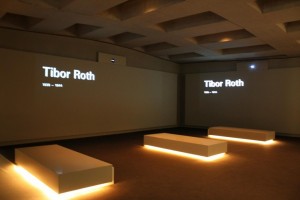
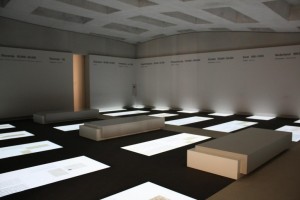
To start I want to give you a very brief history into this exhibit space from the perspective of the different uses it has taken on. It was originally built during the Second World War as a part of a 61 city wide bunker selection program made by the Nazi party. It could house 2,400 guests on any given evening and was used to show that Hitler could protect the inhabitants of the city when war struck. After the war it was a part of Eastern Berlin controlled by the GDR. During this time it was used as a P.O.W. Camp and a secure site to hold meetings where the Allies could not interfere, later it was used to store food, specifically fruits from Cuba during the Cold War, where it got its name the Banana Bunker. When the wall fell it was semi abandoned and used for rave culture and paintball fights. In 2003 the current owners bought it. The renovations took five years, which means it has only been a gallery for the past eight years. The two owners of the bunker live in a house constructed on the top of this building where they have 130 pieces from 23 different artists that they support to varying degrees. This is a treasure trove of intellectual art supported by elite ideals. It was both hard to swallow and awe inspiring all at once.

With this idea in mind I want to do some, quite possibly grotesque, surgery here and deposit a couple quotes from Georges Didi-Huberman’s piece entitled Images in Spite of All: Four Photographs From Auschwitz and just let them sit in relation to the image of a surviving Nazi bunker being used as a modern art exhibit and home.

“Images in spite of all: in spite of our own inability to look at them as they deserve; in spite of our own world, full, almost choked, with imaginary commodities.” P3

“It is troubling that a desire to snatch an image should materialize at the most indescribable moment, as it is often characterized, of the massacre of the Jews: the moment when those who assisted, stupefied, had room left for neither thought nor imagination. Time, space, gaze, thought, pathos – everything was obfuscated by the machinelike enormity of the violence produced.” P7

The pieces at this exhibit have no names, no plaques, no words to show what they are at all… Except for the guide that gives you information and a personalized interpretation on how to experience the work. The only way we know anything about these works is through our own contact and the stories of those who know better. You must not take images of any of the pieces… But you can buy books full of them at the front desk. There lingers a sense that one has gone beyond Hitler and the GDR, but that beyond only stands because of the view it looks out from which lies inside this reign. The walls look different now.

PsychicCity wk5: Jules:Fragen und Antworten

Honestly, how are you doing?
I am not doing all that great currently. I’m sick. finally when I feel like I’m getting a grasp of how to stop isolating myself I am put in necessary isolation without the cognitive function to get much done other than what is necessary for my body. I’m constantly worn out by the demands I put on myself and because I put so many of them there I end up feeling overwhelmed, a sign of poor planning in my mind that only compounds the issue, and I get very little done and the cycle continues from there.

I just feel like I need time and space that there is never time and space for. Like I have this endless pit of despair that I shouldn’t have but don’t know how to get out of and no one can hear me from inside it as if it is swallowing all sound or possible connecting language and all I end up seeing are the faces of angry strangers thrusting their own insecure daggers down into this whole saying grab on let me help you out.

Yeah. It feels like nothing really helps. As if everything just makes it feel worse. As if there’s nothing I can do to stop the momentum of this quicksand I’m sinking into. It just escalates and I feel less the further in I go. And that’s the thing is the feeling is what can get me out. If only I could feel something. If only I could express something I could make it out because feeling makes the quicksand into a beach looking out at the ocean endless and constant but somehow still significant in each iteration even though it’s just the same shit over and over again. But I can’t get to the expression. It’s like it’s not only something swallowing me up but smothering me from above as well. I’m lost in the absence.

Do you hate it here or love it?
I don’t hat or love it. I am just here and currently the situation feels pretty bad to me. I can’t seem to crawl out of the whole I’ve dug for myself. Objectively the town is great. So many places to explore, so much beauty and information free to all and plenty of encouragement to get out and really be in it. Besides showing up to class as much as possible I find myself rarely saying yes to those things because I limit myself using the excuse that I have “too much to do.” I feel like such a downer most of the time.

Are you homesick?
I think I am. I have found myself wishing this was all over or wondering why I am here when I could just as easily be doing all of these readings, studying German, making notes, and the like in Olympia where I am closer to the community I’ve been a part of for the last seven years. Is that homesickness?

Are things getting hard?
Things are getting progressively more overwhelming. It’s getting harder to find the motivation, energy, and general willpower to get started on most things, even the ones I love to do like bike and immerse in nature. I find myself slipping deeper into a self I do not respect, feel consistently disempowered by, and find in most cases repulsive to be around. I find myself justifying this by saying that it is just the me that is learning to feel comfortable with uncomfortable situations, but at what point can that self no longer find balance within the darkness? Academia and the city life seem to suit me very little. I find myself being very bad at too many things. Even at the things I know I love. Closing off and shutting down.

What is your temporal experience at this point? (For example: I don’t operate on dates or days of the week)
My temporal experience has seemed to shift and fluctuate wildly during this entire trip. Where at first my sleep schedule and eating habits were very regular they are now either way too much of or way too little of both and all other combinations. My study schedule can’t seem to find a regular pattern either.

Are you remembering things? Can you access images and feelings and emotions at any point in this city?
I haven’t been feeling the lightness and alertness I feel I am used to with Spring. I am so grateful we came in the spring because imagining myself here in the winter seems oppressively difficult emotionally. I can’t seem to access many feelings except for feeling down about myself or slightly annoyed at others.

Are you unable to?
Yup

Are your habits changing?
Yes. Like I said earlier things feel like they are in constant flux and the patterns I am used to having when I am at home like regular meal times and time spent outside and physical activity have all but gone away.

What is scaring you?
How isolated I feel. How overwhelmed I’m getting. How down on myself. How hard it has become to do even the things I love. How hard it has been to just appreciate my privilege of being here and doing this. How hard it has become to appreciate much of anything.

How do you handle being alone?
Outside I have plenty of things to do. I haven’t been going recently though. Inside I isolate myself, and turn off my brain with Stephen Colbert or John Oliver.

What could you possibly do in a strange place to truly calm down? (For Example: when things get bad, I go into antique shops to assuage my anxiety)
Find the nearest park. Sit under a tree.

Is class stressful?
Sometimes. I just get into my head about certain things and then I can’t seem to get back out until I realize I haven’t been following the thread and then try to jump back in. Often times this doesn’t work though. I think for the most part class feels like decompressing, but thinking about it is often times a stressful activity.

What kind of thoughts are you thinking? There’s usually a pattern there.
I’ve been thinking a lot about how behind I am and how I wont be able to catch up. A lot about the my lack of self worth.

Do you miss anyone (it’s ok to not)?
I do. I miss my friends and community back in carnation and I miss my partner Ellie.

Information Center/Topography of Terror

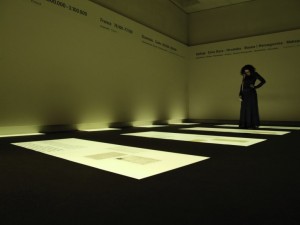
Going down below the Memorial to the Murdered Jews of Europe to the Information Center was like stepping into the mass graves scattered across these countries. It takes you step by step through the process of how the holocaust came about. It shows you six victims pictures blown up so you can get a sense as to who was targeted.

Information Center/Topography of Terror

The first of four rooms gives you numbers in estimation of the Jewish people killed in each of the countries occupied. On the floor in patterns that echo the stelae above there are notes from diaries, letters, postcards thrown from mass transport trains where people stood packed sometimes for 30 plus hours. One that caught my eye was the brief letter to her father saying that they were taking them off to die today and how they wish they could live but alas they are to die.

Information Center/Topography of Terror


The second room gives you an image of different families from different regions that were put to death, again on the stelae pattern as above, only now instead of lights on the floor they are pillars that don’t quite reach the ground.

Information Center/Topography of Terror

The third is a room where four projectors are constantly telling the stories of different names of individuals that lost their lives and placing their names on the blank walls. I couldn’t stay in this room for very long as it was maddening to hear the monotony with which the speakers told their stories, like listing off numbers on a document, like a roll call when no one is present.

The last is a room of sites where these massive murders took place. You can listen in on stories and brief histories of a few of these places, and then look at the map and see they are only a drop in the bucket of sites. All the while the same undulation that is seen above on the ground you walk through the stelae on can be seen on the ceiling in these chambers. I got a sense of looking from underwater towards the surface of a wave above only there was no image you could see beyond the wave. The wave barred life entrance.

/

The Topography of Terror was kind of odd to me. I can understand the choice in architecture and grounds layout. They seem to impose a certain terrible foreboding quality. Maybe it is just because of all of the other images I have seen from World War II, but I couldn’t help but feel like this site didn’t get the point it was trying to make across to the audience as well as some others.

I would say the information is all well laid out and organized according to what part of the National Socialist structure they are wanting to emphasize. I feel like I got the sense that there was supposed to be this feeling that since we can see how this was all laid out we can somehow make sure to never make this same mistake again, but by the end of the hanging placards of information I realized that many of the people who were a part of this regime were never punished for their crimes. It makes a good point though in asking how do you punish any one individual for the crimes committed so anonymously or out of fear of death.

At the beginning I assumed that all of what I saw would be the face of evil and by the end what I saw were terrifying acts of murder under the pressure of a force that no individual could possibly hope to stand up to. The survival instinct of most of these individuals heavily outweighed their ability to do otherwise. That being said, there was something lurking beneath the surface that seemed far to close to home with the situations the world is currently tensioned under.

Listening to Berlin

I am sitting underground. Allows talk with each other all around me. They show me cold colors of friction. Vibrations like screams, shrieks like sirens of death. Humming undertones that scourge the ear into a painful slumber. I hear what goes without saying. I hear a silence only listened to by deaf ears that are somewhere else in thought. I listen quietly. Am I silent? Where do I scream inside and never listen? I hear a prolonged rhythm only noticeable if you can distract yourself from that which surrounds you. A constant flow of jabbering German that might as well be gibberish except for the token words that grab hold of your attention and bring you back out of pure soundscape. My ear constantly wants to name, to point where, to ask why. I try to suspend and push the sound flat together as if it is just one note, as if it is one song, in harmony with all of the vibrations around it synchronizing its entrance into my ear. I hear scuffling, I hear breathing, I hear banging, yelling, raspy throat noise asking, back and forth I hear momentum quickening, lulling. I hear to the left and to the right, how does one flatten this? How does one numb direction? Orientation of space created by shapes of sound? I find myself struggling in frustration and I wonder, is that just the noise around me? How am I separate from this consuming rhythm? How am I attached? All of this is written after I am no longer hearing these things. Where am I in that sound now? How is it still apart of me? Do I still contact it? What frequency am I playing?

Das Kinderkrankenhaus

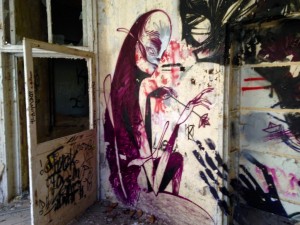
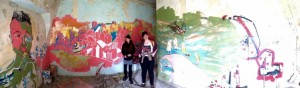
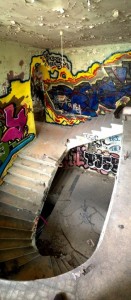
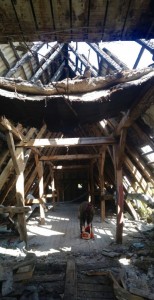
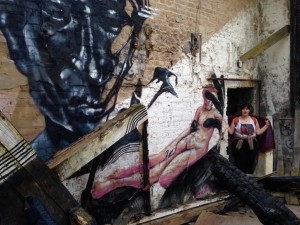
This place was like nothing I’ve ever seen before. I want to stay away from describing the history of this place because it is intricate and complicated and there are many things to say about the experience of it that is somewhat separated from that intellectual history in my mind. With that being said I do want to give you a sense of what you are walking into when you step inside this crumbling facade. It’s original purpose was a children’s hospital intended to combat the rising infant mortality rate in Berlin. This building has since changed ownership and purpose many times over the course of its life. Since 1997, when it last changed hands, it has been unused and abandoned because it failed to meet many of its funding goals and struggled to file the correct bureaucratic documentation required to move forward with renovations and reconstruction. It has since experienced many fires, various structures collapsing, decaying, and/or purposefully being destroyed. Along side this destruction is the appeal of why you would even consider going here. The artwork.
Das Kinderkrankenhaus

And the artwork.

Das Kinderkrankenhaus

Tags!

Das Kinderkrankenhaus

Architecture!

Das Kinderkrankenhaus

Murals!

Das Kinderkrankenhaus

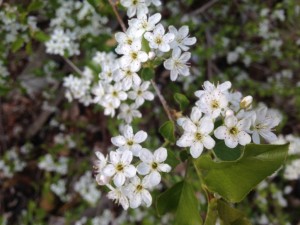
Nature!

Das Kinderkrankenhaus

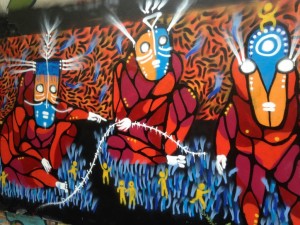
Colors!!!!!

Das Kinderkrankenhaus

And this is only a small part of the work there. It’s is like diving into an abyss of color, texture, space and light unlike any possible museum. I was amazed to be immersed in this subject of culture that is coming from the ground up. It has as little influence from the higher forces of society because it is intentionally temporary and transitory, always under danger of being smashed, painted over, defaced, crumbled, etc. It has no possible monetary gains to be made by the artists. It shows how these peoples individual culture shows through in their work. So it is a part of society and possibly the overhanging powers of society are dominating these individuals in their own lives which then projects itself into their work. I get this sense of convulsing within that control though. Of seizing in it as the body rejects that authority when they do this work. Those spasms shape the work out of a madness or maybe just onto a chaos that can transmute these flailings into something of value.

Adorno says in his essay The Autonomy of Art, “art is not autonomous in the sense that it is metaphysically removed from and independent of society. It is autonomous in that it is not reducible to the requirements of society, namely in the presentation of a harmonious and meaningful whole… relevant parts of Leibniz’s theory are… They reflect the universe from their own individual perspective.” p240

Gedenkstätte Berliner Mauer

Another meet up with the group and get a tour day! So glad that we have all of these opportunities to visit these places around Berlin and see how they have preserved history. This tour was particularly interesting because of its specific implementation in the community. Before I get into this however, I want to briefly touch on the two documentaries we watched onsite directly before we engaged with the wall itself.

The first of these documentaries showed us a look into how this wall came into formation and what was happening in the communities of citizens on both sides of the wall once it was in place. I was surprised to learn that the tensions between these superpowers of the GDR and the Allies known as the Cold War started a mere three years after the end of the Second World War. With this information alone I cannot imagine what it would have been like to be a German citizen at the time. To have survived the War only to find yourself stuck between governments that have their own conflicts of interest could only have been maddening. It was only during the tour we were told that both sides put Nazi leaders in places of leadership simply because they knew the people and the situation best.

The second film was a computer engineered reconstruction of both the Berlin Wall and the East/West boarder that divided the country in half. It focused largely on the wall itself and each of the components were laid out in a series to show what it would have taken to be successful in crossing this boundary. Two walls on either side of a “death strip” also known as no-man’s land where there was any combination of trip wires, “Stalin’s Lawn” (a blanket of vertical iron rods laid out on a grid), anti tank barricades, barbed wire, guard towers, trip lights, land mines, etc. In various escape attempts or just misfortunate events, such as children falling into the river and drowning in no man’s land, the wall claimed a total of 136 lives.

Gedenkstätte Berliner Mauer

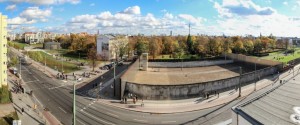
When we walked out into the light of day to look at this monument to the wall it was hard not to be immersed physically and emotionally in what this place meant. We walked along a portion of the wall that was reconstructed after it was torn down to show that liminal space between a world of capitalism and a world of communism. This was personally very hard for me to understand. It seemed a little perverted to build the wall again, in a place where this was a reality for residents who may still live in this neighborhood. This specific location was particularly hard hit with casualties because the gap between the two sides was so narrow. A church destroyed because it concealed a portion of the wall from view along the boarder, metal markers that represent the tunnels made to evacuate from East Berlin, faces of the victims(mainly young men, but some women and children as well) who fell at the wall, and finally a recreation of the death zone enclosed between two iron barriers. Even though the experience was sickening at times to contemplate, I couldn’t help but be in awe of the ingenuity and the general gumption of those who made it across. It wasn’t easy for them once they made it either; often bringing only a few belongings or nothing, often disowned by family members left behind, exiled from everything they knew it was certainly an isolated existence to stay or go.

It is easy to look back and say well they just could have waited the 28 years the wall was in place and then had their freedom, but they were under the impression that this would always be the case. These are people being led by fascism that took advantage of a desperate time to fortify its own standings. I can only imagine the palpable insanity of the situation.

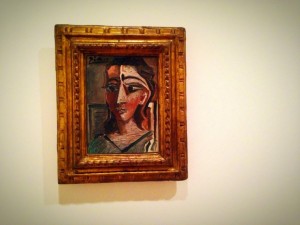
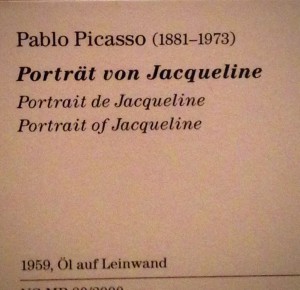
PsychicCity: Porträt Von Jacqueline (Museum Berggruen Berlin)

PsychicCity: Porträt Von Jacqueline (Museum Berggruen Berlin)

She sits cubed flowing in swirling color-dust

Solidified like rock

The moisture out of the oil and leaving behind only the dry work

She is unknown to those who gaze

Yet if you can shift your perspective,

and blur even the harsh edges

you will find that she is gazing also with cubed emotion

The right side sadness with a glimmer of compassion

and the left is direct and piercing in perception

Her reality is realized within her roughness and her softness

The line drawn starkly between the two

The colors blurring where delineation is unecessary

The model’s shape in reality has remained fused with my perception

Who would say this is right or wrong?

All I know is I am here.

PsychicCity: Porträt Von Jacqueline (Museum Berggruen Berlin)

Brandenburger Tour

What started with at a pillow fight ended at a fake checkpoint.

That being said this tour was incredibly informative and well led. The ten minute history blitz of Germany that took us from all the “Friedrichs” to the fall of the Berlin Wall was a great refresher on the formation of Germany as a country. This helped to situate us among the different monuments and buildings that surrounded us. A few notable ones were the Brandenburg Gate itself, the Victory Column, the Reichstag Building, and the US and French Embassies.

Within the majestic nature of these structures there was always an implication of what was even if it was only applied through the structure of what is now. The Reichstag Building is a perfect example. It was originally situated outside the city walls as a symbolic representation of how much the leaders of the time paid head to power of this parliament. The culprits of the building burning in 1933 remain unknown, and somewhat inconsequential, but Hitler capitalized on the event as another step towards elimenating the other parties in opposition to the NSDAP. It stood vacant Throughout WWII and was only partially renovated in the sixties where it sat mere meters away from the Berlin Wall on the Western side. Only in June of 1990 was the reconstruction started and was finished in 1999. The new clear dome that overlooks the parliament is only the present phase of the symbol this building has become. With tours of this dome open to the public one can see down into the proceedings. Although it still sits outside the gate it is no longer outside the scope of the citizens of Berlin.

This was our first glimpse into this city’s determination in it’s intention to take responsibility for its convoluted and often painful past. It was important for me to remember that these symbolic monuments were intented to somewhat permanently remember in order to never repeat the past, and was not meant as reparations for those actions.

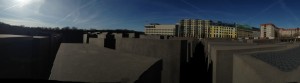
The next site on our tour was The Memorial to the Murdered Jews of Europe. As we came up to this entire city block that has been filled with 2,711 concrete, rectangular pillars I found it hard to witness people laughing and playing in and around these man made stones. Having been to the Jewish Cemetery just recently in Prague, where I was told the artist who rendered the memorial found inspiration, I found the people running around all of these faceless, grave like pillars to be incredibly disrespectful. Our guide made sure to tell us straight away that the artist had intentionally attached no meaning to the piece other than the name. There was no plaque or instructions as to how to think about the site. The only rule enforced was one was not allowed to stand on the pillars. When pushed to answer what this space meant, even though he had intended a purposeful meaninglessness in it, he said it was meant to show how a man made structured and ordered system can still be chaotic and even maddening. With this in mind we walked through the pillars.

I was immediately struck by how the children were racing through them playing tag. I saw a little girl laughing for just a moment flash in front of me… And then she was gone. Another moment later and I could hear her soft footfalls and rapid breathing running past me down another row, but this time I didn’t see her. I saw the faces of my colleagues or sometimes just their backs as they stepped into line with my row and then disappeared again around a corner. In my mind I couldn’t help but displace these encounters over a longer period of time or in a different context that was more threatening and more permanent. When I I merged on the opposite side it was as though I was surfacing out of a lake, even though I was able to breathe freely throughout the experience there was a sense of releasing a held breathe and gasping for air again. My initial feelings of the laughers, and players, and all other sorts of being within this piece, was washed away allowing them to be as much a part of the memorial as the pillars were not. We briefly discussed with our group what our individual experiences of this were and moved on to the next site. I had a hard time leaving.

Brandenburger Tour

I don’t want to go too much further in depth about any of the other places we encountered that day because they all pale in experience to this sacred moment for me. That being said the other tour sites were also moments of important and conflicting duality. From Hitler’s bunker site that is now just a gravel parking lot to the tourist trap that is a mere representation of what Checkpoint Charlie was, it was certainly provoking to see how these places were inhabiting the city today.

Jüdisches Museum Berlin

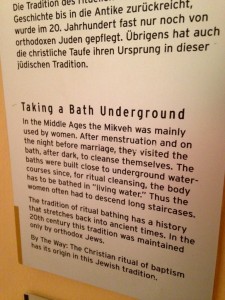
It was very important to first and foremost know that this is a museum of two hundred years of German-Jewish history. We started off getting a tour of only a few different aspects of the museum. Even within this hour and a half section with the guide it was easy to see that you could spend a week in this museum and still not have touched on everything it had to offer.

Jüdisches Museum Berlin

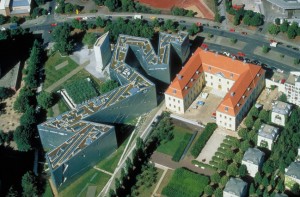
We speculated about the architecture of the two buildings themselves. As you can see from the photos there is a baroque style building next to an ultra-modern brutalist structure. What we focused on in particular with the architecture was the link between these two buildings that connected them via an underground tunnel system. Three main tunnels hold three different symbolic “axis” of the Jews during WWII. It was of the utmost importance to let the viewers see that even though this museum is not intended to be a Holocaust museum it certainly recognizes this part of the German-Jewish history in Germany. It places this at the forefront of the museum in order to then be able to appreciate the rest of their history in its relation to this. While walking through the longest axis that connects the new building with the old I was struck by the obvious idea that the past represented in the new building is only possible because of a narrow passage of artifacts and individuals who made it to the other side of the Holocaust, bringing with them shards of the knowledge and culture that were here. These shards have left certain voids that are explicitly represented in the architecture. This has created a sense of a scarred and broken history that has been woven together and is strong despite the struggle.

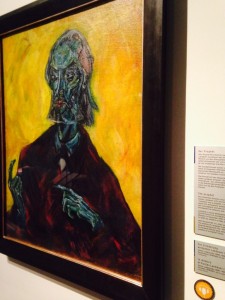
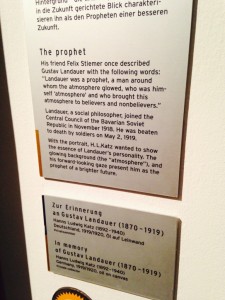
We then discussed what it meant to be a German Jew throughout the history of this country and were introduced to three different prominent figures in the Jewish community of the time directly before WWII.

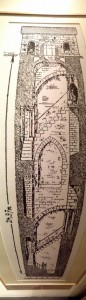
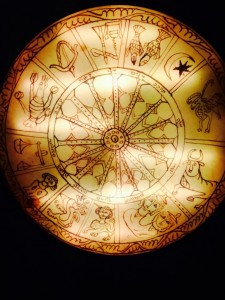
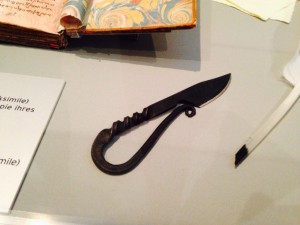
At this point we endeavored to make our own way through the serpentine giant in order to discover an ancient past, other important figures, and the prejudices they’ve endured throughout their time in Northern Europe. Like the voids intentionally left in the structure of this building I think it is crucial to leave space for the viewer to create their own empathetic connection with this place and fill in the gaps I have left with their own interpretation. Some images to help with the process.

Jüdisches Museum Berlin Jüdisches Museum Berlin Jüdisches Museum Berlin Jüdisches Museum Berlin Jüdisches Museum Berlin Jüdisches Museum Berlin

« Older posts Newer posts »