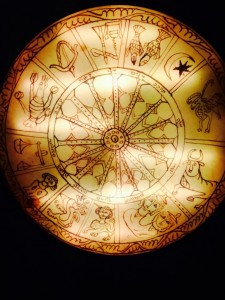
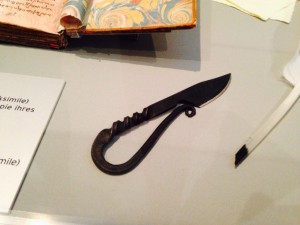
It was very important to first and foremost know that this is a museum of two hundred years of German-Jewish history. We started off getting a tour of only a few different aspects of the museum. Even within this hour and a half section with the guide it was easy to see that you could spend a week in this museum and still not have touched on everything it had to offer.
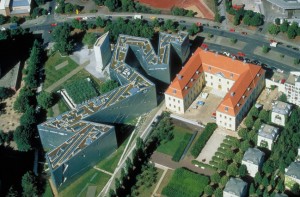
We speculated about the architecture of the two buildings themselves. As you can see from the photos there is a baroque style building next to an ultra-modern brutalist structure. What we focused on in particular with the architecture was the link between these two buildings that connected them via an underground tunnel system. Three main tunnels hold three different symbolic “axis” of the Jews during WWII. It was of the utmost importance to let the viewers see that even though this museum is not intended to be a Holocaust museum it certainly recognizes this part of the German-Jewish history in Germany. It places this at the forefront of the museum in order to then be able to appreciate the rest of their history in its relation to this. While walking through the longest axis that connects the new building with the old I was struck by the obvious idea that the past represented in the new building is only possible because of a narrow passage of artifacts and individuals who made it to the other side of the Holocaust, bringing with them shards of the knowledge and culture that were here. These shards have left certain voids that are explicitly represented in the architecture. This has created a sense of a scarred and broken history that has been woven together and is strong despite the struggle.
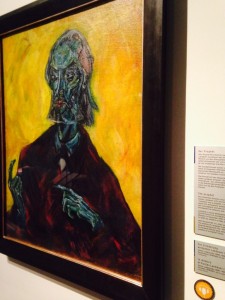
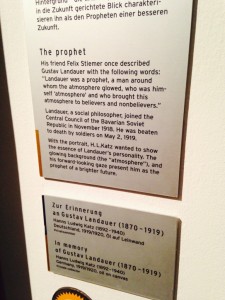
We then discussed what it meant to be a German Jew throughout the history of this country and were introduced to three different prominent figures in the Jewish community of the time directly before WWII.
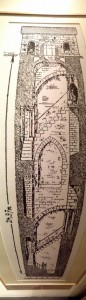
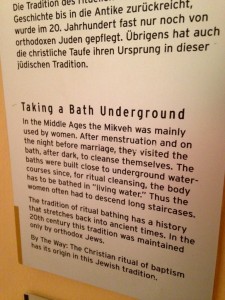
At this point we endeavored to make our own way through the serpentine giant in order to discover an ancient past, other important figures, and the prejudices they’ve endured throughout their time in Northern Europe. Like the voids intentionally left in the structure of this building I think it is crucial to leave space for the viewer to create their own empathetic connection with this place and fill in the gaps I have left with their own interpretation. Some images to help with the process.