

- Classical Mechanics: Taylor 2.4-2.7, Ch. 3, 4.1-4.2
- Differential Equations: Boyce/DiPrima 2.3; 2.4
- Multivariable & Vector Calculus: Hughes-Hallett 14.1-14.2, 14.6; 14.4-14.5
Mathematica Lab 1
- Here is Mathematica Lab 1.
- The lab is to be completed and saved to your program share Cubbie by Friday September 30 for faculty feedback. Mostly, I’ll be looking for the graphs you generated for Taylor 1.50 and 1.51 as requested in Part 4, number 8.
- Note 1: When searching for MMA on a campus computer, type Wolfram Mathematica into the search window.
- Note 2: There were some computers where MMA was not properly installed. This should now be corrected; if you find campus computers that still don’t run it, let the staff know and they can pass that info on to their supervisor.
Classical Mechanics Homework Assignment #1
Classical Mechanics Homework Assignment #1, due at beginning of class by 5 pm Thursday September 29 to the box outside Krishna’s office Lab 2 3255. All problems from Taylor.
- 1.10
- 1.29
- 1.30
- 1.38
- 1.40
- 1.48
Guidelines (for this and subsequent assignments):
- You are welcome to work together, with program tutors, use external resources.
- You must write up your solutions individually. Submitted solutions must represent your own personal understanding at the time of submission.
- Each solution should stand alone, without needing to refer to problem statement in text. This can be accomplished by simply copying the problem statement at the beginning of the solution or by producing a solution that incorporates the problem statement within it.
- Use standard 8.5 inch x 11 inch paper (blank, lined, graph, etc. – your choice). No “fuzzies” on edges if you tore the paper from a notebook. Suggest you three-hole paper in advance so returned assignments can be collected in a 3 ring binder.
- Stapled in upper left hand corner.
- Name clearly printed in upper right hand corner of first page, with page number.
- Subsequent pages numbered in upper corner opposite staple, along with your name or initials.
- Submit solutions in ordered sequence that matches assignment order.
- Good solutions will included sketches where applicable and combine explanations (usually narrative sentences) and equations.
Week 1 Reading
- Classical Mechanics: Taylor Ch. 1, 2.1-2.3
- Differential Equations: Boyce/DiPrima 1.1-1.3; 2.1-2.2
- Multivariable & Vector Calculus: Hughes-Hallett 13.1-13.4
- Seminar: “Why should physicists study history?”
Fall quarter Syllabus, Covenant
Welcome to Physical Systems and Applied Mathematics!
Dear Students!
Welcome to Physical Systems and Applied Mathematics (program description here). We are excited to begin our challenging work together. Important program information is in the posts below, including:
- Complete Student Survey by September 25
- Fall quarter first reading (updated 9/20)
- Fall Quarter Textbooks (updated 9/20)
- Updated Fall Class Schedule
- First Class Meeting!
Frequently Asked Questions and Answers (coming soon!)addressed in class
We look forward to receiving your Student Survey by September 25 and seeing you at our first class meeting on Monday September 26 at 9 am in Sem 2 D3105.
sincerely, Vauhn and Krishna
First Class Meeting!
Our mandatory first class meeting begins promptly at 9:00 am Monday September 26 in Seminar 2, building D, room D3105. We require all students, no matter how many credits they are registered for, to attend this first session. (If you are only registered for the differential equations portion of the program and have a schedule conflict, please contact faculty well in advance.)
We are eager to meet those of you we don’t know, and to begin our work together!
- Special note I: Krishna will be available during the lunch break on the the first day, and invites you to bring your lunch (or run and grab some) and join him. No obligation – some of you will have other commitments or responsibilities during the lunch break.
- Special note II: normally, students registered for just the math portions of the program only meet in the mornings. On Tuesday September 27, math students are invited to join us in CAL West at 12:30 to get a first introduction to the computer program Mathematica. If you don’t have a scheduling conflict, we encourage you to attend.
Complete Student Survey by September 25
Please complete our Student Survey by September 25 so we can read and respond to it before our first class meeting. You can find it by clicking here.
Note: You can’t save your responses in the on-line survey form, so read the questions first, compose your responses in a separate file when needed, then copy and paste into the appropriate space on the form; please use simple formatting. We encourage you to keep a copy of your responses.
Updated Fall Class Schedule
(click on image to enlarge)
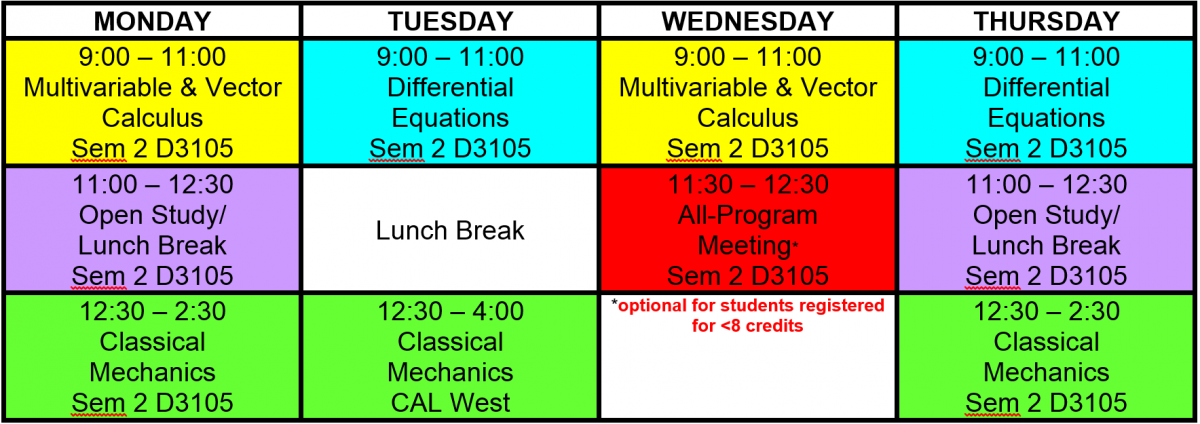
- There are weekly All-Program Meetings on Wednesday from 11:30 – 12:30. Students registered for 4 credits may choose to attend; all other students should attend.
- The Open Study/Lunch Break time on Monday and Thursday are optional opportunities to study and socialize with your classmates. In general, at least one of your faculty will also be present.
- We’ll make sure to always include a short break during the Tuesday afternoon session.
- (updated 9/20) Thursday meeting room is now Sem 2 D3105.
Fall quarter first reading
(updated 9/20 to add “Why should physicist study history?” short essay from Physics Today)
It is essential that you have your own access to our textbooks so that you can do pre-class reading, follow along in class, complete homework assignments, and study on your own (information about Fall Quarter Textbooks here). We recognize that getting the textbooks by the first day of class may be a challenge, so we have provided the first reading assignments for fall quarter below. (Note: these are large files). We encourage you to start reading this material now so you will be well prepared for our first class meetings in fall. Please note similarities and differences in notation used between the textbooks.
- Classical Mechanics, Chapter 1
- Differential Equations, Chapter 1
- Multivariable and Vector Calculus:
- “Why should physicists study history?”
- printed versions available outside Krishna’s office, Lab 2 room 3255 by 10:30am Wed. Sep. 21. Don’t print out your own version – if you can’t pick up the print version before the first day of class, we’ll bring the extras to the first class meeting.
- Article as .pdf for you to read on your own (please don’t print out, see previous bullet point).
- Article in web version (.html, with links) if you prefer to read that version.
“Why should physicists study history?”: This short essay is non-technical but valuable for some of the themes of the program. We expect you to complete this reading for our first class meeting on Monday September 26. A print version is available for pickup outside Krishna’s office, Lab 2 3255; bring this printout with you to the first class meeting (if you don’t pick a printout up, we’ll have them available for you on 9/26). If you can’t get to Krishna’s office to pick up the printout, use the links above to access and read the essay before the first class meeting.
Classical Mechanics: We expect that you will have read all of Sections 1.1 – 1.6 in Chapter 1 of Classical Mechanics by our first class meeting on Monday September 26. The physics and mathematical notation may be unfamiliar to most, and that’s ok. There should be no physical or mathematical concepts in this reading which are unfamiliar to you. As needed, use your introductory physics and calculus texts and notes to review the concepts. Use the concepts to orient you to the new notation. If you find that there are physics or math concepts that you are unfamiliar with, please make sure to check in with Krishna right away via email. Bring this reading with you to the first class meeting.
Differential Equations: By the first differential equations class meeting on Tuesday September 27, please read over Sections 1.1 – 1.3 in order to familiarize yourself with terminology and notation. Those of you also taking classical mechanics might find good connections and reinforcement. Please note differences in notation used between the textbooks.
Multivariable and Vector Calculus: Some of the most important content in this portion of the program is found in Chapter 12. However, in order to integrate more effectively with the Physics portion of the program we will be starting with Chapter 13 and weaving Chapter 12 into the content throughout the quarter. By the first class meeting on Wednesday September 28, please read over Chapter 13 to familiarize yourself with notation and review concepts. Those of you also taking classical mechanics will find strong connections and reinforcement. Please note differences in notation used between the textbooks.