Of Blood and Beauty

The Evergreen State College

Category: Kunst

Berlin 2016-05-27 14:34:37

Hamburger Bahnhof Museum für Gegenwart
27//5

Spent a day at this former 19th century train station in Mitte, the first terminal style station in Berlin, currently a gallery for modern art and temporary storage for a substantial portion of the art of the Nationalgalerie during its renovation. I meandered through two extraordinary exhibitions, the first, a breadth of Carl Andre’s works, from sculpture, “concrete poetry” and “dada forgeries” to photography and a full catalogue of mail art. The second exhibit, the draw, was the Neue Galerie: The Black Years, Histories of a Collection: 1933–1945, which “features works from the Nationalgalerie which were either created between 1933 and 1945, acquired by the collection during this period, or seized by the National Socialist regime.”

The exhibit includes an incredible diversity of artists, including those who collaborated with the Nazis to implement their visions of the “Aryan ideal” and uphold the mythology of the German bloodline, as well as artists who underwent an “inner migration” and continued to produce art under the auspices of Reich Chamber of Fine Arts merely to maintain their practice, as well as those who worked in exile, in secrecy or in bold defiance of the regime.

The history of each piece is given in detail, including the location of the production of the work, original owners and exhibitions/galleries it may have been shown in or belonged to, to its trace during the Nazi era – whether it was deemed degenerate and shown as a part of a degenerate art exhibition, stashed away, or sold/stolen by Nazi officials – either by official dealers commissioned by the NS to divest confiscated works to fund the Reich or by lone figures such as Goebbels and Goering for personal gain/prestige.

I stood before a painting by Edvard Munch titled “Melancholy” to re-enact the captivated-aura psychogeography assignment, though in reality I basked in suspension before all of the paintings and sculptures, and only made a decision about this work at last. This piece, selected for this exhibit not for it’s relevance to degeneracy, subversion or controversial history, was an example of the categorical inconsistencies within the National Socialist party as to what “degenerate” art appears as. Melancholy is wildly expressionist, with the figure of a woman in a red plume of a dress sitting at a bench, her upper torso doubled forward as her blue hair cascades over her head and into the sea. All figures and landscapes are suggested, the sea, a sea-stack, the horizon, the sun, a cityscape – all sweeping and vivid gestures, without definition at first glance.  The work was painted in 1906/7, prior to any major war. Goebbels, upon seeing the piece, deemed Munch the “Nordic father of Expressionism”, before appropriating the work in 1937 and selling it to a dealer in Oslo. The brushstrokes and errant drips are sweepingly powerful, exact by suggestion; the aura is in the movement of the strokes, the vivaciousness of the color and the forlornness of the figure are in a harmonized tension, a tense harmony. An excess of blue paint is left where free to fall and stain without distraction, but rather to emphasize the movement of the work – it is an untold mark of beauty. In some corners the tweed of the material used for a canvas is left exposed, further emphasizing not heedlessness, but an intensity of focus on aspects disinterested in perfection – indicating that the skill and precision of this work is not the immediate technique or form, but what the work reveals in its expression.

There are many other pieces in this collection with complicated histories and impossible “auras” – from the “Isle of the Dead” by Arnold Boecklin, to famous works by Dix, Kirchner, Picasso, Kollwitz & Klee, to canvases that conceal secrets of a double past and others that make for subversive interpretations.

Definitely worth the visit!

http://www.smb.museum/en/exhibitions/detail/neue-galerie-die-schwarzen-jahre.html

Erwin Hahs – Great Requiem, 1944/1945
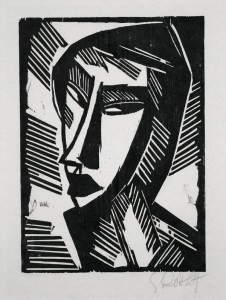


Die Brücke Museum// Karl Schmidt-Rotluff// Expressionism // Warped


Die Brücke Museum// Karl Schmidt-Rotluff// Expressionism // Warped

Karl Schmidt-Rotluff, Female Head

1915, woodcut

||Warped|||


And

just

what

Kind

of

Ideas
lurk

behind//


//twist entwined

Seep,

m a lig n ed

Through the crackled minds

of these

Masks, enshrined?


Face the depraved,

and do not succumb,

wrought in wonder,

to the present, warped asunder:

the first layer,

quiescence,

penance,

pensive before some crooked transe,

secluded delusions,

Then the foreboding furrows of

gloom, shock, grief,

the erratic, the exaggerated, estrangement

Contorted

into

vacancy,

vapidity,

vastidity,

and

a

Dark Melancholic,

Fades along towards

transcendence

omniscience,

half-eyed

SCORN

GLARING

from

heights of

New

Modern

Perceptivity (dulled receptivity)

profound subjectivity

splintered,

Intractable inner multitudes,

torrential,

Around a focal despot:

the interior,

everted,

visage

inverted:

blasé violence

& disfigured

silence.


Berlin 2016-04-16 03:00:56

B O R O S                                                         STREETLEVEL

                                        | & |

COLLECTION                                           R E C L A M A T I O N

________________________________________________________________________


________________________________________________________________________

4//11

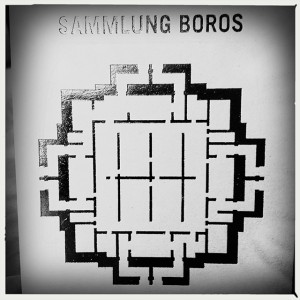
Boros Sammlung Bunker

Construction of bunkers in Berlin began as early as 1940, after the advent of allied air raids on Berlin.  The construction of the Reichsbahnbunker, (Boros Bunker) began in 1943. The Boros Bunker was designed by Karl Bonatz, in a severely redacted Greek classic style, yet not without ideaological aesthetic detail (the above ground building has false window frames, stylized ledges, ornate symmetry) This building was designed with the expectation that these Bunkers would remain a component of Germania after the final victory of the 1000 Year Reich.

Between 1942-45, 4,000 Germans took refuge here.

From 1945-47, the bunker functioned as a Red Army prison.

From 1947 until the dissolution of the DDR, the bunker functioned as a storage facility for the Soviet party elite. As the walls are 1.8 meters thick, the bunker was ideal for the storage of exotic goods: oranges, bananas, nuts, spices, usw. Castro gifted a shipment of bananas to Soviet party members, which were stored at the Boros bunker; from thereon the bunker was referred to as the “banana bunker”

Which was perhaps more culturally apt after 1990, when from 1991 to ’96 the space was used for a stream of endless techno parties and various other fests of that ilk, until it was shut down and purchased in 2003 for the current exhibition space, taking 5 years of strenuous and cautious renovation.

The exhibit changes every 5 years, rotating through the owners’ (Herr and Frau Boros) collection.

This is not a museum, it is not thematic nor theoretical.

There are no names nor (static) descriptions of the works, just the art.

This museum, complicated by the design of the bunker and the conceptual nature of the collection, necessitates a guide. In order to access the names and (intended) concepts, constructions and collections of the work, one must be verbally and physically ushered through the installations. Many of which are self-apparent, but many more are more effectively illuminated by their his/her/stories and creators.

A few interesting installations:

The Flying Garden – Thomas Saraceno

Dreamers vision of a future city – heightened awareness of interconnectivity and disturbance,  all spheres and connections interconnected and inter-effective-affected. “All life connects other life.”

Frequency Curves: “Day Without Yesterday…” – Alicia Kwade

This artist takes interest in Big Bang Theory, and toys with sound produced by light, amplified by speakers, which is not normally audible. This exhibit focused on the limitations of our senses against great universal phenomenon.

Stockholm Trashcans –

A collection of city trash-bins, collected from New York and Sweden, reveal utility, futility, disregard and reverence – through the prism of class divisions – from the state imposing a fine for using trash bins for any other use than garbage (prioritizing property over, perhaps, the comfort of a fire for a homeless camp) to the relative cleanliness of bins found in wealthy districts as compared to the tagged, tattered and “trashed” cans of poorer neighborhoods.

And many many many others.

The collection itself makes demands about class and art, about bourgeois patronage/bourgeois consciousness and the irony of a collection of  (sometimes) politically charged conceptual art directly addressing class division, which is withheld from the public except for a fee and requiring a chaperone.


_____________________________________________________________________________

S T R E E T level ART

13//4

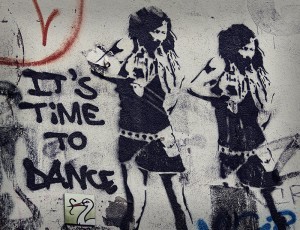
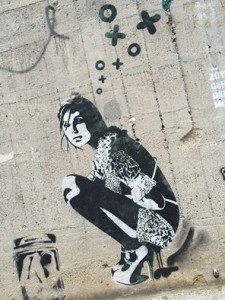
Stencil on the side of the Boros Bunker. Artist: xoooox


In a distinct contrast, here we were guided, unrestrained and free of charge, through the streets of Kreuzberg. A diverse set of artworks are shown, legal and illegal, both skilled and vulgar (left up to interpretation); artists names are given and brief, rumored, histories are told, but these pieces are given no critical explanation.

The difference? “Streets belong to all, street art is a way of reclaiming the streets” and impressing identity/identities upon the face of the city.

From “The Astronaut” a state-commissioned piece by Viktor Ash in 2007 to the pervading “1up” tag lurking on bus-shelters, under eaves, awnings and spanning entire walls, these works cross a wide range of styles, dimensions, purposes and, of course, levels of legality. Tagging comes with the pricetag of 1year in jail, a fine of 2,000 euros, or possible deportation, while stencils, stickers & pasteups are considered a form of littering.

Gentrification has appropriated many of these former-art-dens & havens, converting them into the consumptive highlit world of the culture industry, so, what are the artists to do?

According to our guide, “Many of them have left to buy sustainable farms out of the city, they have started communities of their own, living off of the grid, have created their own galleries or show-spaces.”

They have gone on to a more extreme and, where possible, manageable form of ‘in the world but not of it’. And here, it is not without lament, as in the case of the Blu murals, where two of three were intentionally painted over, that we look on and contemplate these works of art beyond what they offer us immediately  – their persistence, and the seeming omniscience attached to the ‘living’ nature of the ever-changing facade of the streets, reveal a street level philosophy of reclaiming these spaces for our (the folks) own ideas and visions and modes of existence – and yet when these ideas and visions and modes are further compromised by an already destructive dominant culture, by encroaching commercial interests, whether by real estate or by attaching a label to or categorizing and instituting this type of interaction, the artists opt to flee or destroy their work, in order to save it from the degradation of exploitation, categorization, and the choke of objectification.


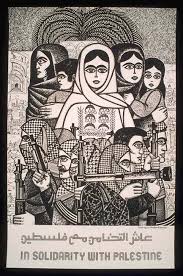
Past Disquiet – Narratives and Ghosts from the International Art Exhibition for Palestine, 1978

Past Disquiet – Narratives and Ghosts from the International Art Exhibition for Palestine, 1978

Haus der Kulturen der Welt

11//4/2016

What began as a traveling “seed exhibition of artists in solidarity with Palestine” – expanded into a worldwide collection and investigation of resistance art movements.  This exhibit documents that expanse, from Palestine to Chile, Italy to Japan.  The curators, having found a catalogue for the exhibition in a library in Beirut, were astonished by the “scale and scope” of the collection, and its absence from any known historical accounts. What they discovered, as they researched the contributors to this collection, from thirty countries, was a worldwide arts movement centered around solidarity and charged by revolutionary politics.

“Past Disquiet is an exhibition of stories collected throughout years of research. Even though the past we uncover is recent, and a number of protagonists are still alive, for the most part they narrate an undocumented chapter in the history of contemporary art: its role in political change and a time when artists brought art to the heart of social life.

The keyword at the heart of ‘Past Disquiet’ (and of the worldwide movement of the 1960s and 1970s) is solidarity.”

Just a few of the many interesting arts collectives/brigades from/in solidarity with Palestine from various countries that stood out:

Palestine Liberation Organization

Plastic Arts Section//Department of Arts and National Culture, Palestine – “mandated to commission, fund and promote the production of posters, art, film, theatre, dance, music and publications; to preserve folklore and cultural traditions, and galvanize support for the Palestinian struggle internationally, in the world of art and culture.”

Arcicoda: Italian art collective

muralismo in Chile: Brigadas Ramona Parra, 1968: “each brigade constituted of 15-20 students and workers, who executed mural paintings during the night or at dawn, born from an urgency to galvanize popular support around social justice and human rights by members of the Communist Party when the media was almost entirely controlled by right-wing political groups. After the coup d’etat, the military erased thousands of images of struggle and hope.” Many Chileans were exiled, and went on to form other arts collectives and muralist brigades in other countries across Europe.

Japan Afro-Asian Latin American Artists Association (JAALA)

International Brigades of Anti-Fascist Painters

Salon de la Juene Peinture

+ + + many others

Also, this exhibit is free on Mondays!

Here’s a link to a great article about the collection:

http://www.museumsportal-berlin.de/en/exhibitions/zeit-unruhe-ueber-internationale-kunstausstellung-palaestina-1978/

Einsteinufer Yogi

Found the warrior yogi at Einstinufer!
Josef Foos aka Street Yogi
“This Berlin-based yoga instructor has been placing small, cork figurines known as ‘street yogis’ in out-of-reach …