a poem-like thing I wrote while working on my project recently:
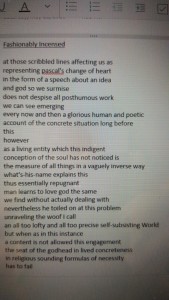

a poem-like thing I wrote while working on my project recently:
I think that if Benjamin had lived much longer he would have made significant revisions to the theories he offers in “The Work of Art in the Age of Mechanical Reproduction.” This is not the place for a general critique, but attempting connect some of the ideas of that essay to my experiences in the Deutsche Kinemathek Museum has, I think, helped me begin to understand why I find this essay so frustrating compared to everything else I’ve read by Benjamin. The problem is that even if you maintain that his description of the authenticity or aura of an art work can or should be read phenomenologically rather than metaphysically (which I do), Benjamin’s analysis still depends on a strong historical concept of authenticity. The most clear and important symptom of this can be found in his distinctions between ritual and politics, and between fetish and value.
I’ve been trying to figure out a way to work through the rest of what I’d like to say about this, and what I think it has to do with the Kinemathek Museum, but it has turned out to require a lot more time and space than I can give it for a blog post. It may become part of my project, as both Benjamin and the concept of ritual are central to that, but we will see. In short, however, there is something really interesting about the way in which the museum begins with the hall of mirrors. This replicates the viewing subject infinitely in a way not unlike (though perhaps obverse to) the universalized perspective of the movie screen. From here I want to argue that Benjamin is wrong about the inherent criticality (or ironic distance) of a film viewer, and bring in some argument from Adorno’s theory of the culture industry to show how through mainstream film we are hypnotized by our own image of our own desires (which have themselves only been produced and magnified previously by this same and adjacent processes).
This might require a little more Freud and Lacan (or Deleuze and Guattari!) than I have time or desire for at the moment, but hopefully this post will at least serve as a reminder to follow through with this later.
Today in pop-up salon, the topics of Heaven and the Kingdom of Ends came up, especially how these ideas seem to evoke a hellish kind of mechanistic being. I made the comment that I found all categorial ethical discussion to remind me of this. I semi-lightheartedly blamed this on my reading too much Nietzsche.
I just wanted to clarify that what I meant by that was not that any and all ethical consideration was bad merely because, for instance, it is restrictive, as I think a lot of people do interpret from Nietzsche. I don’t think this is the case and I don’t, for whatever it matters, think Nietzsche’s work supports this view on the whole either. It is merely that I don’t know how ethics can be thought categorially without necessarily appealing to the same transcendent values or, more importantly, the same transcendental forms of (e)valuation, that have til now also been the general forms of violence and instrumentalization.
I will have to think about this part but: I have the feeling that conceiving ethics categorially, as opposed to, say, strategically, is a reversal of what is general and what is particular about a given problem, analogous to the way capital’s alleged protection of the freedom of the individual over the whole is actually a demand for the sacrifice of individuals in the name of a non-existent whole.
Since it was another thing I don’t think I communicate well, I want to add that this is closely related to but not exactly the same point as I was trying to make in seminar about the drive to make judgments about something like the decisions made by death camp prisoners. I think that both have to do with what appeals to me about mysticism like Benjamin’s but I obviously have a lot of working through these things to do.
© 2026 Of Blood and Beauty
The Evergreen State College
Olympia, Washington