Of Blood and Beauty

The Evergreen State College

Category: Fussballer

All About Allianz Arena

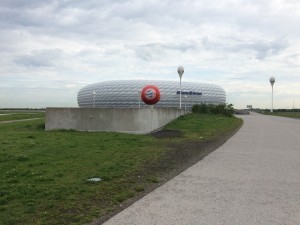
For my second Psychogeography experiment I decided to go on a tour of Allianz Arena, home of FC Bayern Munich! Like many of the places I have been to while on this wanderbondage, this is a place I never thought I would get to go to. This stadium opened up in 2005, which is very new considering the history of stadiums in this country, so it is built using all kinds of state of the art architecture and designing. Before using this stadium, Olympic Stadium was where Bayern played its matches. This is peculiar considering both the rich history behind this club as well as the fact that this field wasn’t designed for football but rather Olympic sporting events, so it still has the track that goes around the field, which both players and fans do not appreciate. One of the most prominent features of this new stadium is that is is capable of lighting up at night, in different colors, depending on who is playing there. If Bayern is playing, the stadium lights up red, if TSV Munich (from the 2nd league) is playing, the stadium turns blue, if the national team is playing there, white, and apparently on St. Patrick’s Day it turns green. My tour guide also informed me that recently, for a match against Italy, the stadium lit up with the colors red, black and gold, to symbolize the national Deutsch colors.
All About Allianz Arena

This stadium can hold 75,000, so by definition, it is the second largest stadium in Germany. Dortmund’s home stadium, Signal Iduna Park, can hold upwards of 80,000. However to counter this, one could argue that it is what happens on the stadium, not around it that matters. And certainly no other teams in this country, in many countries can claim dominance over the domestic leagues like Bayern Munich can. Just recently, they finished wrapping up their 25th Bundesliga title, the next closest would be Dortmund with 5. This level of dominance has grown to aggravate many. FCB had won the last 4 league titles in a row, which has never been done before. True fans of the sport relish the competitive nature of the league and love to see underdogs thrive. Now however, it seems everyone except FCB and Dortmund are underdogs. While many may be disappointed with how the shift of power has been tilted, there is no doubt that the people of this city love seeing their team win over and over again. Because this stadium was built so recently, it allowed a special section to be allowed specifically has a museum dedicated to the history of FCB. How many clubs can claim this?

All About Allianz Arena

FCB was formed in 1900, when a group of 16 men decided to break away from the local gymnastics club, who saw football as a barbaric English game and would not support it in their institution. So, these men formed their own club and it has kept the name ever since. The club was an immediate success, winning all of its first games against opponents by scores of 5 or 6 to zero, I sign of things to come I’d say. In its early years, the club also went through many political ‘advancements’ (for lack of a better word). Problems such as field times and spaces  were hard to come by as the sport in general was only just beginning to gain success. In fact Bavaria as a whole was rather slow to catch on to the football bandwagon as places like Berlin and Dortmund saw prominence in the sport many years earlier. One problem found a solution and FCB partnered up with the local (organization, I forget who, which is disappointing as this is rather important) in 1906 and were able to play at more regular intervals. In order for this to happen though, the club would have to wear red shorts instead of the traditional blue and white. Blue and white are the colors of Bavaria as I have found out after spending a couple days in Munich, so I had wondered why FCB famously wore red all the time, and now I had my answer.

All About Allianz Arena

In the first couple decades of FCB’s existence, much of their success was due to the coaching and organizing of two Jewish men, Richard Dombi and Kurt Landauer. So when the Nazi movement began to gain momentum, and both of these men were forced into exile, the club naturally suffered in its efficiency. All of War War 2 however, naturally took its toll on both FCB and football throughout the country as well. Many players were soldiers and many did not come home. In response to this, after the war, Kurt Landauer returned and helped guide his side once again, but ticket prices were also severely reduced. The equivalent price of a ticket at the time was something like 50 cents. The club wanted to give the people something to cheer for after  the devastation that WW2 had brought. And it worked, attendance slowly increased more and more throughout the years, and the fan base grew so passionate that when FCB made it to their first German Championship, which was played in Nürnburg, thousands of fans rode their bicycles hundreds of kilometers to the game. FCB rewarded this loyalty with free tickets and refreshments at every resting point along the way home, (after they had won of course).

All About Allianz Arena

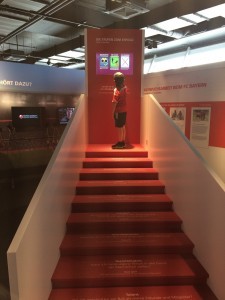
FCB has always had a reputation for trying to connect with their fans. A shining example of this is the fact that in the stadium, they have their very own beer garden. Beer in Deutschland, and especially in Munich, is a national treasure that they take very seriously. And they always have! Munich was in fact founded by monks, hence the name, who often brewed their own beer. Inside the halls leading to the beer garden, there are several pictures of players, dressed in the traditional Bavarian cloth known as Lederhosen, drinking beers with each other. There was in fact also a team picture, with everyone dressed this way, with beers in hand.

All About Allianz Arena All About Allianz Arena

In the late 60’s and 70’s FCB boasted the names of incredible German legends in their lineup. Names like Beckenbauer, Muller and Maier, who all played for the national team as well. The national team of West Germany, that is. With significant contributions from these players, some of the greatest of all time, Germany won the highly public education and exciting World Cup of 1974, defeating a powerhouse Dutch squad captained by Johan Cruyff. The the trophy in Germany, and all the star players coming from Munich, FCB saw a decade long stint of dominance that set the modern trend for their reputation in Deutschland. Many claim that this squad, with these players, was the best they have ever had. Even better than the team who famously won their first treble in 2013. The treble is winning the league title, the domestic cup and the European championship (Champjons League) all in the same year. These incredible names have certainly added to the club, however, make know mistake, every player is remembered. In he stadium, there is a hall of fame with a face and name for every player that has ever played for FCB. If you came through their ranks, you were acknowledged. This type of respect for the players claims its source for the fans, who essentially idolize the players of their team, and consider them part of their Bavarian family.

All About Allianz Arena All About Allianz Arena

FCB also claims one of the most efficient academy systems in the world. I have discussed earlier about the option of young kids, as early as age 7 being picked out for football with the idea that they each have the potential to become the next best players the world. However, what sets FCB apart is their commitment to building these kids up to be good people first and foremost. This is what I respect. They have a three part system of personal, academic and sporting development. Like any school team, they claim that personal and academic come first. This gives off the notion that kids will be successful in life here,  no matter if they play football professionally or not. Of course, what they really want is to keep winning trophies, make money and have the best players, but that doesn’t sell to they out has well. In the end, football in Deutschland starts with the youth. These kids, decades from now, may or may not have played ball, but it will have been so integral in their lives that they will always love it, watch it, play it when they can, and come together with friends and family through it.
All About Allianz Arena


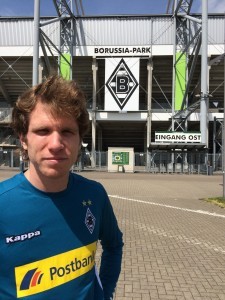
Borussia

Aside from being quite the artist, Emil was able to shed some light on the history of football in northern Deutschland. Many years ago, at the turn of the previous century, coal had been discovered in this part of the country. When it was, Germany had recruited thousands of workers from Eastern Europe to move their and dig for it. These were people from Polish and Slavic backgrounds, in what was at that time Eastern Prussia. With them they brought their cultures as well as the label of Borussia, which is German for Prussia. At the same time as all of this was happening, football, as a sport had begun to emerge as the popular pastime as we know it today.

As coal miners, these Borussian men were the definition of proletariat or working class. After they finished their hard physical labor, they would play football as a way to unwind. The owners of the mines, the aristocrats, saw them and their football as a low game and would have no part in it, the workers relished this. Eventually clubs were formed in this region, two of which became more prominent than the others, and still exist to this day in the highest class of German football. These clubs were Borussia Dortmund and Borussia Münchengladbach. Although the times have certainly changed over the years, the division between worker and owner is still ever present. Today football has become a billion dollar industry, where the big wigs and the top cats have all the money and control the enterprise. Players are able to be paid large sums of money, only when they are able to bend to the will of these owners and do as they say, no matter their performance on the field.

Emil and I had an interesting discussion after he told me this, and it was primarily surrounding a theory of mine. Coal mining is hard, physical labor, and doing so makes a man much stronger and thus would make him a potentially better footballer. I told him about how, in the first decades of the invention of football, the sport was primarily dominated by strength. Tactics were not so fully developed yet and it was not until the 30’s when the influence of tango in Uruguay made players more skillful with the ball and thus feigns and moves became more prominent. No, before all this, the game was primitive, run faster and be stronger. These coal miners were bred to be good ball players, and it shows now all these years later in how they had managed to become so prominent in the rise of football that, these two clubs specifically, are held in such high prestige to this day.

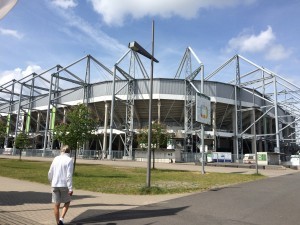
Later Emil brought me to the home stadium of Münchengladbach. They essentially had a whole autobahn exit dedicated to their stadium. Emil said that when there were games, the whole place was packed and that many people would be outside the stadium who couldn’t even get in.

Borussia Borussia

DFB Pokal

While in Viersen, I was able to watch the DFB Pokal final. This is essentially the German championship when it comes to football, the only higher award is winning the league. The two teams playing against each other were Bayern Munich and Borussia Dortmund. These two teams had spent the entire season in first and second place respectively. Dortmund had in fact had the best season they have ever had, and it still wasnt enough to take first place. This game, though, was highly anticipated. The captain for Dortmund, Mats Hummels, who I think is the best defender in the world, was playing his last game for this club, and would be playing for Bayern Munich next season.

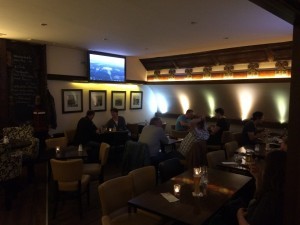
I went to the main square in a bigger town next to Viersen, called Münchengladbach. Here there were many bars and restaurants, all packed together, all showing the big game. For the first half, I was out in the crowded seating area outside without a vey good view. But for the second half I moved inside one of the bars, and found a small room at the back that had many open places. I found the seat with the best view and ordered some food to complete the second half.

DFB Pokal

The game was amazing, there was no clear favorite, both teams had had their chances and opportunities, as well as their swings of momentum. Unfortunately in the 60th minute roughly, Hummels had to get subbed out with a hamstring injury. So now Dortmund had a new player, who wasn’t their captain, on the field. This was, though, a sign of things to come. Dortmund had picked up some new talent who would be joining in the offseason, and would also be parting ways with another one or two players.

In the end the game went into overtime, tied at zero, and then to penalty kicks. No matter how hard they had tried neither team was able to put one in the back of the net. So it came down to pk’s and Bayern won, damn I was rooting for Dortmund, and the German football season had come to an end.

In Search Of…

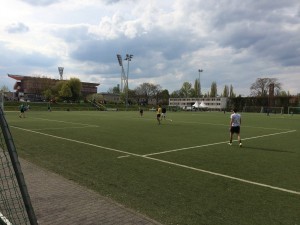
Every weekend thus far while in Berlin I have gone out and seen at least one game. Last week was Hertha, Union before that and so on. The problem with this is that these games are always in the middle of the day and can essentially consume a whole days worth of time. Over the last month or so I have been searching for places to play football. Anywhere. At first I limited my search to more competitive atmospheres, clubs and what not, but that proved unsuccessful, especially considering the method in which I approached this. I do plan on trying to attend/ train with some clubs, but I will need to email coaches and get their approval to do so first. In the time it took me to realize this, I had shifted my focus from playing with clubs to just pick up ball. This lead me to a couple outlets, both of which were through the CIEE, the Monday and Friday sessions. Aside from these two, I had asked around and visited various fields on weekdays, but this revealed two problems. First of all, almost all fields are in use throughout the week by various youth and adult clubs, for practice, and they won’t be sharing the fields anytime soon. Second of all, anyone who wants to play, that isn’t on a club, usually confines their pick up/playing times to weekends, where their work lives won’t be getting in the way. With this discovery, I intended to finally use this latest weekend as an opportunity to go searching for games, and forgo seeing any.

Saturday:

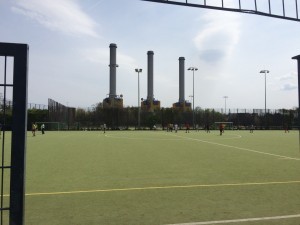
My first day of searching lead me to three different locations. I will start off saying that I had been aware the last couple weeks of pick up games that had occurred at Friedrich-Ludwig-Jahn Sportpark, I had even seen it occurring before and snapped some pictures (I would have played, but I had just seen a game nearby and had none of my gear and was wearing jeans). So I had heard the FLJ might have some people showing up at around 4pm, so I decided to check out some other places first in the meanwhile. The first stop was a complex (these are good bets considering they all have multiple fields and not only one) called Friedenau. It was only a couple stops away via S Bahn so I got there at around 11am. I brought my bike with me for this day trip as well, intending to waste as little time as possible traveling between locations. When I finally arrived at Friedenau, after getting lost briefly, it was a pleasure to see three full size fields, one grass, two turf. As I went farther into the complex, I found two more fields, but they were occupied by youths and their parents. This is another discovery, complexes are hotspots for people to hang out at, they have food and entertainment galore at each of them. Out of all the fields, there were probably eight or so I total, half of them were unused. This would be a great place to playi thought, if only we could get good numbers to show up. Alas, there were only kids playing here, at the home of FC Schoneberg, so it was time to move on to plan B.

The next stop was a complex to the west, not too far, about five or six S Bahn stops. I couldn’t figure out what the complex was called, but I could see that there was a stadium called Horst-Dolm Eisstadion, which actually is an ice skating rink, but I google earthed it and saw that there were good number of other fields around it. So upon arrival, this ice rink was the first thing I saw, but when I moved past it I came across a fields occupied by youth teams playing a game. What I found next, though, was interesting if not noteworthy. The large grass stadium that was nearby was being prepped for American Football. There were bus loads of kids standing outside the gates chatting and holding their pads. This was the first instance of American Football I had actually seen in Germany. I didn’t know if the game had just ended or was going to happen soon, either way,there was no pick up to be had. However, when I went a little bit farther Ito the complex, at this point the opposite edge from which I had entered, I found what I was looking for. A field, with two games going on, each with one half of the field playing the usual sideways method I had grown accustomed to seeing.

In Search Of…

I arrived at around noon and hopped in with them. These games consisted of mostly college students who played for local different local clubs that were just scrimmaging each other for practice. One guy said that they usually had games on Sunday, but had a bye the following day, I asked if this meant they wouldn’t be playing next week and he said no, they still usually play on Saturdays. Huzzah! This was a good find, I hopped in and played some good competitive ball until about 2, then every one started leaving. This gave me 2 hours to get to FLJ, but I had brought everything I needed with me, including lunch,and it would take at least a hour to get there, so I just decided to headstraight there.

FLJ is a large, famous, very popular complex up in Prenzlauer Berg, it is a bit of a trek,  but well worth it. When I arrived an older men’s game, probably fourty year old league was happening so I decided to eat my lunch and watch. They were really quite good, their touches weren’t the best, but they all seemed incredibly fit and able. As the game was coming to its end, the score was tied 1-1, and things were getting heated. One player had an excellent opportunity as he dribbled past the defender in the corner, his pass was deflected though and ended up being shanked for a goal kick. The defender who he had dribbled by, was on the ground, though, I’m guessing he must have been hit by a stray elbow. He ended up staying down, and the game was paused. His team gathered, people with ice packs were tending to him, it was hard to see exactly what was going on. Anyway, he must have had a concussion because not one but two ambulances showed up and carried him away. The game did not continue and the two teams vacated the field, now it was our turn.

In Search Of…

We intended to play a game using the goals, but they were all chained up! This was completely unexpected and very disappointing. We ended up using the goals backwards as they were chained up, and they were both very lopsided and not even with each other. There weren’t as many people there that usually show said Sebastian, a Columbian who was the first person I met. On top of that the level of play was not that good either, but all of that was made up for with the heart that was put into it. We ended playing for 3 hours! People slowly left one at a time, but we ended up just going until no one could walk anymore. Afterwards one of the guys playing said that every Sunday at 11am, some guys would show up and play at Hasenheide park. He said there may not be as many people because it would be May Day, but that I could still count on having some kind of play there. It’s the place with the camels, he said.

Sunday:

The park that this place was at is very close to CIEE. Hermanplatz is two stops away from

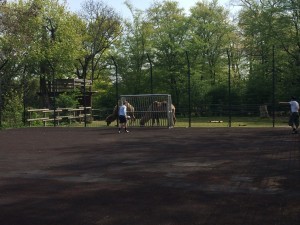
Geneisenaustrasse. I had been told that it wasn’t a field and that the surface was like that of the track found around a field, but this still didn’t inform me of the dimensions. I had seen a regular sized field with this type of surface, or this could be one of the cages that I had yet to play in. When I got to the park I was surprised at how big it was, nonetheless I ventured in. Eventually I saw a big caged area, and as I got closer there was a wooden fence around it, and in this little enclosure were two camels.

In Search Of…

There were two groups when I got there, one was a group of five skilled Frenchmen, the other was a group of a couple elder, out of shape men, a little boy and his older brother who was more my age. These teams would have to be divided. When I first showed up I didn’t know how this was going to be done, so I just grabbed my ball and started juggling. But things are organized here as I alluded to earlier, when everyone seemed ready, three more guys showed up and we were divided into teams. We played for an hour and a half before the French guys had to leave. The three guys that showed up remained behind and we kicked the ball around for another hour or so. I hadoriginally intended to go to the flea market after playing with these guys, but one of the mentioned that there would be more playing going on at Templehof, which wasn’t that far away. They asked if I was coming, at first I said no,  but as they were walking away, I thought that I shouldn’t pass on this and ran to catch up with them. One of the three had to bail but I walked with the other two and managed to speak a little bit. John and Sufien were their names, and they were both great ball players as well as cool dudes. They both barely spoke English, but Sufien was a little more capable and I chatted with him as we walked. He was from Palastine, born I the Gazastrip. He said that he had to move to the Westbank before coming to Germany, I’m not sure exactly what he said when referring to the Westbank but I think he said something like ‘The Fuckers’. He was studying sociology at Humboldt and was in the process of getting his masters there. To me this was really amazing because he was also such a great ball player. You could tell he was of the street variety, though, he could do lots of cool juggling moves, but I doubt he had ever played for a club before though. Made in the cage is my term for him.

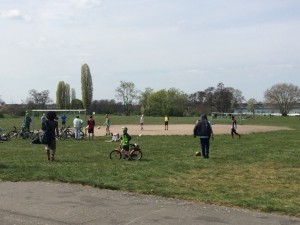
Templehof is huge. I had walked near it one time along the outside,  but once you are on the inside you can see that it is gigantic. I thought we were going to one of the turf fields along the edge of the park, but no, we walked pretty much straight to the middle and there in the distance I could see that there was a dirt field in the middle of all the grass.

In Search Of…

After all the years of people playing on it, the dirt had turned into a soft almost sandlike quality. The two goals helped carve out this barrier in the grass. When the game started I was hoping that we would be able to play just in the dirt area, and that the grass  would be out of bounds, but that wasn’t the case. So unfortunate steely, there were a lot of occasions were the ball would go way outside and things would get hectic and sloppy because of all the space out there. When this happened I usually preferred to stay in the middle area. The dirt was fun to play on, there was quite little traction, so I kept sliding around and losing my balance. It was a beautiful day, but that sun was reigning down on me and I had also been playing for a while before that, so I had to call it quits after two hours there. My shoes and legs were covered in dust, I loved it. I wish I could have stayed and played longer, there were a couple other quite skilled players, but I was just dragging myself around and probably just getting in the way. So I decided to head out and try and catch the end of the flea market only a couple stops away. I said goodbye to Sufien and John, hoping I would see them again. When I got to the flea market and was browsing some wares my classmate Ross came up behind me. He said he was with another classmate Jules, and I sat and chatted with them for a little while. I didn’t stay long because I was hungry and tired, so I soon headed back to Steglitz.