Category: Uncategorized (Page 1 of 3)

Slum School, New Delhi

Heather Schultz 

20170227_145203

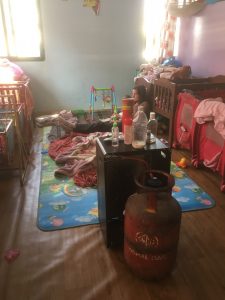
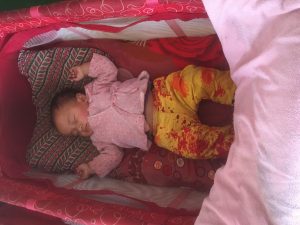
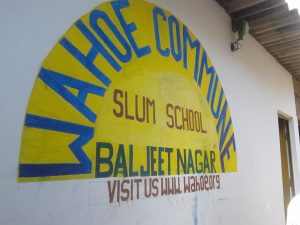
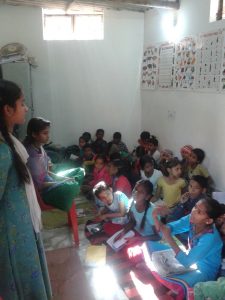
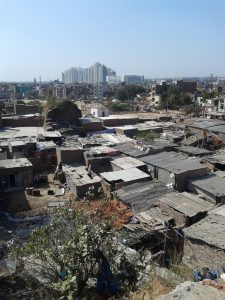
I spent 3 days volunteering at a slum school in Baljaat Nagar, New Delhi. The school is run by the Wahoe Commune, a Delhi-based NGO which runs tours to fund various community building projects. The school is actually an after-school program that serves to encourage and improve academic achievement among slum youth with the hope that these youth will thus be empowered to rise above the economic standards of their parents.

20170227_154230

It has been a very interesting experience for me to see the slum and interact with the children, particularly as our class recently read Behind the Beautiful Forevers, a book about life in an Indian slum. In fact, the slum was not as bad as I expected; the staff at Wahoe explained to me that over the last 10 years there have been vast improvements. Originally people were living in tents, now many of the houses are brick and some have more than one room. However, this is still a slum and conditions are not good, sanitation in particular is an issue. Many homes don’t have toilets and sewage ends up running down the street in places. 

20170227_143146

I hope that these people can continue to find ways to improve their conditions and that the efforts of various organizations also serve to facilitate positive changes in New Delhi and across India.  

Teaching in Bhujrungkhola

Heather Schultz 

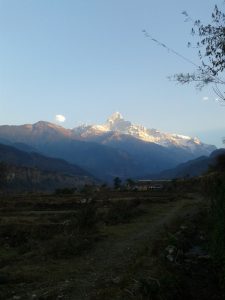
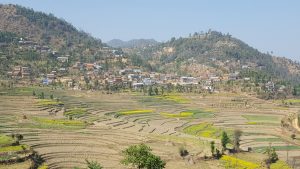
I spent about two and a half weeks teaching at Shree Machhapuchhre Higher Secondary School in Bhujrungkhola, Nepal.  It was an amazing experience. To begin with, the landscape is beautiful. The village is actually located within the Annapurna Conservation Area. Every morning as I walked to school, I was greeted by the sight of Machhapuchhre. The peak dominants the village and provides the school with its name. 

Machhapuchhre

Machhapuchhre

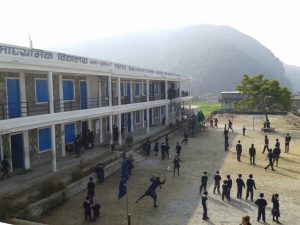
The school itself is somewhat unique in Nepal as it is an English medium government school. As the headmaster explained to me, English provides many opportunities, so why should this be only for those who can afford private school? I  really admired how passionate the headmaster was about providing a quality education for every child in the community. I additionally found the teachers to be friendly, and had some good conversations with them, on everything from teaching to geography to agricultural. The students were curious and eager to learn – which really made them a joy to teach. Any question they knew how to ask in English, they would. Even on the walk to school,  I would often be asked by one student or another, ‘what is your name?’ and ‘where are you from?’ The students also loved teaching me, and I often received impromptu lessons in Nepali. 

Shree Machhapuchhre Higher Secondary School

Shree Machhapuchhre Higher Secondary School

Finally, there was such an amazing sense of community in Bhujrungkhola. Between my kindhearted host family, and the staff and students at the school, I felt incredibly welcomed and included. In fact during my short stay, I attended a party, a religious celebration, a picnic and a wedding. All in all, my time in Bhujrungkhola proved to be an incredible experience.  

Connections to Human Trafficking (Theoretical Analysis)

Lillian Adams

When working at Bal Mandir I met a women who had been volunteering there every thursday for the last 10 years (originally from Ireland). When we spoke to her about our confusion around why so many babies were simply abandoned at birth last minute, she told us many times this can be due to bribery. Explaining that oftentimes, corrupt officers (or other bystanders) may offer young struggling mothers a settlement of money to leave their newborn in the hospital, where it will be taken to a government orphanage. Once in the orphanage it is nearly impossible for a child to be adopted, especially after laws recently passed requiring that a couple be Nepali, over the ages of thirty five and married at least ten years. Though multiple sources have confirmed for me that adoption is made possible through government connections or “bribery”. I learned of an American women able to adopt a child from Bal Mandir only after providing all of the temporary housing for the orphanage after the earthquake in addition to agreeing to pay for years worth of food and supplies for the orphanage. After this she was still required to pay for the child and stay in Kathmandu for four years before being allowed to leave the country. It was explained to me that these laws are in place because international adoption would often result in the Nepali government never being updated on the welfare of the child after adoption. I see this as a legitimate concern, but I believe there are other ways to go about solving this issue. Nepali couples rarely adopt, especially because if a wife is unable to bear children, the husband may take up a second wife, rather than consider adoption.

Once they reach the age of sixteen, orphans are no longer able to reside in the orphanage. They are set up with no resources for finding work, housing, or to continue their education. Many children never set foot outside of the orphanage until this time, Making them specifically vulnerable to trafficking. Due to lack of resources these young teens are extremely likely to accept an offer from the first person to offer them a job or place to stay, which may very likely be a trafficker. This has forced me to draw ties between early abandonment to early teen years… is it possible that these children have been claimed since birth? Is it possible that traffickers have their eyes on these children until the age of sixteen?

Continuing my research, I am searching for statistics that showcase what percentage of orphans become unaccounted for after this time period, in addition, information involving sex trafficking victims/ sex workers and where they came from. It is clear that many girls are taken from rural villages with limited resources, but how many disappearing from the city come from government organizations and orphanages… is there a connection?  


Mid-Session Retreat

20170212_111054

Sanjeev Dahal, our fearless leader

Sanjeev Dahal, our fearless leader

20170212_114654


On February 11, two weeks after our arrival, our students came bumping back into town from their rural placements. For some, it was an all-day journey back into Kathmandu. The next day, we all boarded our little maroon bus, and headed up to Balthali Village Resort. We left the bus in a village down below and most of us opted to hike about an hour up to the beautiful resort where we were greeted with lunch, great views of the Himalayas to the north, and clean air. 

We had some good discussions together reflecting on our work and our learning so far. With facilitation assistance from Hillary Bernhardt, a staff member for the Chelsea Center, we explored what it means to volunteer; what students can offer and what they receive; how to meet “need” in the midst of different value systems; how students’ positionality and privilege shape their encounters and much more. Our discussions were rich, insightful and broad-ranging, demonstrating learning on many different levels.

We also had a yoga class from Yogi Arya whose ashram is near the Pashupathinath complex in Kathmandu. His form of teaching was very different from what we experience in our yoga classes on campus. 

And mostly, we got to enjoy being together in an incredibly beautiful place. The next day we stopped to visit a Shiva sculpture, and then descended into dusty Kathmandu. Students again went out to either the same or new placements for the second half of our stay.

20170216_145517

Teaching in Ramechhap

  About an hour and a half up hill from Manthali rests a village called Dukriharka which is located within Ramechhap. While staying in this village I am teaching English at a school, which includes nursery level, all the way up to 5th grade students. The school day begins at 10 A.M. and ends at 4 P.M. most commonly seven periods, unless it is Friday then the day ends after lunch at 2:00 P.M., or if there is a marriage in the village.

  While I was in the village there were actually two marriages that caused shorter days at the school! Every morning I would walk to school with the three kids that live at my homestay along with their mother and then walk with them home after school as well. At school I only had one of three kids in my classes. I taught 3rd grade, 4th grade, and 5th grade. For many of my class sessions I used drawing pictures and singing songs as ways to remember the lessons, and the kids tend to love that because they are used to a lot of repetition of spoken words or writing. I started with teaching the kids some basic questions and answers in English so that we could communicate more efficiently. I soon realized many of the kids some what knew hokey-pokey and head, shoulders, knees and toes so we did a few lessons on health and body parts and would accompany or end the lesson with one of those two songs or both. Besides body parts, we also studied vegetables, fruits, animals and sustainable practices alongside geology. There were four other teachers alongside the principal and the subjects they teach are science, english, nepali, social studies and the principal taught mathematics. 


Two of the three kids from my homestay and mysef.

Two of the three kids from my homestay and myself.

My main goal for the kids was to leave them with information and ideas to be more conservative with resources, and to practice more sustainable options to the choices they already make every day. 

IMG_1476

  As the two weeks came to an end I noticed the improvement of the fluidity of the conversations I would have with the kids and how the visual lessons worked well for them to help them remember the concepts. Songs made it easy for them to repeat the lessons information again for later use for them.


Teaching and community

My time in Nepal has been spent around communities of women. Women who help each other, support each other, and learn from each other. I thought I was gonna spend most of my time at chorrie but my plans changed.  The first day of placement was actually a holiday celebrating saraswati, goddess of education and knowledge. So lots of placements were closed. I spent my first day at the Chelsea center participating in the festivities. We danced and celebrated with the students and teachers which was an amazing experience. Since my work for chorrie was editing a report from home, I ended up spending a lot of time there. I was able to teach a conversational English class which, while nerve racking, was very fun. There is a real community at the Chelsea center which really drew me in and made me change my placement to there. I’m so excited to work there more. Hillary has already assigned me a few projects and I’m looking forward to getting started. 

My First Full Week at EDUC Nepal

From the moment I enter the yard of EDUC Nepal I am greeted by excited students learning outside. EDUC Nepal offers an education to under-privileged kids in Basundhara, Kathmandu. The cement building, with at least three floors, is a very different atmosphere from public schools in the United States. Teachers and students remove their shoes before entering a classroom or office, a custom observed all around Nepal. Lunch is made on a stove out front, and chickens are kept in the yard where students play. Each classroom includes small tables as the students’ desks and a chalkboard ready for the teacher’s use. Students must ask permission before entering the classroom and greet me each day with “Good morning ma’am” and await permission to sit down. Over the past several days this setting has become more familiar and now seems a wonderful environment for students to learn in. 

I help out in two classrooms with two different teachers, both of whom are friendly and devoted to their students. The kids in each classroom range in age from 2-14 years old. Each day my fellow volunteer and I grade students’ homework and offer stickers as a reward. Our first class is well behaved and follows the teacher’s instructions. Some of the older children help me talk to younger students who don’t know as much English. Mostly the students are just happy to have new faces who want to have fun with them.

16601577_1374436315902406_3947688849504655028_o Our Second class was described to us on the first day as “naughty,” because they are loud and at times unruly. A slightly smaller class, these students have embraced my presence in class and are eager to greet me each day. I have learned all their names, which is harder than it sounds. This class is full of energy and is always excited to show me new games and songs they love. Almost every class day includes a super, lightning fast round of “Head, Shoulders, Knees, and Toes” or a new song brought forward by a volunteer. One of the students is only five years old, and I have been reviewing his English with him. My greatest accomplishment in this class is getting this young student to smile with pride when he gets a word right. These children have been a blessing to work with, they have helped me grow so much already and I am excited to continue learning with my new friends at EDUC Nepal. 

Small Yellow Curtains

My first week here I unfortunately got an infection that lead me to a few nights stay at Grande, an international hospital close to  Dhapasi. My first experiences at the hospital were unimaginably overwhelming. The emergency rooms (2 of them) had beds lined up next to each other with no separation. The staff included many male doctors and female nurses that were extremely friendly and helpful. Something I noticed right off the bat was how little privacy mattered. I would be in a room full of other patients and my symptoms and results were expressed outloud for everyone to hear. Personal questions asked by many different people and there was a bit of a language barrier. Being a foreigner in the hospital felt like I was in the spotlight in the most uncomfortable way. Having everyone staring at me and asking my nurses what was wrong with me was something I had to learn how to be ok with.

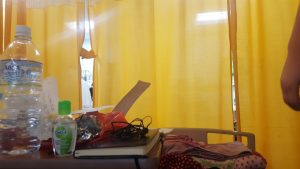
The staff were constantly working. Getting admitted and discharged took hours alone. Everything is so quick back in the states. To get discharged from the hospital took mounts of paper work that then had to be scanned into a computer. Then we waited for the bill and had to run upstairs to pay, then back down for documentation. Getting admitted into the hospital was scary and overwhelming. All of the single rooms were taken so I shared a small, warm room with 3 other patients, who were all elderly men.  The only thing separating us wear these small thin yellow curtains, they were constantly getting moved. I was so dependent on these curtains , they were the only thing that allowed me to feel remotely comfortable. Everyone’s family members all stayed in this room with us. I stayed 2 nights in this room hooked to an IV. Oh how time completely stopped on the 6th floor. There was one bathroom that all four of us shared, and I was the only one that used toilet paper. My IV was through my hand and I was on various types of medication, some I didn’t even know the reason why they were giving it to me. Getting information was something I found the most difficult. Only the main doctor could tell me my test results and answer any discharge questions. He only came around for about 10 minutes a day. All the nurses were extremely young but had the biggest hearts. I made some really amazing connections with these hard working women despite the language barrier.

I had a button to ring a nurse anytime I needed anything like ordering food, having the IV taken out so I could go to the bathroom or if I had any questions (although they went unanswered most of the time). In America, if I ring for a nurse, one comes flying in. In Nepal, I ring for a nurse and one might come eventually. They were all so busy taking care of so many different patients. I had a nice conversation with one that had a dream of moving to California for school. She was so fascinated by my tattoos and kept calling me beautiful even when I was so sweaty and claustrophobic. Looking back on the days I spent there makes me happy to be out. This small, overcrowded, muggy room was all that I saw for days and it had felt as if I had all my cards out on a table for a bunch of stangers to see. It was very hard for me to have any control over my situation or even have any clue of what was going on. The nights were the hardest part for me, the fluorescent lights kept me up among constant vital checking and pain killer injections. Each of my roommates had a different diagnosis with different procedures to take during the night. Overall, this experience taught me how to be patient, when to speak up and how to deal with not having any privacy whatsoever. Stay healthy folks. IMG-20170207-WA0011 

Prep for Valentine’s Day @ E.D.U.C -Zoey J

 IMG_3249  I chose my placement at EDUC (Education and Development for the Underprivileged Children of Nepal) not only to gain experience teaching English but to learn more about the country and culture of Nepal through hands on interaction with the kids. Being surrounded by over 20 kids at once who are so excited for me to be there but barely speak English was overwhelming at first. Each day that I go back to teach at EDUC I learn more and more about the kids, their individual personalities, (and their complicated names). 

IMG_3225

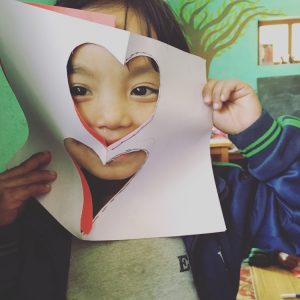
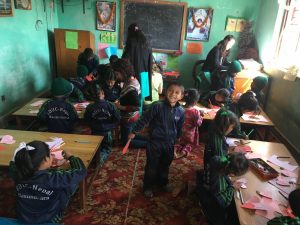
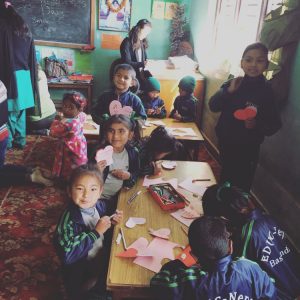
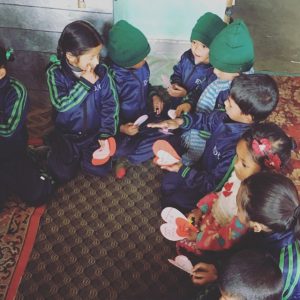
Today at EDUC (2/10/17), Tess and I got our two classes together and showed them how to make Valentine cards in preparation for Valentine’s Day. On the way to school we bought red, purple, and pink paper, coloring markers, scissors, glue, candy, and chocolate. After getting all the kids together in one classroom, we demonstrated how to cut heart shapes from the folded colored papers. With some help, the students were eager to cut out hearts in all different sizes. 

IMG_3248

We then showed the kids how to write “Happy Valentine’s Day” in the cards along with a couple other words like “smile” and “love”. Some students also went ahead and drew pictures on their cards, and many wrote name’s of individuals whom they wanted to give their cards to. Tess collected the cards when they were finished, and with help from the teachers had the kids sit in a circle at the back of the room.

IMG_3250

Tess then passed out the cards to the kids and we both were also given a few of the Valentine’s! As she passed out cards, I passed out the different candies to the students. Each candy given was followed with a, “thank you, ma’am”. I could tell the kids really enjoyed our crafts day, and I’m glad everything turned out and was successful. 

Bal Mandir Infants Week 2 update

Hygiene Update:

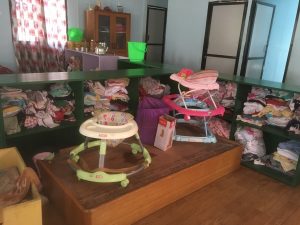
It is my second week at the Bal Mandir Infant orphanage and we have kicked things into high gear! The other volunteers and I began by scrubbing the floors, then each crib by hand with tooth brushes and dish soap. When we asked to wash the blankets we were told “not possible, each is used in the night”, after realizing not one blanket had ever been washed we were very determined to get them clean. After bringing an employee from volunteer Nepal to help translate, the care givers have agreed to let us clean ten blankets a day, because really they are not used… Long story short we have conquered many a battle. The babies are already beginning to shed their colds and the room went from hundreds of flies to a few occasionally on site! Additionally, the caregivers have taken a liking to our baby wipes and have started using them to “bathe” the babies, I am so grateful for this! I plan to leave as many baby wipes as I can before my departure.
 clothes

More Observations/ Next Steps:

The babies are fed bottled milk around 9am. Bottles are shared around the room, causing the spread of germs. Additionally, the amount each baby drinks (if at all) is not monitored, if a baby is asleep at this time they will miss out completely, or a baby may be fed so much they choke on their vomit. The babies are not fed the bottles, but expected to hold them on their own and feed themselves (this includes two month old Iska). The babies are not fed again until around 2:30pm, rather than milk they are spoon fed a solid brown soup. They care givers bring out one spoon at a time to ensure volunteers may not participate in feeding. Baby spoons have been provided, but they prefer to use a very large table spoon. They then fill the table spoon entirely, with a brown soup that is steaming hot (you can literally see steam coming from the spoon). The entire spoon is lodged into the babies mouths, frequently causing them to gag and cough the hot food all over themselves. Each baby I have seen fed this way cries more when they are fed than when they were hungry. I have tried to ask why they are fed this way but the communication gap is limiting. 

Possible solutions: I would suggest that the feeding bottles have tape around the bottom with the name of each baby (there are enough bottles fro each to have their own). This will ensure no germs are spread and the amount each baby eats may be monitored. Additionally I would suggest the use of baby spoons, so that the amount of food entering the babies mouth is not overwhelming. it is also easier for the food to cool when blown on if it is a smaller amount in the spoon. 

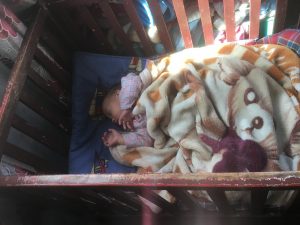
Other Observations/Solutions: There are enough cribs for each baby, but every night they are placed “wherever”. If each crib was labeled or assigned to a specific child, germs can be more easily contained and sleep schedules can be more closely monitored. Although I may be getting ahead of myself, if each crib could have a clipboard or white board for that specific child then “poops” may be monitored as well. This is very important, for a baby may not have a “movement” for days, and it would go unnoticed. 
crib 2gas

Itsmatika sleeping in crib


« Older posts