Author: Lillian

My name is Lillian(Lilli) and I’m currently a Junior at The Evergreen State College. My emphasis is in Human Rights and Management, with a specific interest in Human Trafficking. During my time here I have explored these areas through volunteering in Nepal, interning with Washington Hospitality Association and more!
Originally I am from Chico Ca where I worked as a contemporary choreographer for 5 Years before moving to Olympia. I’m also a crazy cat lady Vegan who is equally as passionate about animal rights as human rights.

Connections to Human Trafficking (Theoretical Analysis)

Lillian Adams

When working at Bal Mandir I met a women who had been volunteering there every thursday for the last 10 years (originally from Ireland). When we spoke to her about our confusion around why so many babies were simply abandoned at birth last minute, she told us many times this can be due to bribery. Explaining that oftentimes, corrupt officers (or other bystanders) may offer young struggling mothers a settlement of money to leave their newborn in the hospital, where it will be taken to a government orphanage. Once in the orphanage it is nearly impossible for a child to be adopted, especially after laws recently passed requiring that a couple be Nepali, over the ages of thirty five and married at least ten years. Though multiple sources have confirmed for me that adoption is made possible through government connections or “bribery”. I learned of an American women able to adopt a child from Bal Mandir only after providing all of the temporary housing for the orphanage after the earthquake in addition to agreeing to pay for years worth of food and supplies for the orphanage. After this she was still required to pay for the child and stay in Kathmandu for four years before being allowed to leave the country. It was explained to me that these laws are in place because international adoption would often result in the Nepali government never being updated on the welfare of the child after adoption. I see this as a legitimate concern, but I believe there are other ways to go about solving this issue. Nepali couples rarely adopt, especially because if a wife is unable to bear children, the husband may take up a second wife, rather than consider adoption.

Once they reach the age of sixteen, orphans are no longer able to reside in the orphanage. They are set up with no resources for finding work, housing, or to continue their education. Many children never set foot outside of the orphanage until this time, Making them specifically vulnerable to trafficking. Due to lack of resources these young teens are extremely likely to accept an offer from the first person to offer them a job or place to stay, which may very likely be a trafficker. This has forced me to draw ties between early abandonment to early teen years… is it possible that these children have been claimed since birth? Is it possible that traffickers have their eyes on these children until the age of sixteen?

Continuing my research, I am searching for statistics that showcase what percentage of orphans become unaccounted for after this time period, in addition, information involving sex trafficking victims/ sex workers and where they came from. It is clear that many girls are taken from rural villages with limited resources, but how many disappearing from the city come from government organizations and orphanages… is there a connection?  
 

Bal Mandir Infants Week 2 update

Hygiene Update:

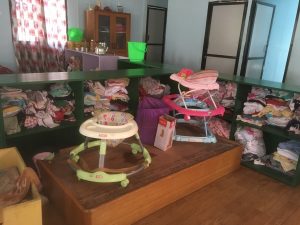
It is my second week at the Bal Mandir Infant orphanage and we have kicked things into high gear! The other volunteers and I began by scrubbing the floors, then each crib by hand with tooth brushes and dish soap. When we asked to wash the blankets we were told “not possible, each is used in the night”, after realizing not one blanket had ever been washed we were very determined to get them clean. After bringing an employee from volunteer Nepal to help translate, the care givers have agreed to let us clean ten blankets a day, because really they are not used… Long story short we have conquered many a battle. The babies are already beginning to shed their colds and the room went from hundreds of flies to a few occasionally on site! Additionally, the caregivers have taken a liking to our baby wipes and have started using them to “bathe” the babies, I am so grateful for this! I plan to leave as many baby wipes as I can before my departure.

 clothes

More Observations/ Next Steps:

The babies are fed bottled milk around 9am. Bottles are shared around the room, causing the spread of germs. Additionally, the amount each baby drinks (if at all) is not monitored, if a baby is asleep at this time they will miss out completely, or a baby may be fed so much they choke on their vomit. The babies are not fed the bottles, but expected to hold them on their own and feed themselves (this includes two month old Iska). The babies are not fed again until around 2:30pm, rather than milk they are spoon fed a solid brown soup. They care givers bring out one spoon at a time to ensure volunteers may not participate in feeding. Baby spoons have been provided, but they prefer to use a very large table spoon. They then fill the table spoon entirely, with a brown soup that is steaming hot (you can literally see steam coming from the spoon). The entire spoon is lodged into the babies mouths, frequently causing them to gag and cough the hot food all over themselves. Each baby I have seen fed this way cries more when they are fed than when they were hungry. I have tried to ask why they are fed this way but the communication gap is limiting. 

Possible solutions: I would suggest that the feeding bottles have tape around the bottom with the name of each baby (there are enough bottles fro each to have their own). This will ensure no germs are spread and the amount each baby eats may be monitored. Additionally I would suggest the use of baby spoons, so that the amount of food entering the babies mouth is not overwhelming. it is also easier for the food to cool when blown on if it is a smaller amount in the spoon. 

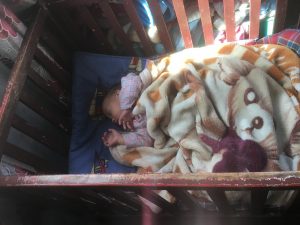
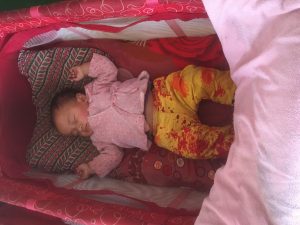
Other Observations/Solutions: There are enough cribs for each baby, but every night they are placed “wherever”. If each crib was labeled or assigned to a specific child, germs can be more easily contained and sleep schedules can be more closely monitored. Although I may be getting ahead of myself, if each crib could have a clipboard or white board for that specific child then “poops” may be monitored as well. This is very important, for a baby may not have a “movement” for days, and it would go unnoticed. 

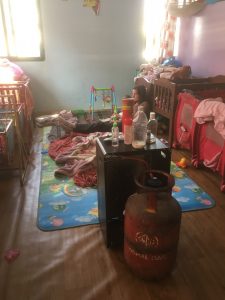
crib 2gas

Itsmatika sleeping in crib


Bal Mandir Infant Orphanage

As I began my journey to my first placement at the Bal Mandir Infant Orphanage I wasn’t sure what to expect. I started off on a very crowded Micro bus where I quickly learned the ways of traveling locals. Then a somewhat chaotic exchange onto a larger bus that took me the rest of the way to Bal Mamndir. Once used to the dusty roads and wild traffic, traveling with the locals was pretty fun and has made me feel very independent.

 bal m

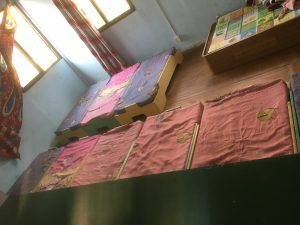
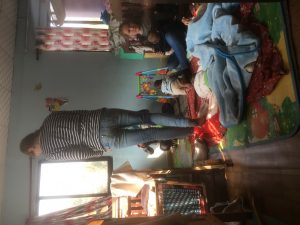
Approaching Bal Mandir, I can see the large building in which they used to inhabit. A large, beautiful structure, once owned by royalty until it was donated to become the largest run government orphanage in Nepal. Because of the devastating earthquake in 2014, the building has been severely damaged and deemed unsafe for the children to live in.  For now, the children are set up in temporary housing behind the original orphanage. From what I can see there is a room for the toddlers, infants and they’re “caretakers”, a room for the older boys, a room for the older girls, a cafeteria and a classroom. The housing I work in is the infant center, which is a room split into two sides, one with beds for the toddlers and one with cribs and blankets for the infants.

 toddlerbaby room

The blankets are rarely washed, and because most of the babies are sick, they are covered in snot, vomit and often feces as well. Because the permanent care takers for the infants do not want too much laundry, the babies often wear the same clothes for days at a time (though there are piles upon piles of donated clothes available). Additionally, when changing nappies (which are a very thin layer of burlap) we are asked to wipe the baby only with the dirty diaper, in order to avoid extra laundry. Because the diapers are such a thin material, anytime the infants wet them it leaks through onto their bed, blankets or the floor… which doesn’t get cleaned either. One of the volunteers bought some reusable, washables nappies that don’t leak, but the next day when we came back all of the new nappies had disappeared. It is still not clear if they were taken home, sold, or simply thrown away. Because of the dirty blankets, the room is infested with flies that culminate the babies cribs. Because the caretakers spend most of their day napping outside on the trampoline, the other volunteers and I have requested permission to bring our own buckets and soap and wash the blankets and clothes ourselves. I am very eager to report back next week with good news regarding clean and happy babies.