Most of us live highly mobile lives. But what is the range and purpose of our movement? We go to work and school, we go on vacation. Some of the themes that we have been investigating is this program are broad sweeps of movements and migrations throughout the region of South Asia, and this is what we are investigating in Nepal.
In fall quarter, we explored the rise and spread of Hinduism (roughly 1900-1400 bce) and of Buddhism (5th century bce) from south Asia throughout Southeast Asia and beyond, and the spread of Islam from the Middle East into surrounding regions (arising in the 7th century ce). The intersections of these sweeps of religious tradition have felt effects in people’s lives today. The ethnography Rituals of Ethnicity by Sara Shneiderman explored ways that a highly mobile ethnic group, the Thangmi people, live part time in Nepal, migrate to India for work opportunities, and sometimes migrate into Tibet as part of annual circuits seeking opportunity. The resulting syncretism in terms of their religious practices is a unique combination of Buddhism, Hinduism and shamanism. And how they negotiate their ethnic identity is a multifaceted, political as well as cultural process.
In winter quarter we have been investigating the flows of money and labor throughout these broad regions. Katherine Boo’s book, Behind the Beautiful Forevers, offered an intimate and heartbreaking look at life in a Mumbai slum. Contiguous to the Mumbai airport and luxury hotels, Anawadi slum dwellers live in an “under world” and provide essential services such as sorting trash, sweeping streets, and serving food at elaborate events, making the lives of conspicuous consumption in the “over world” possible. Boo’s analysis of “opportunity”—whether in the form of hard work, bribery or manipulation—demonstrates ways that almost no one is exempt from complex networks of leveraging one’s position. This reading has prepared us to recognize ways that systems of opportunity are at play here in Nepal as well. Donations of diapers or washing machines to orphanages disappear, just as Boo described in Mumbai. Good intentions of volunteers—whether local or foreign—are drops in streams that may be moving in different directions. Students grapple with their own abilities to leverage their contributions and their time here.
With an open border to India, it’s common for many people to travel back and forth. David Gellner’s recent address, The Idea of Nepal, offers a great analysis of ways this trans-border mobility affects constantly shifting notions of ethnicity. But more broadly, I’ve been surprised by how many people I have encountered in Nepal who have ties to Dubai and other international cities. Pardis Mahdavi wrote about the migrations of laborers from South and Southeast Asia to the city of Dubai looking for work opportunities. In her ethnography, Gridlock: Labor, Migration and Human Trafficking in Dubai, Mahdavi describes a complex range of laborers, from hotel housekeeping, to nannies; from construction workers for the burgeoning cityscape to sex workers. “Trafficking,” Mahdavi argues, may apply to a vast range of opportunity seekers, not just sex workers. And all of these laborers operate with varying degrees of freedom and agency, in search of their own opportunity.
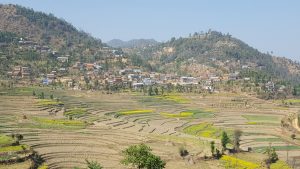
Up near the tiny hamlet of Tutung, Nepal, families had sons and daughters in far flung places, working and sending remittances back. Such ties were visibly evident in villages with larger, and newer homes for some families popping brightly on the landscape, compared to much more modest vernacular homes for others. The owner of my guest house in Kathmandu, recently retired after decades of his own international journeys working for UNICEF, invested in the hotel to provide a job for his son in order to keep him local. A preemptive act against out-migration that most do not have the means to provide. Even so, one of his daughters lives and works in India.
And in everyday ways, people pile into buses, shared vans, taxis and onto motorcycles to traverse the city and the mountains in sweeping, endless, dusty flows. Bricks, concrete, and ri-bar are transported all throughout the hills for reconstruction after the 2015 earthquake. Human laborers break rocks, mix concrete, stack and align to re-inscribe road edges, property, homes and businesses. Cauliflower, potatoes, greens and onions bounce their way from bright field into dusty city markets. And criss- crossing all of this, our students are going out to placements daily, working with kids in orphanages, individuals who have been caught up in the worst sort of trafficking, schools, elder care facilities and more. They are connecting with others, editing grant proposals, writing reports and articles for local publications, reading, cooking, and reflecting. They are finding their way, geographically, intellectually, emotionally, and as a community.

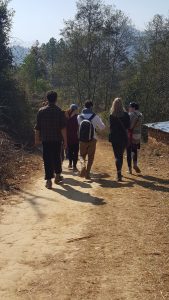
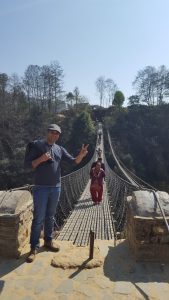


 to restore us. We deliberated about staying overnight or heading back down. Since our driver was worried about the jeep we’d abandoned, we toured the school, said good-bye and headed down–a trip that went remarkably much faster than the walk up. Our drive back to Kathmandu took another four hours of tight, steep turns, honks, dust, bumps and motion sickness.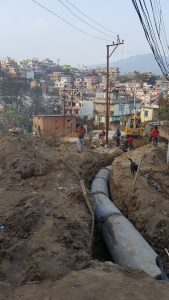
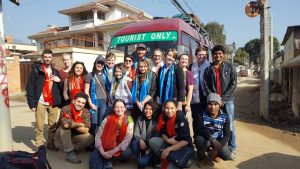
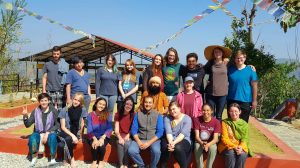
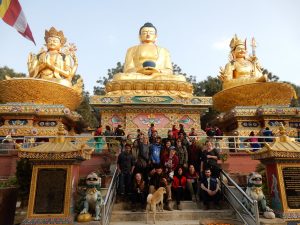 We all arrived in Kathmandu on January 29 and 30th. Our hosts from