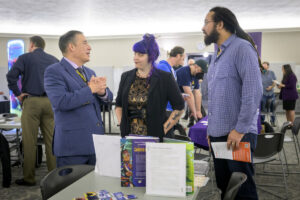
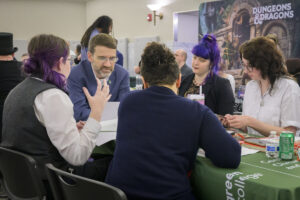
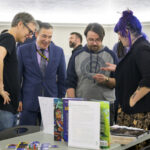
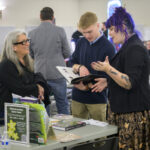
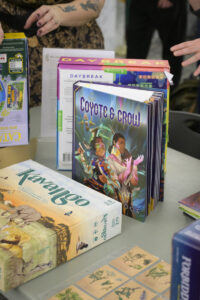
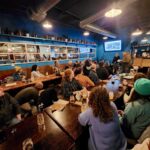
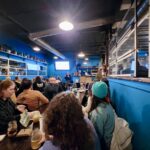
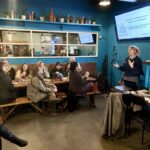
Evergreen made a memorable impact at this year’s Legislative Campus Game Night, where faculty, students, and staff shared how game design and climate education intersect across our curriculum.
Secretary of State Steve Hobbs speaks with Faculty Saltiel and Climate Center Staff
This year, Evergreen expanded from one table to two, allowing us to highlight a wider range of student projects, hands-on climate action games, published titles used in K–12 classrooms, and Evergreen-produced educational materials. Our team engaged directly with Secretary of State Steve Hobbs, legislative staff, community partners, and professionals across Washington’s vibrant tabletop game industry.
Washington is considered a global center for game design, and the event brought together creators – from large studios (such as Wizards of the Coast) to indie developers and local alumni, including Ross Cowman, business owner of Deernicornand president of the TGA. The night sparked meaningful conversations about experiential learning, sustainability, and the ways Evergreen students are using creativity to tackle complex environmental challenges.
Attendees shared that Evergreen stood out as an innovative, community-engaged institution, offering a fresh and exciting glimpse into what our students and faculty are creating!
Legislative game night at the Capitol, 02-03-26
Legislative game night at the Capitol, 02-03-26
Legislative game night at the Capitol, 02-03-26
Legislative game night at the Capitol, 02-03-26
Legislative game night at the Capitol, 02-03-26
Legislative game night at the Capitol, 02-03-26
Thank you to Jason Biehner from Marketing & Communications for the amazing photos! It was really a night of Evergreen collaborations.
We wanted to provide an early update about some important transitions underway for the Center for Climate Action and Sustainability. A more formal in-depth announcement will be coming soon, but we felt it was important to share this initial overview now so our campus partners, students, and community collaborators have time to understand and prepare for the changes ahead.
Transition to “The Climate Center”
Beginning this winter and continuing through spring quarter (until June), we will be operating in a transitional mode as the current Center for Climate Action and Sustainability (CCAS) transitions into The Climate Center.
This shift reflects our desire to simplify our identity, clarify our mission, and take stock of what is working well and what needs to be strengthened. During this transition stage, we will be conducting program evaluations, refining our core services, and preparing for a “2.0” launch of sustainability at Evergreen beginning after June.
A Hybrid Model: Facilities + Academics
The biggest change will be our funding model. The Climate Center will become a hybrid unit combining elements of the former Office of Sustainability (under Facilities/Operations) with the current academic- and community-facing programs of CCAS.
This hybrid structure will allow us to:
Continue offering the climate literacy programming, workshops, and classroom visits our students and faculty rely on.
Increase campus-wide sustainability support through Facilities & Operations.
Help develop Evergreen’s next generation of sustainability planning through data-informed and community-informed processes.
Half of our work will directly support the campus’s long-term sustainability operations and infrastructure, while the other half will maintain our academic engagement, outreach, and public service programming.
Programming Changes & Continuity
Most of our public-facing programming will continue with only modest adjustments to our capacity. For example:
Our Climate Lecture Series will transition from ~six guest lectures per year to three larger, more ambitious guest lectures by visitors supplemented with public campus lectures by Evergreen faculty.
We are planning a Summer Institute where faculty can help co-select the year’s upcoming guest speakers and collaborate on grant proposals to fund them.
Workshops, classroom talks, and community presentations in Evergreen classrooms and off campus will continue (and in some cases increase).
Our Sustainability Idea Lab consulting program will grow into a more structured, recognizable resource for supporting student and community nonprofit sustainability projects.
Sustainability Action Plan & Campus Initiatives
A major emphasis of Sustainability at Evergreen 2.0 will be helping the institution move toward a renewed and integrated sustainability vision. This includes:
Working with Facilities and campus leadership to incorporate a modernized Sustainability Action Plan including student well-being and health into the Master Infrastructure Plan (formerly the Climate Action Plan). Supporting renewable energy expansion on campus through projects such as the Thunderdome solar array and related efforts aimed at reducing Evergreen’s long-term energy costs.
Assisting in evaluating and updating approaches with Renewable Energy Certificates (RECs) to ensure we are aligned with current state and regional sustainability best practices.
Focusing on campus health, well-being, ecosystem resilience, and climate adaptation.
Leadership Transitions
The current Director of CCAS will be transitioning into full-time teaching in the MES Program. During this transition:
The Assistant Director will assume many of the responsibilities previously associated with both the former Director of Sustainability and the CCAS Director.
The role will also have a new title: Assistant Director for Campus Sustainability reporting to the Dean of Native Programs and Experiential Learning.
This position will continue to maintain community partnerships and public-facing workshops, while increasingly helping campus units design and implement sustainable operational practices.
Continued Student Support & Advisory Roles
We will maintain our advisory and liaison roles with several campus groups and committees, including the Clean Energy Committee (CEC), the Campus Sustainability Council, Space-Land Use Group (SLUG), and various academic pathways. We will also continue facilitating student-led sustainability projects, supporting internships, and collaborating with off-campus partners across the South Sound region—focusing on youth education, community climate programming, and K–12 curricular development.
Feedback & Participation
As part of our transition, we are gathering feedback from students, staff, faculty, alumni, and community collaborators who have worked with us. We would greatly appreciate hearing from you about:
What has been working well
What you’d like to see continued
What programs should expand in this 2.0 version of the Climate Center or Sustainability at Evergreen, or what new directions we might consider.
Any other ideas for improving the relaunched unit planned for AY 2026–2027 (including other possible names)
You can reach us at climateaction@evergreen.edu with questions, reflections, or suggestions. We will also be circulating a short feedback form soon to help us gather input systematically.
Looking Ahead
The team has many projects and upcoming events in progress, from continued expansion of regional partnerships and increased faculty collaboration initiatives to ongoing project support for students and community organizations. While some elements of the center will pause for evaluation this spring and summer, our core mission remains unchanged:
To support climate literacy, sustainability leadership, and regenerative practices across Evergreen and in the wider community.
We are excited about the opportunities this transition provides and deeply grateful to our community and campus partners. We look forward to building a stronger, more clearly focused, and more sustainable Climate Center together.
With appreciation, The Climate Center at The Evergreen State College
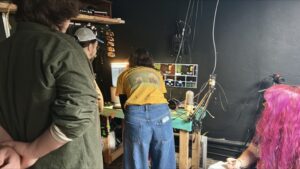
We’re excited to share the first steps of a new collaborative project between the Climate Center and Evergreen’s Game Design students and faculty—one that’s been a long time in the making. This month, we officially launched a pilot video‑podcast series exploring the intersections of games, climate justice, and education called “Roll for Change!”.
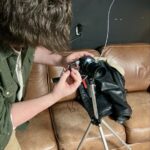
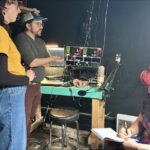
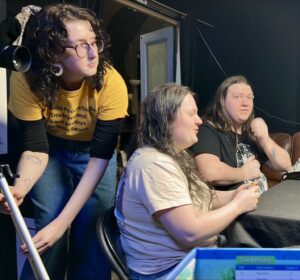
Early last Saturday morning, a team of enthusiastic students, staff, faculty, and an alumni community member (Ross Cowman, owner of Deernicorn and President of the TGA) gathered outside the fantastic Mystic Game Shop to kick off the project. The session focused on two main goals: building shared skills around recording and production, and playtesting the format through a live, game‑based recording.
Learning the Ropes of Production
The morning began with a hands‑on introduction to the basics of video‑podcast production. Participants learned about audio setup, camera framing, lighting considerations, and collaborative recording workflows. For many, this was a first opportunity to step behind the scenes of a media production process—acquiring knowledge that will be essential as the project grows and future episodes are refined.
This pilot session was intentionally designed as a learning experience. By experimenting early, we’re able to identify what works, what needs adjustment, and how to make the process more accessible and sustainable for students and collaborators moving forward.
Play as a Lens for Climate Futures
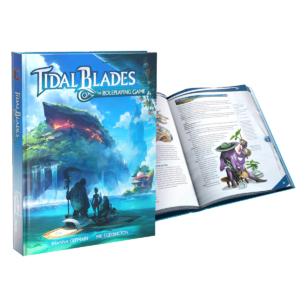
After the production briefing, participants were introduced to the game that anchored the session: Tidal Blades, a tabletop role‑playing game that fits within the“Tidalpunk” subgenre of solarpunk. With its emphasis on oceanic cultures, renewable technologies, and community resilience in the face of larger threats, the game provided a some entry points for conversations about climate justice and ecological futures.
For this session, players used characters inspired by the United Nations’ Inner Development Goals (IDGs), a framework focused on cultivating the internal skills and values needed to address complex global challenges. Through play, participants explored themes including renewable energy, aquatic life, collective care, and the emerging concept of the blue economy, which centers the sustainable and equitable use of ocean resources.
Looking Ahead
We learned a great deal from this first pilot recording, from making technical adjustments to improving our pacing and facilitation. The insights gathered will help us refine the process for next month’s session and future episodes, while the next step for this episode will focus on editing the recording and preparing it for release.
This pilot is just the beginning. Our goal is to create a series that highlights how games can be powerful tools for climate education, bringing creativity, empathy, and critical thinking into conversations about justice, sustainability, and the future we’re building together!
If you’d like to follow along, be sure to subscribe to our newsletter for updates on the project and announcements about when the first episode will be released. We can’t wait to share what’s next.
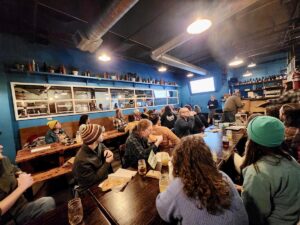
Happy New Year! January’s Green Drinks gathering brought together 40 community members at 3 Magnets all-ages pub downtown for an evening of connection, learning, and collective momentum.
A huge thank you to Bruce and Tony for stepping in with some emergency pizza that saved the day and kept the conversation (and energy) flowing.
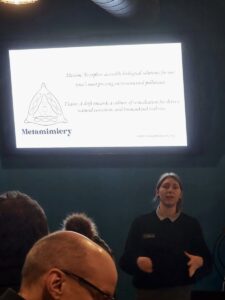
Featured Speaker: Mack Kleiva (MES ’25), Metamimicry
Mack presenting on bioremediation
Our featured presentation came from Mack Kleiva (Evergreen MES ’25) of Metamimicry, who shared the organization’s story, vision, and deeply inspiring work.
Mack walked us through Metamimicry’s history and current projects, highlighting hands-on, place-based restoration happening literally in people’s backyards, alongside expanded bicoastal efforts in Florida, including bioswale work that supports ecological resilience in the face of climate pressures.
The stories and examples underscored how powerful grassroots stewardship can be — and how those efforts scale when relationships and shared values are centered.
South Sound Salmon Enhancement Group is hiring an Accountant
🤝 Community Resiliency & Mutual Aid
Oly Whistles is hosting 3D printing parties to create anti-ICE whistles, printed with hotline numbers to call if someone witnesses ICE activity. These efforts support rapid response and community care. See this video for more info, or visit their central page!
🗣️ Call to Action: Chehalis Basin Developments
There are proposed developments in the Chehalis Basin with potentially significant budgetary and ecological impacts. Local government is actively seeking public input through both virtual and in-person sessions.
Community voices matter — this is a critical moment to engage.
📰 Local News
DERT (Deschutes Estuary Restoration Team) shared that key updates, events, and opportunities are coming soon. If you’re not already subscribed to their newsletter or following them on social media, now’s a great time to plug in and stay informed about important local restoration work underway.
Upcoming Community Events 🌿📅
There’s no shortage of opportunities to learn, connect, and get involved in the coming weeks. Here are several upcoming events shared with us — check out the flyers for full details:
Native Plant Watercolor Workshop January 8 | The Salmon Center, Belfair
A creative, nature-centered evening exploring native plants through watercolor.
Pier Peer at Boston Harbor Marina January 16 | 6:00–8:00 PM
Discover the fascinating creatures living beneath the pier with guided, light-supported exploration.
Eat Planet Friendly Thursday, January 15 | 6:30 PM
Learn how food choices that support human health can also reduce carbon footprints.
An Evening with Paul Koberstein: Canopy of Titans January 20 | Olympia Timberland Library
A timely discussion of forests, biomass energy, and impacts along the North American West Coast, combined with the monthly meeting of the Sierra Club’s South Sound Group. Held at the Olympia Timberland Library at 4:30 PM on January 20th Tuesday, January 20 4:30 – 6:00pm
Public Lecture: Gaming for Change January 21 | Evergreen State College
Exploring how tabletop games and simulations support climate justice, systems thinking, and education.
Thank you to everyone who joined us, shared announcements, and helped make this gathering such a vibrant start to the year. Green Drinks continues to thrive because of the curiosity, care, and commitment of this community — we can’t wait to see you at the next one!
Folks listening to the spotlight presentation
If you want to catch even more community announcements, opportunities, and events (or share your own for the next month) either join the South Sound ECO Net, or email them to ClimateAction@evergreen.edu!
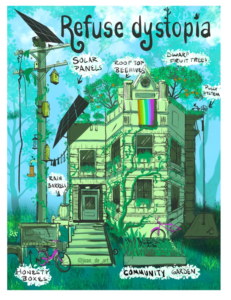
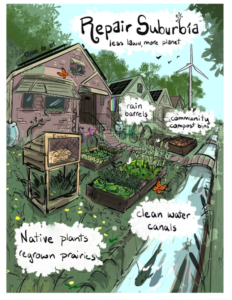
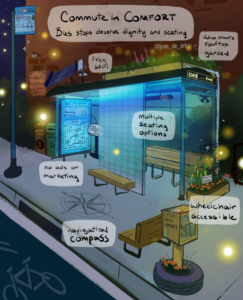
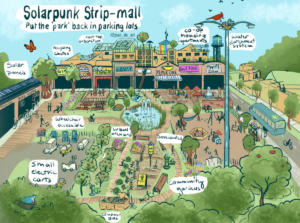
Solarpunk is a movement including stories, art, and real-world projects that ask a core question:
What if we actually solved the climate crisis — and built a more just, caring world while we did it?
Instead of dystopias or apocalyptic collapse, Solarpunk imagines hopeful futures where communities:
Transition away from fossil fuels to renewables
Repair relationships with land, water, and non-human kin
Build systems based on cooperation, mutual aid, and justice
Blend appropriate technology with local knowledge and culture
You’ll often see images of rooftop gardens, community microgrids, colorful dense neighborhoods, bikes and transit instead of highways, and public spaces full of life. That “aesthetic” is part of it, but Solarpunk is less about the look and more about the practice of building livable futures now.
Why Solarpunk Matters to the Center for Climate Action & Sustainability
At CCAS, we see Solarpunk as more than a genre. It’s a tool for education, and organizing, and inspiring action.
Climate work is often framed around what we don’t want: less carbon, less pollution, less harm. That’s essential—but it’s not enough. To move people from paralysis to action, we also need shared images of what we do want:
What does a just, decarbonized Evergreen campus look and feel like?
How does the South Puget Sound Ecoregion thrive in a changing climate?
What does everyday life look like when equity, care, and regeneration are the norm?
Solarpunk helps us:
Name and visualize those futures in concrete, local ways.
Connect head and heart—linking data and policy to stories, art, and place.
Lower the barrier to entry for climate conversations, especially for students who feel overwhelmed by doom.
Practice “prefigurative” work: trying out small-scale versions of the world we want—in our classrooms, clubs, gardens, events, and community partnerships.
In short: envisioning a just, equitable, brighter future isn’t a “bonus” to climate action. It’s central to how we choose strategies, build coalitions, and stay with the work for the long haul.
How We Use Solarpunk at CCAS
Across our programs and partnerships, Solarpunk shows up in different ways:
Curriculum & workshops – Integrating Solarpunk themes into classes, project design tools, and co-curricular workshops that help students imagine and prototype sustainable futures.
Student projects – Supporting projects that feel like pieces of a Solarpunk world: community gardens, repair and reuse initiatives, renewable energy education, mutual aid, and more.
Storytelling & events – Framing events (like talks, climate cafés, and game nights) not just around “what’s wrong,” but around “what can we build instead?”
Regional collaboration – Linking Evergreen’s work to a wider ecosystem of local organizations experimenting with resilient, regenerative practices.
If you’re interested in using Solarpunk as a lens for your project, course, or community partnership, CCAS is happy to brainstorm and support you.
Learn More: Solarpunk Video Playlists
To help students, staff, faculty, and community members explore Solarpunk at their own pace, we’ve curated three YouTube playlists:
Solarpunk 101: Intro to the Idea.Short, accessible videos that introduce the basic concepts, aesthetics, and values of Solarpunk. Great starting point if you’re new to the term.
Solarpunk 201: How Can We Use it? Talks, mini-documentaries, and case studies that show how people are putting Solarpunk principles into action—through community energy, urban design, art, mutual aid, and more.
Solarpunk 301: Extended Deep Dives.Longer lectures and essays for those who want to dig into political, social, and philosophical questions: justice, decolonization, economic systems, and the challenges of making hopeful futures real.
Get Involved
If Solarpunk sparks something for you, we’d love to connect:
Want to design a Solarpunk-inspired project or an Independent Learning Contract (ILC)?
Interested in incorporating Solarpunk themes or topics into your program or course?
Curious about collaborations between CCAS, student groups, and community organizations?
Contact us at ClimateAction@evergreen.edu to talk about how your ideas can plug into the broader work of climate justice, sustainability, and vibrant futures at Evergreen and beyond.
Two years ago, the director of Evergreen’s Office of Sustainability (OOS) left, and last year, the college confirmed the position will not be refilled. The OOS has been dissolved until further notice.
This office managed critical responsibilities, including:
Evergreen’s Greenhouse Gas emissions reporting (for state compliance)
AASHE STARS sustainability metrics
Zero waste and carbon reduction goals
Development of the Climate Action Plan (CAP) in 2007
Assisting with Sustainable Campus Infrastructure development (greenhouses, bike repair stands, waste audits/education, etc.)
With the office closed, there is no active climate/sustainability action plan on campus. However, a portion of the former OOS Director’s FTE will be generously supporting the CCAS as it continues to provide some overlapping services such as facilitating Evergreen’s off-campus contacts and communications. It will not be involved with infrastructure planning or projects.
Facilities/Operations has completed CCA building audits and a Decarbonization Plan for the Department of Commerce (supported by $600K in grants from the Department), entered into a Demand Response Agreement to reduce utility usage, and submitted EPA and Department of Ecology Greenhouse reports. It will also be monitoring updates to CETA and CBPS.
Facilities believes that including a section on Sustainability/Climate Action should be considered in the approaching updates to the Campus Infrastructure Master Plan, to support the recent college strategic plan. The administration’s hope is to have student engagement with all aspects of the college regarding sustainability.
For questions or concerns regarding the long-term continuation of the remaining OOS roles and the campus’ environmental stewardship goals, the best points of contact for campus operations/infrastructure sustainability would be the Facilities and Operations office and/or the President’s Office (President@evergreen.edu).
The Center for Climate Action and Sustainability (CCAS), housed in academics as a public service center, was asked by college leadership to focus primarily on off-campus partnerships and regional collaborations rather than internal operations. While CCAS will still offer classroom and student/faculty support, a majority of its projects and work will be in collaboration with off-campus state and non-profit entities, focusing on education development and ecological restoration work. This will also allow CCAS to expand its donor base and regional network.
In Spring, the CCAS Assistant Director submitted a grant proposal to fund MES Fellowship students revising and examining the outdated Climate Action Plan (CAP). The CCAS team explored options for an updated CAP, including renewable energy pathways, zero waste goals, and the potential for a Green Revolving Fund. However, both our internal assessment and administrative guidance make it clear that CCAS does not currently have the funding/staff capacity to take on the core duties of the former Sustainability Office.
Instead, as the OOS is not being reinstated, we are recommending that the college consider hiring an external consultant to lead the creation of a renewed climate or sustainability action plan, with CCAS available to support at a limited capacity.
Shifting Priorities – Less On-Campus, More Regional Work
Going forward, CCAS will emphasize:
Off-Campus Community & Regional Research Projects: Brand new partnerships on efforts like Capital Lake/Deschutes Estuary restoration, Chehalis Basin planning, Oly Ecosystems’ projects, Thurston County’s Climate Action Plan, and statewide energy infrastructure will be taking us off-campus and working with the high schools, county, and Cascadia bioregion at large.
Storytelling & Publicity: Amplifying Evergreen students’ and faculty’s sustainability projects and research, making the wider community aware of projects such as the MES thesis work, the new Mushroom Lab, and campus decarbonization efforts.
Education & Engagement: Continuing classroom visits; guest lectures; and creating useful resources, climate-focused curriculum, and professional development opportunities for students and faculty.
Graduate Fellowship Program: Continuing expansion from two to four fellows via matching endowment funding, supporting advanced research and project coordination for CCAS.
Internships: Transitioning from paid to for-credit internships for the time being, and expanding partner opportunities and coordination with the new Internship Office.
Campus project consultation efforts will also be put on the back burner, as the Public CoLab initiative (a physical and virtual hub space providing resources and assistance to students and the public with sustainability projects) was unfortunately not approved by our administration at this time. A future version may be developed when CCAS is able to find time for alternative ways to provide those services.
Sustainability Across Campuses
Clean Energy Committee Welcomes New Student Crew
This fall, the Clean Energy Committee (CEC) is excited to welcome a new cohort of student leaders dedicated to advancing sustainability and climate action on campus. Faculty and CCAS Director Dr. Anthony Levenda will continue to provide guidance, alongside Enija Reed, a second-year MES student with CCAS. As a result of last spring’s student vote to expand the green fee, CEC has increased funding to support educational programming and implement active solutions to reduce carbon emissions and promote climate resilience across Evergreen’s campus. This expansion empowers students to take a more active role in shaping Evergreen’s energy future through hands-on projects, outreach, and innovation.
Residential & Dining Sustainability
RAD Sustainability is launching fall outreach with new flyers and a feedback/suggestion form to engage students in sustainable living. While garden plots on lower campus are paused for seasonal bed rebuilding, students can access community plots at the Organic Farm. New beds near the Rec Pavilion are underway for the Edible Campus program, with expansion plans in motion, and CCAS will be helping convert the historic Aquaponics Greenhouse to a student-accessible greenhouse over the Fall Quarter, in time for winter gardening.
The Bike and the Bees
Evergreen’s sustainability efforts continue to buzz with student-led initiatives. Last year, students working with the Olympia Beekeeper’s Association received a grant from the City of Olympia’s Inspire program to fund up to five nucleus bee hives and supplies in partnership with Evergreen’s Sustainability in Prisons Project. While administrative staff ultimately decided the Organic Farm was unprepared to host the hives, three were successfully donated to the Freedom Farm, where students with Individual Learning Contracts (ILCs) tended to them throughout the summer. There is now a call to form a student club to support a long-term beekeeping program on campus. Interested students and faculty should reach out to faculty advocates:
Meanwhile, the Bikeshop Co-opis making strides toward a permanent campus home. Students collaborated with Facilities and received preliminary approval from the Space and Land Use Group (SLUG) to convert a staff/faculty lounge into a dedicated Bikeshop space, pending union agreement. To move forward, the Co-op will need to secure funding through proposals to the S&A Allocation Board and/or the Clean Energy Committee. For the space to be operational, Student Activities has requested an operations manual to address safety and staffing concerns—this was submitted at the start of summer and is currently under administrative review.
Tacoma Campus Food Security
At Evergreen’s Tacoma Campus, students, staff, and faculty are working closely with local partners and community leaders to address food insecurity through sustainable, place-based solutions. These efforts include expanding access to existing community gardens and offering educational programming to empower residents with the skills to grow their own food. Additionally, the campus is continuing to develop its Hydroponics Lab as a hands-on learning and production space, supporting innovative approaches to urban agriculture and food justice.
Looking Ahead – Formation of the CSC
While some of these transitions mean less direct support for on-campus sustainability projects, we’re working hard to build bridges between Evergreen and the broader community. A highlight will be Solarpunk Super Saturday this spring, a revival and reinvention of historic Evergreen traditions, blending campus and community in celebration of ecological imagination and action.
If you’re a student, faculty, or staff member interested in shaping Evergreen’s sustainability future, we invite you to join the reinstated Campus Sustainability Council. This space will serve as a collaborative forum in which we can share ideas, coordinate efforts, and build momentum for climate action on campus.
If you have questions, concerns, or stories of your own sustainability work to share, pleaseconnect with us at ClimateAction@evergreen.edu.
We know some of these changes may be difficult to hear, and we share that sense of challenge. At the same time, we see this as a chance to grow Evergreen’s leadership in climate action through partnerships that connect the college to Cascadia and beyond.
In response to the evolving landscape of sustainability work at Evergreen, we’re excited to announce the formation of the Campus Sustainability Council—a new collective space for students, staff, and faculty to coordinate, communicate, and collaborate on sustainability efforts across campus.
This initiative has emerged in part due to the indefinite dissolution of the Office of Sustainability and the proposed redirection of the Center for Climate Action and Sustainability (CCAS) toward more externally focused, off-campus public service work. The Council is designed to fill the gap by fostering a decentralized, inclusive, and action-oriented community for campus sustainability.
What Is the Sustainability Council?
The Council is both a virtual asynchronous space and a quarterly in-person roundtable, open to all members of the Evergreen community and the public.
A Microsoft Teams space will be established with dedicated channels for key topic areas such as:
Food & Agriculture
Transportation
Energy & Carbon
Zero-Waste
Biodiversity & Land Stewardship
Climate Justice & Education
Events & Outreach
These channels will enable users to upload documents, share updates, ask questions, and coordinate projects in real-time or asynchronously. The goal is to connect earlier, collaborate more effectively, and advance sustainability goals further.
A quarterly roundtable session will be held every Wednesday of Evaluation Week, providing a space to:
Reflect on the past quarter’s activities
Plan for the upcoming quarter
Identify areas for collaboration
Share resources and updates
These sessions will be open to the public, and we encourage community members, local partners, and alumni to join the conversation.
Who Can Participate?
Everyone. The Council is not run by any single office or department—it is a shared space for all who care about sustainability at Evergreen. Whether you’re working on a class project, managing a campus initiative, or just curious about how to get involved, you’re welcome.
What’s Next?
More information will be released as final details are completed, including how to join the Teams space and participate in the first roundtable. In the meantime, questions, ideas, and expressions of interest can be directed to:
📧 ClimateAction@evergreen.edu
Let’s build a more connected, resilient, and sustainable Evergreen—together.
Thanks to everyone who joined us at Green Drinks this month! Here’s a round-up of the amazing community projects, events, and opportunities that were shared. Dive in and get involved! 👇
🌱 Community Events & Projects
Permaculture Rising – Melissa shared a bounty of happenings—nursery sales, food preservation workshops, and deep dives into food forests and permaculture!
Surfrider Foundation – Lynn announced a Cigarette Butt Pickup happening Monday the 15th, starting at City Hall. They’re also celebrating a great cleanup collaboration with Thurston Econet!
Capital Land Trust – Will shared an upcoming event, an Afternoon of Reflection at Inspiring Kids Preserve, on Tuesday, Sept 23 from 4:30–6:30 PM . They’re also teaming up with the Puget Sound Estuarium in November (on the 8th, 9th & 11th) for a Salmon Experience at Bayshore Preserve.
Puget Sound Estuarium – Clarissa shared lots of exciting events. Everything from Underwater Drone adventures (Pier Peer) at Boston Harbor Marina, to their upcoming Speaker Series. And a fun fundraiser with bands and a drag show 🎶👑
Fix-It Fair – Nov 5 – Rob, from Thurston Solid Waste, announced the 3rd annual Fix-It Fair at Lacey Makerspace! Bring broken items, sign up to volunteer, or just come check it out. 🔧 Past fixes even included a 3D printed toaster knob replacement!
TCAT Celebration – Sept 20 Mason, from Olympia Community Solar, shared that the Thurston Climate Action Team (TCAT) is hosting a celebration/fundraiser on Saturday the 20th.
Thurston Econet Mixer & Speaker Series – Phoebe shared that Econet’s monthly gathering will be supplemented by a Thursday after-hours social at Vic’s Pizzeria this month, giving eco-educators another opportunity to get together! They’re also launching a speaker series — reach out if you have topics or presenters in mind! Be sure to join their email listserv to share your events!
🪵 Tumwater Urban Wood Reuse – Brian (through Michael) shared that the City of Tumwater is exploring a wood reuse program to repurpose trees into woodshop and community materials instead of landfilling them.
📣 Environmental Action & Elections – Ronda suggested the Enviro-Talk ListServ for those interested in local environmental conversations and knowledge sharing (especially among retirees with expertise!).
🗳 She also reminded us to review local candidates and keep up the pushback on the Olympia Airport Expansion.
🌟 Evergreen Orientation Mixer – Oct 22 – Looking to connect with students? Evergreen is hosting a mixer with nonprofits and organizations on Oct 22 from 7–9 PM, with refreshments.
🌞 Solarpunk Saturday Returns (Spring 2026!) – Evergreen’s beloved “Super Saturday” will return with a new twist—Solarpunk Saturday: a day of workshops, music, storytelling, and maybe even a play about the future.
📬 Want your org or event featured next month? Let us know at next month’s gathering!
💬 And don’t forget to follow and support these amazing local efforts!
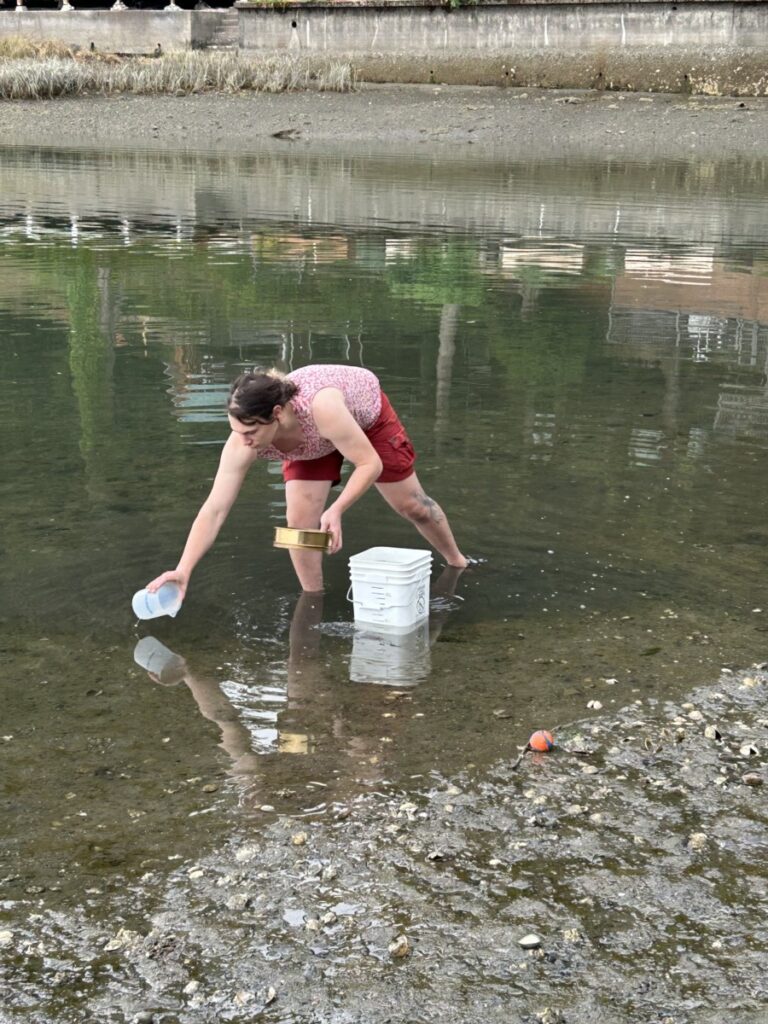
This week marked the beginning of a seven-year ecological journey at Evergreen State College’s Geoduck Beach, where the CCAS team (myself, Ian, and Emma) embarked on the first round of data collection following the removal of a concrete armored bulkhead. The goal: to understand how the shoreline evolves and recovers over time.
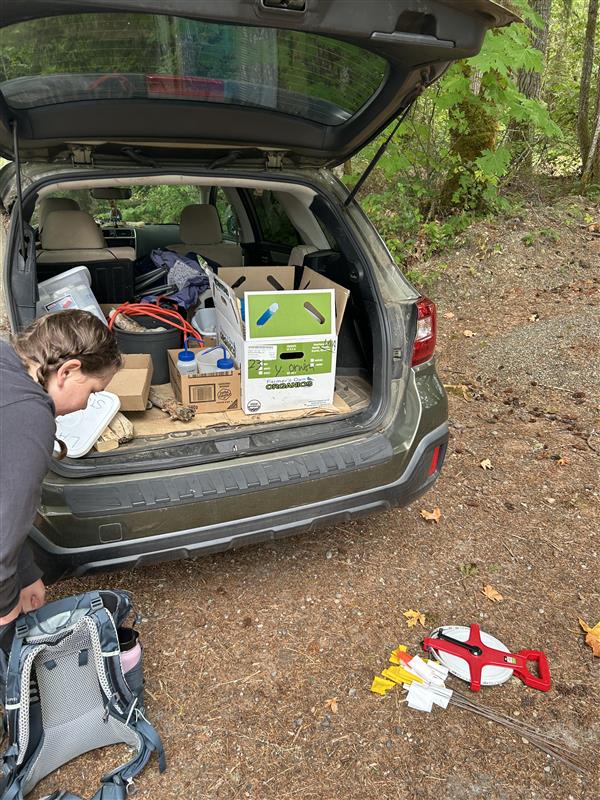
We met at the gate around 11 AM, grateful for a break in the heat wave. The weather was unusually cooperative: cool, overcast, and only flirting with drizzle. As we unloaded gear and stretched out the morning stiffness, Ian had already flagged the sampling zones and packed the supplies in their trunk. After a brief pause for birdwatching (a necessary ritual), we got to work.
🪤 Pitfall Traps: The Bug Hunt Begins
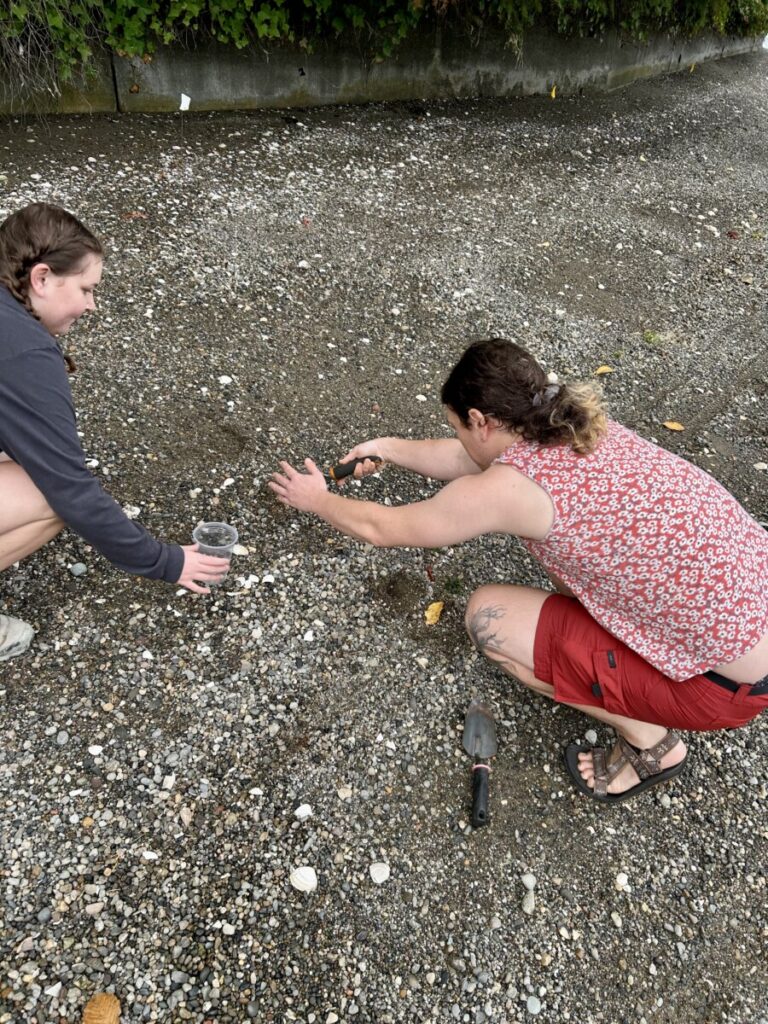
Our first task was installing pitfall traps. Simple plastic cups dug into the wrackline to catch crawling insects. Ian explained the importance of placing the cups flush with the soil to avoid disturbing the terrain and to ensure bugs would naturally fall in. We added water and a few drops of soap to break surface tension, a trick that helps trap insects effectively.
Emma and Ian had immediate success—within minutes, their traps had caught a few bugs (mine, I noted, remained stubbornly empty till the very end). Still, it was exciting to see the method in action and understand how even small changes in placement or terrain can affect results.
Pictured (left to right) Emma Hamaker-Teals and Ian Mann setting up pitfall traps
🧱 Wrackline as a Living Border
As we moved between flagged zones, Ian shared an observation that stuck with me: the wrackline is more than just a line of debris. It’s a living intersection where the contents of the sea meet the land. It’s a place of exchange, accumulation, and transformation. That insight gave our work a deeper sense of purpose.
🧪Sediment Samples & Fallout Traps
Next, we collected sediment samples using core tubes, digging into the wrackline and placing the samples into labeled tubs. It was more physically demanding than expected—digging, bending, and hauling—but many hands made the work light.
We also set up fallout traps on the bluff, placing bins to catch airborne debris over 24 hours. Emma reminded us to label everything clearly with laminated cards to prevent curious passersby from disturbing the setup. Poison ivy was a concern, so gloves and long sleeves were a must.
Ian collecting sediment samples to be filtered and analyzed
🌲 Log Analysis & Wrackline Survey
We wrapped up with log analysis, measuring woody debris and noting characteristics like moss, barnacles, and dimensions. The wrackline survey followed, using the Survey123 app to document debris types and density.
Throughout the day, we discovered small ways to improve future sessions (bringing a pop-up table, a large tote box for supplies, and even a speaker for morale and fun). We talked about comfort items like snacks, hand sanitizer, and kneepads, and how these small additions could make a big difference.
Emma retrieving gear for the day!
🌞 Looking Ahead: A Solarpunk Tradition?
As we packed up, I found myself imagining what this could become. A summer tradition rooted in Solarpunk values—blending community science, ecological restoration, and joyful collaboration. Emma and I brainstormed ways to involve younger students, especially K–5, in meaningful and age-appropriate ways. We envisioned future sessions with volunteers from the Puget Sound Estuarium, South Sound’s GREEN Tean, TRIO Upward Bound College-ready program, or even just curious locals, followed by shared food and connection.
This first day was more than just data collection. It was a beginning. A moment of learning, reflection, and dreaming.
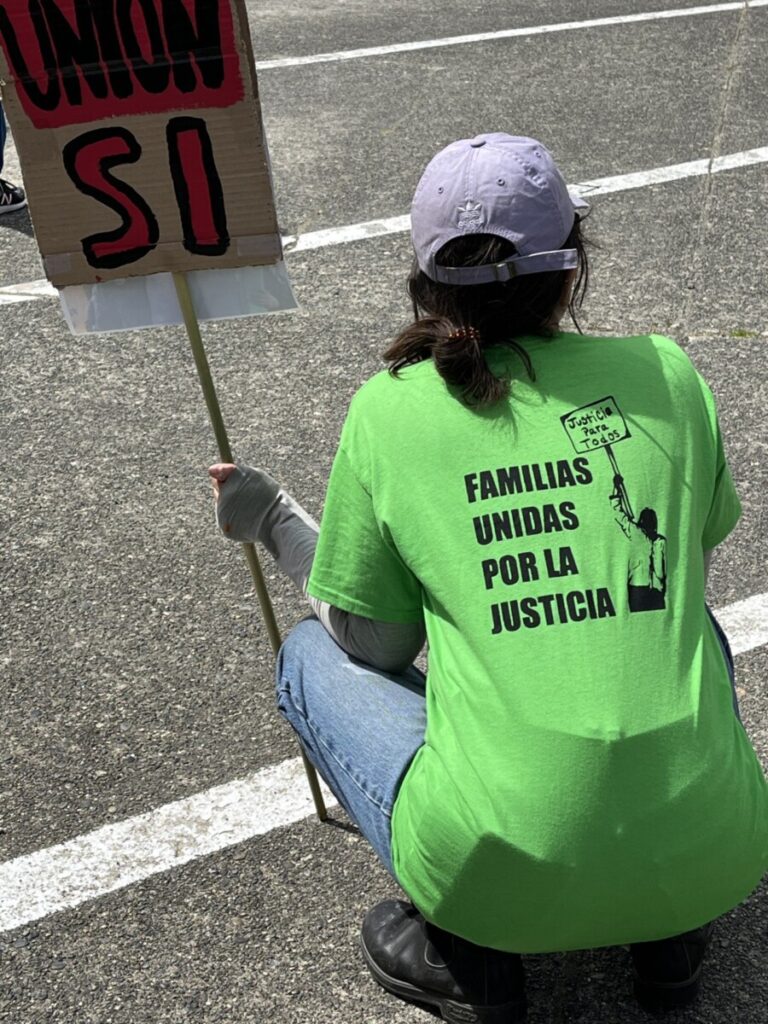
Photo taken during a protest advocating the enforcement of human and labor rights sanctions – Farmworkers Justice Day 2025
Welcome – from the Center!
This spring and summer, the Climate Center was buzzing with activity! From hosting events, collaborating with partners, to sparking conversations about climate action, justice, and creativity. From games and roundtables to symposiums and community gatherings, our focus has been on connection: connecting people to ideas, to one another, and to practical ways we can work toward a more sustainable future.
🌱 Event Highlights 🌱
Climate Games Day – April 9
In partnership with Evergreen’s International Study Abroad program, we hosted a lighthearted afternoon of snacks, games, and big ideas. Participants tackled resource-trading games and strategic challenges that sparked creative solutions to climate adversity.
Earth Week – April 22–24
Three days of celebrations, learning, and action:
• Earth (Field) Day – April 22 An outdoor celebration of our local environment, student projects, and ways to engage in campus sustainability.
• Rachel Carson Forum – April 24 Hosted by MESA, this year’s Forum honored the 40th anniversary of the Master of Environmental Studies (MES) program. Guest speakers Dr. Rob Knapp, Dr. Francisco Santiago-Avila, and Dr. Adam Romero explored themes of sustainable design, transforming our relationship to wildlife, and reimagining U.S. agriculture.
• Farmworkers Social Justice Day – April 23 Honoring José Gómez, we highlighted the fight for farmworker justice, food sovereignty, and solidarity with those who grow our food.
Equity Symposium – Climate Lecture Series Special
Faculty member Sam Saltiel led an interactive workshop exploring Solarpunk and tabletop role-playing games (TTRPGs) as tools for creativity, climate action, and personal empowerment. Participants reflected on their strengths and imagined practical steps toward a greener future.
Sustainability Roundtable – May 12
A collaborative design charrette on reimagining Evergreen’s communal bike shop. Together, we discussed why this space is vital for sustainability, accessibility, and student health—and what’s needed to bring “Bike Shop 2.0” to life.
Climate & Sustainability Symposium – May 17
Co-hosted with Thurston Climate Action Team (TCAT), this convention brought together climate and sustainability representatives from across Thurston County. The day was filled with workshops, networking, and collaborative visioning for regional action.
Climate Lecture Series: Empowering the Energy Workforce
Nikki Luke explored how energy governance impacts workers and communities, with a focus on justice in the U.S. South. She highlighted how race, gender, class, and ability intersect with energy policy—and where opportunities for change lie.
🌞 Summer Highlights 🌞
Critical Edge Alliance Conference
This June, Evergreen hosted the international Critical Edge Alliance conference, bringing together educators and innovators from around the globe. CCAS presented on what teams and institutions can do in the face of climate change and federal opposition—sharing practical strategies for resilience, collaboration, and action.
Building Networks & Partnerships
• Thurston Eco Net + Cascadia NOW! – We connected our local community of environmental educators and outreach staff with our Cascadia NOW! partners, establishing a fiscal sponsorship to support ongoing collaboration.
• Olympia Green Drinks – We continued co-hosting monthly gatherings for people in green careers and interests to meet, share resources, and strengthen our local sustainability community.
• WOHESC Statewide Calls – We kept convening sustainability leads from Washington colleges and universities to exchange tips, share projects, and learn from one another’s successes.
Grants & Student Fellowships
We secured a $20,000 grant to fund MES Fellowship students working on Evergreen’s new Sustainability Action Plan 2.0 and ecological restoration projects across campus.
Summer Institute: Teaching Social Action
In partnership with the Washington Learning and Teaching Center, we hosted a two-day Summer Institute focused on Teaching Social Action—exploring pedagogy. And the theme of Solarpunk with sustainable planning for classroom praxis. Faculty and staff engaged in hands-on design sessions and shared approaches to building climate literacy and agency in their students.
Looking Ahead
We’ll wrap up the summer at the Burien Solarpunk Festival, connecting with Indigenous Futurists partners and other visionaries shaping regenerative futures.
This summer, our work has been about momentum—releasing a wave of new projects, resources, and case studies for classes, community partners, and anyone ready to act for a sustainable future.
📚 Projects & Partnerships
• MES Fellows & Faculty Collaborations – Our fellows continued work on climate planning, ecological restoration, and community engagement projects.
• Community Engagement – We tabled at the Tumwater Elevate Fair, showcasing climate-and-art intersections and our new trivia game Fact or (Science) Fiction, highlighting BIPOC and femmes in STEM.
🎥 In Case You Missed It
• Videos, blog posts, and zines from our events will be shared on our website and social media this fall—stay tuned!
📅 Upcoming
Mark your calendars for fall events, including the continuation of our Climate Lecture Series and sustainability skill-building workshops.
Get Involved
Volunteer, partner with us, or join an event. Follow us to stay updated: