Winter Quarter 2016 Event:
José Gómez Farmworker Justice Day
-West Coast Farmworker Movements
Panel Presenters:
In addition to the presentations and group discussions, |
|
| World Café style discussion after the panel presentation facilitated meaningful discussion among event attendees. Questions included:
The World Café Discussion method provided an effective framework for stimulating and interactive conversation focused on collaborative dialogue about the challenging issues of the injustices faced by farmworkers and the food system. |
|
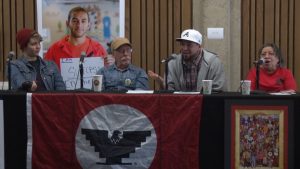 |
|
| Ramon Torres: “Our children deserve a different future. We need more indigenous students going to college, becoming doctors and lawyers. Why not, if Obama became president, why not an indigenous president?”
|
Rosalinda Guillen: “Today I won’t be inspiring or hopeful. I bring a mixed message. It’s getting late, we haven’t listened. We need to organize in a way to change the whole food system.” |
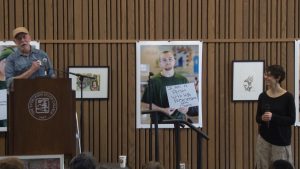 |
David Bacon, telling the story of a woman leaving her father in Mexico. “When she left, her father said, ‘when you leave, you’ll never return.’ And the woman, now in the US, said ‘Right, I don’t call him. I can’t go back, I don’t have the money. It would be too painful to call him’.” |
| “This year’s Farmworker Justice Day highlighted the potential of unity surrounding a key interest and a necessary dialogue. Overall, I was proud to see many new faces glowing with a yearning to learn – to rethink. I was pleased to hear David Bacon’s insight on Filipino history and Mexican labor movements. However, I really enjoyed Rosalinda’s perception on community engagement and Ramon’s view of action. These are all instrumental ingredients to create a democracy, but it takes a stirring of unity to produce justice. I thought the day was informative and painted a picture few get to see and even less experience, but it came down to relationships.”-Evergreen Student | 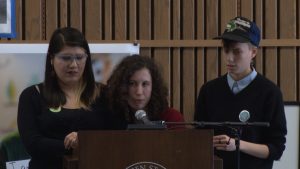 |
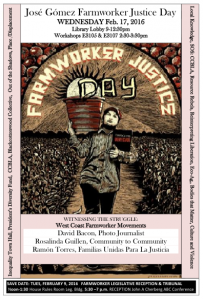
Direct Action Event-Students Protest Farmworkers’ Unfair Wages and Working Conditions |
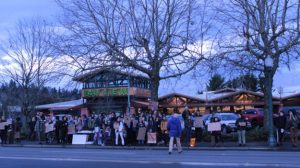 photo courtesy of Cooper Point Journal, click here for full article |
Resources:
- David Bacon, Event Presentation
- Community to Community Development, Rosalinda Guillen
- Familias Unidas por la Justicia, Boycott Sakuma Berries
- José Gómez
- Center for Community-Based Learning and Action, Newsletter featuring event
- Olympia Farmworker Justice Collective
Impact and Effect:
“The Jose Gomez Farmworker Justice Day was a powerful and important event. Evergreen’s Mission Statement boasts a commitment to social and environmental justice, and hosting this annual Farmworker Justice Day is critical in supporting students in upholding this mission. Rosalinda Guillen and Ramon Torres, two of the the speakers at the event, led an informative and moving panel on the lives, unjust treatment, and organizing of migrant farmworkers in the US. Afterwards, they offered workshops on boycotting as a political strategy as well as creating signs for the Familias Unidas Driscoll Berry picket that was to be happening later that afternoon. I came away from this day impressed at how Evergreen supports this building of solidarity between students and migrant farm workers. The issues these workers are organizing around are relevant to students who are studying food systems and sustainable agriculture – but really anyone who eats food. Evergreen students are learning the tools and building the relationships that are necessary to be part of creating a more just and livable world for everyone.” -Evergreen Student
The event strengthened and deepened our teaching/curriculum/community by offering very significant information on a largely disregarded and forgotten part of the workforce – communities that are marginalized, targeted or made invisible. The intersection of food systems, workforce, ethics/justice regarding migrating or new communities, the growing tension over “borders” and “the other” are all essential elements in the discussion of conditions facing farmworkers here in the region, the west coast broadly and beyond. The event connects well with our interdisciplinary work , linking issues/themes/areas of food production, labor, public health, social justice and cross-national movements. This year’s event paid particular attention to the challenge of just, effective and respectful documentation of communities and their struggles. This helped engage and connect those interested in the issues (food, justice, labor) and those compelled by the challenges of representation (documentary, media, story, research).
Sponsors:
- President’s Diversity Fund
- Center for Community-Based Learning and Action
- Evergreen Fund for Innovation
- The Black Cottonwood Collective
- Deans’ Match
Participating Programs:
Faculty: |
Programs: |
|
| Martha Rosemeyer, Thomas Johnson and Carolyn Prouty | Ecological Agriculture: Healthy Soil, Healthy People | |
| Karen Gaul and Zoltan Grossman | Resource Rebels: Environmental Justice Movements Building Hope | |
| Eric Stein and Steven Flusty | Place and Displacement | |
| Carolyn Prouty, Laura Citrin and Rita Pougiales | Bodies that Matter | |
| Elizabeth Williamson and Frances V. Rains | Out of the Shadows: Women of Color in the Era of Civil Rights | |
| Steven Niva and Catalina Ocampo | Culture and Violence | |
| Lin Nelson | Student Originated Study: Working in Community | |
| Anne Fischel, Michi Thacker and Grace Huerta | Local Knowledge: Building Just and Sustainable Communities | |
| Alice Nelson, Savvina Chowdhury and Therese Saliba | Reinterpreting Liberation: Third World Movements and Migrations | |
| TESC Student Group | Olympia Farmworker Justice Collective | |
| Sarah Williams, Steven Scheuerell and Abir Biswas | Terroir: Chocolate, Oysters and other place-flavored foods |