Chapter 8: Composing a Soprano Voice and Harmonizing a Bass
This chapter doesn’t actually have a list of terms exercise at the end… It instead asks that I memorize certain procedures/tools for composing which I think would be tedious and unhelpful for me to try to replicate here.
Chapter 9: Modulatory Progression
Modulation: An extension beyond the harmonic unit controlled by the tonic triad. Forte argues that it should be “regarded as ordered harmonic extension, not as ‘change of key for the sake of variety,’ as some authors would have us believe” (275). The two types of modulation are diatonic and chromatic.
Quasi-Tonic: A triad which begins to function like a tonic.
Modulating Dominant: The dominant of the quasi-tonic. It serves to establish the quasi-tonic as the harmonic goal.
Pivot Chord: Acts as a transition between the tonic and the quasi-tonic. This triad, which is a part of the original harmonic unit, always acts as a dominant preparation for the modulating dominant.
Natural Modulation: A modulation in which the switch between keys requires little or no chromatic alterations. The only completely natural modulation is between relative keys.
Returning Progression: The harmonic journey back to the original key. The progression should effectively direct itself towards the V of the main tonality, or toward dominant preparation as the I or original tonic will follow naturally.
Modulating Sequence: The use of a sequence to rapidly change the tonal focus. The usage of a pivot chord and modulating dominant are maintained, but they are embedded in the sequence.
Modulatory Series: A succession of modulations.
Interlocking Modulations: Occurs when a modulatory phrase ends on the modulating dominant and the quasi-tonic which follows at the beginning of the next phrase is also a pivot chord in a new modulation.
Incomplete Modulation: A progression which implies a modulation, moving to the modulating dominant, before returning instead to the original tonic.
I have transcribed the music and film from the insane looking code language that I presented the last time that I posted scans. Its more or less done at this point. There are a few strange glitches that arose during the process but its nothing that can’t be worked around. For example, the piece contains all of the pitches that occur in two octaves of the chromatic scale (the center line of the staff is a B) except for the high F which is skipped in the notation. This makes it so that instead of skipping a sharp and going directly to the next line up from E to F, a sharp appears on the same line as the E that represents an #F (confusing I know but now there isn’t enough time to adjust it and technically its functional). This glitch makes it so that there is only one (low) F and three C’s. At first I thought of this as a fatal flaw in the piece and I actually almost burned all of my work during a nervous breakdown. I’m really glad that I didn’t do that and I’ve realized that what I perceived as an idiotic mistake is actually a fateful element of chance within a piece that embraces chance, difference, and even idiotic mistakes. I just hope that whoever sings this will be able to work around it (and if they can’t [or if they’re simply unavailable {which is seeming more and more likely}] than I will use this as a chance to brush up on my saxophone). Honestly, this whole experience has been the most challenging project I have ever attempted. I’ve felt an intense lack of confidence and an unprecedented level of insecurity throughout the entire process. I still doubt that this piece will come to fruition by the end of the quarter, I’ve built my self a mountain too large to climb and yet I haven’t stopped trudging on. I have learned more lessons from this project than any other endeavour in my educational career but there is one that stands out above all; now that I’m at the finish line, about to graduate, looking back at everything I’ve done and ahead to my uncertain future, I am struck with the terrifying realization that, though I’ve come so far and learned so much, I know nothing. Maybe this is just the artists burden. I just don’t know if its a burden that I can carry for the rest of my life.
Now that I’ve gotten that out of my system I’ll do my best to describe my progress with the music and the video.
The first thing that I did was an unintentional trial run at transcribing the organization charts onto the grand staff.
I say “unintentional” because I expected it to be the final iteration of the piece but after completing the first two of four sections I had some new ideas that I wanted to work in. I wanted to make a more complex organization of the volume and rhythm dynamics within the individual cells so I created what I called “sub cell organization charts”
So then I started transcribing again with the new added complexities and made it to the end before realizing that I had left the high #f.
After I finished with the music I moved onto organizing the film. I explained much of how this was all organized in my last post “Oversized Update” but I will post the scans of the charts here.
These are some pre organization planning charts that I made
And these are the actual organization charts
After finishing the charts I transposed them into shot lists but I didn’t have the chance to scan those. I still have half of the shot list left to shoot and its quite a bit. I’m thinking that I will probably
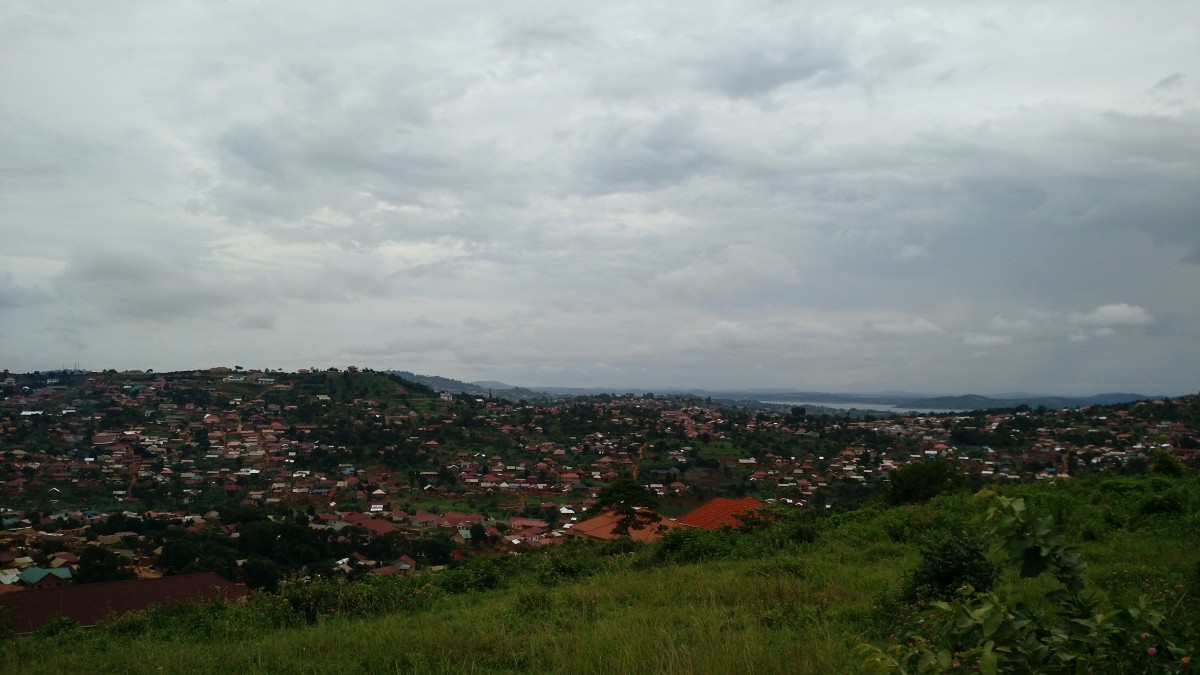
Suburbs of Kampala near the International School of Uganda
This week I continued my work at the International School of Uganda (ISU). Surprisingly enough I was able to teach a lesson on ‘The Grid’ to the Grade 9 class I am helping with! We also did a listening activity and listened to ‘It’s Gonna Rain’ by Steve Reich, ‘Kanon Pokajanen’ by Arvo Pärt and ‘Itz Not Rite’ by DJ Rashad.
On Thursday, I got to see the International Schools Music Festival which took place at ISU. In the morning, the junior school (elementary school) students from 9 international schools from the Kampala area, went to different music workshops. In the afternoon, all the different schools gathered together for a the performances. The performance began with a song by a Ugandan a cappella group called Sauti ya Afrika. After Sauti ya Afrika’s introduction, each international school performed a piece that they had prepared for the festival.
After the individual performances, the students from all of the schools collectively performed ‘Street Songs’ by Carl Orff. This was the result of the workshops they had participated in during the morning sessions. The ensemble included choir, recorders, xylophones and traditional drums.
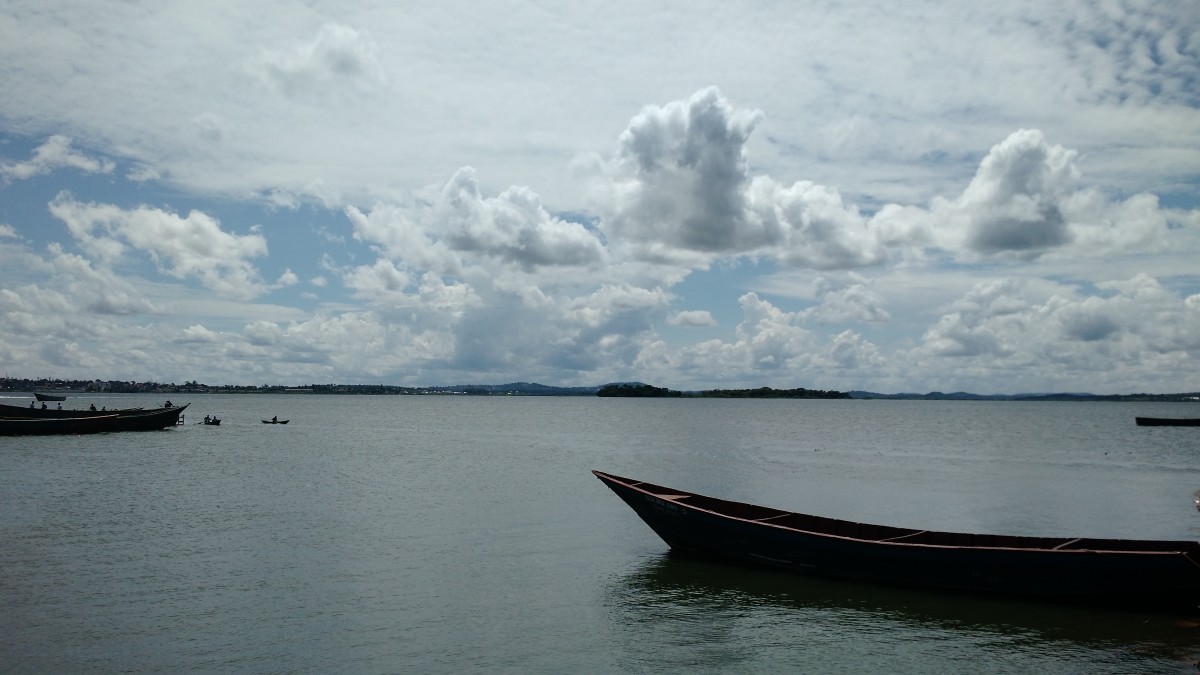
Lake Victoria from Ggaba Market
I started off Saturday by taking a matatu from Kololo (where I am staying) into downtown Kampala. I spent some time just walking around and observing the city. While Kololo is still part of the city, it is a slightly more residential area. The downtown area however is a slightly overwhelming environment. While walking around I encountered the sights, sounds and smells of heavy traffic amidst tightly packed buildings seemingly filled to the brim with shops.
After walking around for a while and grabbing a bite to eat, I made my way over to the Old Taxi Park to find a matatu that could take me to Kansanga, where I was heading to see a concert in the evening. The book I have been reading this week, Abyssinian Chronicles by Moses Isegawa, describes the taxi park and its relation to Kampala in the following two passages:
“The seething, kidney shaped bowl functioning as the taxi park had originally been a volcanic hill. During the last active phase two things happened: the hill shattered, creating this valley and the surrounding valleys were transformed into the seven round-topped hills at the core of the city of Kampala” (Isegawa 83).
“The volcanic fire dormant below and the solar fire blazing from above, the relentless surge of vehicles and all the souls on parade here, turned this vessel of cobwebbed fantasies, this cocoon of termite ridden ambitions, this lapper of blood and chewer of flesh, into the most fascinating spot in the whole city” (Isegawa 84).
These two passages are set during the early period of Idi Amin’s dictatorship in the early to mid 1970s. While things have changed significantly since then, the image of a “relentless surge of vehicles” still rings true. Unfortunately upon arriving, I found out that the Old Taxi Park doesn’t have matatus that go toward Kansanga. One of the difficult things about transportation in Kampala is that there isn’t a method of public transit that is easy to navigate. I was eventually able to make my way over to Usafi Market where the matatus towards Kansanga depart from.
Once in Kansanga I went to the International University of East Africa for a dance performance titled ‘Come Together.’ This was a collaboration between the Makerere University Department of Performing Arts and the Norwegian College of Dance. One of the most interesting aspects of this performance was that it was primarily composed of Beatles songs. The majority of which were covers. Most of the songs were played from recordings but a few were live covers by Ugandan musicians from Makerere University. These live covers were my favorite parts of the performance and featured a guitarist, a traditional drummer, a cajón player, a vocalist and two dancers. The rest of the dances combined contemporary and modern dance with some traditional Ugandan elements.
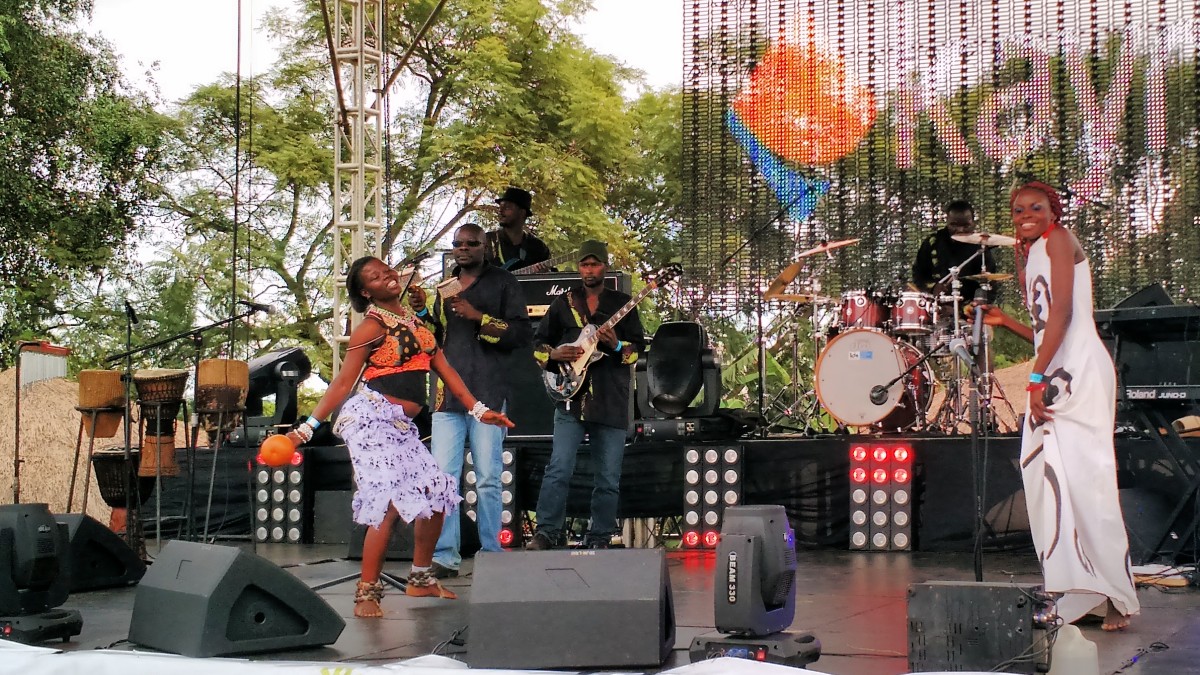
Suzan Kerunen at Blankets and Wine
On Sunday, I went to a festival in Kampala called Blankets & Wine at the grounds of the Uganda Museum. The first artist to play was Suzan Kerunen. She is from the Alur tribe in the West Nile area in the north of Uganda. Most of her lyrics were in Alur with a little bit of English here and there. The band incorporated Ugandan instruments such as the adungu (type of harp), endingidi (single string fiddle) and drums alongside guitar, bass, keyboard and a drum kit. Here is a video of her performing one of her songs a few years ago:
The next band to perform was called Janzi Band. They used similar instrumentation but sang primarily in Luganda and English and incorporated a bit Kiswahili. They had a definite reggae influence and played covers of several reggae songs in addition to their original material. Eric Wainaina followed their performance. He is a musician from Kenya who has gained a lot of popularity throughout East Africa. He sang primarily in English and Kiswahili. The final performance was by a Ugandan duo named Radio & Weasel. They aligned more with my view of typical Ugandan pop music and I could hear a dancehall influence in their songs. Their lyrics were predominantly in Luganda and English.
This combination of varied instrumentation and languages is definitely one of the characteristics of the music of Kampala that has stood out to me the most. As I continue my journey, I will attempt to further explore these diverse elements.
My journey has come to an end. After two days of driving, I have finally made it back to Olympia. What a journey it has been. It was extremely surreal driving back to Olympia. As I began driving on the highway, the urban sprawl almost immediately dissipated into rolling green hills and snow-capped mountains in the distance. As I ventured on, the landscape became more familiar and temperate. The desert was gone, and I was once again surrounded by forests and mountains. What a big difference just a day of driving can do to the scenery.
There was something really comforting about it. I started to notice how living in Los Angeles was effecting me and my habits. I noticed while in Oregon how impatient my driving had become. In California, 15 miles over the speed limit is standard. I felt like I was constantly in a rush. I quickly realized that this attitude towards driving was unhealthy and stressful, and I began to acclimate to my old habits. Los Angeles is built on stress; every time I left my house it was impossible not to see people getting road rage. While the projection of the culture of Southern California through media in my life has typically been relaxation and sunshine,
As I get more involved with developing the world, I more frequently have to stop writing to flesh out some aspect of a civilization, character, or concept that I’ve neglected. To help myself out a bit with this, I’ve composed a list of many of the important things that I believe should be covered if one attempts to create this type of world world from scratch. I have a few different categories. The ones I’ve posted here so far pertain to history as well as how magic should be handled. They are works in progress and I am adding new bullet points from time to time:
World History
How long have people been in the area? Did they evolve here, or migrate from somewhere else?
How far back do recorded histories go? Whether written annals, stone carvings or stories told by griots and skalds, it’s important to know the full scope of humanity’s knowledge of its own history.
Where did civilization begin and spread? Near fertile lands and bodies of freshwater, with access to shelter, obviously.
What do people believe? This is more subjective to an individual region’s history, but must always be considered.
How many languages are spoken and how are they related? Where did different languages develop and where did they intermingle to form new dialects? Perhaps there is a trade language commonly spoken among merchants of many civilizations.
Which peoples or countries have traditionally fought each other, traded goods, made alliance, or been rivals? And where are there still hard feelings? Old offenses may be left to fester over decades; it is important to have at least a general idea of various factions’ feelings towards one another.
Which peoples have been involved in conflict in the RECENT past? When, why, and how was the most recent conflict conducted? Who won and under what circumstances?
Which peoples are the most advanced? This could include academically, militarily, philosophically, technologically, or magically (although there is overall very little magic left in my world, making this less of a consideration in this case).
How does the calendar work? How do people tell time? It probably wouldn’t be the same across the board, even with a widely used system (such as the Gregorian calendar), there would still be other methods used.
Specific Country’s Histories
Why did people settle where they did? Similar question to the larger-scale one above.
How accessible is the area? This directly affects trade, as well as the frequency of visitors from other areas, which in turn would dictate how quickly people in the area would hear news from throughout the realm, as well as possibly making them less of a target from neighboring kingdoms.
Weapons technology? The weapons, armor, and fighting style of a faction or country can be crucial to their overall aesthetic. Does the kingdom employ rank-and-file conscripts, heavily armored knights, or elite archers? Maybe they come from a plains region, and they fight from horseback better than those who come from forested areas?
Who are their rivals and foes? As stated before, old cuts run deep. Maybe two lords allying their power would be practical or convenient from a narrative point of view, but if enmity exists between them then perhaps one lord’s bitterness would overrule his or her otherwise pragmatic nature.
Who are the heroes and villains of each country’s history? Why and what does this say about them?
What is the population of the kingdom?
How diverse is the country? Countries with territory on the border of culturally different regions will no doubt have some intermingling. To what extent has this happened?
What are the primary imports and exports? This will say a lot about the lifestyle or values a commoner might have; for example if a country’s main export is rice, then the villages in that area may have a stronger sense of community, due to the necessity of having large rice fields which need to be worked by many people. Compare this to areas where wheat is the dominant crop, which is easy to be grown and tended by one small family. They may have a more individualistic point of view.
What are the recent wars or conflicts? Who won? Same idea as the above section, but on a more micro level.
What does the terrain and landscape look like? What is the placement of farmland and water resources? I try to paint a picture for myself. What kind of climate does the region have? Temperate? Tropical? Are there more deciduous or coniferous trees? What kind of soil and bedrock do people stand on? Those in wet, marshy lowlands will have difficulty laying down foundation for building, while those living in heaths with have problems planting crops in the acidic soil.
What kinds of flora and fauna live in the area?
How do the citizens make their living? Be it as a farmer, crafter, soldier, or clergy, the common folk need to sustain themselves. What are the most common and acceptable ways to do so?
Magick
What can magic NOT do? This to me is a fundamental point. What are magic’s limitations, and how do practitioners try to get around them? There must be rules to any magic system, otherwise magic fails to be viable as a narrative tool, and either seems too contrived or functions only as a deux ex machina. (The reader does not necessarily need to know what these rules are, however!)
What is the price of using magic? Again, does anyone try to get around it? There must be a price of magic, unattainable or not understood by the common folk.
Is there a difference between miracles and magic? Many fantasy works distinguish the two as separate. Do the gods have an active role in the world or are “miracles” really just coincidences falsely attributed to divine intervention?
Where does magic come from? It could be bestowed by the gods, be channeled from a resource such as mana, or simply come from the personal willpower of the user.
Are there long-term effects of using magic? They could be either positive or negative, but negative makes more sense to me.Maybe magic is addictive and/or causes insanity? I sure hope so, because overpowered mages who have all their shit together and can spontaneously conjure up fireballs or teleport sure are boring to me, and you won’t find them in my world.
Is magic a renewable resource? Or exhaustible? If it is exhaustible, that could be a reason for a low-magic setting, where only certain remote areas still have untapped magical power.
How are spells cast? Can they be stored or saved for later? Perhaps a lengthy incantation or ritual is needed before a spell can be cast, or maybe magic energy can be stored inside an object like a staff or gemstone for later use.
How much is known about the laws of nature, physics, and magic? Are there some early “ologists” or researchers who study these things? When it comes to dealing with magic, I personally prefer it when little is known and less is understood. It should be something mysterious and feared.
What varieties of magic are there? What can actually be done with magic? Whether true magic, religious or occultist rituals, or just parlor tricks, misdirection and sleight of hand, what magical or supernatural practices exist or have existed in the world? These can be herbal, ritual, or alchemical practices, or things like pyromancy, necromancy, or elemental magic.
Do people get stronger or weaker with magic with age?
Can the ability to use magic be lost or taken away?
How do non-magicians view magic? For that matter, how do the people who use magic view it/themselves?
How long do magical practices take to learn?
Are wizards organized? Is there some form of hierarchy?
Are magic and science compatible? How does magic interact with technology?
Is there a magical means of transportation or communication?
Is there forensic magic?
How is magic used in combat, if at all?
How was the beginning of civilization influenced by the presence of magic?
Connections between cities and music. Cities and Music. Music and Cities. The closest you’re going to get to a Los Angeles native musician is a local musician. Yet, most, if not all local musicians are transplants from other places.
Including us.
Tuesday was a day of outer musical exploration. Surf City has a main street with a weekly block party every Tuesday. The street is lined with fruit vendors, dessert
shops and 40-50% off surf, skate and Rec gear. Where the perpendicular streets meet with Main St. there is a PA system, drum set and multiple amplifiers (or some minimalist variation of this set up). The grid there makes for four simultaneous musical acts from the late afternoon until around 10 O’Clock that play for people as they walk by. Eli, Kory and I were watching a band play, Satisfaction by The Rolling Stones, when Kory recognized two of his friends; Hannah and Cindy. Hannah and Cindy are in a group called, “Hippie Heidi” and they played outside the surf museum at the end of Main St. where they promote a show every Tuesday night. We introduced ourselves and did that thing where you network with people. They offered us a spot in the next week’s line up.
We had two songs.
Fortunately I had been producing like a mad man and already had enough skeletons to begin preparing a concept for this performance. However, I didn’t do much work all weekend: I partied. This seems unproductive but all work and no play makes Jack a dull boy.
So, Wednesday we went into the Hollywood Hills to pick up a friend of Eli’s: Jack. Jack just returned from filming a promotional tour across American college campuses for a Social Media Application called Yik-Yak. If you wonder where all the social media junkies and juggernauts live, hang-out and network: it’s in Los Angeles. They defend their culture rationally but the sheer economic existence of it is maddening: seventeen and eighteen year old kids making tens of thousands of dollars to tweet, to vine, to…be connected. To be liked.
It was on this day that Eli and I toured melrose ave. Everything in the fashion district sounds like traffic. A ghost town of rubber tread drones sans skateboard clicks and sidewalk cracks. No one is walking. It’s too dry. Occasionally an employee is huddled adjacent a shaded wall puffing away insecurity. “Get out of here with your floral suit and bugati and your watering can and your patch of maintained grass and stained glass furniture. People are starving out here!”
He doesn’t say it, he thinks it. You can see his children in his face; the sullen crest of his crashing expression. The gravity of materialism pulls at the faces of these people. Some can afford to pick them up and some cannot. Some work for others mouths and some mouths here only work for themselves. You can’t hear them, though. The bleached streets manufacture goods in silence. This is art. This is avant-garde, Mon Amie. This is the shadow beneath the Hollywood Sign: advertisements plastered across windows of buses and buildings with pinholes for the impoverished eyes to peek out at you between models breasts and reflect sunset blvd like stars in an eery night.
I would paint it if not for the darkness of my own soul that I’d expose.
That night a group of us crashed an expensive hotel where we were invited to party with has-been pop stars and ‘want-to-be’ Egyptian fashion forward adolescents. These people adorn so many falsities it only justifies to speak of them with countless adjectives. We drank their bud-light and ran a muk. We stole three crystal wine glasses.
Back at the surf shack I Dj’d a three hour set from a graveyard catalogue of music whilst sipping tequila out of my free goblet. I haven’t taken to the 1’s and 2’s since I started producing heavily. I played out a few times in downtown Olympia last year but the crowds there are partially apathetic to any music that requires you to dance. Population density affects crowd mentality. If the musicians in LA are not native than something could simply be said of the vastness and density of niche or conformist groups here and what that means for frequency. If frequency is a set amount of times a particular energetic motion occurs over a period of time than a larger frequency implies more energy and vice versa. More energy is more momentum; the more momentum you have the larger object of still energy you can set into motion. With a higher frequency of people existing in a space of time the energy within that space and time is going to be of an equal frequency when these people gather to support something. Low population = low involvement. High population = high involvement. I’m realizing that this is something observable on a personal level. Each person I meet has a much higher resonating momentum than people I have experienced enjoying Olympia. When meeting people vibrating at higher frequencies I feel myself being pulled higher and higher. I can see artistic success in their eyes and genius between the teeth of their smile. Everything you dream of is just within reach here. Vibrate a little faster. Surround yourself with the kinetic energy of those moving in a positive direction and watch as your wings catch the Los Angeles thermal into the sky.
The pot weather is pretty good here, too.
Thankfully because Eli and I took 48 hours after our eventful weekend to write, arrange and rehearse a seven song performance for Cinco De Mayo. We’ll post photos, videos and other miscellaneous content in next weeks post. I recovered my HardDrive from Keaton’s Studio and have attached the song temporarily coined, “Cloud 9” which we wrote, composed and produced during our first week in Los Angeles and performed on May 5th. Next week I will include some more of the finished instrumentals we performed.
My first full week in Chicago and I feel different, indeed. I have been thinking endlessly about my day. Every where I look I am impressed and amazed. I am feeling slightly lonely, but seeing so many faces in the city is helping me out. Most people are very friendly and warm, that niceness of strangers will have to suffice for now.
My first major live encounter with Chicago music was at the Chicago Cultural Center. There, I was welcomed with a free entrance and an abundance of walls and angles to admire. The architecture of the interior was splendid, incredibly reminiscent of the 1920s. This space has clearly been kept up and loved by the community for decades. I came to a hallway of photographs. Featuring an assorted quality and composition style, these photographs depicted the glamorous and not so glamorous sides of the city of Chicago. Mostly, black and white, these photos captured the unseen street corners, and faces of Chicago. It was refreshing to see someone else’s concrete perspective. I knew the music was starting at noon and I needed to get a seat. I wandered around the corner to find a medium sized open air room, with about ten rows of folded chairs. Excitement and anticipation was in the air as the seats slowly filled about quarter to twelve, with a small, but substantial amount of the seats being taken by a rambunctious high school aged German tour group. I grabbed a seat in the first row, I came all the way here and I figured I might as well the best view I can. I did not have any expectations, and if I had any subconscious ones, they were not high at all. This was a free blues event during lunch time on a Tuesday. But to my surprise, the club went up on a Tuesday after all. The event boasted a performance from semi famed blues and soul singer, Chick Rodgers, originally from Tennessee, but made a name for herself in the windy city. She was backed by a four piece band, with all members originating from Chicago. They started without Chick, playing with the traditional blues riff that Chicago native Muddy Waters so famously used. They four piece band played out a cover of “Hoochie Coochie Man” that was so immediately captivating that my face was struck with emotion of pure joy and enjoyment. I normally have a large smile plastered on my face when I hear live music that I love, but I truly had never been so thrilled to hear live music. Do you know that woman who can pop her eyes out of her head for a spectacle? I thought a similar occurrence was about to happen to me, but with my teeth. I was in such pure bliss that two full rows of my teeth were exposed for almost an hour in a jubilant smile. After the first song was over, Ms. Chick Rodgers was introduced to audience, and a petite, stylish, sleek woman in her sixties mosied to the stage with a delicate lace handkerchief clutched in her right hand. No one needed a keen eye to know that there was a goddess among us commoners. She was a blues/soul diva and she was going to give us a show. The first instruments started to play and she shifted from side to side to the beat, with a smug look on her face as if she was going to reveal something to us soon. Finally, the sweet sound of heaven escaped from her full lips. Her voice filled the room with warmth and energy. People started dancing in their seats, nodding their heads, or even jumping up to wiggle. She had a unique quality to her voice, but it also sounded amazingly like Aretha Franklin, someone who you could easily compare to Chick. By the third song, mist was in my eyes, and even escaped from my tear ducts onto my cheeks. I had never witnessed something so profound. Her voice combined with the masterful instrumentation in the background struck me, and awoke me from within. That, and having my moon sign in Cancer which causes me to cry at anything I feel emotionally connected to. By the end of the magical hour, almost nearly every member of the audience was dancing in their seats, had red, raw hands from clapping along to the beat. For the first time in my life, I was not once distracted during a musical performance. I didn’t think about the summer, what food I ate, I didn’t question if I remembered to clean my ears after my shower last night. My mind, body and soul was 100% in the music.
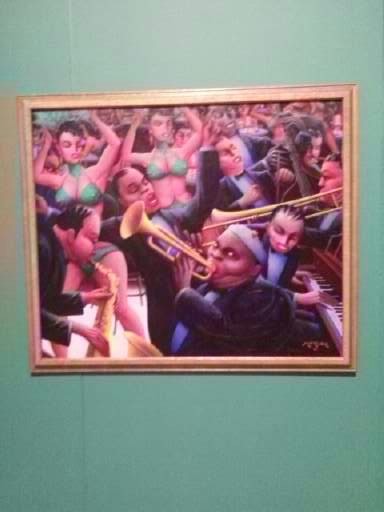
My next endeavor in the large Chicago Cultural Center structure was to the Archibald J. Motley painting exhibit about Chicago’s Jazz Age in the 1930s. I walked up a few flights of stairs to enter another large room. There were dozens of paintings depicting Bronzeville in it’s heyday. The subjects ranged from single portraits of loved ones to Motley, to backstage perspectives of scantily clad dancers preparing for their showcase. One of Motley’s goals was to capture all sides of the African American life, not just the stereotypical one often portrayed in society. There was a true undertone of pushing people to expand their view of Bronzeville in the time. Not only was it filled with talented musicians and dancers, but teachers, mothers, community workers, a whole range of occupations.
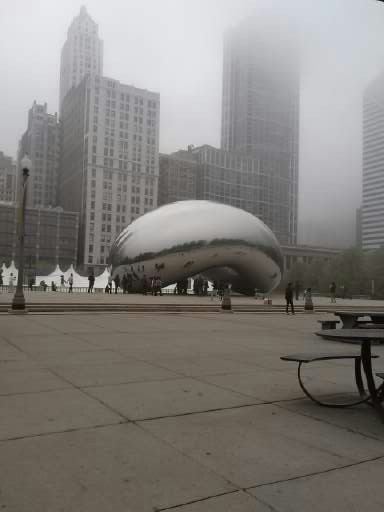
From the Cultural Center, I pondered to Millennium Park about two blocks away. I ate some food that I packed in my backpack early that morning, and just observed. I sat in various places where there were lots of people passing by including walkways and at a picnic bench by the Cloud Gate or known to locals as “the bean”. I saw people touring with their friends and family and me seeing those people made me truly realize that I am not lonely. I simply have not been paying attention to the sweet strangers that have surrounded me on the sidewalks and in parks. A certain part of me has come to complete contentment with traveling alone. I am grateful that I am able to experience this, and overcome this lonely tendency.
I really can’t believe I’m only writing my third update. This week has been insane and is really still happening (why this late), so it is important to understand I haven’t had the time to fully reflect on the events of the past week.
It started with the street fair in Huntington Beach on Tuesday, where fish tacos are $2.25 and Main street hosts live music and a farmers market. Kory introduced us to two girls who are apart of the Good Vibes Tour, which is a group of people who put on shows for free or ask for non-perishables as an entrance fee to give as donations to the food bank. We got to see their “spot” for the street fair, which was at the surfing museum on a side street that connects with Main. They had some live music and a table selling shirts and pictures as well as a local shaper’s selection of surfboards. We let them know about our trip and talked about the possibility of playing the following Tuesday for Cinco de Mayo. We didn’t know for sure if we’d be playing or not.
The next morning Kory had a casting audition in LA so we decided to head out with him. We got the full LA traffic understanding this time. The past trips we’ve made it in about 45 minutes to an hour, but when its hard picking songs that you haven’t already played, you know it’s been a while. I think it took us two and a half hours to get there but we eventually made it. Kory’s agency was in Melrose, which we later found was the fashion district, and understood really quickly our wallets weren’t going to be of any use here. Every store was so uniquely designed and furnished you couldn’t actually tell what anything was, and then just around the corner there was so many signs for each building you were just as easily confused. It was like walking through a page of Invisible Cities.
We left and picked up a friend of ours from WA who had just gotten back from a tour with the YikYak app team. We brought him to Newport, Keaton, Tyler and Brandon came down too because Keaton’s mom had flown down as well from WA for her daughter’s baby shower. And on top of it all Haley who is also from WA and who was with us the first week we were here drove over from Vegas and we all had an awesome reunion back at the surf shack with a fire, food and Steve DJ-ing til 4 am.
After a second night of partying, we got a call from our friends asking to perform at the show in Huntington for Cinco de Mayo. We accepted. The following two days were spent compiling all the song skeletons we had and turning them into a performable half hour set. Of the forty-eight hours we had, half was spent entirely on reading or writing the lyrics a quarter was spent sleeping and the other quarter eating and keeping level heads. We performed well, had a small audience, but the important thing was that we showed exactly what it is we are capable of and explained why we do what we do and had a fun time doing it. Kory got some good film of it and I want to have it ready before I talk about everything I’ve learned from the experience.
In the meantime, I’m writing this and relaxing after such a crazy week and watching game of thrones. There has been a powerful storm swell that came up from the south and created XL waves at the wedge which is a local big wave surf spot here (symbolic of my weeks intensity.) The footage as been amazing but saturated. instead of maybe seeing 1 or 2 good shots of someone dropping into a huge wave, it was all over the place. People’s ability to have a camera on them all the time has created a tolerance for how great things really are, or maybe we just get so focused on one thing we ruin the ability to enjoy anything else. This week I started focusing to directly on wether or not I could memorize my lyrics and I exhausted myself forcing to work on it. But as soon as I messed up my first lyrics on the first song I knew that it didn’t matter because its just about enjoying the moment. I took this picture last week and it reminds me that even when the waves get gnarly and huge and the wind stirs up, its usually when the sky looks most beautiful
As we walk up to the bank of the river my cousin explains to me you don’t talk to the people who ask you “I bet I can tell you where you got dem shoes…New Orleans Louisiana”, about two seconds after this picture was taken..” I bet I can tell you where you got dem boots…”
Sitting in my living room thinking back on my experience in New Orleans my mind floods over everything I did while there, I went ten days in a surreal dream. I arrived on a Sunday, cloudy, muggy, strange.. I developed a new sleeping pattern while there. My cousins a jewlery artist and dose most his work at night, like late at night, so I would stay up with him, the beautiful thing about flying into the sun, so to speak, I mean go east, the latter you can stay up cause that ol internal clock is three hours behind, where here I was use to getting up at seven thirty eight, there it was eleven oclock or noon, going to bed.. like five. Anyways I digress, Monday my cousin and I drove S. Claiborne into the French Quarter, this was my first experirence and I was dazed and confused in this new land. Not kowing where anything was and being on a level plan made the ride in sort of like a psychedelic, disoriented introduction to the suddenly tall infractucture and buildings. Jesus Christ, I thought to myslef as we entered the city, this place is more maddening then Seattle! We parked on some side street in the Quarter and got out, the smells of food, cigarettes, bars and other stenches raced in to my nose, sounds of traffic, people and some music (not as much as I thought) battered my ears.
It was weird, for as much music as there seemed to be, it was all centered in one area it seemed. There was this one cat though who was this huge like six’ ten” kinda guy, real wide dude, but anyways he was just kinda wlaking around with his tuba, blowin and puffin as he stode down the streets. I had saw him when we first got to the Quarter then again a little later but by the time I saw him again and decied to ask for an interview he had been on a phone call, and it was right after I got an interview with this beautiful woman playing fiddle.. the two minute interview went something like this…
Me: What Style of music would you call what you play?
Moniek: Ah- I, I play my own songs, they are inspirational to the travels Ive made around the world but the last ones I made are more N’orleans now I am here more cajun, folkie sounds. (laughs)
Me: Where are you from?
Moniek: I am from the Netherlands, but I travle aroud to tour and play but aslo to learn about the musichere I go.
Me: What influences you?
Moniek: I think what a lot of other musicans do, nature, and here in New Orleans the vibe, everybody is so into it. And there are more cajun style that goes more into what is New Orleans I think, and then Ive been in Ampsterdamn so much it comes out in songs…
Me: Um you say youve traveled around where do you plan on taking your music next?
Moniek: Next I play in Belgim and I’ve come actually from India, just before New Orleans, so the songs I worte in India are just now starting to come out and they will be played on tour when I am with the band, I am in a band. And then Im in spain playing in july then augsut in italy and then its over, i problably come back here in febuarary, this is the fourth time I’ve done that, fouth year for three months.
… I cant seem to figure out how to post the interview audio, but in my next post which will be about food, I will include it along with a picture of my new addiction..
Anyways it was odd, there wasn’t a lot of street musicians except in this central space, you can actually hear the tuba player while I interview her. I couldn’t help but wonder what the streets must have been like in 1910, 20s, 30s, 40s, 50s. Back in the days when Jazz Kings roamed the streets, and grooved at every club, was there more music on the streets or was it the same? Fuck, if only Marty McFlys time machine could take me back.
(Above) THe Hilton Inn with a clarinet painted on it, from first drive into the Quarter
(Below) A church nestled in the courtyard across the street from Cafe du Monde, where I interviewed Moniek.