
It seems that so much time has passed since I wrote the first post of this trip, not only due to the fact that it’s been ten days since that time, but as well as because I have come so far in my studies. I have shifted plans a slight bit and changed the museum […]
Page 16 of 35
So I’ve arrived at the end of the first week of my study. I’d be lying if I said it wasn’t difficult to stay on task. Sometimes there’s so much else to do (I could totally clean my room right now instead of writing this blog post…). Sometimes I find myself gripped by the ennui which Botton warned us about. It’s a struggle, but it wouldn’t really be any fun if it wasn’t. I’ll supply some thought as to how I can better focus myself to this study at the end of this blog post, but, for now, I’ll write a bit about what I’ve learned.
During the first week of my study I’ve read Part I of Helmholtz’s On the Sensations of Tone – As a Physiological Basis for the Theory of Music. I was quickly enraptured by the text, and dug into the reading, but soon found the content to be a little overwhelming. In the introduction, Helmholtz won me over by explaining the reason for his research and writing. His goal was to unite two schools of thought: “physical and physiological acoustics” and “musical science and esthetics” (Helmholtz 1). This matched descriptions of the book which also promised a comprehensive, yet easy to grasp, understanding of sound from a scientific point of view. The early material consisted of describing how sound works. It was detailed enough that I could easily follow it, and it cast new light on subjects which were already familiar to me. However, I soon lost myself in the rapid current of new information that Helmholtz began introducing. I found myself adrift, reading about descriptions of experiments which I didn’t fully comprehend and hoping to find paragraphs or sentences which could tie together the different terms and ideas that were being developed. Though I understand, and greatly admire, the extensiveness of Helmholtz’s research, I couldn’t retain or connect to some of the stuff he was throwing at me. His analysis of the human ear, for example, was something that I was initially interested in learning about, but the content was so dense that most of it went over my head.
My solution was to find supplemental sources which provided similar information in a more readily digestible form. These sources gave me a means to get my head around the depth of knowledge Helmholtz was throwing at me.
The above example helped me immensely by affording a moving visual representation of the inner workings of the ear. Though Helmholtz undoubtedly goes into more depth, the video provides information in simpler terms which I can retain more easily. I also found it helpful to perform the experiments that Helmholtz described or, if they were too complex, at least look up video demonstrations. For example, after reading about sympathetic resonance, I sung a D note into the hollow of my acoustic guitar. When I stopped singing I found that the D string was vibrating. Another source, HyperPhysics, has information on everything I wanted to learn about and more.
Part II of On the Sensations of Tone looks like it will be easier for me to connect to as it addresses topics more musical in nature. I will, however, look for other sources whenever I encounter something I don’t understand so that I can connect with and fully appreciate what Helmholtz has to teach me.
As I move forward with my study, there are a few other things I’d like to keep in mind. The first is that I should better maintain my personal journal. Writing this blog post has helped me touch down and grasp what it is I’ve been doing so far. I’ve written down my thoughts a few times, but I think it would help me more to make it a regular, perhaps daily, routine. I’ve also found that I’ve been putting my goals too high, and the result is that I’ll burn myself out before I reach my goal. Rather than set a huge list of daily goals, I’m going to try to start thinking more in terms of weeks. In this way I’ll spread out my workload so that things like the reading will be easier to get through, and I’ll have more time and energy for daily things like practicing music or writing in my journal. Lastly, I’ve realized I don’t have a full schedule for my study up (woops). I have a draft right now which I’ve been agonizing over. I plan on finishing and posting that tomorrow. My hope is that it will act as a guide I can follow for the rest of this study.
As I approach the middle portion of my time in Los Angeles, I reflect on how quickly my trip has gone by. It feels like just yesterday I arrived, eager to explore the environment as well as the literature that I picked to read while I am here. It’s such a difficult city to explore, due to the decentralized nature of the city itself. While this aspect makes being a tourist/newcomer to the city, it has also greatly benefited the city. In Kenneth H. Marcus’s book, Musical Metropolis: Los Angeles and the Creation of a Music Culture, he brings up a point that one of the keys of the creation of Los Angeles’s music culture was the decentralization of the city, which occurred between 1880 and 1940. While Los Angeles has a vast metropolitan area, it extends much further, into what is known as Los Angeles county, spanning a whopping 4,083 square miles (larger than Connecticut). When two intercontinental rail lines were built in the early 19th century, the urbanization of Los Angeles began, and real estate boomed. In 1880, there was a population of 11,000 people, while a decade later there were over 50,000. As of 2000, there is around 16.37 million people that reside in the greater Los Angeles area. The dispersion of power in Los Angeles occurred not by accident; the Charter of 1889 provided citizens more power over their locales, attempting to avoid the giant endemic corruption that existed in cities such as New York and Chicago. This balancing of power into the outer cities of Los Angeles transformed Los Angeles into not just a collection of suburbs, but “a city surrounded by many satellite sub-center cities and communities” (Marcus, 3). Unlike other major cities in the United States, Los Angeles did not have all of it’s culture focused into one downtown sector. This allowed for a greater diversification of music scenes, and created different musical communities as well. And with all of the immigrants moving into the city from different parts of the world, the diversity of sounds was overflowing.
This development of the city as a spread out collection of cities was made possible by the technology of the time. In fact, Los Angeles was the first modern metropolis to be built around the idea of the car. The car culture in Los Angeles allowed people to not only live far away from each other, but they could also travel across the city, allowing musical communities to intersect. The car culture in L.A. boomed in the 40’s and 50’s, and became much a part of the music scene as well. A blossoming genre at the time was ‘sunshine pop’, lead by artists such as The Beach Boys, Gary Usher, Jakc Nitzche, Jan and Dan, The Pyramids, etc. These artists painted an image of L.A. that had been at the base of the city for far beyond their times. It displayed a mythical land of sun, surfing and women, with a tinge of innocence within. The car was an object of fun, where one rode down the ‘drag’ to be noticed by walking passer-bys (much like what people do on 4th avenue in downtown Olympia still) as well as it being viewed as an object of leisure and relaxation. While this view of the city was predominately held by the white, upper-class population of the city, it became world famous, and represented the city to the rest of the country and the world. Cars not only moved through the city, but they became an integral part in the identity and image of the city.
Walking down Venture Blvd, I can see that the car culture is still heavily dominant here. As one of the few actually walking down the sidewalk, a feeling of alienation kicks in. While the restaurants and shops are lit up and filled with people, the sidewalks are empty. But the way that the city is designed, this in inevitable. If you want to get around beyond your satellite community, you need to have a vehicle.But even then, parking is an even bigger issue. On many of the side streets, one has to have a permit to park, and the only places that I have found in the area for parking have ranged in the $20-30 area. Thus, I have begun to utilize the public transportation systems.
On Friday night, I went to The Roxy on the Sunset Strip, where I was Panda Bear and Ducktails.
(above is the album that he is touring on, entitled Panda Bear Versus The Grim Reaper)
The show was phenomenal. Panda Bear played fevered, textured pop music, with many vocal overlays and harmonies. His style reminds me of The Beach Boys; progressive pop structure, vocal arrangements, and vocal tone-wise. The crowd was very active, and the night was filled with dancing and a feeling of happiness and content. Ducktails also gave the same vibe. A California native, I could begin to see how the concept of ‘sunshine pop’ still remains While more driving and formulaic, the music was light, beachy, and happy. While at times the lyrics became depressing in both sets, the overall vibe of the sound was positive. The lyrical content had a similar focus as well; an idyllic view of life in the sunshine, where bad things can happen, but the sun continues to shine.
Located in Northern Liberties, about a mile and a half from my home, the Piazza at Schmidts is a beautifully landscaped, 80,000 square-foot, open-air plaza with free events year-round, surrounded by three new buildings including 35 artists’ studios and boutiques and four new restaurants.

Here is a short video about the Piazza.
Click here to view the embedded video.
Last night, I walked through Fishtown into the Piazza in hopes of hearing live music. To my disappointment, no one was playing. Before I left, I went inside a music shop in the Piazza called Creep Records.

For 11:00 p.m., there were quite a few customers. The employees behind the counter seemed to know the customers who were casually looking through records in between heckling one another. I asked if there were any bands playing nearby. One of the employees was eager to tell me about a concert at a local venue called Ortlieb’s. The main act was a blues/psychedelic/rock/pop band called “The Blurry Nights.” Before he left, he gave a free copy of their latest album, a poster advertising their show, and a few free local music magazines.
Here is the poster he gave me:

I immediately left Creep Records in hopes of finding the concert. As you can see by the map below, I was within walking distance.

The Ortlieb’s night club has had a long, iconic history of music in Philadelphia. Throughout the decades Ortliebs has been “the local place” to see Jazz, Funk, and Soul music. This is the front of the venue:

According to various websites, the venue also had a brewing company that is now abandoned in Northern Liberties and is also a local hotspot for photographers who take pictures of “Ruin Porn.” The abandoned building that almost encompasses an entire block traces its roots back to 1869. An extensive history of the brewing company can be found here: http://pabreweryhistorians.tripod.com/OrtliebFinalEdit.htm
The following are images of the inside of the abandoned factory:


Unfortunately, I didn’t make it to see the opening act “Fishtown Beats” but I made it in time to see Blurry Nights. They were a psychedelic blues band that covered several songs from Seattle in the early 90’s. I have noticed that a lot of bands play covers from the grunge era. Several bands that have been suggested to me by my coworkers (several of which are art and music majors at Temple University outside Fishtown) are signed to Sub Pop records in Seattle. Two of these bands are Metz and Piss Jeans. Although the bands started out side of Philadelphia city limits, several of the members from both bands live here in Fish Town.
Here is a crude recording of Metz playing at the The First Unitarian Church in Philly.
Here is a crude recording of Pissed Jeans Sub Pop Release party on February 13, 2013.
The past ten days or so have been some of the strangest, most eye opening days of my life. To start, I went to Coachella quite last minute thanks to a gifted ticket. My time at the festival was mostly unrelated to this project, although I certainly applied an understanding of many of the performance and listening skills Andrea taught the program. Since there were artists from all over the world there, I wasn’t able to focus directly on Chicago music. I ended up meeting my family in California and because of our different locations and schedules, we all had to leave at different times and have different kind of tickets (standby and regular). Because I was on a little bit less hectic schedule as the rest of them, and I had some of my reading with me, I agreed to take a standby ticket and hopefully get on the first flight I could. I tried to get on the 6 am flight and saw each one of my family members leave to get on a flight home while I was trying to remain positive after being stuck in LAX all day. I wasn’t able to leave until that Tuesday (5/13) in the afternoon. After that painful 40 hours in Los Angeles, I don’t wish my worst enemy to get stuck in LAX and it’s surrounding areas. That whole fiasco certainly put a funky start to my independent research and set me back two days without access to the internet.
It’s as if the big D-O-G in the sky planned it out, because the book I selected for myself to read the first week of the research study was barely resourceful at best. It is titled, The Chicago Music Scene 1960s and 1970s. It was a large collection of photos with small to medium blurbs attached. The blurbs provide some basic history as well as the artists connections to other artists and venues. There was a lack of real insight or intelligent writing. I suppose I could have done a better job of determining that this book was more of an encyclopedia than a narrative book, but the amazon.com subscription definitely did not match what I understood this book was.
It was not all a waste, though. While there was no nitty gritty information contained in the pages, I was able to collect a list of names and venues that kept popping up in the blurbs. One trend that I noticed consistently was that a lot of the folk and acoustic artists of Chicago music scene emerged from universities and colleges above any other music. My immediate thoughts on why this is leads me to Bob Dylan. There were absolutely non-college aged folk and acoustic musicians, but this era of the 60s and 70s saw a population of young students be so influenced by Dylan and other folk masters and wanted to turn it into something of their own.
In addition to the lackluster reading, I have been having a somewhat difficult time getting in contact with DJs and other people in the Chicago music scene. I find it vital to this project that I speak and communicate with the people involved from the ground up, so that I can get the fullest understanding possible. I have gotten one response from Rachael Cain, a House music vocalist from the 1980s, who now runs Trax Records, which was arguably the most important House label in Chicago back in the 80s to now. I have been texting her, but unfortunately, she seems flaky and goes for days without emailing me back. I hopefully will get her on the phone or meet her in person when I get to Chicago. I have also contacted three DJs from Chicago who were heavily involved in the scene. One DJ, Derrick Carter told me that he doesn’t do interviews but wished me luck. Thanks, Derrick. The luck is cool but your words would have been cooler. The other two DJs have not responded despite my email and Facebook messages. I know the other two have done interviews in the past and I can probably gain some understand from those.
This time period since my last post has been good for me to do a lot of taking care of business things for my upcoming trip. I have been solidifying my sleeping arrangements and planning my days ahead. I can work the best when I have all of my actives laid out in a concrete way, and so in doing that for my trip to Chicago, I hope that I can best utilize my time there.
Sunday April 12, 2015 I woke up disoriented. I had not slept very much and realized I forgot to book my hotel in Portland for that night. I frantically searched the hotel website that I was planning on staying at but they don’t do booking online for same-day reservations. I called to ask if they had any availability and they ended up being completely booked. I searched online for other hotels/motels/b&b’s/etc. but none of them ended up working out. I was disappointed that of all things I could forget to do, it was book a hotel, but I also was thankful that Olympia to Portland is only about a 2-hour drive. That’s when I decided I would just drive back to Olympia that night.
Still a bit disoriented, I grabbed my backpack and headed out. While I was on the freeway I couldn’t help but feel a great sense of joy. Sure, I wasn’t going to Ireland, but this was the first road trip I had ever taken alone… And that was a good feeling (several days later I find out that the plane I was supposed to be on to go to Ireland had an emergency landing in New York do to an engine failing). After arriving in Portland I quickly became irritated because there are so many one-way streets and so many stoplights in a row you can’t turn left at to get to the street you need! I finally said f it and decided to spend $10 to park at a lot for only 2 hours. I grabbed my cruiser and skated towards Powell’s City of Books. I stopped at a bench to people-watch and look at the architecture around me but I got bored pretty quickly because there weren’t very many people in that area. I looked around Powell’s for about an hour and a half and purchased a new wallet, 2 pairs of socks, and 3 amazing books that have nothing to do with my field study. I skated back to my car (about 10 blocks) and headed to where the Portland Poetry Slam Finals were being held.
I missed the turn for the street I was supposed to be on but luckily I was able to find it just fine, an hour and a half early. I realized I didn’t have any cash on me so I went to Voodoo Doughnuts to use their ATM but the line was out the door quite a bit, so I searched credit union ATM’s nearby so I didn’t have to pay the fee and found one a few blocks away. I get there but they have a sign saying they moved 5 blocks away… So I get there and they’re closed. I had to take a moment to breathe because at this point I was frustrated at just about everything – mostly because I had not eaten anything that day and it was about 5:30pm by that point. I ended up going to a 76 gas station, which was only a block away from where I originally was when I realized I didn’t have any cash. I got the cash, went back towards the venue, and sat in my car listening to Globelamp while I wrote down observations about my surroundings.
Finally to the Portland Slam Finals!!! It was strange being in a new city completely  alone. After paying, a woman drew on everyone’s hand either in blue or black ink to determine potential judges… If you knew a poet personally, you got written on in black, if you didn’t you got blue like I did. I sat alone in the 2nd row corner while a stained glass white jesus stared me down. The host went up to the stage to explain a little about slam poetry and to thank people for helping put this night together. They got in trouble by the fire marshal at their last venue so
  they did not have a set place until about 2 weeks before the event. I went to a Portland Slam event in the Fall of 2014 so I recognized a few of the performers and audience members. The host, Jill Greenseth, did not perform while I was there during the Fall trip but they had made it to the Slam Finals and were more amazing than I even thought possible. They are also one of the finalists who are going to Nationals. Below are recordings of their pieces in order of what round they were performed.
Another one of my favorite poets from the Portland Slam Finals is named Doc Luben. In Fall 2014 Kirstie Opel interviewed him before the show. This was a whole new level of poems and it was incredible being able to be apart of the audience. He is also a finalist going to Nationals and below are 3 of his pieces in order of what round he performed them.
I recorded every poet and kept track of all the scores. A poet/musician named Jared Paul was the featured poet of that night and opened up the night (fast-forward 1 week and he was at Evergreen doing a workshop about slam poetry that I almost went to when I didn’t even realize that was the same guy). There were 3 rounds – the first 2 rounds had 9 poets and the last round had 6 – from there a decision had come based off the total scores of all 3 rounds of 4 people who are going to represent Portland at the National Poetry Slam held in August in Oakland, California.
Attending the slam was great inspiration for my writing. I spent the rest of week 3 reading Fugitives & Refugees, going to the Capitol Forest, and writing. Fugitives & Refugees was a good choice for this weeks reading because it had various suggestions of places in Portland to visit while also giving a little bit of history and even some directions. I took notes on places that caught my eye from cafes to haunted locations. I have decided to visit Forest Park – the biggest park in Portland that has over 60 miles of trails and connects to 5 other parks and wildlife sanctuaries (page 116).

creek watercolor
I decided to take trips to the Capitol Forest in Olympia because I love forests and because it is a great place to get writing done. I also decided to work with watercolors for this weeks sketch. I jumped a fence off the trail that led me down to the creek. It was so peaceful and was actually about 70 degrees that day. It’s certainly not the best watercolor in the world but I am still learning how to work with watercolors and I have never been great at drawing.
I have written 3 poems this week but am planning on editing them to make me a bit more comfortable having other people read… But here is the first little bit of one:
I sit amongst pine needles
And broken glass
On the empty staircase
Between madness and sanity
An ant circles around dead leaves
And I wonder if god
Looks at me with the same curiosity
The past week I didn’t get to stay in Seattle as long as I would have liked, but I also didn’t plan on going at all in the first place. This first week I thought I would only be able to do some reading and studying and that I wouldn’t start making my weekly trips down till the following week, however, I went down to visit and have dinner with my family. My sister live on Queen Anne hill not far from Kerry Park, there are amazing views around there and just as amazing soundscapes. It is almost as if you can look at the water and hear it then look at the city and hear it as well, like your eyes are shooting targets for your ears. I took particular notice of the street drumming while i was driving around Seattle this week, it really is just all around. I’m not sure I ever really notice how prominent it is, probably because when something never stops you start to stop hearing it. When I started to listen more intently on the drumming I felt like I was listening to little themes or heartbeats from different parts of the city. While driving through downtown there was many drummers and it was fast and seemed hectic, when I got to the U-District I felt like it started to single out into one drummer and the pace slowed, and then when I got up the hill to Queen Anne I felt like I left the chaos down below and it turned into a calming murmur.
This week I read Ernest Callenbach’s Ecotopia. It is a fiction book about northern California, Oregon, and Washington succeeding from the United States and becoming their own nation. It reads as a journalist’s diary/column that he writes as he is there. It was an enjoyable read, and I started to really romanticize the idea of this actually happening. The link between these places is made by a bioregion, that is a way of distinguishing an area by is environmental traits. In the real world this area would also include some parts of Canada, Idaho, and Alaska. Prior to this book a professor at Seattle University named this bioregion Cascadia, obviously because of the cascade mountain range. When I think of Cascadia the first thing that comes to mind is actually soccer and a type of beer. This is because there is a strong rivalry between the Seattle Sounders, the Portland Timbers, and the Vancouver (Canada) Whitecaps; they compete for the a trophy called Cascadia Cup. The idea of Cascadia goes far beyond just soccer and beer though, some people really do want to succeed from the United States and form their own country (and they have a pretty good argument on why it would be possible), but I honestly am far less interested in succession as I am the idea of Cascadia having its own people and culture. There is an idea that people from this region should be active in it and stay working for it, this is called bioregionalism. Bioregionalism would include things like eating locally, using local materials, keeping native plants, and using energy you can harness from the environment you live in. The site cascadianow.org has a good definition Cascadia:
“A much more common definition of Cascadia instead seeks simply to help further local autonomy, empower individuals and communities to better represent their own needs, as well as push or environmental and economic responsibility, and increased dynamic, transparent and open governance. The Cascadia movement encourages people to re engage with their local communities, develop local and personal resilience (community gardens, disaster preparedness, etc.), and create alternate lines of regional communication, politics, and interdependence that better represent the social, cultural and political boundaries that define our region.”
The idea of Cascadia is also useful to my field study, because I am looking for what makes influences on Seattle music, I’m sure the environment and the people who live there will be large parts of it. Also when looking at the bioregional map of Cascadia I realized I haven’t really traveled much out of it, I think this would make it particularly hard to see things as being different from or original to Seattle when I know so little about what the opposition would look like. I know what going to a show, hearing music on the streets, or making music with friends is like here in Seattle; but, I could not speak to what that is like in other places. However, I am lucky enough that I will be able to tag along on a road trip to New Orleans and Alabama. I will be gone for around eight days and I’m hoping this will provide me with great contrast to my home.

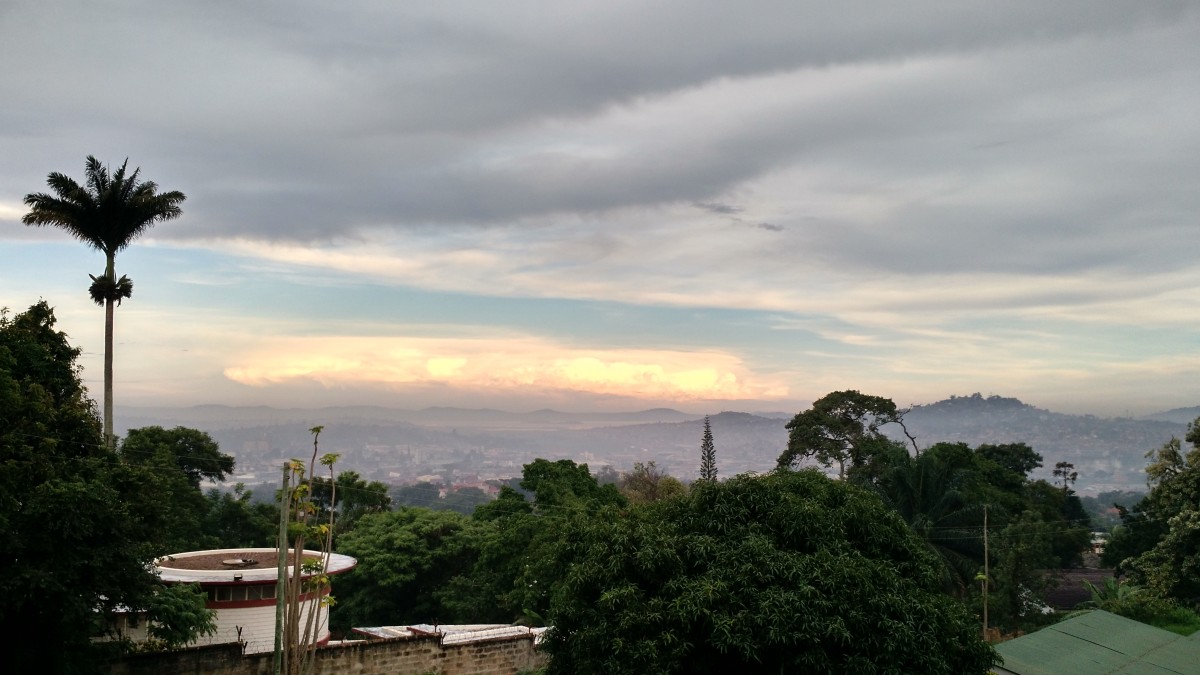
View of Kampala from Kololo Hill with Lake Victoria in the distance
Once I finally arrived at the airport in Entebbe, I made my way through customs and collected my luggage. I then took a taxi to the house I am staying in for my first two weeks in Kampala. It was already dark when I landed but I still tried to take in as much as I could on to drive to Kampala.
As we progressed along the Kampala-Entebbe road, I was able to catch glimpses of the Friday night nightlife. Along the road there were many clubs, restaurants and many other locations playing music. As we drove, I would hear just a small clip of sound from each one. Coincidentally, the room I am staying in is right next to a club. However, three of the first songs I heard before I went to sleep (I was way too tired to try and go out after the trip) were ‘We Found Love’ by Rihanna, ‘Waka Waka (This Time For Africa)’ by Shakira and ‘Drunk in Love’ by Beyoncé.
One of my first observations on the next morning was how different the soundscape is here. In addition to the club next door the night was filled with the sound of barking dogs. The morning was filled with a variety of beautiful bird songs as well as the sound of roosters welcoming the new day with a cockadoodledoo.
The earth here is also distinct. It is a deep brick orange that contrasts beautifully with the luscious greens of the vegetation. Amongst the trees and other plants I have also caught glimpses of various birds including a vibrant flash of red and blue swooping briskly from one tree to another. I plan to find a book on the flora and fauna of Uganda so I can learn more about what I am seeing. There is also a balcony overlooking the beautiful garden of the house I am staying in. I hope to spend some of the sunny afternoons reading and birdwatching from there.
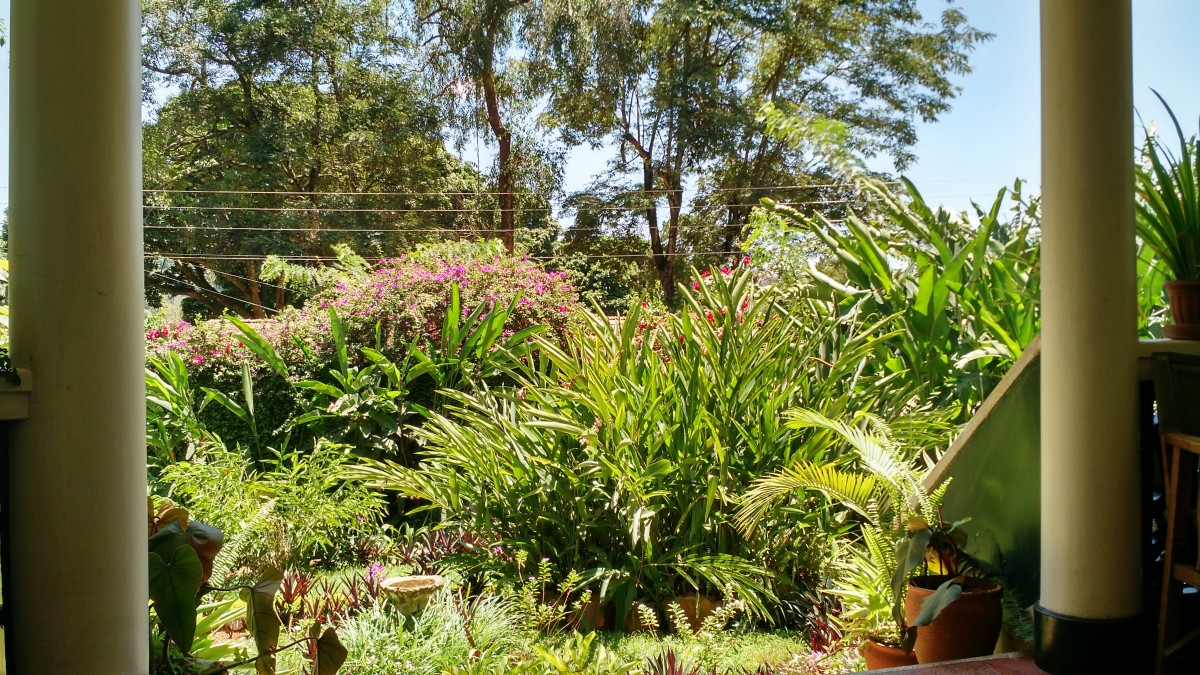
View from the balcony at Cathy’s house
Even though I have been here a few days I am still getting the feel for navigating the city. Part of the difficulty is that the streets aren’t organized on any easily discernible grid. This however is understandable as the city is built entirely on hills so the roads tend to curve up and around the hills. Kampala was originally built on 7 hills and was the center of the Baganda kingdom. It has now spread onto the surrounding hills as well. I am staying with a family friend, Cathy, on Kololo Hill. Fortunately, this is close to both Makerere University and the National Theater.
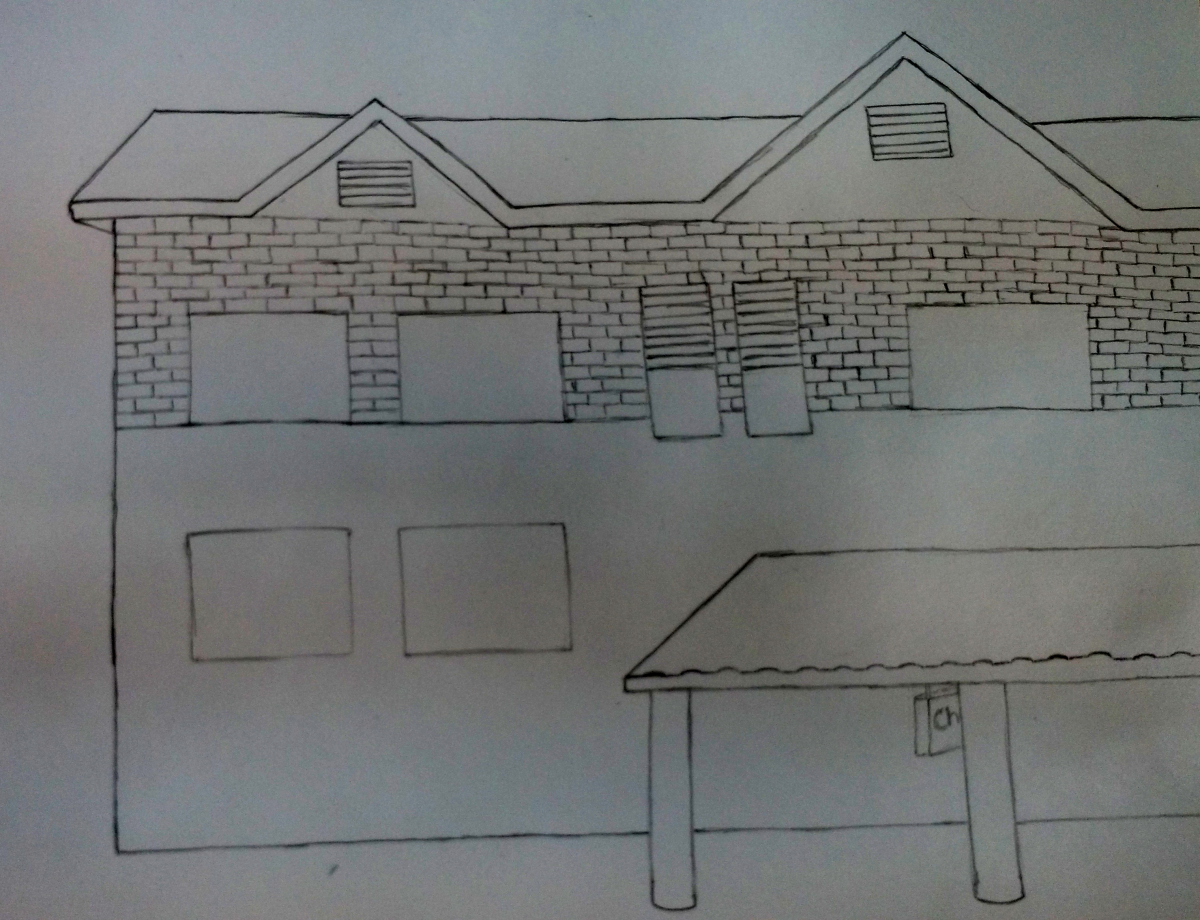
Building at Kisementi near the house where I am staying
On my second day in Kampala, Cathy introduced me to her friend Denis. Denis first showed me two shopping centers in walking distance from where I am staying just in case I need to pick up anything while I am here. From there we walked to the National Theater and took a look around. At the National Theater I was able to get a list of scheduled events which will definitely be convenient during my stay. From there we walked to a taxi stop and took a Matatu (minibus) to the Shell station in Bugolobi. From there we walked a short distance to Gattomatto and Jazz Ville. These are two venues that Denis said would be good for hearing live music while I am in Kampala. From there we took another Matatu to another venue called Zone 7 in a neighborhood called Nakawa. Next we went to Ntinda to go to the Ndere Center to see the Ndere Troupe perform.
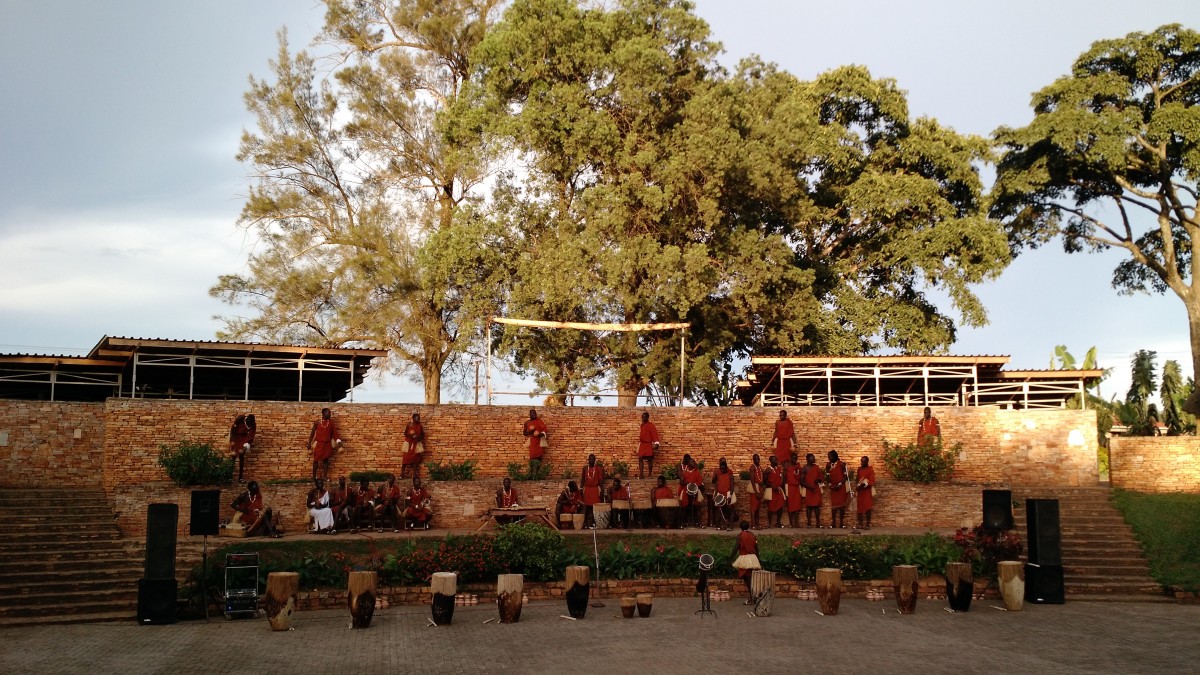
Ndere Troupe
The Ndere Center was a wonderful experience. The NdeMolly, another of Cathy’s friends, met us there. She is a dancer and was able to explain the dances, music and musical instruments. The dancers performed dances from all over Uganda as well as a few dances from Rwanda and Burundi. One of the goals of the Ndere Troupe is to promote unity through the inclusion of dance and music styles from a diverse group of people.
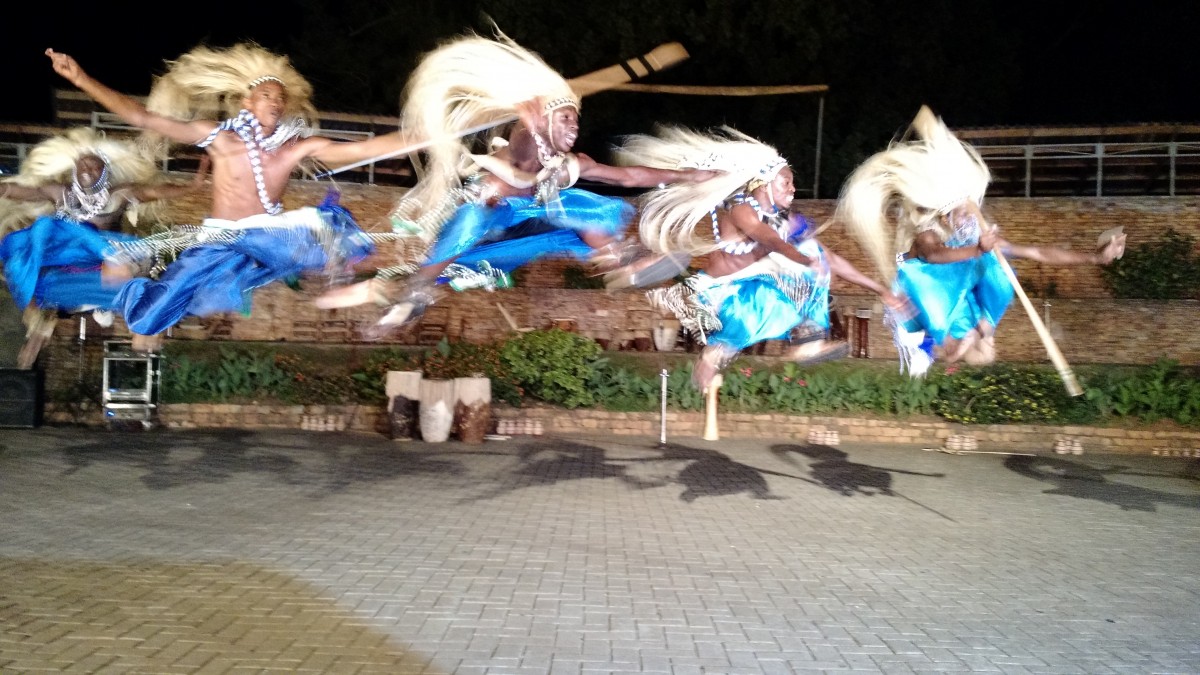
Ndere Troupe performing a dance of the Banyarwanda
A passage from Waiting by Goretti Kyomuhendo highlights the diversity of cultures found throughout East Africa. The narrator of the story is from a district of Uganda called Hoima. The majority of the people in Hoima speak Nyoro which is the language of the Banyoro people. In this passage she is talking to one of her friends about the Tanzanian army that is passing through their town while attempting to drive Idi Amin’s army out of Uganda:
“But what about their own languages? I mean, the languages of their tribes?”
“They don’t speak them.”
“Then how can they tell what tribe someone belongs to?”
“I’m sure it must be difficult since everyone speaks the same language. Maybe they can tell by their names, you know, just like here; people from different regions have different names.” (82)
The language the Tanzanian soldiers speak is Kiswahili. Kiswahili is primarily a Bantu language from the east coast of Africa (Kenya, Tanzania and northern Mozambique). However due to the cultural integration with Arab trader it also contains a large Arabic influence. Kiswahili is considered a lingua franca for much of East Africa including Kenya, Tanzania, Mozambique, Uganda, The Democratic Republic of Congo, Rwanda and Burundi. In Kampala a large percentage of the population speaks English as it is the official language of Uganda. However, walking around the city it is easy to hear a wide variety of languages including Luganda (Kampala was originally the center of the Baganda Kingdom) and Kiswahili.