Page 3 of 5

❄ Winter Wrap-Up Newsletter ❄ 

As the season of quiet reflection comes to an end, we’re taking a moment to highlight the work we’ve been doing throughout last winter quarter. From engaging community workshops to expanding sustainability initiatives across campus, CCAS has continued to foster collaboration, education, and action. 

Below, we share key updates on past events, ongoing projects, and what’s ahead for spring. For more details on each initiative, follow the included links! 

❄️ Winter Events Recap 

This past quarter, CCAS collaborated on several events that brought climate action, sustainability, and storytelling into focus. 
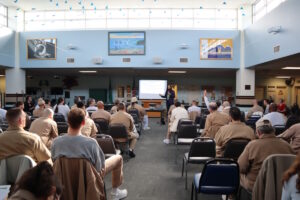
We kicked off the winter season with a Sustainability in Prisons Project (SPP) workshop, a first post-COVID in-person collaboration at Stafford Creek Correctional Facility. This session introduced foundational climate science by Director Anthony, explored the humanimpact of climate change by CCAS alum Mina, and closed with a discussion on envisioning and building Solarpunk futures from AD Michael, inspiring attendees to imagine informed actionable sustainability solutions.
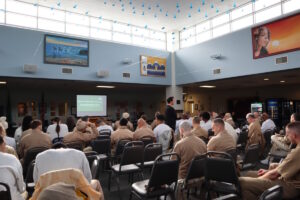
In partnership with the House of Welcome Longhouse, we co-hosted a screening of Finding Common Ground: Collaborative Leadership in Washington State. The documentary explored the journey from historical environmental conflicts to present-day collaborations that shape conservation efforts in the Pacific Northwest. The event concluded with a panel and community discussion on conflict resolution in sustainability work. 
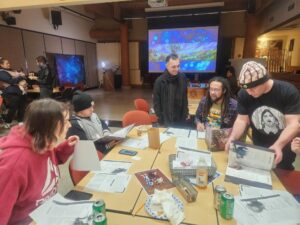
Our quarterly Sustainability Seminar & Roundtable, “Imagining a Sustainable Evergreen”, once again brought together students, faculty, and even local business/industry partners to discuss ongoing sustainability efforts. From campus pollinator projects to energy infrastructure improvements, the event sparked new ideas for collaborative action and future green initiatives at Evergreen. 
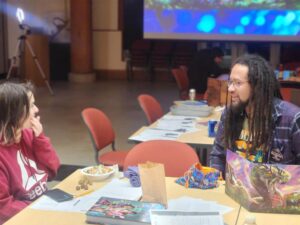
The Coyote & Crow Longhouse Game Night introduced students to Indigenous futurism through storytelling and role-playing. Co-hosted with the Native Pathways Program and the Indigenous Futurists Society, the event encouraged players to explore sustainable and decolonized relationships with land and technology within a collaborative, narrative-driven experience.

The Climate Lecture Series this quarter featured two compelling discussions. In January, Jacob Johns and Jhajayra Machoa Mendúa shared insights on Indigenous climate resistance, emphasizing the role of frontline communities in global environmental justice movements.

In February, Dr. Mijin Cha explored the Just Transition framework, focusing on how sustainability policies must be designed to protect both workers and communities as we shift toward a carbon-free economy.

🌍 Work in the Community 

Beyond campus events, CCAS deepened its engagement with local and regional sustainability efforts through workshops, resource creation, and project consultations. 

We participated in the Deschutes Estuary Restoration Team’s (DERT) Community Envisioned Deschutes Estuary (CEDE) Series, presenting on the role of higher education in restoration efforts, pollution solutions, and place-based community development. We look forward to continuing this work during the upcoming Olympia Arts Walk, where synthesized information regarding the restoration project community design will be featured. 


Not only did our students and staff get to attend and present at the Washington & Oregon Higher Education Sustainability Conference (WOHESC). Our Assistant Director has also taken on a leadership role in the monthly Sustainability Director & Educators Chats, where we’ve facilitated discussions on campus policy changes, AASHE STARS reporting strategies, and student engagement tactics. 

This winter, CCAS officially joined the Thurston ECO Network, a coalition of sustainability and outreach professionals. As part of this group, we’ll be working to expand educational partnerships, community engagement efforts, and professional development opportunities for sustainability practitioners in the region.

The Human Dimensions of Global Change (HDGC) Specialty Group of the AAG hosted a webinar titled Teaching Climate and Environmental Justice on January 30. This virtual event, open to all, featured three experts—Jennifer Atkinson (a former Climate Guest Lecture), Jessica Creane, and our own Anthony Levenda—who shared innovative strategies for engaging students in climate and environmental justice topics.

Additionally, CCAS was featured in the Cooper Point Journal, where we highlighted student-led sustainability initiatives on campus. These projects serve as a testament to the creative and impactful work students are leading in climate action. 

🔬 Projects & Programs 

Our ongoing projects and academic collaborations continue to evolve, providing students with opportunities to apply sustainability concepts in real-world contexts. 

CCAS has been working closely with Facilities & Environmental Studies faculty to advance the Bulkhead Removal & Salmon Habitat Restoration Project, an initiative focused on removing barriers to salmon migration and restoring ecological balance in local waterways. 

At the Tacoma Campus, we’ve been advising on the integration of student-led hydroponics research into kitchen spaces, bridging the gap between campus-grown food and student-run food service initiatives. 

The Evergreen Story Maps Initiative is also progressing, with faculty and student researchers developing an interactive GIS-powered map that highlights key sustainability projects across campus. This will serve as both an educational tool and a digital archive of Evergreen’s evolving sustainability landscape. 

Through the Student Success Stories Archive, we are documenting and sharing the experiences of students who have participated in community-based internships, sustainability research, and climate action projects. Our goal is to provide future students with inspiration and insight into career pathways in environmental work. 

Meanwhile, the Community Internship Program continues to grow, with students partnering with local organizations to gain hands-on experience in sustainability-related fields.

The Idea Co-Lab (Climate Cafe Series) launched as a space for students to workshop climate action projects, collaborate with faculty mentors, and gain access to sustainability resources. This quarter, one of our most exciting partnerships has been with Artists with Ecology, where MES Fellowship students will be working with the a combination of local teams to develop an art installation that also serves as a data-monitoring tool for local ecosystems. 

📅 Looking Ahead: Spring Events & Initiatives 

Spring quarter will bring a packed schedule of sustainability initiatives, including our biggest event of the year: 

  • 🎲 Worldwide Climate and Justice Games Day – This event aims to educate students about global climate change, solutions, and justice through engaging and interactive games. As part of the Worldwide Climate Education Week initiative, participants will play games like CATAN – New Energies, highlighting the importance of transitioning to green energy and community/global citizenship thinking.

    • Date: April 9th (Wednesday) | Time: 3:00 – 5:00 PM
    • Location: Social Justice Center, The Evergreen State College
    • Organizers: Center for Climate Action and Sustainability & International Study Abroad Office
  • 🌍 Earth (Field) Day – In celebration of Earth Day, the Center for Climate Action and Sustainability invites you to Earth Field Day—an open space for rest, reflection, and connection with the Earth and each other. This midday gathering is your chance to step outside, touch some grass, and reclaim rest as a powerful act of resistance.

    • Date: Tuesday, April 22nd | Time: 12:00 – 1:30 PM
    • Location: Red Square, The Evergreen State College
  • 🌿 MESA Rachel Carson Forum – Hosted by the Master of Environmental Studies Association (MESA) at The Evergreen State College. This year, we celebrate the 40th anniversary of the MES program with a special focus on “Stories of Adaptation: How has environmental work changed over the last 40 years?”

    • Date: Thursday, April 24th | Time: 4:00 – 8:00 PM (Doors open at 4:00 PM)
    • Location: Purce Hall 1, The Evergreen State College (Hybrid Remote options available)
  • 🌱 Thurston Climate Convention & Sustainability Symposium – This regional gathering will bring together climate action organizations, students, researchers, and policymakers for a day of knowledge-sharing and collaboration. The symposium will feature faculty and student research presentations, workshops, and networking opportunities.

    • Date: May 17th | Time: Purce Hall 9:00 AM – 5:00 PM, Evans Hall 5:00 PM – 9:00 PM
    • Location: The Evergreen State College

Read more about other events this quarter on our www.evergreen.edu/climate page, including: 

  • Equity Symposium Workshop – Examining storytelling & games as tools for climate action. 
  • Farmworkers Justice Day – Exploring sustainable agriculture & labor rights. 
  • Sustainability Roundtable – Continuing our quarterly discussions on campus sustainability.

Additionally, CCAS continues to pursue several grants, including the Career Connect Washington Grant, which would expand our Community Internship Program, and ongoing proposals through the Rose Foundation and NSF R212 Regional Resilience Innovation Incubator grants with community partners.

📬 Stay Connected!

📧 Contact us: ClimateAction@evergreen.edu
🌎 Visit our main website: www.evergreen.edu/climate
📢 Follow us on social media: https://linktr.ee/evergreenccas


Solarpunk: A Vision of Hope and Action at The Evergreen State College

Author: Michael Joseph

Solarpunk is more than just a genre of speculative fiction or an aesthetic of green roofs and solar panels. It’s a vision of a sustainable, equitable future where humanity has embraced regenerative practices that harmonize with nature. At its core, Solarpunk imagines a world rooted in solutions, community, and joy—a “yes” vision to counter the heavy narrative of climate despair. It’s a call to action that celebrates not just the fight against environmental challenges, but the creation of a better, more interconnected world.

This optimistic outlook aligns perfectly with The Evergreen State College’s legacy. Founded on principles of innovation, community, and interdisciplinary learning, Evergreen has long championed the kind of systems thinking and creative problem-solving that Solarpunk thrives on. The college’s focus on environmental studies and its commitment to alternative educational methods make it a natural hub for Solarpunk-inspired action.

Why Solarpunk Matters for Climate Action

In a time when climate discourse often feels dominated by “no”—no to fossil fuels, no to waste, no to environmental destruction—Solarpunk offers a refreshing counterbalance. It’s about saying “yes” to solutions: Yes to renewable energy. Yes to urban gardening. Yes to resilient communities that uplift one another. By focusing on what we can create rather than what we must reject, Solarpunk inspires action through hope and imagination.

This approach is especially vital for combating climate anxiety and burnout. Solarpunk introduces an element of play, joy, and curiosity—essential for sustaining long-term engagement in climate work. At Evergreen, this ethos could transform sustainability efforts into something not just urgent, but deeply inspiring and fulfilling.

Repair Clinics, Bike Shops, and the Solarpunk Campus

Practical initiatives like repair clinics, communal bike shops, and accessible bike stands are inherently Solarpunk. They embody principles of resourcefulness, community-building, and ecological stewardship. Repair clinics teach students to mend and maintain their belongings, reducing waste and building self-sufficiency. Communal bike shops and bike stands make sustainable transportation more accessible, fostering a culture of low-impact travel while empowering students to keep their bikes in good condition.

On college campuses, these initiatives not only achieve sustainability goals—they also support student health and wellness. Biking, for example, is a low-cost, eco-friendly way to promote physical fitness and mental health. It encourages movement, reduces reliance on cars, and provides a sense of freedom and connection to the environment. As part of Evergreen’s focus on holistic education, these efforts contribute to a campus culture where sustainability, wellness, and community care are deeply intertwined.

Building a Solarpunk Future at Evergreen

By integrating Solarpunk ideals into its operations and campus culture, The Evergreen State College can lead by example, inspiring students to envision and build a better world. Imagine an Evergreen campus buzzing with repair clinics where students learn hands-on skills, dotted with solar-powered bike stands, and bustling with bike-friendly pathways that invite students to embrace active, sustainable transportation.

These efforts aren’t just about reducing emissions or promoting green technology—they’re about creating a campus where innovation, joy, and hope thrive. In the process, Evergreen can solidify its legacy as a pioneer of progressive education, modeling what a Solarpunk future could look like for the broader world. Together, we can say “yes” to a brighter, more sustainable tomorrow.

Meet the 2025 Evergreen Spring Sustainability Fellows!

The Center for Climate Action and Sustainability (CCAS) is proud to introduce this ongoing year’s cohort of Sustainability Fellows — a group of outstanding student leaders working to support Evergreen’s sustainability goals, deepen community partnerships, and contribute to climate action initiatives across campus and beyond.

The Sustainability Fellowship is a grant-endowed program that selects two graduate-level students each year to contribute to real-world projects. Thanks to expanded support this particular year, four incredible students were chosen to participate. And, for the first time, the Center for Climate Action and Sustainability is proud to house and grow this program, helping fellows contribute their skills to meaningful environmental and social impact work.

Since its founding, the Fellowship has helped advance Evergreen’s decarbonization planning, land stewardship efforts, energy and building assessments, and sustainability reporting. Fellows have gone on to pursue additional graduate programs, professional roles in the environmental field, and leadership positions in public service and advisory boards.

What the Fellows Are Working On

This year’s Fellows are already deeply engaged in projects that impact both the Evergreen community and the wider South Puget Sound region, including:

  • Ecological Restoration and Salmon Habitat Work: Assisting in the restoration of Geoduck Beach by supporting bulkhead removal efforts, creating educational materials about Indigenous stewardship and coastal ecology, and partnering with the South Sound Salmon Enhancement Group and the Squaxin Island Tribe.
  • Sustainability Story Maps: Designing an interactive ArcGIS Story Map to showcase Evergreen’s green buildings, programs, and ecological initiatives — a resource for current students, prospective students, alumni, and visitors.
  • Career and Green Workforce Research: Interviewing alumni and former interns to better understand pathways into sustainability careers, and developing resources to help future students navigate these fields.
  • Climate Education Innovation: Creating new educational programs that use tabletop role-playing games and board games to teach climate resilience skills, environmental storytelling, and coping strategies for eco-grief and climate anxiety.
  • External Grant Applications – from a National Science Foundation R212 grant, to the Rose Foundation, and Career Connect Washington, our students have been assisting Evergreen and Non-profits with meeting programmatic funding needs where possible.
  • Event Support and Policy Tracking: Assisting with high-profile events like the Rachel Carson Forum, representing Evergreen at regional climate conferences, and tracking emerging climate and energy policies that could influence campus planning.

Need Help with a Sustainability Project?

Our Fellows have availability over Spring and Summer Quarters to assist with feasibility studies, research projects, data collection, grant writing, and project management consulting.
If your department, program, or office could use support on a project related to sustainability, land stewardship, climate action, curriculum development, or green workforce initiatives, reach out! They’re excited to apply their skills to new challenges and collaborations. Email ClimateAction@evergreen.edu to get in direct contact.

Follow Their Work

Want to see more of what they’re up to?
Follow the Climate Center at Evergreen on Instagram, check out our WordPress blog, or sign up for our quarterly newsletter.

Instagram: https://www.instagram.com/ccasevergreen/
Student Blog: https://sites.evergreen.edu/ccas/news/
Newsletter Signup: http://eepurl.com/iKgKhI

Meet the Team!

Recap: Community Highlights from April’s Green Drinks Gathering

Thanks to everyone who came out for another energizing evening of community connection at Green Drinks! Here’s a recap of some of the announcements and updates shared during the event, along with flyers and links for those who want to learn more or get involved:


Fertile Ground Programs

Marisha Auerbach of Fertile Ground shared updates on several upcoming offerings for gardeners and permaculture enthusiasts. Two flyers were posted to the board that detail their upcoming workshops:

  • Learn Soil Building Strategies
    Saturday, April 19, 10am–4pm at Permaculture Rising in Olympia
    This hands-on workshop will cover composting, hugelkultur, sheet mulching, vermicompost, and more.

  • Grow Your Own Produce Series
    Monthly Zoom workshops, February–November, first Wednesdays, 6–8pm
    A year-round support series for growing food ecologically. Topics range from seed starting and soil testing to cover crops and harvesting.


Citizens’ Climate Lobby

A representative from the Citizens’ Climate Lobby shared their focus on four key policy areas, including solar energy and forest protection. The Olympia chapter meets every second Saturday of the month, and they’re part of a larger national organization advocating for climate solutions through bipartisan legislation.
https://community.citizensclimate.org/groups/home/1271


Stop the Olympia Airport Expansion

Local attorney and advocate, gave a passionate presentation on the risks of the proposed expansion of the Olympia Airport. Concerns included:

  • Increased air and noise pollution

  • Threats to Tumwater’s drinking water

  • Harm to local ecosystems including salmon runs and endangered species like the Olympia pocket gopher and streaked horned lark

  • The impact of temperature inversions, which frequently trap pollutants in the Olympia area

She emphasized that this isn’t just an ecological issue—it’s a public health issue too. One community member also noted that the expansion might aim to reroute flight traffic from other regions, raising questions about who truly benefits.

This could be a pivotal moment to advocate for rail expansion instead of doubling down on air traffic infrastructure.

Link to the petition and Stop Olympia Airport Growth website


Fix-It Fair – April 15

A great opportunity to extend the life of your belongings! The Fix-It Fair will take place on April 15, where folks can bring broken household items (clothes, appliances, etc.) to be repaired free of charge by skilled volunteers. It’s a perfect event for families, students, and anyone looking to save money and reduce waste.
https://www.thurstoncountywa.gov/departments/public-works/solid-waste/garbage-recycling/education-resources/community-programs-events/fix-it-fair

Another Fix-It Fair is already in the works for November, so stay tuned.


Climate Center Updates

We also shared upcoming events connected to the Center for Climate Action and Sustainability at Evergreen:


Next Green Drinks Gathering

Mark your calendars! Our next meetup will be at Vic’s Eastside (the newest location). We’ll post more info soon, including whether a guest speaker will join us.

Have an idea for a future guest speaker? We’re looking for folks who can give a 15–20 minute talk about their organization, campaign, or sustainability effort in the region.
Email us your suggestions:
climateaction@evergreen.edu

Gaming for Good: Using Tabletop Games to Inspire Climate Action

Indie Game Designer hosts a side table activity with Legislative members and student interns.

Earlier this month, we had the unique opportunity to attend Legislative Tabletop Gaming Night at the Washington State Capitol, hosted by the Department of Enterprise Services. This event, held inside the Legislative Building itself, was designed to introduce lawmakers and legislative staff to the vibrant and growing world of tabletop games—and to show how these games can inform and support policy conversations around a multi-billion-dollar creative industry that Washington is proud to call home.

We were honored to be invited by Secretary of State Steve Hobbs, and joined the event thanks to Sarah “Sam” Saltiel, a faculty member at Evergreen and a leader in game-based education. The two of which had a breakfast meeting with other industry designers and producers. Together, we shared how tabletop roleplaying and board games can be used as powerful tools in the classroom and beyond, especially in the context of climate change, environmental literacy, and community resilience.

 At our table, representing the Center for Climate Action and Sustainability, we explored how educational games can help players of all ages develop systems thinking, empathy, collaboration skills, and a deeper understanding of sustainability and justice. It was a joy to engage with curious community members, policy staff, and fellow educators in conversation about the role games can play in tackling real-world issues.

 This event was especially well-timed, as we’re also releasing a Spring blog post with recommendations for climate- and environment-themed tabletop games that educators, students, families, and curious learners can explore. From cooperative play to scenario-building, these games offer a hands-on way to imagine and practice the futures we want to build. You can find that blog post here in the coming week!


Looking Ahead: Earth Month Events

We’re also excited to announce three special events coming up this April for Earth Month at Evergreen:

🎲 Worldwide Climate & Justice Games Day | 📅 Wednesday, April 9
     As part of the Worldwide Climate Education Week initiative, we’re hosting a game session using titles like CATAN – New Energies to spark dialogue about the climate crisis, energy transitions, and global citizenship. Come play, learn, and connect with others passionate about justice and the planet.

🌍 Earth (Field) Day – Red Square Field Day | 📅 Tuesday, April 22
    Join us for a laid-back, earth-loving field day celebration in Red Square! We’ll have fun games, and ways to engage with sustainability and each other. Drop by anytime from 12-1:30!

📚 Rachel Carson Forum: Stories of Adaptation | 📅 Thursday, April 24
    Honoring the legacy of Rachel Carson—pioneering scientist, writer, and environmental activist—this event brings together a diverse group of speakers to reflect on the evolution of environmental work, the challenges ahead, and the stories that shape our path forward. Hosted by the Master of Environmental Studies Association (MESA), as we celebrate 40 years of the MES program! 


At the Climate Center, we believe that imagination is a climate solution, and games can be a portal into more just, resilient, and creative futures. Whether you’re a seasoned gamer or just curious, we hope you’ll join us this spring in playing for the planet.

Stay tuned for updates and sign up for event notifications at: www.evergreen.edu/climate/events-and-workshops

#TabletopForChange #ClimateEducation #ClimateJusticeGames #EarthMonth #EvergreenClimateAction #SustainabilityThroughPlay #EvergreenEarthWeek

If you’d like to read about the following year’s Legislative Gaming Night, read on here!

Evergreen Climate Lecture Series: Just Transitions with Mijin Cha

Write-Up Compiled on February 19th, 2025 by MES Student Ian Mann

As part of Evergreen’s Climate Lecture Series, the campus community was lucky to have Dr. Mijin Cha, an assistant professor at UC Santa Cruz, join us to discuss the topic of ‘Just Transition: Ensuring Equity in the Shift to a Carbon-Free Economy’ and share her expertise on the subject. Dr Cha’s vision for a Just Transition has two core tenets. First, any effective global strategy for mitigating climate change must include decreasing fossil emissions by transitioning to energy derived from renewable sources like wind and solar. Second, this transition towards renewable energy production must also include just outcomes at all scales. 

 The history of the Just Transition movement has been intertwined with both the labor justice and environmental justice movements, and Dr Cha’s presentation highlighted the necessity of including labor justice in plans for future energy transitions. Dr. Cha’s vision for a Just Transition focuses on making sure that workers who were previously employed in carbon-intensive industries, such as coal mining or gasoline production, are not left behind in a new and more sustainable future economy. This includes attention towards addressing the effects of economic mono-dependency in areas such as rural Appalachia where there are few economic alternatives to working in the fossil-fuel industry. 

  To pursue labor justice as part of an energy transition it is vital to recognize that, while workers in such industries contribute to fossil fuel emissions through their day-to-day jobs, it is unjust to blame them or hold them responsible for increased carbon emissions. It is not these workers, but rather the corporations which employ them, who are becoming richer by putting the rest of humanity at risk from the adverse effects of climate change. Many contemporary economic models treat workers as replaceable cogs in the market machine, who will choose to move to new locations in search for better jobs if the opportunities in their area vanish. However, these economic assumptions are nothing but fantasy, as it is painfully obvious that people have other motivations besides job opportunity, such as family ties, communities, and other place-based attachments, which determine whether a geographic move is a viable option for them or not. 

 In the wake of failed slogans such as former President Biden’s advice that coal workers “learn to code” in order to remain competitive in a green job market, we must recognize that moving to an urban center or learning an entirely new trade is not a possibility for many workers whose jobs will disappear as society pursues a transition towards much-needed green energy infrastructure. Rather, these workers must be provided with new opportunities to contribute to their communities through low-carbon employment without having to leave those communities or having to learn an entirely new set of skills. 

 Dr. Cha also highlighted the importance of gender equity in labor for a Just Transition. Many high-carbon jobs, such as the examples mentioned above, are situated in male-dominated industries. However, in a discussion of what types of low-carbon employment could be supported in a Just Transition, it is important to consider the fact that many jobs in traditionally “pink-collar” sectors such as teaching, nursing, and care work, are ideal examples of low-carbon employment. Addressing gender inequity across workplaces must also be a part of making sure workers can still make a living as part of the low-carbon sector. 

 Dr. Cha provided examples of measures that could be taken at many different scales as part of a Just Transition. At regional scales, these could look like opportunities for workers to apply their skills to new greener industries and better adjust to new workplaces rather than having to completely re-skill, providing support for workers during transitions in employment, decoupling health insurance from employment status, and pursuing the elimination of gendered pay gaps both within and across industries. At a global scale, a Just Transition could take the form such as free and open access to renewable technologies across borders, or the strengthening of international climate funding measures through pursuing global strategies that are both equitable and sustainable. 

 The Evergreen community thanks Dr. Cha for sharing her experience as an academic, author, and organizer who has worked on both theorizing and actualizing a Just Transition, as well as providing an example of effective climate communication and sharing her hope for a brighter future for everyone. Her book on the subject, A Just Transition For All: Workers and Communities for a Carbon Free Future, is sold by MIT Press and can be purchased through the following link: https://mitpress.mit.edu/9780262550796/a-just-transition-for-all/. It is also available as an open-access eBook here: https://direct.mit.edu/books/oa-monograph/5880/A-Just-Transition-for-AllWorkers-and-Communities 


The Sustainability Grad Fellowship: Updates

Brief notes for program evaluation of Fall ‘24-25 with the Center for Climate Action and Sustainability (CCAS) 

Program Overview 

The Sustainability Graduate Fellowship Program, currently housed within the Center for Climate Action and Sustainability (CCAS), has continued to demonstrate significant value for The Evergreen State College. Originally managed by the Office of Sustainability, the program transitioned to CCAS this fall quarter following leadership changes. Recognizing the program’s critical role in advancing sustainability initiatives and student learning, CCAS ensured its continuation and integration into our broader climate action goals. 

Impact and Key Achievements 

The fellows have been instrumental in driving tangible progress across campus sustainability initiatives, providing both operational support and thought leadership. Below are highlights of their contributions: 

  1. Advancing Sustainability Metrics 
    • Fellows played a key role in AASHE STARS reporting, identifying areas for improvement to feasibly elevate Evergreen from Silver to Gold status. 
    • Their insights have informed strategies to enhance Evergreen’s sustainability performance with high-impact, low-lift actions. 
    • Historically they have contributed to greenhouse gas emissions reporting, gaining hands-on experience with institutional sustainability assessments. 
  2. Land Stewardship and Policy Development 
    • Fellows supported the development of a Land Stewardship Initiative, emphasizing ecologically sustainable and Indigenous-informed practices. This work has since been absorbed into the Space and Land Use Group (SLUG). 
    • Their collaboration with SLUG has enhanced campus governance protocols, ensuring sustainable land management practices are incorporated into decision-making. 
  3. Flagship Projects 
    • Thunderdome Pavilion Solar PV Array: Fellows led and supported the successful $256,000 grant initiative to install a solar photovoltaic array on the Thunderdome pavilion, contributing to campus renewable energy goals. 
    • Bulkhead Removal Project: Fellows accelerated this project through historical, ecological, and cultural research, reducing the timeline from 1-2 years to under one academic quarter. 
    • Contributions include educational signage development, public communication, and stakeholder engagement with faculty, students, and community members. 
    • They designed frameworks for future undergraduate research and ecological monitoring at the project site. 
  4. Enhancing Communication and Campus Engagement 
    • Fellows have developed educational tools such as ArcGIS Story Maps to highlight sustainability elements within Evergreen’s built and natural environments. Identifying lost LEED certification records/resources and have surprised facilities staff with their research and innovative findings. 
    • They supported literature reviews and conceptual work for sustainability definitions and frameworks to guide campus initiatives. For later integration into our planned campus-wide Sustainability Action Plan (SAP). 
    • Currently are playing an active role in organizing events like the Rachel Carson Forum, and public Town Halls on project, ensuring alignment with campus themes and community interests. 
  5. Skill Development and Professional Growth The program has provided graduate students with significant professional development opportunities, including: 
    • Training in project management tools (e.g., Gantt charts, online platforms). 
    • Exposure to interdisciplinary work such as graphic design, public speaking, and stakeholder communications. 
    • Development of Standard Operating Procedures (SOPs) for research and scientific design, enhancing undergraduate research pathways. 
  •  

Current Scope and Future Goals 

Currently, the program supports five graduate fellows: two first years working 10 hours per week, one second year working 20 hours. And another full 20-hour first year as CCAS wanted to utilize all the qualified candidates. Looking ahead, CCAS aims to: 

  • Expand the fellows’ involvement in policy development, particularly evaluating Renewable Energy Certificates (RECs) and their alignment with the Clean Energy Transformation Act (CETA). 
  • Compile a comprehensive Sustainability Timeline documenting Evergreen’s past achievements, current initiatives, and future goals within the Sustainability Action Plan (SAP). 
  • Support curriculum development, undergraduate research mentorship, and project management training. 

Conclusion 

The Sustainability Graduate Fellowship Program has proven invaluable for accelerating Evergreen’s sustainability goals, fostering interdisciplinary student learning, and advancing campus initiatives. With continued funding, the program holds immense potential to expand its impact through: 

  • Additional renewable energy and infrastructure projects. 
  • Expanded research, public engagement, and policy development. 
  • Deeper integration of sustainability into campus operations and student experiences. 

CCAS is deeply committed to nurturing the program’s success and ensuring it serves as a cornerstone for Evergreen’s leadership in sustainability and climate action. 

For additional information or updates, please contact the Center for Climate Action and Sustainability.a


This year’s Fall 2024-25 Fellowship Students include: 

Student Profile 

Bio and Digging Deep 

Ian Mann 

Pronouns: They/Them  

Academic Program/Year: Master of Environmental Studies Program Year 1/2  

Hometown: San Diego, CA  

A Fun Fact About Me: I love playing music! 

What’s one project or initiative you’d love to work on during your time here?  

I am excited about working with the bulkhead removal project, particularly in terms of working on the erosion control measures (soft armoring) and helping manage construction impacts and upland revegetation.  

Bio: Ian grew up in San Diego, CA, and has been slowly crawling northward since graduating from Cal Poly San Luis Obispo in 2019 with a B.S. in Environmental Earth and Soil Science. After completing their undergraduate degree, they lived in Chico, CA, and worked for a year for the primary cleanup contractor on the Camp Fire Cleanup Project in Paradise, CA, conducting on-site hazard assessments, site mapping, soil sampling, and contamination monitoring, and also served a summer term with the Washington Conservation Corps. Ian is a first-year student in the MES program and is passionate about a wide range of environmental topics such as biogeochemistry, soil contamination, and political ecology. 


Emma Hamaker-Teals 


Pronouns: She/Her  

Academic Program/Year: Masters in Environmental Studies 1st Year 

Hometown: Kennewick, Washington  

Fun fact: I am an avid reader and hiker 

Bio:  I grew up in Washington but left to pursue my undergraduate degree at the University of Oregon. I graduated with a degree in general social science and a minor in environmental studies. This past spring I did a study abroad in New Zealand and was able to learn firsthand about some of their indigenous environmental conservation methods. This, along with my schooling, got me interested in our environment and the different ways that we can lessen human impact on our earth.    

Enija Reed 


Pronouns: She/They  

Academic Program/Year: First Year MES Student  

Hometown: Arlington, Washington  

A Fun Fact About Me: I love photography and travel. 

Currently within the MES program and Sustainability Grad Fellowship program, Enija hopes to gain more perspective and knowledge on the field of climate change and sustainability, participate in the public knowledge building surrounding the restoration efforts of the bulkhead project off Geoduck Beach, and gain skills help in her hopeful future of climate and environmental action.   


Bio: Enija grew up in Washington State, leaving for a year to live in Arizona. With a passion for Marine Biology and Environmental Action, she came back to Washington and started her undergraduate degree at Evergreen State College. During undergrad, she studied climate changes effect on migration and traveled to Morocco, to meet with different NGOs who work with migrants and climate change. In addition to this, she worked with CCAS and participated in a community internship program at the Puget Sound Estuarium, focusing on environmental education, exhibit design, and grant database development.    

Amanda Rueda 


Pronouns: She/Her  

Academic Program/Year: Master of Environmental Studies Program Year 2/2  

Hometown: Born in Riverside, CA but grew up in Centralia, WA.   

What’s one project or initiative you’d love to work on during your time here?  

I am excited to broaden my research experience to habitat restoration and climate science with new ecosystems. One goal is to help with project development for long-term monitoring of forage fish after the Bulkhead removal project!   

Bio: Amanda graduated from Western Washington University in 2021, majoring in biology with a marine emphasis. She began studying marine mammals as a volunteer in the WWU Marine Mammal Ecology Lab. Then, she interned with Pacific Mammal Research in Anacortes, WA and assisted with photo identification of harbor seals and porpoises.  During this time, she was a long-term substitute teacher at Centralia Middle School and enjoyed teaching and encouraging youth. Next, she joined Sealife Response, Rehabilitation, and Research as an animal husbandry intern and helped with rehabilitating stranded and malnourished harbor seal pups.  Now, she is in the final year of the Master of Environmental Studies Program with Evergreen and is collaborating with Cascadia Research Collective on her thesis topic on gray whale foraging in the Puget Sound.    


Appendix: 

  1. Link to Logic Model for Commenting: Logic Model [Fellowship].vsdx 
  2. One-pager on Bulkhead Removal Study: First Draft 
  3. Thunderdome Solar Array Article: Read more here 
  4. Meet the Student-Staff: https://sites.evergreen.edu/ccas/meet-the-team/  

Solarpunk Survivalist’s Guide: Thriving Through Resilience and Action

The challenges we face—climate change, political instability, systemic injustice—can feel overwhelming. But Solarpunk offers us a vision of hope, resilience, and action. This guide isn’t about naive optimism or doomer despair; it’s about meaningful meliorism—the belief that with thoughtful effort, we can make things better. 

Solarpunk is more than an aesthetic. It’s a movement rooted in regenerative relationships between people and the planet, imagining futures where communities thrive. This guide is a starting point, combining practical tools and emotional strategies to help you navigate tough times and build a better world.

1. Start With Yourself: Emotional Resilience and Self-Care

Before you can engage with broader action, you need a strong foundation. Taking care of your physical and emotional well-being is essential, not optional. 

  • Maslow’s Hierarchy of Needs: Address basic needs like rest, nutrition, and safety before tackling larger challenges. 
  • Expand Your Window of Tolerance: This psychological concept refers to the capacity to cope with stress and regulate emotions. Practices like mindfulness, journaling, and time in nature can help expand it. 
  • Grieve and Feel: It’s okay to mourn the losses around you. Honoring these feelings makes space for growth and action. 

Practical Tip: Incorporate mindfulness into your day. A simple nature walk or grounding exercise can help you process emotions and recharge. 

Related Resource: 

Work That Reconnects offers exercises to foster emotional resilience and community connection. 

2. The Four Levels of Action: From Personal to Global

To make change less overwhelming, use the framework of the Four Levels of Climate Action, which applies to many areas of life: 

  1. Individual: Start small. Grow your own food, repair items, reduce waste, or learn a new skill.
  2. Close Community: Build stronger connections with family and friends. Create mutual aid networks or start local projects.
  3. Broader Communities: Volunteer, organize events, or support local organizations.
  4. Systemic Change: Advocate for policy changes, support sustainable businesses, and push for corporate accountability. 

Practical Tip: 

Reflect on where you are in these levels and what feels doable for you right now. Small, imperfect actions collectively create powerful change. 

Related Resource: 

Dr. Ayana Elizabeth Johnson’s Climate Venn Diagram helps identify where your passions, skills, and needs intersect.

3. Find Your Role in the Ecosystem of Change

Not everyone is a frontline activist, and that’s okay. Consider your role in the broader social ecosystem: 

  • Healer: Focus on care and emotional well-being. 
  • Storyteller: Inspire others through writing, art, or performances. 
  • Organizer: Create systems and bring people together. 
  • Builder: Design practical solutions, from permaculture gardens to green infrastructure. 

Practical Tip: 

Use the Climate Venn Diagram or Joanna Macy’s Four Questions of Preparation to discover your role: 

  • What do I love? 
  • What am I grateful for? 
  • What do I grieve? 
  • What do I envision?

4. Community Resilience: Building Together

Solarpunk emphasizes collective action and mutual aid. No one thrives alone. 

  • Start a Mutual Aid Network: Share resources, skills, and support with your neighbors. 
  • Celebrate Joy: Host community art projects, potlucks, or music events to foster connection and hope. 
  • Reclaim Nature: Collaborate on regenerative projects like community gardens, habitat restoration, or tree planting. 

Practical Tip: 

Look for local groups already doing this work, or start your own with a small, focused mission. 

Related Resource: 

The Indigenous Environmental Network offers guidance on community resilience and environmental justice.

5. Decolonize Your Mindset: Reframing Nature and Humanity

Western myths often portray humans as destroyers of the environment, but Indigenous practices show that we can be regenerative stewards of the earth. 

  • Challenge the Wilderness Myth: Humans are not inherently harmful to nature. Many cultures have coexisted sustainably with their environments for centuries. 
  • Reconnect with the Land: Spend time observing, learning from, and contributing to your local ecosystem. 

Practical Tip: 

Learn about Indigenous practices and perspectives in your area. Start small by planting native species or learning traditional ecological knowledge. 

Related Resource: 

Robin Wall Kimmerer’s Braiding Sweetgrass is an excellent introduction to Indigenous wisdom and sustainability.

6. Avoid Burnout: Regenerate Yourself

Burnout doesn’t just harm you—it ripples through your community. Avoid it by prioritizing rest, reflection, and regeneration. 

  • Feel Good vs. Do Good: Ask yourself: Is this action about venting or building bridges? Balance emotional release with constructive action. 
  • Slow Down to Go Far: Focus on strategic, sustainable efforts rather than quick fixes. 

Practical Tip: 

Incorporate “regenerative rest” practices into your week—disconnect from social media, spend time in nature, or engage in creative hobbies. 

Related Resource: 

Adrienne Maree Brown’s Emergent Strategy explores sustainable movement-building inspired by nature. 

7. Taking Action: Tools and Resources

To get started, here’s a curated list of tools, readings, and resources: 

  • Books: 
    • Emergent Strategy by Adrienne Maree Brown 
    • All We Can Save by Ayana Elizabeth Johnson & Katharine Wilkinson 
    • This Changes Everything by Naomi Klein 
  • Podcasts: 
    • How to Save a Planet 
    • Outrage + Optimism 

You can also visit our resource page to find links to additional information. And if you see opportunities or gaps, please email us at ClimateAction@evergreen.edu so we can continue adding/cross linking other collections of resources!

Conclusion: Hope as a Practice 

The future isn’t set in stone, and neither are we. Solarpunk reminds us that resilience and regeneration are possible, even in the face of daunting challenges. Start small. Rest often. Dream big. Together, we can create a world where hope isn’t just an idea but a practice. 

Mad Max: Selfishness, and the Availability of Community

-Anonymous

Since 1979, Mad Max has been a subject of interest to audiences internationally. It was originally a response to the oil crisis in the 1970’s and was built on wide-spread panic, as most dystopian movies and novels tend to do. It is violent, and for such a depressing idea, it is very interesting. In the eighties, there were three movies: Mad Max, Mad Max: Road Warrior, and Mad Max: Beyond the Thunderdome. In 2015, Mad Max was revamped, and the most widely known film, Mad Max: Fury Road came out. Recently, a new installment, Mad Max: Furiosa hit movie theaters.

The movies are violent, bloody, and just overall not a situation anyone wants to find themselves in. It takes place in a future Australia, where trees and green plant life are no longer an option for sustaining all of the people in the desert wasteland. Water and gasoline are hoarded by motorcycle riding warlords, who the average person must submit to, or face an extremely gruesome death. 

The first trilogy is about a man named Max, played by Mel Gibson (booo) who is trying to uphold the last whisperings of the law, while biker gangs ravage the country. His wife and young son are murdered by said biker gangs, and he goes on a path of revenge, trying to end the scourge of the nation. He ends up in the last movie, as a gladiator who gets dropped into the desert and is rescued by a pack of feral orphans who he follows into the desert. Basically, it is all over the place, and the plot is as thin as spider silk. 

Fury Road (2015) however, is a much richer plot, and has depth to it. It follows a woman named Furiosa, who rescues a warlord’s five wives, and takes off on a high-speed chase through the desert. She meets a “war boy” (a man who paints himself in white paint and lives a life so that he can die in war, an honorable death) and an escaped captive, named Max. Yes, the same Max from earlier. This time, played by Tom Hardy.

The most recent movie, Furiosa, is one that I have not seen. From what I have heard, It is possibly the bloodiest, most violent installment, and it is not a fun watch. Furiosa gets taken from her mother, who dies brutally, and is thrust into the hands of the warlord Dementus. He tries to conquer the citadel, the home of Immortan Joe, the warlord from Fury Road. 

Regardless, the future in Mad Max is quite terrifying. Any sort of apocalypse is. The thing to do in an apocalypse is not to hide on your own, stuck in a bunker in no-where Idaho. It is to find community, to build sustainable energy sources, and find yourself a home within community. What can a doomsday prepper do if they find themselves with a broken leg and no doctor? What can a doomsday prepper do, when they have been alone so long that they don’t remember the sound of their voice? Prepping, while it seems like the answer, is really not. While a community can crash and burn during the pains of hunger, and the scarcity of clean water, they still have the capabilities to survive. One cannot build a life filled with sustainability, healthy food production, and safety, alone. It is simply not possible. Mad Max is the picture of selfishness, and lack of community. The biker gangs may be working together (which is why they have survived) but they could still share their bounty and keep people alive. I don’t see the world ending anytime soon, but learning to share may have to come long before the four horsemen arrive.

Why your Evergreen Vote Matters – Both Nationally and Locally 

With the November 5th election approaching, it’s easy to focus on the “Big Election” – the one that will shape the next four years in the White House. But it’s important to remember that some of the most impactful changes happen closer to home, often in the local elections and ballot measures that don’t always make front-page headlines. 

In fact, many local measures have long-term effects on your community—on things like transportation, schools, housing, and the environment. These are issues that might not grab national attention, but they affect your everyday life and the future of the place you live. However, they often slip under the radar, a consequence of both media sensationalism and the desensitization that comes with nonstop political coverage. Whether this lack of attention is a bug in the system or an intentional feature driven by political interests is up for debate—but the importance of these issues is not. 

For those of you who are new to Washington State or Olympia, it might surprise you to learn that the political landscape here isn’t as clear-cut as it seems. While the area is known for its progressive leanings today, historically, Olympia has deep roots in industries like lumber, fishing, and farming. Many long-time residents still embody these working-class values. 

The 1970s brought a wave of change, largely thanks to the founding of The Evergreen State College, which injected the region with a more diverse population and a broader spectrum of political thought. These shifts have contributed to a slightly more diverse, varied political climate, that blends traditional values with forward-thinking ideas. 

This election, particularly the local ballot measures, will shape the policies and programs that directly affect your life, not just for the next four years, but for years to come. Whether you’re planning to be here for one year, two years, or longer, the decisions made in this election will impact you—and also the children, families, and future students who call Olympia home. 

So, if you’re new to the area, your vote is especially important. Whether it’s about funding local schools, addressing climate change, or improving transportation, these ballot items could affect not only your time at Evergreen but also the community you interact with daily. 

Make your voice heard. Your vote is a critical part of shaping both the present and the future of this unique region. If you’re curious to know a bit more about some of the key local ballot measures you’ll be seeing on your ballot. Read on!

What’s on the Ballot: 

What is Initiative No. 2117? 

Initiative 2117 would repeal the 2021 Washington Climate Commitment Act (CCA), which aimed to reduce greenhouse gas emissions by 95% by 2050. If passed, No. 2117 would also prohibit state agencies from running programs that manage carbon emissions, like cap-and-trade. 

What is Cap-and-Trade? 

In simple terms, cap-and-trade is like a game where big companies have to follow rules about how much pollution they’re allowed to make. Imagine each company has a jar, and they can only fill it up with a certain amount of pollution (carbon emissions). If they want to make more pollution than their jar allows, they have to buy extra room from other companies that aren’t using all of theirs. It encourages companies to find ways to make less pollution so they can sell their extra space to others. 

This system helps keep the air cleaner while also allowing businesses some flexibility. If Initiative 2117 passes, it would stop this system in Washington State. 

How Did Initiative 2117 Get on the Ballot? 

Initiative 2117 was proposed by Let’s Go Washington, a group led by State Rep. Jim Walsh and conservative donor Brian Heywood. The state legislature took no action on the proposal, so it was added to the ballot for voters to decide (ballotpedia.org). 

Opponents of Initiative 2117 

Those against No. 2117, including environmental groups, tribal nations, and labor unions, say that repealing the Climate Commitment Act would mean cutting billions of dollars from programs that help reduce pollution, fight wildfires, and protect our water and air. They also warn that vulnerable communities, including tribal lands and low-income areas, would be hit the hardest by more pollution and fewer environmental protections . 

Supporters of Initiative 2117 

Supporters of No. 2117 believe that the current cap-and-trade system raises costs for everyday people by making gas, utilities, and groceries more expensive. They advertise that repealing the system would help lower living expenses for families in Washington and say that the current system doesn’t do enough to actually reduce pollution so it should be eliminated entirely (ballotpedia.org). 

What’s Next? 

For more information about voting, registering to vote, or getting involved in local issues, visit the Civic Engagement page or Evergreen.edu/Vote. If you want to voice your concerns or get involved in a campaign, connect with WashPIRG and the Geoduck Student Union (GSU). These groups can help you stay informed and take action on important issues like Initiative 2117. 


« Older posts Newer posts »