
At the beginning of COVID-19, I decided I would go back to school as an avenue to contribute to collective justice. I enrolled at The Evergreen State College in 2020 and unknowingly began my journey toward climate action. Over the past two years, through a multidisciplinary scope, I have learned about the imperial and colonial dynamics underlying current global relationships, how those relationships are defined through neoliberal capitalism, and how the prioritization of a racist and classist economy comes at the expense of environment and ecology. I have learned to lift the veil of the Manifest Destiny, and see the legacy of violence, exploitation, and extinction that has created our global/social climate crisis.
My relationship to myself and the world around me has largely been defined by the time I spend outside. The more aware I became of ecological degradation through my coursework, the more I personally felt it: I began choking on the pollution I sensed in the air when I’d run, I felt the oil on my skin when I’d surf in the Pacific Ocean, I was forecasting the death of forests at the hands of industry on every hike. My intellect and critical thinking was expanding, but my heart was breaking and my spirits were sinking under the weight of loss. I couldn’t move, I couldn’t eat, and – because of the pandemic – I couldn’t find community. Instead, I was staring at a Zoom screen of mostly black squares with names of people I’d never met, clinging to lectures and readings as though they were pieces of a puzzle that would solve the whole ambiguous problem.
As black Zoom squares became moving and talking pictures and classes became hybrid, I learned many of my peers were experiencing similar emotional responses to our shared learning content. Class seminars served to collectively process feelings of paralysis and helplessness in response to the gravity and complexity of climate change. An Evergreen course I was in hosted a guest lecturer: Cal Poly Humbolt Professor of Environmental Studies: Sarah Jaquette Ray. It was through Sarah Jaquette Ray and her work that I learned there was a name for the shared experience of difficult emotions around climate change: climate anxiety.
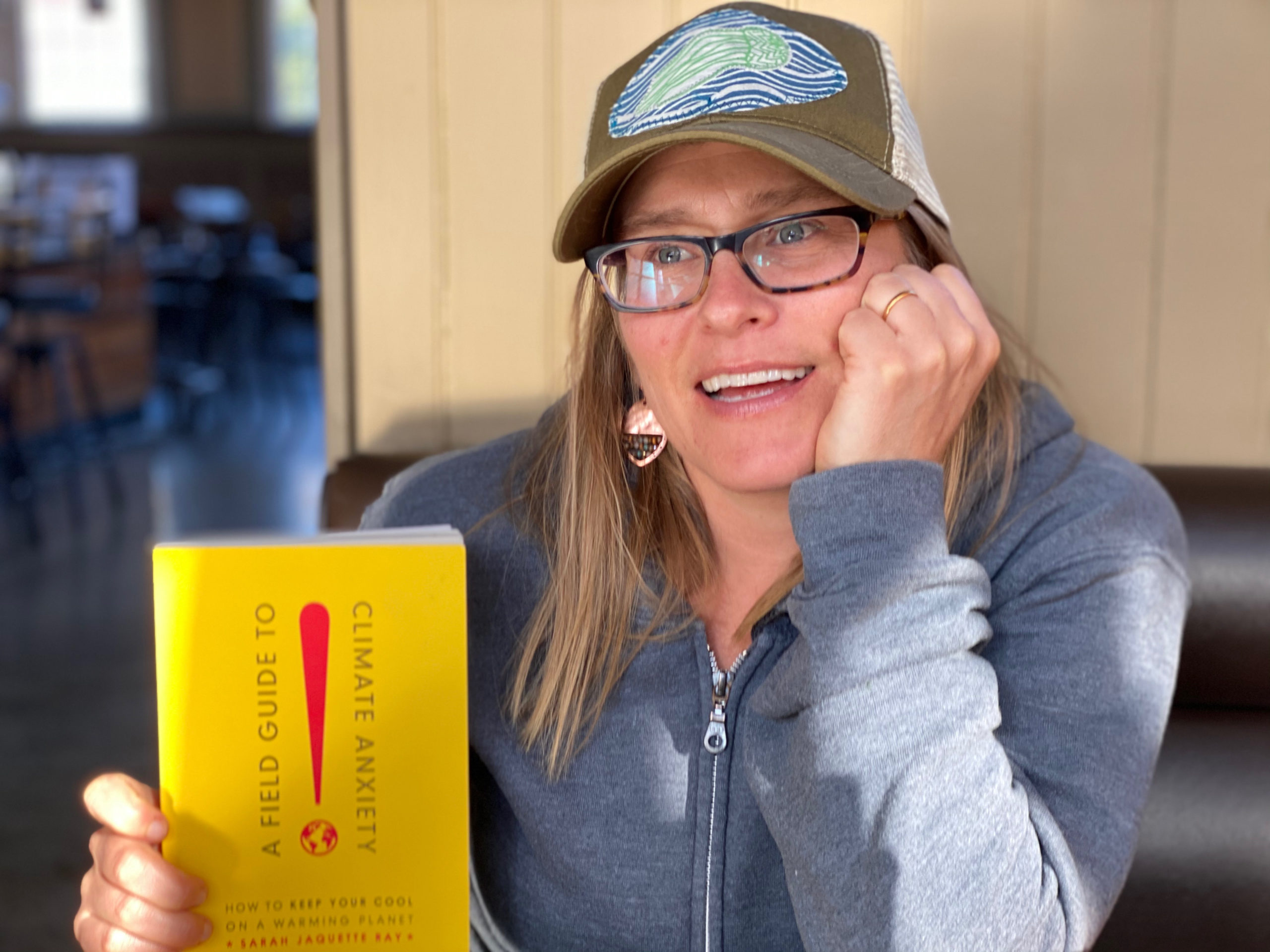
Dr. Sarah Ray, holding a copy of her book. Image credit: Good Grief Network.
Climate anxiety (interchangable with eco-anxiety) is used to describe an emotional response to the engagement with ecological degradation and climate change. Other ecological emotions encompassed within climate anxiety include: “fear, anger, exhaustion, powerlessness, feelings of loss, helplessness, and even phobia and despair”.[1] Leading researcher of climate anxiety, Panu Pihkala, identifies it as a phenomenon which – depending on the severity – has the ability to paralyze or “emerges as an adaptive response to the vast socio-ecological problems of our time” when it is “connected with expectation, motivation, and hopes.”[2]
I believe this point between paralysis and motivation is where the Center for Climate Action and Sustainability (CCAS) can be a resource to Evergreen. Facilitating elements of adaptive coping to the learning community encourages both individual health as well as the individual capacity to address the causes of climate change.[3] The Evergreen State College already provides an “education model that is participatory and democratic,”[4] which encourages the necessary sense of agency for students to feel capable of addressing climate change. In order to put a sense of agency into practice with feedback, the Center for Climate Action and Sustainability can connect students to local change-making opportunities through internships and other community partnerships. The Center can also build awareness of climate anxiety and other difficult emotions by providing literature, resources for hope, and a space for facilitated discussion groups[5], which encourages adaptive coping to stress and climate risks.[6] After experiencing and subsequently researching climate anxiety, what I see as most critical to overcoming the paralysis climate anxiety evokes, is to navigate hope with “a radical imagination about the future we desire”.[7] By facilitating creative workshops and active student engagement, CCAS can expand individual capacity to envision a hopeful and desired future within a climate-changed world. This capacity to imagine a desired world through hopelessness, guilt, and other difficult emotions we experience through climate change, serves as a channel to individual empowerment.
The Center for Climate Action and Sustainability is actively working to connect the Evergreen learning community to resources of hope and empowerment. As soon as the Center opened, I applied for an internship available to students, and was given the opportunity to do self-directed research and communication of climate anxiety in community with like-minded people, which subsequently allows me to work through my own experiences of difficult emotions. The Center will also be hosting a Climate Speaker Series, which has featured Dr. Jennifer W. Atkinson, a UW professor of environmental humanities who focuses on climate and mental health. The Speaker Series will also feature Dr. Sarah Jaquette Ray, who authored A Field Guide to Climate Anxiety. In addition to the speakers, CCAS will facilitate a creative workshop during the winter quarter, which will provide tools to empower those experiencing climate anxiety.
– Jamie Fiano, CCAS Intern, Spring 2023
[1] Baudon, P., Jachens, L. (2021). A scoping review of interventions for the treatment of eco-anxiety. International Journal of Environmental Research and Public Health, 18(9636). https://doi.org/10.3390/ijerph18189636.
[2] Pihkala, P. (2020). Eco-anxiety and environmental education. sustainability, 12(10149).
[3] Ágoston, C., Csaba, B., Nagy, B., Kőváry, Z., Dúll, A., Rácz, J., & Demetrovics, Z. (2022). Identifying types of eco-anxiety, eco-guilt, eco-grief, and eco-coping in a climate-sensitive population: a qualitative study. International Journal of Environmental Research and Public Health, 19(2461). https://doi.org/10.3390/ijerph19042461.
[4] Ojala, M. (2015). Hope in the face of climate change: associations with environmental engagement and student perceptions of teachers’ emotion communication style and future orientation. The Journal of Environmental Education, 46(3), 133-148.
[5] Pihkala, P. (2019). Climate anxiety. MIELA Mental Health Finland. https://helda.helsinki.fi/handle/10138/307626.
[6] Mah, A. Y. J., Chapman, D.A., Markowitz, E.M., & Lickel, B. (2020). Coping with climate change: three insights for research, intervention, and communication to promote adaptive coping to climate change. Journal of Anxiety Disorders 75(102282). https://doi.org/10.1016/j.janxdis.2020.102282.
[7] Ray, S.J., (2020). A field guide to climate anxiety: How to keep your cool on a warming planet. University of California Press.