Author: Michael Joseph (Page 3 of 4)

The Sustainability Grad Fellowship: Updates

Brief notes for program evaluation of Fall ‘24-25 with the Center for Climate Action and Sustainability (CCAS) 

Program Overview 

The Sustainability Graduate Fellowship Program, currently housed within the Center for Climate Action and Sustainability (CCAS), has continued to demonstrate significant value for The Evergreen State College. Originally managed by the Office of Sustainability, the program transitioned to CCAS this fall quarter following leadership changes. Recognizing the program’s critical role in advancing sustainability initiatives and student learning, CCAS ensured its continuation and integration into our broader climate action goals. 

Impact and Key Achievements 

The fellows have been instrumental in driving tangible progress across campus sustainability initiatives, providing both operational support and thought leadership. Below are highlights of their contributions: 

  1. Advancing Sustainability Metrics 
    • Fellows played a key role in AASHE STARS reporting, identifying areas for improvement to feasibly elevate Evergreen from Silver to Gold status. 
    • Their insights have informed strategies to enhance Evergreen’s sustainability performance with high-impact, low-lift actions. 
    • Historically they have contributed to greenhouse gas emissions reporting, gaining hands-on experience with institutional sustainability assessments. 
  2. Land Stewardship and Policy Development 
    • Fellows supported the development of a Land Stewardship Initiative, emphasizing ecologically sustainable and Indigenous-informed practices. This work has since been absorbed into the Space and Land Use Group (SLUG). 
    • Their collaboration with SLUG has enhanced campus governance protocols, ensuring sustainable land management practices are incorporated into decision-making. 
  3. Flagship Projects 
    • Thunderdome Pavilion Solar PV Array: Fellows led and supported the successful $256,000 grant initiative to install a solar photovoltaic array on the Thunderdome pavilion, contributing to campus renewable energy goals. 
    • Bulkhead Removal Project: Fellows accelerated this project through historical, ecological, and cultural research, reducing the timeline from 1-2 years to under one academic quarter. 
    • Contributions include educational signage development, public communication, and stakeholder engagement with faculty, students, and community members. 
    • They designed frameworks for future undergraduate research and ecological monitoring at the project site. 
  4. Enhancing Communication and Campus Engagement 
    • Fellows have developed educational tools such as ArcGIS Story Maps to highlight sustainability elements within Evergreen’s built and natural environments. Identifying lost LEED certification records/resources and have surprised facilities staff with their research and innovative findings. 
    • They supported literature reviews and conceptual work for sustainability definitions and frameworks to guide campus initiatives. For later integration into our planned campus-wide Sustainability Action Plan (SAP). 
    • Currently are playing an active role in organizing events like the Rachel Carson Forum, and public Town Halls on project, ensuring alignment with campus themes and community interests. 
  5. Skill Development and Professional Growth The program has provided graduate students with significant professional development opportunities, including: 
    • Training in project management tools (e.g., Gantt charts, online platforms). 
    • Exposure to interdisciplinary work such as graphic design, public speaking, and stakeholder communications. 
    • Development of Standard Operating Procedures (SOPs) for research and scientific design, enhancing undergraduate research pathways. 
  •  

Current Scope and Future Goals 

Currently, the program supports five graduate fellows: two first years working 10 hours per week, one second year working 20 hours. And another full 20-hour first year as CCAS wanted to utilize all the qualified candidates. Looking ahead, CCAS aims to: 

  • Expand the fellows’ involvement in policy development, particularly evaluating Renewable Energy Certificates (RECs) and their alignment with the Clean Energy Transformation Act (CETA). 
  • Compile a comprehensive Sustainability Timeline documenting Evergreen’s past achievements, current initiatives, and future goals within the Sustainability Action Plan (SAP). 
  • Support curriculum development, undergraduate research mentorship, and project management training. 

Conclusion 

The Sustainability Graduate Fellowship Program has proven invaluable for accelerating Evergreen’s sustainability goals, fostering interdisciplinary student learning, and advancing campus initiatives. With continued funding, the program holds immense potential to expand its impact through: 

  • Additional renewable energy and infrastructure projects. 
  • Expanded research, public engagement, and policy development. 
  • Deeper integration of sustainability into campus operations and student experiences. 

CCAS is deeply committed to nurturing the program’s success and ensuring it serves as a cornerstone for Evergreen’s leadership in sustainability and climate action. 

For additional information or updates, please contact the Center for Climate Action and Sustainability.a


This year’s Fall 2024-25 Fellowship Students include: 

Student Profile 

Bio and Digging Deep 

Ian Mann 

Pronouns: They/Them  

Academic Program/Year: Master of Environmental Studies Program Year 1/2  

Hometown: San Diego, CA  

A Fun Fact About Me: I love playing music! 

What’s one project or initiative you’d love to work on during your time here?  

I am excited about working with the bulkhead removal project, particularly in terms of working on the erosion control measures (soft armoring) and helping manage construction impacts and upland revegetation.  

Bio: Ian grew up in San Diego, CA, and has been slowly crawling northward since graduating from Cal Poly San Luis Obispo in 2019 with a B.S. in Environmental Earth and Soil Science. After completing their undergraduate degree, they lived in Chico, CA, and worked for a year for the primary cleanup contractor on the Camp Fire Cleanup Project in Paradise, CA, conducting on-site hazard assessments, site mapping, soil sampling, and contamination monitoring, and also served a summer term with the Washington Conservation Corps. Ian is a first-year student in the MES program and is passionate about a wide range of environmental topics such as biogeochemistry, soil contamination, and political ecology. 


Emma Hamaker-Teals 


Pronouns: She/Her  

Academic Program/Year: Masters in Environmental Studies 1st Year 

Hometown: Kennewick, Washington  

Fun fact: I am an avid reader and hiker 

Bio:  I grew up in Washington but left to pursue my undergraduate degree at the University of Oregon. I graduated with a degree in general social science and a minor in environmental studies. This past spring I did a study abroad in New Zealand and was able to learn firsthand about some of their indigenous environmental conservation methods. This, along with my schooling, got me interested in our environment and the different ways that we can lessen human impact on our earth.    

Enija Reed 


Pronouns: She/They  

Academic Program/Year: First Year MES Student  

Hometown: Arlington, Washington  

A Fun Fact About Me: I love photography and travel. 

Currently within the MES program and Sustainability Grad Fellowship program, Enija hopes to gain more perspective and knowledge on the field of climate change and sustainability, participate in the public knowledge building surrounding the restoration efforts of the bulkhead project off Geoduck Beach, and gain skills help in her hopeful future of climate and environmental action.   


Bio: Enija grew up in Washington State, leaving for a year to live in Arizona. With a passion for Marine Biology and Environmental Action, she came back to Washington and started her undergraduate degree at Evergreen State College. During undergrad, she studied climate changes effect on migration and traveled to Morocco, to meet with different NGOs who work with migrants and climate change. In addition to this, she worked with CCAS and participated in a community internship program at the Puget Sound Estuarium, focusing on environmental education, exhibit design, and grant database development.    

Amanda Rueda 


Pronouns: She/Her  

Academic Program/Year: Master of Environmental Studies Program Year 2/2  

Hometown: Born in Riverside, CA but grew up in Centralia, WA.   

What’s one project or initiative you’d love to work on during your time here?  

I am excited to broaden my research experience to habitat restoration and climate science with new ecosystems. One goal is to help with project development for long-term monitoring of forage fish after the Bulkhead removal project!   

Bio: Amanda graduated from Western Washington University in 2021, majoring in biology with a marine emphasis. She began studying marine mammals as a volunteer in the WWU Marine Mammal Ecology Lab. Then, she interned with Pacific Mammal Research in Anacortes, WA and assisted with photo identification of harbor seals and porpoises.  During this time, she was a long-term substitute teacher at Centralia Middle School and enjoyed teaching and encouraging youth. Next, she joined Sealife Response, Rehabilitation, and Research as an animal husbandry intern and helped with rehabilitating stranded and malnourished harbor seal pups.  Now, she is in the final year of the Master of Environmental Studies Program with Evergreen and is collaborating with Cascadia Research Collective on her thesis topic on gray whale foraging in the Puget Sound.    


Appendix: 

  1. Link to Logic Model for Commenting: Logic Model [Fellowship].vsdx 
  2. One-pager on Bulkhead Removal Study: First Draft 
  3. Thunderdome Solar Array Article: Read more here 
  4. Meet the Student-Staff: https://sites.evergreen.edu/ccas/meet-the-team/  

Solarpunk Survivalist’s Guide: Thriving Through Resilience and Action

The challenges we face—climate change, political instability, systemic injustice—can feel overwhelming. But Solarpunk offers us a vision of hope, resilience, and action. This guide isn’t about naive optimism or doomer despair; it’s about meaningful meliorism—the belief that with thoughtful effort, we can make things better. 

Solarpunk is more than an aesthetic. It’s a movement rooted in regenerative relationships between people and the planet, imagining futures where communities thrive. This guide is a starting point, combining practical tools and emotional strategies to help you navigate tough times and build a better world.

1. Start With Yourself: Emotional Resilience and Self-Care

Before you can engage with broader action, you need a strong foundation. Taking care of your physical and emotional well-being is essential, not optional. 

  • Maslow’s Hierarchy of Needs: Address basic needs like rest, nutrition, and safety before tackling larger challenges. 
  • Expand Your Window of Tolerance: This psychological concept refers to the capacity to cope with stress and regulate emotions. Practices like mindfulness, journaling, and time in nature can help expand it. 
  • Grieve and Feel: It’s okay to mourn the losses around you. Honoring these feelings makes space for growth and action. 

Practical Tip: Incorporate mindfulness into your day. A simple nature walk or grounding exercise can help you process emotions and recharge. 

Related Resource: 

Work That Reconnects offers exercises to foster emotional resilience and community connection. 

2. The Four Levels of Action: From Personal to Global

To make change less overwhelming, use the framework of the Four Levels of Climate Action, which applies to many areas of life: 

  1. Individual: Start small. Grow your own food, repair items, reduce waste, or learn a new skill.
  2. Close Community: Build stronger connections with family and friends. Create mutual aid networks or start local projects.
  3. Broader Communities: Volunteer, organize events, or support local organizations.
  4. Systemic Change: Advocate for policy changes, support sustainable businesses, and push for corporate accountability. 

Practical Tip: 

Reflect on where you are in these levels and what feels doable for you right now. Small, imperfect actions collectively create powerful change. 

Related Resource: 

Dr. Ayana Elizabeth Johnson’s Climate Venn Diagram helps identify where your passions, skills, and needs intersect.

3. Find Your Role in the Ecosystem of Change

Not everyone is a frontline activist, and that’s okay. Consider your role in the broader social ecosystem: 

  • Healer: Focus on care and emotional well-being. 
  • Storyteller: Inspire others through writing, art, or performances. 
  • Organizer: Create systems and bring people together. 
  • Builder: Design practical solutions, from permaculture gardens to green infrastructure. 

Practical Tip: 

Use the Climate Venn Diagram or Joanna Macy’s Four Questions of Preparation to discover your role: 

  • What do I love? 
  • What am I grateful for? 
  • What do I grieve? 
  • What do I envision?

4. Community Resilience: Building Together

Solarpunk emphasizes collective action and mutual aid. No one thrives alone. 

  • Start a Mutual Aid Network: Share resources, skills, and support with your neighbors. 
  • Celebrate Joy: Host community art projects, potlucks, or music events to foster connection and hope. 
  • Reclaim Nature: Collaborate on regenerative projects like community gardens, habitat restoration, or tree planting. 

Practical Tip: 

Look for local groups already doing this work, or start your own with a small, focused mission. 

Related Resource: 

The Indigenous Environmental Network offers guidance on community resilience and environmental justice.

5. Decolonize Your Mindset: Reframing Nature and Humanity

Western myths often portray humans as destroyers of the environment, but Indigenous practices show that we can be regenerative stewards of the earth. 

  • Challenge the Wilderness Myth: Humans are not inherently harmful to nature. Many cultures have coexisted sustainably with their environments for centuries. 
  • Reconnect with the Land: Spend time observing, learning from, and contributing to your local ecosystem. 

Practical Tip: 

Learn about Indigenous practices and perspectives in your area. Start small by planting native species or learning traditional ecological knowledge. 

Related Resource: 

Robin Wall Kimmerer’s Braiding Sweetgrass is an excellent introduction to Indigenous wisdom and sustainability.

6. Avoid Burnout: Regenerate Yourself

Burnout doesn’t just harm you—it ripples through your community. Avoid it by prioritizing rest, reflection, and regeneration. 

  • Feel Good vs. Do Good: Ask yourself: Is this action about venting or building bridges? Balance emotional release with constructive action. 
  • Slow Down to Go Far: Focus on strategic, sustainable efforts rather than quick fixes. 

Practical Tip: 

Incorporate “regenerative rest” practices into your week—disconnect from social media, spend time in nature, or engage in creative hobbies. 

Related Resource: 

Adrienne Maree Brown’s Emergent Strategy explores sustainable movement-building inspired by nature. 

7. Taking Action: Tools and Resources

To get started, here’s a curated list of tools, readings, and resources: 

  • Books: 
    • Emergent Strategy by Adrienne Maree Brown 
    • All We Can Save by Ayana Elizabeth Johnson & Katharine Wilkinson 
    • This Changes Everything by Naomi Klein 
  • Podcasts: 
    • How to Save a Planet 
    • Outrage + Optimism 

You can also visit our resource page to find links to additional information. And if you see opportunities or gaps, please email us at ClimateAction@evergreen.edu so we can continue adding/cross linking other collections of resources!

Conclusion: Hope as a Practice 

The future isn’t set in stone, and neither are we. Solarpunk reminds us that resilience and regeneration are possible, even in the face of daunting challenges. Start small. Rest often. Dream big. Together, we can create a world where hope isn’t just an idea but a practice. 

Why your Evergreen Vote Matters – Both Nationally and Locally 

With the November 5th election approaching, it’s easy to focus on the “Big Election” – the one that will shape the next four years in the White House. But it’s important to remember that some of the most impactful changes happen closer to home, often in the local elections and ballot measures that don’t always make front-page headlines. 

In fact, many local measures have long-term effects on your community—on things like transportation, schools, housing, and the environment. These are issues that might not grab national attention, but they affect your everyday life and the future of the place you live. However, they often slip under the radar, a consequence of both media sensationalism and the desensitization that comes with nonstop political coverage. Whether this lack of attention is a bug in the system or an intentional feature driven by political interests is up for debate—but the importance of these issues is not. 

For those of you who are new to Washington State or Olympia, it might surprise you to learn that the political landscape here isn’t as clear-cut as it seems. While the area is known for its progressive leanings today, historically, Olympia has deep roots in industries like lumber, fishing, and farming. Many long-time residents still embody these working-class values. 

The 1970s brought a wave of change, largely thanks to the founding of The Evergreen State College, which injected the region with a more diverse population and a broader spectrum of political thought. These shifts have contributed to a slightly more diverse, varied political climate, that blends traditional values with forward-thinking ideas. 

This election, particularly the local ballot measures, will shape the policies and programs that directly affect your life, not just for the next four years, but for years to come. Whether you’re planning to be here for one year, two years, or longer, the decisions made in this election will impact you—and also the children, families, and future students who call Olympia home. 

So, if you’re new to the area, your vote is especially important. Whether it’s about funding local schools, addressing climate change, or improving transportation, these ballot items could affect not only your time at Evergreen but also the community you interact with daily. 

Make your voice heard. Your vote is a critical part of shaping both the present and the future of this unique region. If you’re curious to know a bit more about some of the key local ballot measures you’ll be seeing on your ballot. Read on!

What’s on the Ballot: 

What is Initiative No. 2117? 

Initiative 2117 would repeal the 2021 Washington Climate Commitment Act (CCA), which aimed to reduce greenhouse gas emissions by 95% by 2050. If passed, No. 2117 would also prohibit state agencies from running programs that manage carbon emissions, like cap-and-trade. 

What is Cap-and-Trade? 

In simple terms, cap-and-trade is like a game where big companies have to follow rules about how much pollution they’re allowed to make. Imagine each company has a jar, and they can only fill it up with a certain amount of pollution (carbon emissions). If they want to make more pollution than their jar allows, they have to buy extra room from other companies that aren’t using all of theirs. It encourages companies to find ways to make less pollution so they can sell their extra space to others. 

This system helps keep the air cleaner while also allowing businesses some flexibility. If Initiative 2117 passes, it would stop this system in Washington State. 

How Did Initiative 2117 Get on the Ballot? 

Initiative 2117 was proposed by Let’s Go Washington, a group led by State Rep. Jim Walsh and conservative donor Brian Heywood. The state legislature took no action on the proposal, so it was added to the ballot for voters to decide (ballotpedia.org). 

Opponents of Initiative 2117 

Those against No. 2117, including environmental groups, tribal nations, and labor unions, say that repealing the Climate Commitment Act would mean cutting billions of dollars from programs that help reduce pollution, fight wildfires, and protect our water and air. They also warn that vulnerable communities, including tribal lands and low-income areas, would be hit the hardest by more pollution and fewer environmental protections . 

Supporters of Initiative 2117 

Supporters of No. 2117 believe that the current cap-and-trade system raises costs for everyday people by making gas, utilities, and groceries more expensive. They advertise that repealing the system would help lower living expenses for families in Washington and say that the current system doesn’t do enough to actually reduce pollution so it should be eliminated entirely (ballotpedia.org). 

What’s Next? 

For more information about voting, registering to vote, or getting involved in local issues, visit the Civic Engagement page or Evergreen.edu/Vote. If you want to voice your concerns or get involved in a campaign, connect with WashPIRG and the Geoduck Student Union (GSU). These groups can help you stay informed and take action on important issues like Initiative 2117. 


Planting the Seeds of Change: Exploring Evergreen’s Ecology of an “Edible Campus”

Exploring the Legacy of Student-Led Projects at Evergreen with our newest academic program.

Recently, I had the opportunity to engage with a group of motivated students during a workshop session with Evergreen’s new Edible Campus academic program. This experience was not only a showcase of student ingenuity but also a reflection on the powerful legacy of student-originated projects that continue to shape our campus. It was during this session that I witnessed firsthand how students are driving change through hands-on work in sustainability, community well-being, and innovative design. 

Cynthia Kennedy set the stage by introducing me to the students, prompting them to try to guess just how many student-initiated projects have impacted Evergreen’s infrastructure. The 50 students (many of them first-year students) estimated the number to be between around 4 or 8, with a few guessing 30. A single student boldly guessed 100. By the end they learnt that there are over 160 student-led projects (that I personally know of) cataloged in the Greener Project Database, and that’s just the ones that have been able to catalog successfully thus far. 

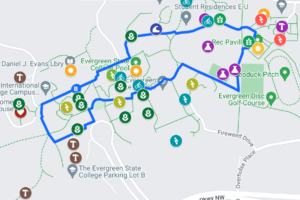
We then embarked on the two-hour walking tour, exploring key sites across campus that highlight the sustainable initiatives students have brought to life so they could learn from and implement lessons to their own upcoming work. Starting at the Seminar 2 building, we ventured through various community gardens, the covered pavilion (affectionately known as the Thunderdome), and residential areas where students actively participate in permaculture and sustainable living practices. We also visited the aquaponics greenhouse, a prime example of how students are addressing food insecurity while maintaining a close connection to the land and sciences. 

One particularly exciting stop on the tour was the intended site for the return of the campus bike shop, an important project that will not only support sustainable transportation but also create a community hub for students interested in cycling culture and repair work. We wrapped up our journey at the House of Welcome Longhouse, where we discussed ongoing work in the botanical gardens, emphasizing the integration of Indigenous knowledge and community stewardship. And I acknowledged the presence of my own very first project at Evergreen, a wood drying shed still standing more than a decade later from 2013. 

We also didn’t shy away from the reality of when projects fail. I explained how my very first attempt at a project led to total disaster. But how it genuinely was the best thing that could’ve happened for me (leading to the aforementioned successful drying shed). And they saw first hand the difference between a garden with a plan and one without.

Throughout the tour, we talked about practical tools for student projects, like the principles of design thinking, the power of GANNT charts for project planning, and understanding the organizational structure of The Evergreen State College. Some were particularly interested in the funding opportunities available through the Clean Energy Committee, which provides financial support for student-led sustainability projects. I was happy to support Cynthia and Steve’s work with this program. As this kind of real-world application of academic learning allows students to take their ideas from concept to reality, turning Evergreen into a living laboratory for change. 

What was perhaps most inspiring was hearing from students about their own ideas and what they hope to bring to the campus community. Many of these students are experiencing in-person instruction for the first time in their higher education academic careers, and their eagerness to solve problems was contagious. They weren’t simply identifying issues—they were actively brainstorming solutions and exploring ways to make Evergreen a better, more sustainable place for everyone. Even down to how to make Red Square less slippery in the rainy seasons! 

The work students are doing now echoes the hopeful, regenerative future that solarpunk envisions—where people live in harmony with the environment, harness technology for the greater good, and build resilient, connected communities. Evergreen, in many ways, embodies these values already, and it was exciting to share that connection with these students. 

As we continue to support these efforts through programs like Edible Campus and other sustainability initiatives, I am filled with hope for what the future (and Evergreen) holds! The students I met on this tour are not only passionate but also deeply committed to making a difference. Their work is a testament to the potential of student-led projects to transform our campus and inspire broader change. I look forward to seeing their ideas take shape in the coming months and years, and I hope they continue to build a campus—and a world—that reflects their values and vision. 


Kicking off O-Week with Nausicaä (and the Power of Imagination): Inspiring Environmental Leadership at Evergreen

Realizing through first-year students how Empathy, Environment, and Leadership Resonate with Evergreen’s Mission.

On September 24th, the Climate Center hosted with the Experiential Learning Hub a film screening of Nausicaä of the Valley of the Wind as part of the campus Orientation Week. This wasn’t just any movie night; it was a deeply reflective experience for many students, and it offered more than just entertainment. The themes of environmentalism, leadership, and the solarpunk way of life intertwined with the lived experiences and aspirations of the Evergreen student body. 

I was struck by how the film served as a mirror to so many of the issues we care about in our academic and personal lives—sustainability, social justice, and the need for balance between technology and nature. As Aeowyn, one of our senior student workers, put it in her introduction of the film, Nausicaä is about a young woman growing into an activist and a leader, standing between the forces of destruction and renewal. Her journey, set in a post-apocalyptic world where people have rebuilt their lives in harmony with the land, feels remarkably close to the solarpunk ideals that are gaining momentum today. Solarpunk imagines a future where technology and nature coexist in symbiosis, and that’s exactly what the people of the Valley of the Wind demonstrate—living sustainably in a world that has been ravaged but still holds beauty and hope. 

The students and staff who attended—nearly 60 of them—were visibly moved by the film. Many were seeing it for the first time, while others, like myself, had grown up with it. The event felt intimate, despite the full room. We had set up comfortable spaces, served fresh fruit and veggies snacks from our own campus Organic Farm, and welcomed everyone with classic popcorn from Student Activities. Intended to make the space feel safe and inclusive, particularly with the heavier themes present in the film, including environmental collapse, violence, and the lasting scars of war. 

One of the most powerful aspects of the event were the (unintended) post-film discussion (like true Greeners many of us couldn’t refrain from seminaring on what we’d just seen). Students and staff began to share how Nausicaä sparked their own thoughts on activism, climate justice, and leadership. They resonated with the way Nausicaä blends scientific inquiry—she collects data, studies plants, and constantly tests her environment—with a more intuitive, almost spiritual understanding of the world. This duality reminded many of us of how we, as individuals and communities, navigate different ways of knowing. Nausicaä’s use of both Western scientific methodologies and Indigenous wisdom resonated deeply with students. Her ability to unite people not through force, but through empathy, learning, and leadership, mirrors the kind of change we aspire to foster on campus and beyond. 

As I reflected on the event afterward, I realized how important it is to provide students with examples of both the challenges and the possibilities that lie ahead of us. Nausicaä shows a world on the brink of collapse, but also one where small communities have figured out how to live in balance with the environment—a vision that felt especially pertinent in a time of growing climate anxiety. The students saw characters who grappled with power, corruption, and greed, but who ultimately found ways to heal both the land and their societies. It’s a reminder that even in the face of overwhelming adversity, there’s room for hope, ingenuity, and collective action. 

This screening was more than just the start of the school year; it was a way to begin conversations about the roles we each play in shaping the future. As we watched the film together, we were reminded of the different ways people can contribute to social change. Whether as storytellers, healers, builders, or guides, the characters in Nausicaä embody many of these roles, and students were quick to see themselves reflected in these archetypes. Nausicaä herself is an inspiring example of how to lead with both strength and compassion—a message I hope will stay with students throughout the year. 

Hosting this event reaffirmed the power of storytelling as a tool for sparking social imagination. It wasn’t just about watching a movie; it was about connecting with each other, thinking critically about the world we live in, and exploring what’s possible. And as we continue our work on campus, whether through climate action projects, internships, or student-led initiatives, the themes of Nausicaä will likely serve as a guiding light—reminding us that even in the most difficult times, we have the capacity to create a better future.

Washington’s Climate Centers Unite!

A Day of Inspiration and Collaboration: Reflections on the WAHESC Annual Meetup at UW

On Wednesday, August 28th, I made the drive from Olympia to Seattle, eagerly anticipating the annual Washington Higher Education Sustainability Conference (WAHESC) meetup. A part of WOHESC‘s Washington side. As someone deeply involved in sustainability efforts at Evergreen State College, this gathering was more than just a networking opportunity—it was a chance to reconnect, share ideas, and find inspiration among a community of like-minded individuals dedicated to climate action and sustainability.

A Walk Through UW: Integrating Nature, Humanity, and Urban Spaces

After gathering, our day began with a walk-and-talk tour around the University of Washington campus, where we explored how this urban institution works to integrate nature and human development. One of the most memorable spots was a secluded area that Daimon, UW Sustainability’s Communications Coordinator, referred to as a “secret garden.” Tucked away from the bustling urban environment of Seattle, this quiet space felt like stepping into another world—a peaceful retreat where nature reclaims its place among the cityscape. Walking through hidden branches, we entered this serene spot, and it was easy to see why it’s a favorite among those who seek a moment of calm in their busy lives.

As we continued our tour, Daimon shared a touching anecdote about the campus’s iconic fountain. Every spring, mama ducks lead their ducklings to the fountain, but the little ones often struggle to climb out on their own. In response, the university installs a ramp each year to help the ducklings safely exit the water. This simple yet thoughtful solution perfectly encapsulates  UW’s approach to sustainability: using human ingenuity and technology to address caused issues and strive to coexist harmoniously with the natural world.

Another highlight of the tour was our visit to a building designed with biophilic principles—a concept I was newly introduced to. Biophilic design focuses on enhancing the natural aspects of a space rather than hiding them. The building’s wooden interior, with its visible textures and natural elements, stood as a testament to this philosophy. It was a powerful reminder of the importance of bringing nature into our built environments, not just as an aesthetic choice, but as a way to foster well-being and connection to the natural world.

Inspiring Conversations and Collaborative Exchanges

The tour wasn’t just about exploring the campus; it was about the conversations that took place along the way. I had the opportunity to speak with Danny, the director of UW’s Campus Sustainability Fund (similar to our own Clean Energy Committee), about the challenges and successes we’ve both encountered in our roles. As two individuals that recently entered into leadership positions in sustainability, it was incredibly validating to hear about the similar hurdles we’ve faced and the strategies we’ve used to overcome them.

These conversations highlighted the collaborative spirit of WAHESC. One particularly exciting moment was when I shared an idea for the Greener Project database that we’ve been developing at Evergreen. To my surprise, this concept sparked interest among other attendees, leading to discussions about creating a shared online tools library for WAHESC members. This collective resource could serve as a repository for sustainability projects, educational tools, and engagement activities, accessible to all participating institutions.

The idea of student engagement was another recurring theme throughout the day. We exchanged strategies on how to better involve students in sustainability efforts, with one standout example coming from Bellevue College, where students participated in a mountain biking tour of a wind turbine farm. This kind of hands-on, experiential learning is something we’re excited to explore further at Evergreen, inspired by the innovative approaches shared at this meetup. And now CCAS hops to lead a similar trip with Evergreen’s SWS and TOP program.

A Legacy of Sustainability: The Medicinal Garden and Indigenous Stewardship

Our tour also took us to a historic medicinal garden, a living relic from the UW medical school’s early days. While modern medicine has evolved, this garden remains a powerful symbol of the university’s roots and its ongoing commitment to sustainability. The garden not only preserves the history of medicinal plants but also ties into the broader theme of indigenous stewardship, highlighting the deep connections between traditional knowledge, ecological restoration, and contemporary sustainability efforts.

This area of campus is also a spot of student activity, with numerous projects focused on ecological restoration. It was inspiring to see how students are actively contributing to sustainability efforts, working on projects that honor both the past and the future. One particularly charming detail was learning that herons nest in this area, fishing in nearby waters and adding to the sense of a campus that truly lives in harmony with its natural surroundings.

Reflections and Looking Forward

As I drove back to Olympia, I couldn’t help but feel invigorated by the day’s events. Summer can be a quiet and sometimes isolating time at Evergreen, but this meetup was a reminder of the vibrant, supportive larger community in higher education we’re part of. It was also a powerful affirmation that no one institution has all the answers when it comes to sustainability—we’re all learning and growing together, finding new ways to integrate nature, technology, and human ingenuity in our efforts to build a better future.

Looking ahead, I’m excited to continue working on the online tools library and exploring new student engagement strategies inspired by our WAHESC peers. This meetup has renewed my commitment to sustainability and reminded me of the incredible potential that exists when we come together, share ideas, and support one another in our collective journey toward a more sustainable world.

Call to Action

I encourage everyone reading this to get involved in sustainability efforts at your own institutions or in your communities. Whether it’s through small everyday actions or larger initiatives, each contribution helps build a better future for all. Follow along with our work at the Climate Center, and consider joining us this upcoming WOHESC conference March 5-7th—you never know what inspiration you might find!

Community Recap: August Green Drinks

Event Recap:

On August 7th, the Olympia Green Drinks community gathered for another enriching evening filled with vibrant discussions, insightful presentations, and plenty of networking opportunities. This month’s event was highlighted by our special guest speaker, Mo, an archaeologist with extensive experience working with state parks and indigenous communities. Mo captivated the audience with stories of the geological and cultural histories of our region, emphasizing how understanding the past can guide us in addressing today’s climate challenges. 

Event Highlights: 

Community Announcements: 

  • Puget Sound Estuarium is buzzing with exciting events, fundraisers, and exhibits. It’s a great time to get involved and learn more about our local marine ecosystems. 
  • The Olympia Port Watching Groups are taking action, with a petition challenging logging activities. Their efforts to make information more accessible online are commendable. 
  • The Clean Water’s Alliance is gearing up for a summit focused on protecting the Black Hills from mining activities—an event not to be missed for those passionate about environmental preservation. 
  • Mark your calendars for Merisha Workshops on August 24th, where you can dive into permaculture and seed-saving techniques. 
  • Don’t forget the Festival of the Steh-chass on August 17th, a celebration of culture, community, and sustainability. 

The Main Event: Guest Speaker Mo 

Mo’s presentation was a deep dive into the intersection of archaeology and climate action. Highlighting the Stone Age, or what Mo termed the “Organic Age,” as a period of indigenous innovation, they discussed the concept of “catch and release archaeology” and the importance of returning people to the land as a form of sustainability. Mo reminded us that archaeology not only unearths lost artifacts but also uncovers the stories and practices that can inform our current climate strategies. They emphasized that many of our ancestors around the world survived climate challenges, and by understanding their methods, we can adapt similar approaches today. 

One fascinating example shared was the indigenous use of ironwood trees, a brilliant illustration of how archaeological knowledge, when combined with indigenous wisdom, can offer profound insights. Mo explained how the bark and materials from these trees could be woven into incredibly strong, water-tight baskets. This process was not only ingenious and effective but also more sustainable than traditional pottery (and more lightweight). These woven baskets were lighter, compostable, and easily broken down, challenging the conventional notion that societies without pottery were primitive. 

It was also emphasized that archaeology is not just about uncovering artifacts but also about understanding the innovative practices that have sustained communities for generations. They remarked, “I’ve always seen myself as Punk. And at some point, I learned that being an activist doesn’t always mean putting your body on the line.” This powerful statement resonated with many in the audience, reminding us that activism can take many forms, from scholarly work to everyday actions that drive change. 

Upcoming Events: The evening also featured announcements of several other exciting upcoming events, including the grand opening of Oly Opi, a bird-watching tour, and a unique shark dissection event. Plus, don’t miss the Native Art Fair in Tacoma, which promises to be a fantastic celebration of indigenous art and culture. 

Overall, the August edition of Olympia Green Drinks was a blend of education, activism, and community spirit. We’re looking forward to seeing everyone at the next event—stay tuned for more details! 

For more event photos visit the Olympia Green Drinks’ Instagram Post!

Green Drinks December Community Gathering

🌿🍃 Green Drinks Olympia Community Update 🍃🌿

Hey Olympia friends! Last week’s Green Drinks meetup was a blast, full of engaging discussions and inspiring initiatives. Here’s a quick recap of what students and the community learned and some upcoming opportunities:

The main feature of the night was a presentation from DERT by our very own Evergreen MES Grad student Casey Allen and Caroline Slagle. Who did a fantastic job outlining the ongoing success of restoring the Deschutes Estuary from capitol lake, and engaging the group while taking in community input!

  1. 🌊 Restoring the Deschutes Estuary: Big shoutout again to DERT for their insightful presentation. If you want to learn about the upcoming community design charrettes and voicing visions for Heritage Park and the Estuary, join their cause and stay updated with their monthly newsletter. Dive in at Deschutes Estuary Restoration Team. 
  2. 📚 Discover Olympia’s Hidden Histories: Explore the untold stories of our city with the Evergreen project. A must-see for history buffs! Check it out here.
  3. 🏗️ Shape Your City: The City of Olympia is looking for voices on their Design Review Board. Apply by Dec 15th at Port Olympia.
  4. 🌱 Eco-Friendly Real Estate Class: Interested in sustainable real estate? Keep an eye out for Brian’s upcoming class!
  5. 🐻 Speak Up for Grizzlies: Your voice matters in the grizzly bear restoration project. Share your thoughts here.
  6. ✍️ Your Voice in Thurston County: Engage in public comment periods and help shape our community’s future. Learn more at Public Participation.
  7. 🌲 Forest Carbon Storage Discussion: Curious about carbon storage under our national forests? NPR has the scoop. Read more here.
  8. 🌊 Turn of the Tides Event: Puget Sound Estuarium shared the Dec 9th info for a day of eco-centered fun! Details at Yelm Community.
  9. 🛍️ Local Business Updates: Exciting times for Blue Heron Bakery and King Solomon’s Reef. Stay tuned for their new ventures!
  10. 💧 Join Puget Sound Keepers in Lobbying: Get involved in environmental advocacy with Puget Sound Keepers. Check out upcoming events to engage here.
  11. 🌺 Gardening Workshop: Enhance your green thumb with our community member’s workshop, starting in February. To learn more explore fertileground.org.

We’ll see y’all again in the New Year! 💚 #GreenDrinksOlympia #CommunityEngagement #EcoOlympia

Cultivating Sustainability: The Evergreen State College Tacoma’s Hydroponics Lab Initiative

Introduction: In the heart of Tacoma, Washington, The Evergreen State College is embarking on an innovative project to revolutionize sustainable agriculture and education. The Hydroponics Lab, a brainchild of collaboration between The Tacoma Evergreen State College, and Garden of Eden LLC, aims to introduce a cutting-edge approach to urban farming, providing students with hands-on experiences in sustainable practices.

CCAS Student-Staff Intern Vanessa Doveno (Class of ’24) in Fall Quarter took an individual learning contract to examine community engagement and aspects of sustainable design with a focus on urban agriculture and redeveloping the beloved Tacoma Outdoor Community Garden with grant funding. In Winter Quarter, she stepped into the additional role of project manager and student-lead for the Hydroponics, and expanded recruitment for the garden. Keep an eye out for future updates from her work!

Sowing the Seeds of Change: The project’s roots delve deep into a 4 year dream. Spearheaded by Michael Twiggs, CEO of Garden of Eden LLC, the initiative proposes the development of an indoor hydroponics lab at the Tacoma campus. This garden serves a dual purpose: producing fresh, locally grown food and serving as a laboratory for students to explore the intricacies of urban farming. The community garden also hopes to be a space in which  community members of all ages can  be involved in in educational programs.

Phase 1: Indoor Gardening: The inaugural phase focuses on the establishment of an indoor hydroponic garden, utilizing advanced techniques for cultivating leafy green vegetables and microgreens. Students will actively engage in learning about indoor growing techniques, experimenting with alternative crops, and understanding the dynamics of a sustainable urban indoor gardening business. The curriculum spans science, technology, engineering, math, and agriculture, embodying a comprehensive “STEAM” approach.

Phase 2: Teacher Training: As the project takes root, future phases envision training leads in hydroponic gardening programs at elementary and secondary levels. This not only expands the project’s impact but also aligns with the broader mission of fostering education and community engagement.

Phase 3: Sustainable Living Institute: Looking ahead, the project aspires to evolve into a Sustainable Living Institute, fostering research, innovation, and community development through sustainable practices. This visionary step aligns with a commitment to addressing broader environmental and societal challenges.

Funding the Future: To realize these aspirations, the project sought support from the Clean Energy Committee. A proposal was submitted Dec. 4th 2023, outlining the funding required for the Hydroponics Lab’s Phase 2 implementation, emphasizing the importance of sustainability, educational enrichment, and community engagement.

Community Involvement and Training: The engagement of students, faculty, and the wider community is integral to the project. Student workers will play a pivotal role in the day-to-day operations of the lab, gaining valuable experience and contributing to the its success. Regular training sessions, workshops, and seminars aim to spread awareness and knowledge about hydroponics, promoting a culture of sustainable practices.

Cultivating Success: With a meticulous timeline in place, including deep cleaning, orientation, and safety training, the project is set to take off at the beginning of the Winter quarter. As the hydroponic garden begins to flourish, it symbolizes not just the growth of plants but also the cultivation of sustainability, knowledge, and community at Tacoma campus.

Conclusion: While still in the development and “growing” phase, the Hydroponics Lab can be a beacon of sustainable innovation, education, and community engagement. As the project unfolds, it promises to cultivate not only fresh produce but also a future generation passionate about sustainable living and environmental stewardship. This initiative embodies the college’s commitment to holistic education and its role as a catalyst for positive change in the community and beyond.

To follow more on either the hydroponics lab development, or the community garden you can follow these links below:

Unveiling Potential – A Site Assessment Journey with Olympia Community Solar

On August 22nd, 2023, a community of CCAS interns, Evergreen Staff, and 3rd Party Contractors/Consultants performed a site assignment for the upcoming potential solar installation of the Covered Rec Pavillion.

By: Keira Jensen, MES Grad student, CCAS Extern

It was a quiet day, with full clouds just starting to rain. Mason, the president of Olympia Community Solar (OCS), had gotten there early to get baseline drone footage of the rooftop. He and Evergreen’s manager for this project were both standing in the damp field facing towards the empty roof. As the drone was looping down through its last flight, the solar installers trickled in. Some started chatting with colleagues from other companies, others were already clearly taking mental notes on the state of the building. A clipboard was passed around to confirm attendance and collect contact information, once that was done the site assessment officially began. 

The project manager gave a brief background of the project, overviewed the timeline, and went over the requirements for safety and technical specifics. The installers started asking questions, some were answered in the moment, and some would have to wait until the information could be dug up. All questions were recorded by the Evergreen staff, so that official answers could be shared out with everyone later. 

The air felt alive with potential. You see the place as it is, but also more and more start to see it as it could be. The trucks that will move in, where equipment will be stored, the steps needed to avoid damaging the grass, or at least repairing in after. The quiet day-to-day of the field disrupted, as workers move about their business, applying their craft as they set up rigging and frames and solar panels. 

Each vision is a bit different, changing based on replies to questions on the quality of the roof, access to storage areas for equipment, and what exactly the electrical setup and metering systems look like. The process is professional, but exciting in a way that makes it easy to envision just what a solar installation here will look like. The different movement and loading plans, the shifting visions of how to best lay out the panels. The idea of putting them in the shape of a geoduck gets a laugh from the crowd. 

There are no firm segments to the process. Questions get asked throughout, and at some point, people want to take a look at the electrical wiring and meter. The first room to look at is a discreet block of concrete within the main building, with a dim light and only enough space for a few installers to shuffle in at a time. They look at the wiring setup, take notes, snap pictures, then mill and chat outside. 

The same thing happens again, this time in a back room in a small building full of washers and dryers. This is where the building’s electrical system meets up with the rest of the campus’s grid. More talking, more pictures. This room is even smaller, so the process takes longer leaving more time to mingle. People make new connections, and follow-up on shared projects and plans. As the rain gets heavier questions start to fade out, last comments are made on timelines and submission dates, and everyone starts to disperse. And the site assessment is done. Nothing physically has changed – but the feeling of potential still lingers. I’m excited to see what comes of it. 


« Older posts Newer posts »