Exploring the Legacy of Student-Led Projects at Evergreen with our newest academic program.
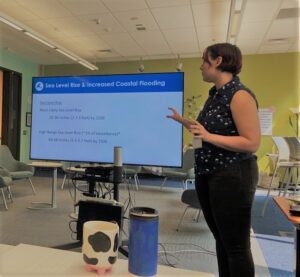
Recently, I had the opportunity to engage with a group of motivated students during a workshop session with Evergreen’s new Edible Campus academic program. This experience was not only a showcase of student ingenuity but also a reflection on the powerful legacy of student-originated projects that continue to shape our campus. It was during this session that I witnessed firsthand how students are driving change through hands-on work in sustainability, community well-being, and innovative design.
Cynthia Kennedy set the stage by introducing me to the students, prompting them to try to guess just how many student-initiated projects have impacted Evergreen’s infrastructure. The 50 students (many of them first-year students) estimated the number to be between around 4 or 8, with a few guessing 30. A single student boldly guessed 100. By the end they learnt that there are over 160 student-led projects (that I personally know of) cataloged in the Greener Project Database, and that’s just the ones that have been able to catalog successfully thus far.
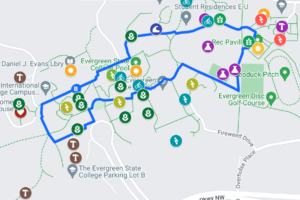
We then embarked on the two-hour walking tour, exploring key sites across campus that highlight the sustainable initiatives students have brought to life so they could learn from and implement lessons to their own upcoming work. Starting at the Seminar 2 building, we ventured through various community gardens, the covered pavilion (affectionately known as the Thunderdome), and residential areas where students actively participate in permaculture and sustainable living practices. We also visited the aquaponics greenhouse, a prime example of how students are addressing food insecurity while maintaining a close connection to the land and sciences.
One particularly exciting stop on the tour was the intended site for the return of the campus bike shop, an important project that will not only support sustainable transportation but also create a community hub for students interested in cycling culture and repair work. We wrapped up our journey at the House of Welcome Longhouse, where we discussed ongoing work in the botanical gardens, emphasizing the integration of Indigenous knowledge and community stewardship. And I acknowledged the presence of my own very first project at Evergreen, a wood drying shed still standing more than a decade later from 2013.
We also didn’t shy away from the reality of when projects fail. I explained how my very first attempt at a project led to total disaster. But how it genuinely was the best thing that could’ve happened for me (leading to the aforementioned successful drying shed). And they saw first hand the difference between a garden with a plan and one without.
Throughout the tour, we talked about practical tools for student projects, like the principles of design thinking, the power of GANNT charts for project planning, and understanding the organizational structure of The Evergreen State College. Some were particularly interested in the funding opportunities available through the Clean Energy Committee, which provides financial support for student-led sustainability projects. I was happy to support Cynthia and Steve’s work with this program. As this kind of real-world application of academic learning allows students to take their ideas from concept to reality, turning Evergreen into a living laboratory for change.
What was perhaps most inspiring was hearing from students about their own ideas and what they hope to bring to the campus community. Many of these students are experiencing in-person instruction for the first time in their higher education academic careers, and their eagerness to solve problems was contagious. They weren’t simply identifying issues—they were actively brainstorming solutions and exploring ways to make Evergreen a better, more sustainable place for everyone. Even down to how to make Red Square less slippery in the rainy seasons!
The work students are doing now echoes the hopeful, regenerative future that solarpunk envisions—where people live in harmony with the environment, harness technology for the greater good, and build resilient, connected communities. Evergreen, in many ways, embodies these values already, and it was exciting to share that connection with these students.
As we continue to support these efforts through programs like Edible Campus and other sustainability initiatives, I am filled with hope for what the future (and Evergreen) holds! The students I met on this tour are not only passionate but also deeply committed to making a difference. Their work is a testament to the potential of student-led projects to transform our campus and inspire broader change. I look forward to seeing their ideas take shape in the coming months and years, and I hope they continue to build a campus—and a world—that reflects their values and vision.