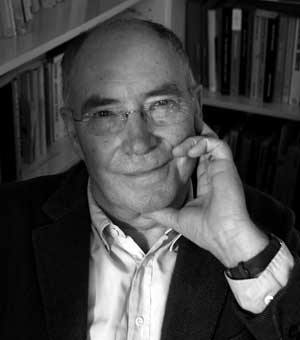
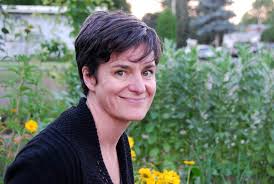
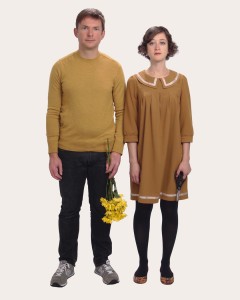
Common Place (Ugly Duckling Presse 2015) is Rob Halpern‘s most recent book of poetry. Other titles include Music for Porn (Nightboat 2013), Disaster Suites (Palm Press 2009), and Rumored Place (Krupskaya 2006). Together with Taylor Brady, he also co-authored the book-length poem, Snow Sensitive Skin, which has been reissued by Displaced Press. Recent essays and translations appear in Chicago Review, Journal of Narrative Theory, and The Claudius App. Rob currently splits his time between San Francisco and Ypsilanti, Michigan, where he teaches at Eastern Michigan University and Women’s Huron Valley Prison.
Melissa Buzzeowrites a literature of encounter, but also: descent, healing, refusal. She is the author of four full-length books: The Devastation (Nightboat 2015), For Want and Sound (Les Figues, 2013), Face (Bookthug, 2009) and What Began Us (Leon Works, 2007). She teaches creative writing at Pratt Institute in Brooklyn and maintains a radical palm reading practice. At one time, she went to Cornell and then to Iowa. Currently she is working on a specific kind of memoir simply called Writing.
Historian and philosopher of art, Thierry de Duve, is Professor emeritus from the University of Lille 3, and was Kirk Varnedoe Visiting Professor at the Institute of Fine Arts, New York University, for the fall semester of 2013. His English publications include Pictorial Nominalism (1991), Kant after Duchamp (1996), Clement Greenberg Between the Lines (1996, 2010), Look—100 Years of Contemporary Art (2001), and Sewn In the Sweatshops of Marx: Beuys, Warhol, Klein, Duchamp (2012). He is presently finishing a book of essays on aesthetics, forthcoming from the University of Chicago Press.
Matthew Offenbacher seeks constructive, positive positions at often difficult intersections of individuals, communities and institutions. His work has been called “freakishly egoless”, vulnerable, funny and queer. Offenbacher grew up in Portland, Oregon, and currently lives in Seattle, Washington. He runs a press which publishes ‘zines and books by Northwest artists. His essays include Green Gothic (2009), which has become a landmark in Pacific Northwest art history. Recent exhibitions and projects include The V&A at Veronica, Deed of Gift at the Seattle Art Museum, and Flower Painting at Lather Daddy Laundromat. Other notable exhibitions include The Gift Shop (2009-10) at the Henry Art Gallery.
Steven Hendricks was born in Omaha, Nebraska. He moved out west to attend Evergreen. He completed his MFA in Writing at The School of the Art Institute of Chicago and then returned to Washington to teach at Evergreen. Hendricks’s work has appeared in The Denver Quarterly, Web Conjunctions, Fold: The Reader, The Encyclopedia Project (Vol. 2), Sidebrow, and at XCP (archived at PennSound, 2005). Hendricks is also a practicing bookbinder and letterpress printer. His artists’ book work, Breathing Machine, appears in Lark Books’ anthology 500 Handmade Books: Inspiring Interpretations of a Timeless Form. He has shown artist book works in galleries in Olympia, Portland, and Seattle. His first novel, Little is Left to Tell, was published by Starcherone Books in the Fall of 2014.
Linda Weintraub is a curator, educator, artist, and author of several popular books about contemporary art. Her recent writing explores the vanguard intersection between art and environmentalism, including TO LIFE! Eco Art In Pursuit of a Sustainable Planet (University of California Press). Weintraub’s previous books on eco-art include the series, Avant-Guardians: Textlets in Art and Ecology (2007). Weintraub established Artnow Publications in order to apply environmental responsibility to the books’ material production. She is also the author of In the Making: Creative Options for Contemporary Artists and Art on the Edge and Over: Searching for Art’s Meaning in Contemporary Society. Weintraub served as the Director of the Bard College museum where she curated over sixty exhibitions. She was the Henry Luce Professor of Emerging arts at Oberlin College. Her current book projects include Art-is-an Environmental Health Clinic (author) and In The Making: Creative Options For Contemporary Architecture (editor).
Sister Spit began in San Francisco in the 1990s as a weekly, girls-only open mic that was an alternative to the misogyny-soaked poetry open mics popular around the city (and the nation) at that time. Inspired by two-bit punk bands who managed to go on the road without hardly knowing how to play their instruments, Sister Spit became the first all-girl poetry roadshow at the end of the 90s, and toured regularly with such folks as Eileen Myles, Marci Blackman, Beth Lisick, and Nomy Lamm. The tour was revived as Sister Spit: The Next Generation in 2007, and has toured the United States annually since, with authors and performers such as Chinaka Hodge, Dorothy Allison, Lenelle Moise, Justin Vivian Bond, and many others. In this next incarnation, out of respect to the changing gender landscape of our queer and literary communities, Sister Spit welcomes artists of all genders, so long as they mesh with the tour’s historic vibe of feminism, queerness, humor, and provocation.
In addition to the authors of Sister Spit Book’s two most recent publications, Man Alive: A True Story of Violence, Forgiveness and Becoming a Man, and Rad American Women A-Z, the tour incorporates artists and activists with wide-ranging audiences, styles and voices. Furthermore, the Sister Spit Tour invites local guest writers to add to the lineup.
Bruce Conner, BOMBHEAD, 1989, Courtesy of The Conner Family Trust, San Francisco
“Bruce Conner’s Atomic Sublime Cinema”
San Francisco-based artist Bruce Conner made his first experimental film, A MOVIE, in 1958, at the height of national anxiety about the atomic threat. Over the following decades, his films continued to address the cultural and political fallout of the Cold War. This talk examines Conner’s filmic output over two and a half decades, from his pioneering works of “found footage” montage, to his participation in psychedelic expanded cinema performance, to his more intimate portraits of female friends and later interest in music video. It argues that these works are expressions of the “atomic sublime,” an aesthetic that captures the paradoxical experience of “terrible beauty” that is generated by witnessing an atomic explosion. By attending closely to the historical and cultural context of Conner’s apocalyptic cinema, this talk proposes a reconsideration of postwar American art’s engagement with the aesthetics of “the sublime.”
Johanna Gosse is an art historian specializing in the postwar American avant-garde, with an emphasis on experimental film and media practices. She earned her PhD in the History of Art from Bryn Mawr College in 2014 with a dissertation on the experimental films of San Francisco-based artist Bruce Conner. Her writing has appeared in journals such as Camera Obscura, MIRAJ: Moving Image Review & Art Journal, Radical History Review, The Journal of Black Mountain College Studies, various exhibition catalogues, and Abstract Video: The Moving Image in Contemporary Art, an edited collection forthcoming from the University of California Press in 2015. You can read more about past work and current projects at: www.johannagosse.com.
Allison Cobb is the author of Born2 (Chax Press) about her hometown of Los Alamos, New Mexico, and Green-Wood (Factory School) about a nineteenth-century cemetery in Brooklyn, New York. The New York Timescalled Green-Wood “a gorgeous, subtle, idiosyncratic gem.”
Cobb’s work combines history, nonfiction narrative and poetry to address issues of landscape, politics, and ecology. She is a 2015 Djerassi Resident Artist; a 2014 Playa Resident Artist; she received a 2011 Individual Artist Fellowship award from the Oregon Arts Commission; and she was a 2009 New York Foundation for the Arts Fellow. She works for the Environmental Defense Fund. She lives in Portland, Oregon.
Amaranth Borsuk is the author of Handiwork (Slope Editions, 2012), and, with Brad Bouse, Between Page and Screen (Siglio Press, 2012). Abra, a collaboration with Kate Durbin forthcoming from 1913 Press, recently received an NEA-sponsored Expanded Artists’ Books grant from the Center for Book and Paper Arts at Columbia College Chicago and will be issued in 2014 as an artist’s book and iPad app created by Ian Hatcher. Her collaborative digital projects include an erasure bookmarklet, The Deletionist, with Nick Montfort and Jesper Juul, and Whispering Galleries, a site-specific LeapMotion erasure work for the city of New Haven. Another collection of poems is forthcoming from Kore Press. Amaranth is an Assistant Professor of Interdisciplinary Arts and Sciences at the University of Washington, Bothell, where she also teaches in the MFA in Creative Writing and Poetics.
Andy Fitch’s most recent books are Sixty Morning Talks and (with Amaranth Borsuk) As We Know. Ugly Duckling soon will release his Sixty Morning Walks and Sixty Morning Wlaks. He recently published a critical book, Pop Poetics: Reframing Joe Brainard, with Dalkey Archive Press. With Cristiana Baik, he is currently assembling the Letter Machine Book of Interviews. He has a collaborative book forthcoming from 1913 Press. He is a founder of The Conversant and currently edits Essay Press. He teaches in the University of Wyoming’s MFA program.