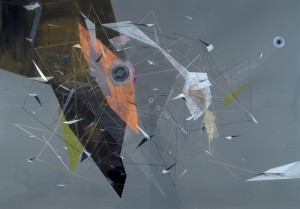
Steffani Jemison was born in Berkeley, California, and is currently based in Brooklyn, New York. She holds an MFA from the School of the Art Institute of Chicago (2009) and a BA in Comparative Literature from Columbia University (2003). Jemison uses time-based, photographic, and discursive platforms to examine “progress” and its alternatives.
Jemison’s work has been exhibited nationally and internationally at venues including the Brooklyn Museum; the Drawing Center; LAXART; the New Museum; the Royal Danish Academy of Fine Art; the Studio Museum in Harlem; Laurel Gitlen; Team Gallery; and other venues. Her publishing project, Future Plan and Program, commissions literary work by artists of color and has published books by Martine Syms, Jibade-Khalil Huffman, and Harold Mendez, among others. She has participated in artist residencies at Smack Mellon, Brooklyn; the International Studio and Curatorial Program, Brooklyn; Project Row Houses, Houston; the Core Program at the Museum of Fine Arts, Houston; the Skowhegan School of Painting and Sculpture, Maine; and the Studio Museum in Harlem, New York. Jemison has served as a visiting critic in the graduate art programs at Columbia University, the University of Pennsylvania, and the University of Illinois-Chicago. She was a 2013 Tiffany Foundation Biennial Awardee and a 2014 Art Matters Grantee. In 2015, she presented her new multipart commission Promise Machine at the Museum of Modern Art.
Jemison is currently an artist-in-residence in the Sharpe-Walentas Space Program. She teaches at Parsons The New School for Design, the Cooper Union, and the School of the Art Institute of Chicago.
Wendy Red Star is an artist living and working in Portland, Oregon. Red Star received her B.F.A. from Montana State University-Bozeman and her M.F.A from UCLA in 2006. She has exhibited both nationally and internationally. Her exhibitions include shows at the Fondation Cartier pour l’Art Contemporain, Hallie Ford Museum, The Eiteljorg Contemporary Art Fellowship 2009, Utah Museum of Contemporary Art, Missoula Art Museum, St. Louis Art Museum, National Museum of the American Indian-New York, Portland Art Museum, Minneapolis Institute of Arts, Indianapolis Museum of Contemporary Art, Metropolitan Museum of Art, Bockley Gallery, and Haw Contemporary gallery. She has been a visiting lecturer at a range of respected institutions, including The Banff Centre, CalArts, National Gallery of Victoria (Melbourne), Portland State University, Dartmouth Hood Museum, Figge Art Museum, Fairhaven College, Fine Artworks Center-Provincetown, and I.D.E.A. Space-Colorado College.
JOHN FEODOROV
Born in Los Angeles of mixed Navajo (Diné) and Euro-American heritage, John Feodorov grew up in the suburbs of Southern California while making annual visits to his family’s land near Whitehorse, NM. The time he spent with his mother and grandparents on their homestead near the Anasazi ruins at Chaco Canyon continues to inform and impact his work.
John has been called a conceptual artist, a political artist, as well as a Native American artist, but he is still not sure how to define what he does. His work includes painting, drawing, assemblage, installation, video, music and songwriting. He also has engaged in experimental performance in the past, but not lately. Currently, he writes and performs with his art/pop band, The Almost Faithful.
John’s work as been widely exhibited and has been featured in several publications; most recently in Time and Time Again, by Lucy R. Lippard, and Manifestations, edited by Dr. Nancy Marie Mithlo. He was also featured in the first season of the PBS series, “Art 21: Art for the 21st Century”.
John has also worked with the Seattle-based afterschool arts program, Artscorps, and served as an Arts Commissioner for the City of Seattle. He is currently an Associate Professor of Art at Fairhaven College.
SARA SIESTREEM
Sara Siestreem (Hanis Coos and American, 1976-) is from the Umpqua River Valley in South Western Oregon. She grew up in Portland, Oregon. She is a Master Artist and Educator. She comes from a family of professional artists and educators and her training in both fields began in the home. Siestreem graduated Phi Kappa Phi with a BS from PSU in 2005. She earned an MFA with distinction from Pratt Art Institute in 2007. Siestreem is the weaving student of Greg Archuleta, Greg Robinson, and Nan MacDonald. She is represented by Augen Gallery in Portland and her work has been shown in museums and figures in prestigious private and public collections nationally.
Her studio work is multi-disciplinary. Her primary language is painting, but she also works in photography, printmaking, drawing, sculpture, video, and traditional weaving.
She teaches Foundations in Studio Arts and Indigenous Studies at PSU and Traditional Weaving Practices for The Confederated Tribes of Coos, Lower Umpqua, and Siuslaw Indians. She works as a consultant and free lance educator for museums and cultural groups regionally. Siestreem also serves various youth organizations and individuals in the role of mentor, workshop leader, promoter, public speaker and volunteer.
She lives and works exclusively in the arts in Portland, Oregon.
CORWIN CLAIRMONT
Corwin (Corky) Clairmont is a contemporary artist and enrolled member of the Confederated Salish and Kootenai Tribes. Living in Los Angeles, Corky pursued a contemporary exhibiting artist career as well as teaching and becoming department head of printmaking at the Otis/Parsons Art Institute located in Los Angeles, Ca. Upon his return to Montana in 1984, Corky began administrative work at the newly credited Salish Kootenai College located in Pablo, Montana on the Confederated Salish and Kootenai Reservation. This included the creation of the SKC Fine Arts Department and art degree program. Through work as a printmaker, conceptual and installation artist, Corky’s images discuss and explore situations or issues that effect tribal people such as sovereignty, colonization, giving a cultural and historical perspective. Corky’s artwork has been exhibited through out the United States and in several Countries including Germany Norway, New Zealand, France, and most recently at the US Embassy located in Kinshasa, Democratic Republic of Congo, Africa. Awards have included Ford and National Endowment of the Arts, the Eiteljorg Fellowship Award, and the 2008 Montana Governors Award for Visual Arts. He currently serves on the State Board of the Montana Arts Council.
Lisa Blas is a visual artist of Guamanian / Italian-American descent working in painting, collage, photography, and installation. Based in New York, she draws from art history, nature, and current events to reflect on specific cultural and political legacies, past and present. She has exhibited nationally and internationally, while living and working in Los Angeles, Washington, DC, Lille, France and Brussels, Belgium during the years of 2001 – 2012. Concurrent with exhibiting her work, Blas has taught across disciplines in Fine Art and Art History at the undergraduate and graduate level, with a special focus on the museum and historical archives. Recent solo exhibitions are LISA BLAS / Still Lifes, Sometimes Repeated at Rossicontemporary, Brussels, LISA BLAS / As if pruning a tree, after Matisse at Musée Matisse, Cateau-Cambrésis, France, and group exhibitions A Particular Kind of Solitude: An exhibition inspired by the writings of Robert Walser at the Elizabeth Street Garden, New York, and Sensations That Announce The Future at Evergreen College Gallery, Olympia, Washington. She is currently working on a project for the forthcoming issue of Public Art Dialogue: The Dilemma of Public Art’s Permanence, to be published in winter 2016. B.A. 1996 University of Southern California / Political Science M.F.A. 2001 Claremont Graduate University / Painting
Born in Peekskill, NY, Dannielle Tegeder currently lives in Brooklyn, New York, and maintains a studio at The Elizabeth Foundation in Manhattan. She received a BFA from the State University of New York at Purchase (1994), and an MFA in Painting and Drawing from The School of The Art Institute of Chicago (1997). For the past fifteen years, her work has explored abstraction. While the core of her work is paintings and drawings, she has recently begun to include large-scale installation, sculptural objects, video, sound, and animation.
Since receiving her MFA in 1997 from the School of the Art Institute of Chicago, Dannielle’s work has been presented in over 100 gallery exhibitions, both nationally and internationally in Paris, Houston, Los Angeles, Berlin, Chicago, and New York. She has participated in numerous institution exhibitions including PS1/MOMA, The New Museum, The Brooklyn Museum of Art in New York, and Museum of Contemporary Art in Chicago. Several of her drawings have recently been purchased as part of the Contemporary Drawing Collection at the Museum of Modern Art, and her work is in the permanent collections of The Museum of Contemporary Art in Chicago, and The Weatherspoon Museum of Art in Greensboro, NC.
Amjad Faur currently teaches photography and visual arts at The Evergreen State College, in Olympia, Washington. He came to Evergreen from the University of Arkansas, where he primarily taught art history and critical theory. His current research involves the overlapping visual languages of colonial Europe in the Middle East and the tropes/signifiers scattered throughout Western art history that harmonize with these expansionist tendencies.
Bruce Conner, BOMBHEAD, 1989, Courtesy of The Conner Family Trust, San Francisco
“Bruce Conner’s Atomic Sublime Cinema”
San Francisco-based artist Bruce Conner made his first experimental film, A MOVIE, in 1958, at the height of national anxiety about the atomic threat. Over the following decades, his films continued to address the cultural and political fallout of the Cold War. This talk examines Conner’s filmic output over two and a half decades, from his pioneering works of “found footage” montage, to his participation in psychedelic expanded cinema performance, to his more intimate portraits of female friends and later interest in music video. It argues that these works are expressions of the “atomic sublime,” an aesthetic that captures the paradoxical experience of “terrible beauty” that is generated by witnessing an atomic explosion. By attending closely to the historical and cultural context of Conner’s apocalyptic cinema, this talk proposes a reconsideration of postwar American art’s engagement with the aesthetics of “the sublime.”
Johanna Gosse is an art historian specializing in the postwar American avant-garde, with an emphasis on experimental film and media practices. She earned her PhD in the History of Art from Bryn Mawr College in 2014 with a dissertation on the experimental films of San Francisco-based artist Bruce Conner. Her writing has appeared in journals such as Camera Obscura, MIRAJ: Moving Image Review & Art Journal, Radical History Review, The Journal of Black Mountain College Studies, various exhibition catalogues, and Abstract Video: The Moving Image in Contemporary Art, an edited collection forthcoming from the University of California Press in 2015. You can read more about past work and current projects at: www.johannagosse.com.
Small shifts in what is familiar amplify human presence and speak to the intricacies of social relations in MK Guth’s work. Her videos depart from everyday scenarios into the site of fiction as an entry point to more complicated issues of identity and self and her sculptural installations often act as visual containers for audience interaction.
M.K. Guth is a visual artist working in video, photography, sculpture, performance, and interactive based exchange projects. In 2012, Marylhurst University released the first Monograph on Guth’s work. The NY Times, Flash Art, ArtForum on line 500 words, Art News, Art in America, and Sculpture magazine are just a few of the periodicals where Guth’s work has been discussed. She is a recipient of a Bonnie Bronson Award, a Betty Bowen Special Recognition Award through the Seattle Art Museum and an Award of Merit from the Bellevue Art Museum.
She has exhibited with numerous galleries and institutions including, The Whitney Museum of American Art, NYC, Boise Art Museum, The Melbourne International Arts Festival, Australia, Nottdance Festival, Nottingham, England, Swiss Institute, NYC, Gallery-Pfeister, Copenhagen, Franklin Parrasch Gallery NYC, Betty Moody Houston TX, White Columns, NYC, The Art Production Fund (NYC / Las Vegas), Yerba Buena, in San Francisco and the Henry Art Museum. Guth is a member and the originator of RED SHOE DELIVERY SERVICE, a collaborative interactive video/performance project. (with Molly Dilworth and Cris Moss) www.redshoedeliveryservice.com MK Guth is represented by the Elizabeth Leach Gallery in Portland Oregon and is an Associate Professor at the Pacific Northwest College of Art.
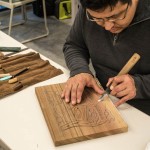
Makah artist, Alex McCarty, is the great-grandson of Hishka, who was chief of the Waatch village, one of the five villages in Neah Bay, Washington. Alex is a carver, painter, printmaker and teacher. Alex earned his Bachelor in Visual Arts and Social Studies from The Evergreen State College in 2000. In 2002, he obtained his Master in Teaching degree from The Evergreen State College. Following his Masters, he was the Art/Carving Teacher at Chief Leschi Schools in Puyallup, Washington for several years.
Alex is currently teaching woodcarving in a full year program at Evergreen titled “Studio Projects: Tradition and Innovation.” His work is being showcased in the library; his carvings and prints, and other traditional style art pieces can be found in display cases within the library. Photographs of McCarty and his students by Briana Martini can be found on the staircase leading up to the 3rd floor of the library.
Alex is a young carver with great respect for older carving traditions. His interest in Makah carving traditions and culture was triggered in high school, when he was asked to work on a diorama of the Ozette Village for the Makah Museum. Working on the project over a nine-month period, Alex had a chance to look deeply into the past. Part of his preparation for making the miniature model was to visit the landforms at the site, and to become familiar with the collection of artifacts housed at the museum. It was Alex’s job to understand everything he could about everyday life at the village, and this helped to create his passion for history.
Through carving, Alex seeks to preserve cultural traditions that he can trace back through time. By observing the pieces from Ozette, as well as other classic West Coast carvings, he discerns “prevalent form-lines,” which characterize the Makah tradition. He works hard at understanding the essence of his heritage, and sees his own work as a preservation and interpretation of this older style. Alex is driven to understand the past in his quest to develop his carving. He observes that “you need to ‘get’ something before you can preserve it.” Throughout his work, Alex strives to incorporate flowing, bold-line designs that he feels are so characteristic of classic West Coast artwork. It is important to him that his work is done well, and that his designs work from different perspectives. As a teacher, he makes the analogy that we need “to see things through multiple perspectives-the way that other people see things” in order to gain a deeper understanding of the world.
While Alex’s work is in demand, often commissioned by galleries or individual collectors, he sees his work as providing more in his life than just income. He values teaching and learning from other artists, and advises people to seek out learning opportunities such as the one he had at Ozette, which he sees as an under-utilized resource. Perhaps his approach to his carving tradition can be summarized in this way: “learn it with care, preserve it with beauty, and pass it on.”
Gretchen Frances Bennett was selected to receive a Special Recognition Award for Betty Bowen. 2014. Also in 2014, she completed postgraduate studies with the Vermont College of Fine Arts, Montpelier, Vermont. In 2012, her work was included in exhibitions at Ditch Projects, Springfield, Oregon and The Hedreen Gallery, Seattle University. In 2011, she developed a temporary work for the Seattle Art Museum Olympic Sculpture Park, presented a solo show at Vignettes, Seattle, and her work was featured in the exhibition Heel Gezellig, Grimm Gallery, Amsterdam. She was awarded a residency with The Corporation of Yaddo in 2011. In 2010, she won a Lower Manhattan Cultural Council residency on Governors Island, New York, and a studio residency with The Association of Icelandic Visual Artists, Reykjavik, Iceland. Her work was included in the 2010 Seattle Art Museum exhibition, Kurt. She helped found the arts collective, Seattle Catalog LLC (Sea-Cat). She teaches at Seattle University.
Dan Attoe was born in 1975 in Bremerton, Washington. He grew up in parts of Washingon, Idaho, Minnesota and Wisconsin, and now lives in Washougal, Washington. He received his BFA from the University of Wisconsin in ’98 and his MFA from the University of Iowa in ’04. Dan is represented by Peres Projects Berlin, Western Exhibitions in Chicago and Fourteen30 Contemporary in Portland, Oregon. He has had several solo shows in Los Angeles, Chicago and Berlin, as well as several throughout Europe.
His most recent gallery solo shows were Landscapes with Water, at Peres Projects in Berlin in March 2014, and Dan Attoe at 1430 Contemporary in Portland in May 2014. Dan has been in numerous group shows in galleries all over the world and several museums – including the Portland Art Museum. He worked with and was part of the inspiration for a line of clothing by fashion designer Adam Kimmel in 2011. Dan is also one of the founders of the art collaborative Paintallica whose most recent installation was at the Iowa State Fair in Des Moines. He enjoys the beauty and the culture in the Northwest and Portland where he sometimes teaches courses at Portland State University.