Lauren Levin is a poet, mixed-genre writer and art writer, author of The Braid (Krupskaya, 2016) and Justice Piece // Transmission (Timeless, Infinite Light, 2018). With Emji Spero, they were developmental editor for We Both Laughed in Pleasure: The Selected Diaries of Lou Sullivan, edited by Ellis Martin and Zachary Ozma (Nightboat, 2019), and with Eric Sneathen, they are editing Camille Roy’s selected prose. Their gender identity is some mix of belated queer, Jewish great-aunt, and aspirational Frank O’Hara. They are still figuring it out. They live in Richmond, CA, are from New Orleans, LA, and are committed to queer art, intersectional feminism, being a parent, and anxiety.
Tatiana Luboviski-Acosta is an artist, & the author of Agon, a forthcoming chapbook from EconoTextualObjects; The Easy Body, a love letter from hell that was published in 2017 by Timeless, Infinite Light; and PDF, a chapbook published by Solar Luxuriance in 2014. Their work, cutting across various materials and disciplines, has been shown & performed in the Los Angeles River, galleries, punk houses, plazas, and microcinemas across the U.S. They are currently working on a project interviewing activist Latinx youth in emergent Latinx communities across the United States; and an experimental documentary on the geography of Helen Hunt Jackson’s novel Ramona in collaboration with their mother Vanessa Acosta. Born somewhere between here and Diriamba, Nicaragua, they were raised in the Huntington Park and Highland Park neighborhoods of Los Angeles and across the West Coast and Mexico; they’ve called California home for a significant part of their life. Tatiana now lives in a rent controlled apartment in the Mission District of San Francisco.
Gretchen Frances Bennett’s (American, b. 1960, Portland, Oregon) recent projects include a solo exhibition at the Frye Art Museum, Seattle, WA (2019); the exhibitions Becoming American, San Juan Island, WA (2018); Fire in the Mountains, Jackson, WY (2018); and The Rough Draft of Everything, Bridge Productions, Seattle, WA (2017). She has read her writing at the Holiday Forever Gallery, Jackson, WY (2017) and as part of the series This Might Not Work at INCA, Seattle, WA (2016). In 2014, Bennett received the Seattle Art Museum’s Betty Bowen Special Recognition Award and completed postgraduate work at the Vermont College of Fine Arts. She is presently at work on her first collection of essays.
Dave Kennedy’s works have been published globally in such magazines as Art21 and Numéro Cinq and exhibited both locally and internationally at such venues as the Brownsville Museum of Fine Art, Photo Center Northwest, Bellevue Arts Museum, Zhou B Art Center, Chicago Industrial Arts & Design Center, Escuela de Belle Arte in Spain, Rogers Park/West Ridge Historical Society Museum, and the Seattle Art Museum’s Gallery.
Represented by Bridge Productions in Seattle, WA, Kennedy is a recipient of a Yaddo Residency and Fellowship, 4Culture Individual Project Award, as well as, Artist Trust’s Grants for Artists Projects, the Joanne Bailey Wilson Endowed Scholarship, and the Vermont Studio Center Fellowship. He has presented multimedia presentations to the Society of Photographic Educators, Cornish College of the Arts, and the University of Washington on topics of marginalization and objectification. He received his MFA from the University of Washington in Interdisciplinary Arts and an undergraduate degree from Western Washington University in Visual Communication. Kennedy is currently working as an adjunct professor at Photo Center Northwest while keeping a full time studio practice in Seattle, WA.
Experimental animation reinterprets, reorganizes and challenges the material, technical, narrative and affective conventions of animation established by mainstream studios. While the participation of women in this field has become more and more visible, their work has not been sufficiently exhibited or discussed, nor have their varied and singular perspectives. To recognize the important contributions that women have made to the field of Experimental Animation in Latin America as directors, animators, artists, art directors, and sound engineers, Moebius Animación has curatedWomen in Latin American Experimental Animation, an exhibition of short films by Latin American women and women of Latin American descent. Join us for this screening of films, presented by co-curator Lina X. Aguirre.
The program features women animators from Latin America exploring multiple techniques like drawing, stop-motion, time-lapse, found footage and paint on glass to produce an exceptional program of experimental animation.
LIna X. Aguirre is a member of Moebius animación, a curatorial and critical project dedicated to Latin American experimental animation. Moebius has curated a selection of 16 short films from Argentina, Brazil, Colombia, Chile, Mexico, and Puerto Rico, produced between 2007 and 2014 by independent filmmakers and artists. This compilation is the result of their effort to map out the artistic field of experimental animation and its intense dynamic during the last decade. They have defined trends in the technical, narrative, material, and sensorial/affective dimensions of the works. Screening (85 min.)
Vivian Hua (華婷婷) is a writer, filmmaker, and organizer who regularly traverses up and down the west coast. As the Executive Director at Northwest Film Forum in Seattle, a Co-Founder of the civil rights film series, The Seventh Art Stand, and the Editor-in-Chief of the interdisciplinary arts publication, REDEFINE, much of her work unifies her interest in the metaphysical with her belief that art can positively transform the self and society.
Her narrative short film, Searching Skies–which touches on the controversial topic of Syrian refugee resettlement in the United States–was released in 2017, after making festival rounds. She is currently writing her next film projects, as well as researching national efforts to preserve cultural space.
Markel Uriu is an interdisciplinary artist based in Seattle, WA. Her work explores impermanence, maintenance, and the unseen. Drawing from her Japanese and Irish-American heritage, she is particularly interested in liminal spaces, and explores these concepts through ephemeral botanical narratives and two-dimensional work. Her subjects of time, cycles, and cultural interchange have culminated in a fascination with invasive species. Her current work explores the nature of invasive species, their environmental impacts, and their links to humanity, colonialism, and globalization.
Markel received her BA from Whitman College in 2011. She is the recipient of various awards and residencies, most recently the 2018 Amazon Artist in Residence, and the 2016-2017 Artbridge Fellow at Pratt Fine Arts Center. She is a member of the Lion’s Main Art Collective for Queer and Trans Artists, Seattle and SOIL Gallery, Seattle, and has shown throughout the United States.
Out of retirement to teach the first ever class from the new Fiber Arts Studio, Gail Tremblay has assembled a brilliant group of master weavers for you!
GAIL TREMBLAY
Writer, teacher, and mixed media artist Gail Tremblay (Onondaga and Mi’kmaq),was born in 1945 in Buffalo, New York. Tremblay taught English, Native American Studies, Art, and Art History at Evergreen State College in Olympia, Washington, where she joined the faculty in 1981. As an educator, she has influenced more than a generation of Native and non-Native students and has been instrumental in building Evergreen’s focus on Native arts and Native Studies.
In the 1980s, while she was teaching a Third World and Feminist Film Theory class, Tremblay began weaving baskets out of scrap 16mm film, old movie trailers, and outdated educational films. In perfect postmodern irony, Tremblay, who has been making baskets since childhood, utilized materials from a medium that often originated and propagated stereotypes of Indigenous people in order to create “traditional” baskets that critique those same stereotypes. Her titles often allude to the film source, which is frequently obscured by the weaving.
JOEFEDDERSEN…former Greener faculty member!
Joe Feddersen, who is Okanagan from the Colville Confederated Tribes, lives on the reservation in Omak, Washington. He taught art programs, from the early 1990’s until he retired, at the Evergreen State College. His work includes a suite of what he calls his Urban Indian baskets that use designs from things like car and truck tire tracks, electrical towers, parking lot designations, and other forms, objects, and structures that have moved from urban America onto American Indian reservations during the 20th and 21st centuries. Many non-Indian viewers often perceive his basket as having traditional Indigenous designs until they read the basket titles and come to see what he is saying about contemporary experiences in the Indigenous
JEREMY FREY
Jeremy Frey started weaving in his 20s, learning to make baskets from his mother Gal Frey. Gal taught him, drawing on what she had learned from her teacher Sylvia Gabriel. Sylvia was renowned for her basketry, especially her porcupine curlwork. Jeremy learned all aspects of the tradition from selecting brown ash to pounding and preparing basket stuff. His work fuses traditional shapes with the innovative use of both traditional and non traditional materials, as well as unique signature designs.
Jeremy was born in 1978 and raised in Indian Township. His work has received national recognition with the 2011 Best of Show award at the Heard Museum Guild Indian Fair and Market and the Santa Fe Indian Market. He was the recipient of a $50,000 United States Artists grant.
TERROL DEW JOHNSON
Terrol Dew Johnson started basketry weaving at the age of ten. He soon learned that he was a born natural and found that it was one of the few things in life that he found intrinsically effortless.
Johnson is a member of the Tohono O’odham nation of southern Arizona. The Tohono O’odham have a long history of basket weaving using a whole variety of techniques using natural materials and dyes. These are all used in order to tie the basketry in with the local landscape colours and flora, making the baskets part of the community and of the larger landscape.
The traditional basketry weaving techniques that Johnson learnt at such an early age, have allowed him to expand into the world of contemporary fine art basketry, while still keeping hold of his traditions, which he uses as a foundation or anchor point for his subsequent career as an artist.
LISA TELFORD
Lisa Telford (Everett) was born in Ketchikan, Alaska, in 1957. As a Gawa Git’ans Git’anee Haida weaver she comes from a long line of weavers including her grandmother, mother, aunt, cousins and daughter. Lisa harvests and prepares her own material, using red and yellow cedar bark and spruce root. The gathering of materials takes her hundreds of miles from home and hours of preparation that vary depending on the final product. Bark is traditionally stored for one year and then must be processed further. Her baskets may be seen in the collections of The Oregon Historical Society, Hallie Ford Museum of Art, The Smithsonian National Museum of the American Indian, The Heard Museum, The Portland Art Museum, and The Burke Museum.
My paintings are usually related in some way to my physical environments and experience of them. Source material I draw from when I’m painting often includes photographs I’ve taken of places I’ve been. Also, the paintings are experiments in creating new environments. An individual painting can become a new place in itself, with sensations of things that might happen in a place, such as weather, touch, landscape, temperature, sex or noise. Abstract marks interact with more recognizable shapes, and a kind of narrative ensues.
When talking or writing about my work, I stray from defining the narratives in a literal way. Instead, I try to describe them as I see them, both as the person that made them and decided they make sense, and also as a witness to the end result.
Semi-abstract “characters” show up in the paintings and suggest meanings with their repetition and associations with each other. For example, a chunk of green and white stripes has its origins in the green and white striped pajama bottoms from Suzanne Valadon’s The Blue Room, 1923. To me, this “character” feels like a queer, feminist reclaiming of the history of painting. A pink fir tree is an odd, out-of-place Pacific Northwestern interloper and solo eloper in the big city.
Making these semi-abstract landscape-based paintings with a personal narrative running underneath is a three-pronged effort. I am looking at my agency in the landscape. I am trying to spend more time in the place by painting it. I’m using paint to make physical contact again. In this intimate way, the paintings explore landscape as a lover and loved one, enmeshed with the paint, and without the safe distance usually afforded by the Sublime in traditional Western landscape painting.
I think of both painting and looking as pleasureful experiences.
Susanna Bluhm 2018
BIO:
Susanna Bluhm is an artist based in Seattle, WA. After growing up in a suburb of Los Angeles, she earned her BA in Studio Art from California State University Humboldt and her MFA in Painting from the University of Illinois at Urbana-Champaign. She has been an Artist-in-Residence at the Irish Museum of Modern Art in Dublin and at the Karl Hofer Gesellschaft in Berlin. Bluhm was a member of SOIL artist-run gallery (Seattle) for five years, and was the 2014 recipient of the Neddy Artist Award in Painting. She lives with her wife and ten-year-old son in Seattle.
I construct narratives, scenes, and stories which point to the tensions found between the individual and communities. I utilize autobiographical threads to inform larger universal fields of experience. Gestures of alienation and displacement are both the aesthetic and subject of much of my work. Often using landscapes and tableaus with day laborers or myself, I explore the way an image is inhabited, and the way that spaces, objects and people are translated into images. My work serves as an expressive and intimate point of contact between the broader realms of subjectivity and political contingency. Through my videos and photographs, I make images that feel at the same time familiar yet distant. I engage the viewer in questions concerning the ways in which the formation and experience of each work is situated—how they exist in and out of place.
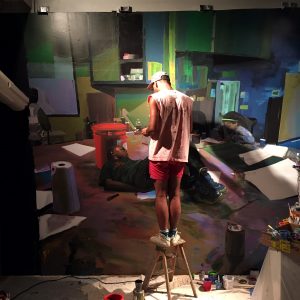
As an artist and community organizer, I construct immersive, interactive installations to connect diaspora communities. I’m interested in media infrastructure and its role in shaping what is knowable. I create portals for displaced peoples to reintegrate our stories across dimensions, devising passageways for us to connect, hear from, and care for one another. I generate art objects as time-capsules to vault these experiences, questions, and memories in the future. My practice deals with continuance, analog internets, rites of passage, the production of history, and the construction of satellites. Painting and sculpture are my prayer language; laced with vestiges of mediation and hearsay; embedded with questions for another time and place.
BIO (b. 1990) Christopher Paul Jordan integrates virtual and physical public space to form infrastructures for dialogue and self-determination among dislocated people. Jordan’s paintings and sculptures are time-capsules from his work in community. His 7000 sqft panoramic mural from #COLORED2017 is now buried into the walls of the Carpenter’s Union Building in Tacoma where it can only be rediscovered through demolition.
Jordan’s installations and public projects have been implemented internationally including Trinidad and Tobago, Taiwan, and Mexico. His work has been recognized by the Neddy Artist Award in painting, the James W Ray Venture Project Award, the Jon Imber Fellowship, the GTCF Foundation of Art Award, and the Artist Trust Fellowship.