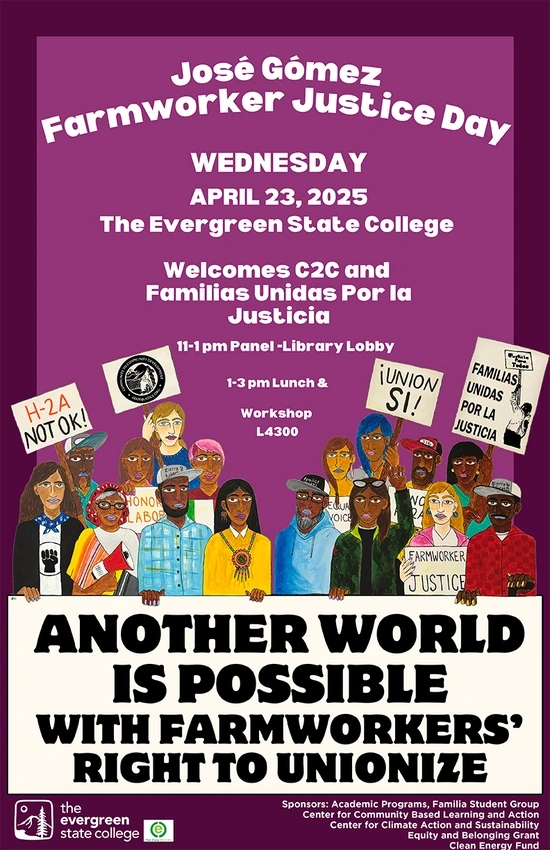
Farmworker Justice Day: (Evans Hall Lobby) Join racial justice organization C2C and Farmworker’s Union Las Familias Unidas por la Justica for the annual celebration of activist and faculty member José Gómez. This annual event honors José Gómez, a faculty member who was been a life-long activist for farmworker justice, LGBTQ+ justice and labor organizing.
Cassie Thornton is an artist and activist from the US, who makes a “safe space” for the unknown, for disobedience and for unanticipated collectivity. She currently lives and works in Thunder Bay, Canada. She refers to herself as a feminist economist, a title that frames her work as that of a social scientist actively preparing for the economics of a future society that produces health and life without the tools that reproduce oppression— like money, police or prisons. She is currently the co-director of the Re-Imagining Value Action Lab in Thunder Bay, an art and social centre at Lakehead University in Ontario, Canada. Her new book The Hologram: Feminist, Peer-to-Peer Health for a Post-Pandemic Future is available from Pluto Press.
Originally from San Francisco, Tongo Eisen-Martin is a poet, movement worker, and educator. His latest curriculum on extrajudicial killing of Black people, We Charge Genocide Again, has been used as an educational and organizing tool throughout the country. His book titled, “Someone’s Dead Already” was nominated for a California Book Award. His latest book “Heaven Is All Goodbyes” was published by the City Lights Pocket Poets series, was shortlisted for the Griffins Poetry Prize and won a California Book Award and an American Book Award. His forthcoming book “Blood On The Fog” is being released this fall in the City Lights Pocket Poets series. He is San Francisco’s eighth poet laureate.
Lauren Levin is a poet, mixed-genre writer and art writer, author of The Braid (Krupskaya, 2016) and Justice Piece // Transmission (Timeless, Infinite Light, 2018). With Emji Spero, they were developmental editor for We Both Laughed in Pleasure: The Selected Diaries of Lou Sullivan, edited by Ellis Martin and Zachary Ozma (Nightboat, 2019), and with Eric Sneathen, they are editing Camille Roy’s selected prose. Their gender identity is some mix of belated queer, Jewish great-aunt, and aspirational Frank O’Hara. They are still figuring it out. They live in Richmond, CA, are from New Orleans, LA, and are committed to queer art, intersectional feminism, being a parent, and anxiety.
Tatiana Luboviski-Acosta is an artist, & the author of Agon, a forthcoming chapbook from EconoTextualObjects; The Easy Body, a love letter from hell that was published in 2017 by Timeless, Infinite Light; and PDF, a chapbook published by Solar Luxuriance in 2014. Their work, cutting across various materials and disciplines, has been shown & performed in the Los Angeles River, galleries, punk houses, plazas, and microcinemas across the U.S. They are currently working on a project interviewing activist Latinx youth in emergent Latinx communities across the United States; and an experimental documentary on the geography of Helen Hunt Jackson’s novel Ramona in collaboration with their mother Vanessa Acosta. Born somewhere between here and Diriamba, Nicaragua, they were raised in the Huntington Park and Highland Park neighborhoods of Los Angeles and across the West Coast and Mexico; they’ve called California home for a significant part of their life. Tatiana now lives in a rent controlled apartment in the Mission District of San Francisco.
Jasper Bernes is author of a scholarly book, The Work of Art in the Age of Deindustrialization (Stanford, 2017), and two books of poetry, Starsdown (2007) and We Are Nothing and So Can You (2015). Essays, poems and other writings can be found in Critical Inquiry,Modern Language Quarterly, Radical Philosophy, Endnotes, Lana Turner, The American Reader, and elsewhere. Together with Juliana Spahr and Joshua Clover, he edits Commune Editions. He lives in Berkeley with his family.
Rosa Clemente is an Afro-Puerto Rican journalist and scholar-activist researching national liberation struggles inside the United States, Afro-Latinx identity+politics, sexism within Hip-Hop culture, media justice, Hip-Hop activism, and African American and Latinx unity. More information about her can be found here: http://rosaclemente.net/biography-of-rosa-clemente/
Rosa’s schedule while she is on campus:
Wednesday, 2/27, 11:30-1pm Lecture Hall 1
Thursday, 2/28, 3-5pm Longhouse
Many thanks to the sponsors and programs contributing to Rosa’s days with us!
Sponsors include: Media Island International, the Women of Color in Leadership Movement, the Willi Unsoeld Seminar Series, the CCBLA, the Art Lecture Series, and the the Dean’s Match.
Programs include: “Who Gets What?: Political Economy of Income, Wealth, and Economic Justice,” – “Political Economy and Environmental and Social Movements: Race, Class, and Gender,” – “Mediaworks,” – “The Spanish-Speaking World,” – “Teaching ELLs: Culture, Theory, and Methods,” and “Unruly Bodies: Health, Media, Biology, and Power.”
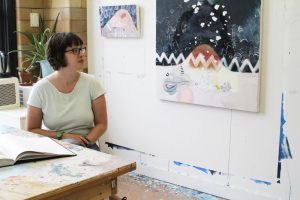
My paintings are usually related in some way to my physical environments and experience of them. Source material I draw from when I’m painting often includes photographs I’ve taken of places I’ve been. Also, the paintings are experiments in creating new environments. An individual painting can become a new place in itself, with sensations of things that might happen in a place, such as weather, touch, landscape, temperature, sex or noise. Abstract marks interact with more recognizable shapes, and a kind of narrative ensues.
When talking or writing about my work, I stray from defining the narratives in a literal way. Instead, I try to describe them as I see them, both as the person that made them and decided they make sense, and also as a witness to the end result.
Semi-abstract “characters” show up in the paintings and suggest meanings with their repetition and associations with each other. For example, a chunk of green and white stripes has its origins in the green and white striped pajama bottoms from Suzanne Valadon’s The Blue Room, 1923. To me, this “character” feels like a queer, feminist reclaiming of the history of painting. A pink fir tree is an odd, out-of-place Pacific Northwestern interloper and solo eloper in the big city.
Making these semi-abstract landscape-based paintings with a personal narrative running underneath is a three-pronged effort. I am looking at my agency in the landscape. I am trying to spend more time in the place by painting it. I’m using paint to make physical contact again. In this intimate way, the paintings explore landscape as a lover and loved one, enmeshed with the paint, and without the safe distance usually afforded by the Sublime in traditional Western landscape painting.
I think of both painting and looking as pleasureful experiences.
Susanna Bluhm 2018
BIO:
Susanna Bluhm is an artist based in Seattle, WA. After growing up in a suburb of Los Angeles, she earned her BA in Studio Art from California State University Humboldt and her MFA in Painting from the University of Illinois at Urbana-Champaign. She has been an Artist-in-Residence at the Irish Museum of Modern Art in Dublin and at the Karl Hofer Gesellschaft in Berlin. Bluhm was a member of SOIL artist-run gallery (Seattle) for five years, and was the 2014 recipient of the Neddy Artist Award in Painting. She lives with her wife and ten-year-old son in Seattle.
Sand works across genres and media, dislodging poetry from the book into more unconventional contexts. From 2013-2015, she served with Garrick Imatani as artists-in-residence at the City of Portland Archives and Records Center, responding to historical surveillance files on local political activists; and then she created textile art with street vendor Marcia Rodrigues Braga during her Despina International Artist Residency in Rio de Janeiro in 2015. Much of her work has focused on economic injustice and homelessness, from a magic show she created about the financial collapse to the Right 2 Survive Ambassador Program she co-founded for housed people to learn from people experiencing homelessness.
She is the executive director of Street Roots, a weekly newspaper sold in Portland, Oregon, by people experiencing homelessness and poverty as means of earning an income.
MARY ANN PETERS is an artist whose combined studio work, installations, public art projects and arts activism have made noted contributions to the Northwest and nationally for over 30 years. Most recently her work has focused on the overlap of contemporary events with splintered histories in the Middle East.
Her awards include the 2016 ArtMatters/Jerome Foundation fellowship at the Camargo Foundation, Cassis, France; 2015 Stranger Genius Award in Visual Art; a 2013 Art Matters Foundation research grant; the MacDowell Colony Pollock Krasner Fellowship (2011); the Civita Institute Fellowship (2004) and the Behnke Foundation Neddy Award in Painting (2000).
She is a founder of COCA (Center on Contemporary Art), a recipient of the Artist Trust Leadership and Arts Award, and former board member and board president of NCFE (National Campaign for Freedom of Expression), the seminal group who defended artist rights and the First Amendment during the Helms era.