

A great blue heron (Ardea herodias) keeps watch as a harbor seal (Phoca vitulina) hunts forage fish in shallow water.
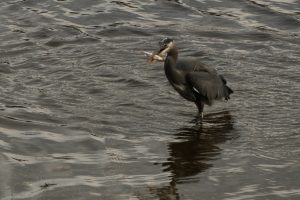
Taking advantage of the harbor seals hunting activities pays off for the great blue heron (above) and a glimpse of surf smelt spawning behavior in the upper intertidal zone of a Puget Sound beach (below).
Marine forage fishes are small, schooling fishes that are key prey items for larger predatory fish and wildlife in a marine food web (Penttila 2007; Quinn et al. 2012). Obligate spawning within the nearshore environment by three of these species — the surf smelt (Hypomesus pretiosus), the Pacific sand lance (Ammodytes hexapterus), and the Pacific herring (Clupea pallasii) — make them vulnerable to the cumulative impacts of a wide-range of shoreline development activities in Washington State (Penttila 2007).
For example, the widespread phenomenon of shoreline armoring in the southern Salish Sea has caused local reductions in beach width, riparian vegetation, the number of accumulated logs, and the amount and type of beach wrack and associated invertebrates (Dethier et al. 2016). The loss of riparian vegetation might have striking effects on the productivity of the high-intertidal beach-spawning surf smelt. About half as many of the surf smelt eggs surveyed at a site with shoreline modifications contained live embryos as compared to those from an unmodified site (Rice 2006). The author documented a changed microclimate, where mean daily light intensity, air temperature, and substrate temperature were significantly increased, and daily mean relative humidity was significantly decreased (Rice 2006).
Potentially more widespread than shoreline modification is the presence of pollutants associated with effluent from industry and urbanization. Urbanization is commonly associated with the degradation of water carried in rivers and streams and is second only to agriculture in this distinction (Gaston et al. 2010). In western Washington State, all streams and rivers eventually drain to the marine nearshore environment where these important forage fish species are obligated to reproduce. In examination of 40 years of sampling data, it was found that herring and surf smelt numbers have declined by up to two orders of magnitude in central and south Puget Sound basins, while jellyfish have increased in abundance three- to nine-fold within these same areas (Greene et al. 2015). These observations of increased jellyfish abundance and forage fish decline positively tracked human population density across all basins and suggest possible linkages between coastal development and pollution and the abundance of forage fish and jelly fish in pelagic waters (Greene et al. 2015).
Even further afield, pollution carried in the bodies of forage fish might be biomagnifying in higher trophic level species that prey on them. In an analysis of persistent organic pollutants (POPs) in the six most common fish prey of rhinoceros auklets (Cerorhinca monocerata) breeding on Protection Island (Puget Sound), Tatoosh Island (WA coast), and Destruction Island (WA coast), Good et al. (2014) report that fish from Puget Sound were 2-4 times more contaminated than those on the outer coast while maintaining similar contaminant profiles. The authors stress the need for monitoring of resident marine birds and their fish prey to assess biomagnification impacts in the Puget Sound marine ecosystem (Good et al. 2014).
In response to the decline in herring and surf smelt (and some of their key predators), the Washington Department of Fish and Wildlife (WDFW) and their partners have put forth significant effort to document forage fish spawning areas along the inner and outer coasts of Washington State. The availability of these data as a spatial layer allow us to ask the question; how near are these important reproductive habitats to our major urban centers?
Within a geographical information system (GIS), I was able to calculate the distance of each of these observations to the nearest urban growth boundary (Washington Department of Ecology [DOE] year 2017 data). While this assessment ignores shoreline modifications that commonly occur outside of the urban growth boundaries, it remains useful in interpreting the effects of high density urbanization and industry on these fish stocks. As a further caveat, the beach spawning location data should not be considered all inclusive as not all areas have been surveyed at the same frequencies (if at all) and the methodology may not detect eggs even when eggs are present (Quinn et al. 2012).

Some example maps of the data used in this analysis; the south Puget Sound near Olympia with the Evergreen State College and it’s undeveloped beach circled in red (above), and the northern Puget Sound an Hood Canal where they meet the strait of Juan de Fuca (below).

Results
As seen in the chart below, about 24% of surf smelt spawning beaches are within the UGA’s utilized by this analysis and more than half of them are within five kilometers of any one of the UGA’s.

About 16% of sand lance spawning beaches are within the UGA’s utilized by this analysis and more than half of them are within five kilometers of any one of the UGA’s.

About 22% of herring spawning areas are adjacent to the UGA’s utilized by this analysis and all of them are within 17 kilometers of any one of the UGA’s.

The median distance to the closest UGA was very similar for the three species, but surf smelt had many more spawning beaches located >20km from any UGA (boxplot below). This reflects a seemingly greater use of outer coast beaches for this species as compared to sand lance, or possibly more difficulty locating their eggs with the field survey methods. Herring are not known to spawn any further west than Port Angeles in Washington State, probably reflecting their habit of attaching their eggs to marine vegetation and other structure.

While it remains unknown how survey frequency and timing might bias the beach spawning forage fish data, they appear to track well with one another (frequency distributions) and also with the herring data which is better known due to their commercial importance. This observation may also be a function of the central location of large urban areas within the Puget Sound. Nonetheless, this analysis contributes to what is known about the distribution of forage fish spawning locations in the southern Salish Sea by linking them to urban centers that are expected to continue experiencing substantial growth. The realization that a considerable amount of these fishes reproduction areas are within or adjacent to our current UGA’s might help guide future planning efforts and assist in the conservation of these stocks.
Related Links
Washington Department of Fish and Wildlife Marine Beach Spawning Fish Ecology
Washington Department of Fish and Wildlife Herring Population Structure and Stock Assessment
Literature Cited
Dethier, M. N., W. W. Raymond, A. N. McBride, J. D. Toft, J. R. Cordell, A. S. Ogston, S. M. Heerhartz, and H. D. Berry. 2016. Multiscale impacts of armoring on Salish Sea shorelines: Evidence for cumulative and threshold effects. Estuarine, Coastal and Shelf Science 175(April):106–117. Elsevier Ltd.
Gaston, K. J., Z. G. Davies, and J. L. Edmondson. 2010. Urban environments and ecosystem functions. Page in K. J. Gaston, editor. Urban Ecology. Cambridge University Press. British Ecological Society.
Good, T. P., S. F. Pearson, P. Hodum, D. Boyd, B. F. Anulacion, and G. M. Ylitalo. 2014. Persistent organic pollutants in forage fish prey of rhinoceros auklets breeding in Puget Sound and the northern California Current. Marine Pollution Bulletin 86:367–378.
Greene, C., L. Kuehne, C. Rice, K. Fresh, and D. Pentilla. 2015. Forty years of change in forage fish and jellyfish abundance across greater Puget Sound, Washington (USA): anthropogenic and climate associations. Marine Ecology Progress Series 525:153–170.
Penttila, D. 2007. Marine Forage Fishes in Puget Sound. Technical Report 2007-03. Prepared in support of the Puget sound Nearshore Project. Washington Department of fish and Wildlife.
Quinn, T., K. Krueger, K. Pierce, D. Penttila, K. Perry, T. Hicks, and D. Lowry. 2012. Patterns of Surf Smelt, Hypomesus pretiosus, Intertidal Spawning Habitat Use in Puget Sound, Washington State. Estuaries and Coasts 35(5):1214–1228. Springer-Verlag.
Rice, C. A. 2006. Effects of shoreline modification on a Northern Puget Sound beach: Microclimate and embryo mortality in surt smelt (Hypomesus pretiosus). Estuaries and Coasts 29(1):63–71. Springer-Verlag.
Leave a Reply